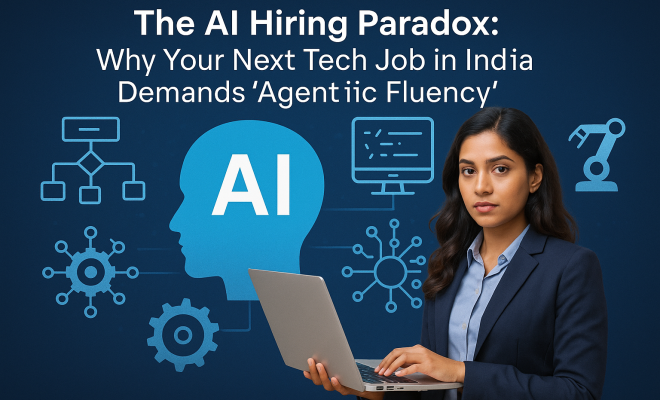
The AI Hiring Paradox: Why Your Next Tech Job in India Demands ‘Agentic Fluency’
You’ve heard the buzz, right? AI is everywhere, changing everything. But for those of us navigating the complex world of tech jobs in India, it’s not just buzz anymore; it’s a fundamental shift. We’re seeing a fascinating, almost contradictory trend emerge in the hiring landscape, one that’s creating what some are calling the ‘AI Hiring Paradox.’ On one hand, companies are demanding AI proficiency more than ever, moving it from a ‘nice-to-have’ to an absolute ‘must-have.’ On the other, there’s a growing chorus of voices urging caution, suggesting that not every AI tool or trend needs to be chased with a frantic sense of FOMO.
Take, for instance, a recent job posting from a major player like Okta, dated September 5, 2026. This isn’t some obscure startup; it’s a significant indicator. Their roles now explicitly list ‘AI fluency in agentic systems’ as a required ability. Not preferred, not a bonus – required. This isn’t just about knowing how to prompt a chatbot; it’s about understanding and working with AI systems that can operate autonomously, make decisions, and even learn from their interactions. This shift is profound, reshaping how we think about skill development and career progression in the rapidly evolving Indian tech sector.
But here’s where the paradox truly kicks in. Just as this urgency mounts, a viral blog post has gained serious traction, arguing that ‘AI FOMO is a trap.’ It suggests that in the rush to adopt every new AI gadget or framework, many professionals might be wasting time on tools that will soon be obsolete or are simply not relevant to their core competencies. The author’s point is compelling: perhaps a more strategic, patient approach to AI skill acquisition is actually the smarter play. This counter-narrative has struck a chord, injecting a dose of realism into an often-frenzied discussion. So, how do you reconcile these two seemingly opposing forces when you’re aiming for those coveted tech jobs in India?
The Mandate for ‘Agentic AI Fluency’ in Tech Jobs in India
Let’s get specific about what ‘AI fluency in agentic systems’ actually means, because it’s a lot more than just being able to use ChatGPT or Google Bard. Agentic AI refers to systems that can plan, execute, and monitor their own tasks with a degree of autonomy. Think of AI agents that can, for example, sift through vast datasets to identify anomalies, generate code based on high-level instructions, or even manage complex project workflows with minimal human intervention. This isn’t just about using AI as a tool; it’s about collaborating with AI as a teammate, understanding its capabilities and limitations, and, crucially, being able to direct its autonomous functions effectively.
For tech jobs in India, this isn’t some distant future scenario; it’s here now. Companies are looking for individuals who can design prompts that empower AI agents to perform complex operations, interpret their outputs, and troubleshoot when things go awry. It requires a deeper understanding of AI principles, machine learning models, and even the ethical implications of autonomous systems. Consider a software developer who can leverage AI agents to write unit tests, refactor code, or even assist in architectural design. Or a data analyst who can deploy agentic AI to automate complex ETL (Extract, Transform, Load) processes or generate sophisticated predictive models with less manual effort. This isn’t just efficiency; it’s a fundamental change in workflow and required expertise.
The demand for this specific type of AI skill signifies a maturation in the adoption of artificial intelligence within enterprises. It’s no longer about simple automation; it’s about intelligent automation and augmentation. This means that if you’re eyeing senior roles, or even mid-level positions that require problem-solving and innovation, demonstrating your ability to work with and even orchestrate agentic AI systems will likely be a non-negotiable requirement. It’s a clear signal that the bar for entry into many specialized tech jobs in India is rising, pushing candidates to move beyond basic AI literacy to a more operational, strategic understanding.
The ‘AI Hiring Paradox’: Standing Out in a Crowded Field
This brings us squarely to the ‘AI Hiring Paradox.’ If everyone is now expected to have AI skills, how do you actually stand out? When basic AI literacy becomes table stakes, the differentiator isn’t just having AI skills, but how you apply them, how deeply you understand them, and how you can articulate their value to a potential employer. It’s no longer enough to list ‘proficient in AI tools’ on your resume. Recruiters and hiring managers, especially for tech jobs in India, are now looking for concrete examples, project experience, and a nuanced understanding of AI’s strategic implications.
Think about it like this: a few years ago, listing ‘Microsoft Office proficiency’ was a standard requirement. Now, it’s assumed. The same is happening with foundational AI tool usage. The paradox lies in the fact that while the demand for AI skills is universal, the supply of truly impactful, application-oriented AI talent is still relatively scarce. This creates a bottleneck where many candidates can claim AI experience, but far fewer can demonstrate the depth required for agentic systems or strategic AI integration. The challenge for job seekers is to move beyond mere familiarity and showcase genuine expertise that translates directly into business value. (See: AI hiring trends in technology.)
This means your portfolio, your project descriptions, and even your interview answers need to evolve. Instead of saying, ‘I used AI for X,’ you need to be able to explain, ‘I leveraged an agentic AI framework to achieve Y, resulting in Z efficiency gains and addressing A specific business challenge.’ The emphasis shifts from simply performing tasks with AI to demonstrating a strategic mindset in deploying and managing AI solutions. For those targeting high-growth tech jobs in India, this paradox isn’t a barrier; it’s an opportunity for those willing to go the extra mile in their skill development and self-promotion. For more context, see California's Bold Stand Against AI.
The ‘AI FOMO is a Trap’ Counter-Narrative
Amidst this intense pressure to acquire AI skills, a refreshing counter-narrative has emerged, encapsulated by the viral blog post proclaiming ‘AI FOMO is a trap.’ This perspective argues that the frantic rush to learn every new AI tool, framework, or algorithm as it appears is not only unsustainable but potentially counterproductive. The pace of AI innovation is dizzying; new models, libraries, and applications are released almost daily. Trying to keep up with every single one is a recipe for burnout and superficial knowledge.
The core message here is one of strategic patience. The blog post suggests that a more effective approach might be to observe which AI tools gain significant traction, prove their long-term utility, and align with your specific career trajectory. Why invest heavily in learning a niche tool today that might be obsolete tomorrow, when a more robust, industry-standard solution could emerge in six months? This isn’t advocating for ignorance; it’s advocating for discernment. It’s about focusing on foundational AI concepts, problem-solving methodologies, and understanding the core principles that underpin various AI applications, rather than chasing every fleeting trend.
For professionals in tech jobs in India, this perspective offers a much-needed antidote to anxiety. It encourages a deeper look at one’s career goals and the specific AI skills that would genuinely enhance them, rather than a scattergun approach. It allows for a more focused and ultimately more impactful learning journey. This isn’t to say you should ignore AI, far from it. It’s about being smart about what you learn, when you learn it, and how it truly integrates with your existing expertise and future aspirations. It’s about quality over quantity when it comes to your AI skill set.
Strategic AI Skill Development for Indian Tech Professionals
So, how do you navigate this paradox and strategically develop AI skills without falling into the FOMO trap, especially when aiming for coveted tech jobs in India? The key lies in a multi-pronged approach that balances foundational knowledge with targeted specialization. First, focus on core AI and machine learning principles. Understanding concepts like neural networks, natural language processing, computer vision, and reinforcement learning provides a robust mental model that transcends specific tools. These fundamentals are less likely to become obsolete and will allow you to quickly adapt to new technologies.
Second, identify the agentic AI systems and frameworks that are gaining significant industry adoption within your specific domain. If you’re a software engineer, perhaps it’s understanding how to integrate large language models (LLMs) into application logic, or how to use AI-powered code generation and review tools. If you’re in data science, it might be mastering platforms that enable automated data pipeline orchestration or advanced analytics using AI agents. The ‘Okta’ example of ‘AI fluency in agentic systems’ is a prime clue here – look for tools and platforms that empower autonomous or semi-autonomous AI operations relevant to your role.
Third, practical application is paramount. Theory is good, but hands-on experience is gold. Build projects, contribute to open-source AI initiatives, or even create small personal applications that demonstrate your ability to work with AI. This is where you can truly showcase your ‘fluency’ and problem-solving capabilities, transforming theoretical knowledge into demonstrable skills. For those seeking to advance in tech jobs in India, a strong portfolio showcasing real-world AI applications will speak volumes more than a list of certifications alone. Employers want to see how you can actually leverage these tools to deliver tangible results.
The Role of Online Education and Specialized Certifications
Given the rapid evolution of AI, traditional academic pathways often struggle to keep pace. This is where online education and specialized certifications truly shine, offering agile and focused learning opportunities for professionals in tech jobs in India. Platforms like Coursera, edX, and Udacity, alongside specialized bootcamps and university extension programs, are increasingly offering certifications specifically designed to address the skills gap in AI. These programs can range from introductory courses in machine learning to advanced specializations in areas like ‘AI Agent Design’ or ‘Responsible AI Development.’ (See: AI in the workplace and safety.)
The monetization potential for these programs is immense because they directly address an urgent market need. Many professionals are looking for efficient ways to upskill without committing to a multi-year degree. A well-regarded AI certification can serve as a powerful signal to employers, validating a candidate’s commitment and proficiency in specific AI domains. For instance, a certification in ‘Prompt Engineering for Agentic Systems’ or ‘Developing with OpenAI APIs’ could become highly valuable. These aren’t just badges; they represent a structured learning path that can provide both theoretical understanding and practical application, often culminating in a project-based assessment.
Furthermore, traditional MBA programs are also adapting, integrating AI modules and specialized tracks. An MBA with a focus on ‘AI Strategy and Implementation’ or ‘Digital Transformation with AI’ can be particularly attractive for those aspiring to leadership roles in tech jobs in India, combining business acumen with deep technological understanding. The key is to choose programs that are current, reputable, and offer hands-on experience or project work that directly translates to the demands of the job market. For more context, see AI Could Devastate Our Future.
Career Coaching: Navigating the AI-Driven Job Market
With such a dynamic and sometimes contradictory landscape, career coaching has become an indispensable resource for individuals targeting tech jobs in India. An experienced career coach specializing in the tech sector can provide personalized guidance on which AI skills to prioritize, how to articulate existing experience in an AI-centric way, and how to effectively market oneself in a job market increasingly influenced by AI. They can help cut through the noise of FOMO and focus on what truly matters for an individual’s career path.
Coaches can assist in identifying transferable skills, even if a candidate doesn’t have direct AI experience. For instance, strong logical reasoning, problem-solving abilities, and an aptitude for learning new technologies are highly valued and can be framed as foundational for AI proficiency. They can also help candidates craft compelling narratives around their projects, highlighting the AI component or the potential for AI integration. This includes refining resumes, optimizing LinkedIn profiles, and preparing for interviews where AI-related questions are now commonplace.
Moreover, career coaches can provide insights into industry trends, inform about emerging roles, and connect individuals with networks that can offer mentorship or job opportunities. In a market characterized by both rapid innovation and strategic caution, having a trusted advisor to help interpret signals and make informed decisions about skill development and job search strategies is invaluable. This is especially true for those aiming for competitive tech jobs in India, where even slight advantages in presentation and strategic planning can make a significant difference.
Optimizing Resumes for AI-Powered Applicant Tracking Systems (ATS)
Here’s a practical reality: before your resume even reaches a human hiring manager for tech jobs in India, it’s likely being scanned by an AI-powered Applicant Tracking System (ATS). These systems use algorithms to parse resumes, extract keywords, and rank candidates based on how well their profiles match the job description. This means that understanding how to optimize your resume for AI is no longer optional; it’s a fundamental necessity.
The monetization potential for B2B SaaS tools that help optimize resumes for AI-powered ATS is huge because it addresses a critical pain point for job seekers. These tools can analyze a job description, identify key AI-related keywords and phrases (like ‘agentic systems,’ ‘prompt engineering,’ ‘machine learning frameworks’), and then suggest how to strategically incorporate them into your resume. They can also check for formatting issues that might confuse an ATS, ensuring that your skills and experience are accurately parsed and recognized.
This isn’t about keyword stuffing; it’s about intelligent keyword placement and ensuring your resume clearly communicates your AI capabilities using the language that ATS are trained to recognize. For example, if a job description mentions ‘experience with generative AI models,’ you need to ensure those exact phrases, or very close synonyms, appear in your experience section, skills section, or project descriptions. Failure to do so, even if you possess the skills, could mean your resume gets overlooked by the AI, never making it to a human reviewer. It’s a subtle but powerful aspect of the modern job search, particularly for high-demand tech jobs in India. For more context, see AI Just Made Fusion Energy a Reality. (See: Research on AI and employment.)
The Future of Tech Jobs in India: Beyond AI Fluency
Looking ahead, the landscape of tech jobs in India will undoubtedly continue its rapid transformation. While AI fluency, especially in agentic systems, is becoming a baseline requirement, what will set professionals apart in the long run goes beyond mere technical proficiency. Critical thinking, creativity, ethical reasoning, and complex problem-solving skills will become even more pronounced. As AI takes over more routine and even complex technical tasks, the human element of innovation and strategic oversight will be amplified.
Consider the role of ‘AI Ethicist’ or ‘AI Governance Specialist.’ These roles, once niche, are becoming increasingly important as autonomous AI systems are deployed across various industries. Understanding the societal impact, potential biases, and regulatory frameworks surrounding AI will be crucial. Similarly, roles that require deeply human skills – such as empathetic design, cross-functional collaboration, and effective communication – will remain indispensable. AI can generate code, analyze data, and even write copy, but it still requires human guidance, vision, and judgment to apply these outputs meaningfully and responsibly.
Ultimately, the future for tech jobs in India isn’t about humans competing against AI; it’s about humans effectively collaborating with AI. It’s about leveraging AI as a powerful co-pilot to achieve unprecedented levels of productivity and innovation. Those who can seamlessly integrate AI into their workflows, understand its strategic implications, and continue to cultivate uniquely human skills will not just survive but thrive in this exciting new era. The current ‘AI Hiring Paradox’ isn’t a dead end; it’s an evolutionary step, pushing us all to become more adaptable, more strategic, and ultimately, more valuable professionals.
Embracing the AI Revolution with Discernment
The journey through the AI-driven job market, especially for those seeking rewarding tech jobs in India, is complex and requires a delicate balance. On one side, there’s the undeniable imperative to gain AI fluency, particularly in the emerging field of agentic systems, as signaled by leading companies. On the other, there’s the wisdom in resisting the urge to chase every fleeting AI trend, instead opting for a more strategic and discerning approach to skill development. The ‘AI Hiring Paradox’ isn’t a problem to be solved as much as it’s a landscape to be navigated with intelligence and foresight.
Your ability to articulate not just what you know about AI, but how you’ve applied it to solve real-world problems, how you’ve collaborated with AI tools, and how you see AI evolving within your specific domain will be your strongest asset. It means moving beyond a passive understanding of AI to an active, engaged, and critical engagement with it. This nuanced approach, combining foundational knowledge with targeted application, will allow you to stand out in a job market that is simultaneously demanding and full of opportunity. Don’t just learn AI; learn how to think with AI, and you’ll unlock the next phase of your career in Indian tech.
Trending Now
- our breakdown of fda warned four peptide sellers at once: what the september 2026 letters actually say
- This iPhone 18 Pro Max Camera Upgrade Changes Everything for Photography
- this guide on the $392 billion illusion: why most startups won’t see a dime of record 2026 funding
- our breakdown of this crucial date reveals california’s bold stand against ai’s dark side
- this guide on this ai just made fusion energy a reality — here’s how
Frequently Asked Questions
What is agentic fluency in AI?
Agentic fluency in AI refers to the ability to understand and work with AI systems that can operate autonomously, make decisions, and learn from interactions. It's becoming a crucial skill for tech jobs, particularly in India, as companies prioritize candidates who can navigate complex AI environments.
Why is AI proficiency important for tech jobs in India?
AI proficiency is essential for tech jobs in India because companies are increasingly requiring candidates to have skills in AI. This shift reflects the growing integration of AI technologies in various sectors, making it a fundamental requirement rather than a mere bonus for job seekers.
What is the AI hiring paradox?
The AI hiring paradox describes the contradictory demand in the job market where companies require AI fluency while also highlighting the importance of not chasing every new AI trend. This paradox emphasizes the need for strategic skill acquisition rather than succumbing to AI FOMO.
How can professionals avoid AI FOMO?
Professionals can avoid AI FOMO by taking a strategic approach to skill acquisition. Instead of rushing to learn every new AI tool, focus on understanding core competencies and relevant technologies that align with career goals, ensuring time and resources are spent wisely.
What skills are needed for tech jobs in India today?
Tech jobs in India today require a blend of traditional skills and new competencies, particularly in AI. Candidates should focus on developing agentic fluency, understanding AI systems, and balancing this with a realistic view of the tools that are truly relevant to their roles.
Have you experienced this yourself? We'd love to hear your story in the comments.