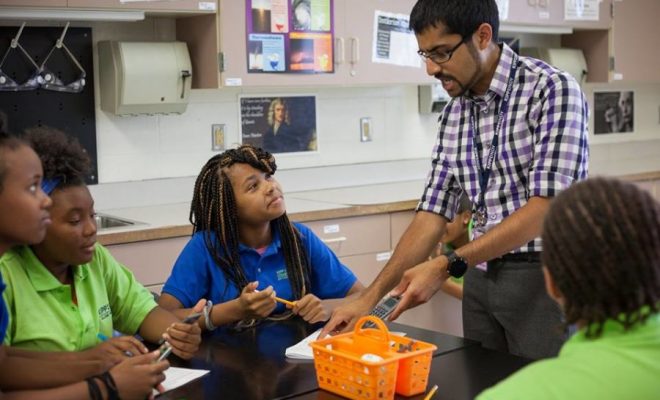
A technology team from Facebook works to serve classroom teachers

This article was written by Nichole Dobo
At a California school, 20 Facebook employees built a software program that could eventually be used in any public school that wants it — free
If an education technology solution is to have any chance of success, it must first be embraced by teachers, students and parents.
A logical way to achieve this is to allow educators to take the lead on the development of high-tech tools. That’s what happened at Summit Public Schools, a California-based charter network, where teachers created a prototype of a new tool that would enable them to customize each school day for each stuPreviewdent.
Then, to strengthen the software and make it more effective, Summit invited in a team of developers from Facebook. Once the enhanced software had been used for a year, the Summit leaders and Facebook agreed to try a larger pilot, with the goal of developing a program any school or teacher could use.
Today, the Summit-Facebook partnership announced the 19 schools from around the country that have been chosen for this larger pilot. They represent traditional public schools and charter schools, spanning rural, urban and suburban communities.
“We want to be able to share everything we are doing, and we are trying to figure out the best we to do that,” said Diane Tavenner, CEO and founder of Summit Public Schools. “The first step was to find a pretty small set of folks who are really excited about personalized learning. The thought here is we can provide them with the tools to do the work they really want to do.”
The program, which will be free to the partner schools, streamlines the process of creating individual learning paths to fit the academic, social and emotional needs of students. It serves as a digital warehouse of sorts.
Related: Summit Public Schools and Facebook announce new personalized learning platform project
The software helps teachers use the system as a sort of electronic filing cabinet, where they can quickly retrieve the best lessons or projects for their students’ particular needs. Students, too, can use the program to unlock the “black box” of school – they can visibly see their progress (or lack thereof) in each subject and preview what lessons are ahead. And children are free to move faster (or slower) through any subject. Students say they feel liberated by the freedom and challenged by the responsibility.
Teachers still work with children in person, and guide their learning.
“We are now all in this together,” Tavenner said. “We are all committed to learning a ton, making it better, because we want to share it even more widely next year.”
The decision to pilot the program to an array of schools – and, importantly, to include teachers from the onset — might prove to be a smart move, considering the disasters experienced by some high-profile education technology plans. A $1.3 billion plan to bring iPads and educational apps to every student in the Los Angeles Unified School District flopped. And InBloom, a well-funded program meant to facilitate the use of data in schools, was announced with great fanfare, but it fizzled.
Related: Carnegie Mellon project revives failed inBloom dream to store and analyze student data
The 19 schools that are now using the Summit-Facebook program are uncovering issues that probably would have dogged the project if it had been released immediately to the public. Every school took part in a summer training program in California, where they worked with Summit Public Schools teachers and students to gain theoretical and practical training. It was also a time for teachers to see the program in real life.
“When [teachers] saw the work Summit was doing, they feverishly called me and started blowing up my phone with text messages,” said Mary Ann Stinson, the principal of Truesdell Education Campus, a public elementary school in Washington, D.C. “They were like, ‘We need to talk to you. This is amazing.’ ”
The professional development didn’t end after the summer session. Partner schools will receive mentoring throughout the school year, with check-ins to celebrate success and troubleshoot problems.
“Our mentor basically helped us create our own model and do what would work for our children,” said Norma Penny, the principal of Carter Lomax Middle School in Houston. “They did not say, ‘You have to do Summit Schools’ model.’ They just shared with us what they are doing, and we took best practice from them.”
That proved to be critical. Educational materials used by Summit Public Schools, for example, are aligned with Common Core standards. That wasn’t a fit for Lomax, which is in a state where those standards are not in use.
Related: Blended learning emerges as a leading trend in education technology, report says
Facebook has been working with Summit Public Schools on this program for more than a year. Now, Facebook is devoting a team of 20 employees, including engineers, to customize the platform to suit the needs of schools.
And, of course, the social media giant’s name adds a touch of star power to the project. This cuts both ways. Some might wonder if Facebook’s decision to immerse itself in school is a means of developing a product that can capitalize on information gleaned from children.
“This partnership is an example of how educators and engineers can team up to unlock more potential than we could have otherwise,” Facebook CEO Mark Zuckerberg wrote in Sept. 3 post about the project. “The platform we’re building with Summit … is completely separate from the Facebook service. Summit subscribes to the White House-endorsed Student Privacy Pledge, so everyone working on this has strict privacy controls to protect student data in accordance with the Pledge.”
This story was produced by The Hechinger Report, a nonprofit, independent news organization focused on inequality and innovation in education. Read more about Blended Learning.
| Name of school | Location | School type |
| Burnett Middle School | San Jose Unified School District, California | public district |
| Columbia Heights Educational Campus | District of Columbia Public Schools, Washington, D.C. | public district |
| Carter Lomax Middle School | Pasadena Independent School District, Houston | public district |
| J. Frank Dobie High School | Pasadena Independent School District, Houston | public district |
| Thompson Intermediate | Pasadena Independent School District, Houston | public district |
| Truesdell Education Campus | District of Columbia Public Schools, Washington, D.C. | public district |
| Dent Middle School | Richland School District Two, South Carolina | public district |
| Denver School for Innovation and Sustainable Design | Denver Public Schools, Colorado | public district |
| Kuna Middle School | Kuna School District, Idaho | public district |
| Research Triangle High School | Durham, North Carolina | public charter |
| Blackstone Valley Prep High School | Rhode Island Mayoral Academy, Cumberland, R.I. | public charter |
| Middle School 88 | New York City | public district |
| Pawtucket Learning Academy | Pawtucket School District, Rhode Island | public district |
| Pleasant View | Providence School District, Rhode Island | public district |
| Joseph Weller Elementary | Milpitas Unified School District, California | public district |
| Pomeroy Elementary | Milpitas Unified School District, California | public district |
| PRIDE Prep | Spokane, Washington | public charter |
| Urban Promise Academy | Oakland Unified School District | public district |
| Venture Academy | Minneapolis, Minnesota | public charter |
Nichole Dobo is a reporter and the blended learning fellow. Her work has been published in the Los Angeles Times, The Atlantic’s online edition, Mind/Shift, WHYY NewsWorks, Slate and in McClatchy newspapers.