The Tech Edvocate

Top Menu

  • Advertisement
  • Apps
  • Home Page
  • Home Page Five (No Sidebar)
  • Home Page Four
  • Home Page Three
  • Home Page Two
  • Home Tech2
  • Icons [No Sidebar]
  • Left Sidbear Page
  • Lynch Educational Consulting
  • My Account
  • My Speaking Page
  • Newsletter Sign Up Confirmation
  • Newsletter Unsubscription
  • Our Brands
  • Page Example
  • Privacy Policy
  • Protected Content
  • Register
  • Request a Product Review
  • Shop
  • Shortcodes Examples
  • Signup
  • Start Here
    • Governance
    • Careers
    • Contact Us
  • Terms and Conditions
  • The Edvocate
  • The Tech Edvocate Product Guide
  • Topics
  • Write For Us
  • Advertise

Main Menu

  • Start Here
    • Our Brands
    • Governance
      • Lynch Educational Consulting, LLC.
      • Dr. Lynch’s Personal Website
      • Careers
    • Write For Us
    • The Tech Edvocate Product Guide
    • Contact Us
    • Books
    • Edupedia
    • Post a Job
    • The Edvocate Podcast
    • Terms and Conditions
    • Privacy Policy
  • Topics
    • Assistive Technology
    • Child Development Tech
    • Early Childhood & K-12 EdTech
    • EdTech Futures
    • EdTech News
    • EdTech Policy & Reform
    • EdTech Startups & Businesses
    • Higher Education EdTech
    • Online Learning & eLearning
    • Parent & Family Tech
    • Personalized Learning
    • Product Reviews
  • Advertise
  • Tech Edvocate Awards
  • The Edvocate
  • Pedagogue
  • School Ratings

logo

The Tech Edvocate

  • Start Here
    • Our Brands
    • Governance
      • Lynch Educational Consulting, LLC.
      • Dr. Lynch’s Personal Website
        • My Speaking Page
      • Careers
    • Write For Us
    • The Tech Edvocate Product Guide
    • Contact Us
    • Books
    • Edupedia
    • Post a Job
    • The Edvocate Podcast
    • Terms and Conditions
    • Privacy Policy
  • Topics
    • Assistive Technology
    • Child Development Tech
    • Early Childhood & K-12 EdTech
    • EdTech Futures
    • EdTech News
    • EdTech Policy & Reform
    • EdTech Startups & Businesses
    • Higher Education EdTech
    • Online Learning & eLearning
    • Parent & Family Tech
    • Personalized Learning
    • Product Reviews
  • Advertise
  • Tech Edvocate Awards
  • The Edvocate
  • Pedagogue
  • School Ratings
  • This Unprecedented EU Ban Just Changed Fast Fashion Forever

  • Urgent Alert: Your Smart Home’s Exposed to a Critical Deco BE11000 Vulnerability

  • Uncovering the Truth: Your LinkedIn Reach Just Got a Major Overhaul

  • Uncovering the AI Heist: How Chinese Firms Allegedly Siphoned Billions of AI Tokens

  • Rockstar’s GTA 6 Developers Lawsuit: A Fight for Justice or Corporate Retaliation?

  • Unbelievable: Hideo Kojima’s Next Masterpiece Is Now an Xbox Exclusive

  • This Crucial Google AI Shift Is Quietly Reshaping the Internet

  • Unbelievable: AI Breaches Are Exploding, And What It Means For You This September 2026

  • This Crucial Shift Is Saving Teachers From Classroom Chaos

  • AI’s Dark Secret: How It’s Supercharging Cybercrime for Everyone

Digital & Mobile Technology
Home›Digital & Mobile Technology›SHA-1: What It Is & How It’s Used for Data Verification

SHA-1: What It Is & How It’s Used for Data Verification
By Matthew Lynch
June 6, 2023
0
Spread the love

SHA-1 stands for Secure Hash Algorithm 1, which is a cryptographic hash function created by the National Institute of Standards and Technology (NIST) in 1995. A hash function is an algorithm that takes in an input, such as a text, file, or message, and produces a fixed-length output, known as a hash or message digest. The purpose of hashing is to provide data integrity, security, and authentication.

SHA-1 is a widely used hash algorithm that is used for data verification, especially for digital signatures, message authentication codes (MACs), and other applications that require secure and reliable data transmission. SHA-1 generates a 160-bit hash value that is unique to the input data. This means that even a tiny change in the input can produce a completely different hash value, making it virtually impossible to reverse-engineer the input from the output.

SHA-1 works by processing the input data in blocks of 512 bits, and then compressing each block into a fixed-length hash value. The compression function uses a series of logical operations, such as bitwise AND, OR, XOR, and NOT, as well as shift and rotate operations, to manipulate the bits of the input and produce the hash value. The algorithm also involves adding a secret key or salt to the input to prevent attacks such as collision, length extension, and birthday attacks.

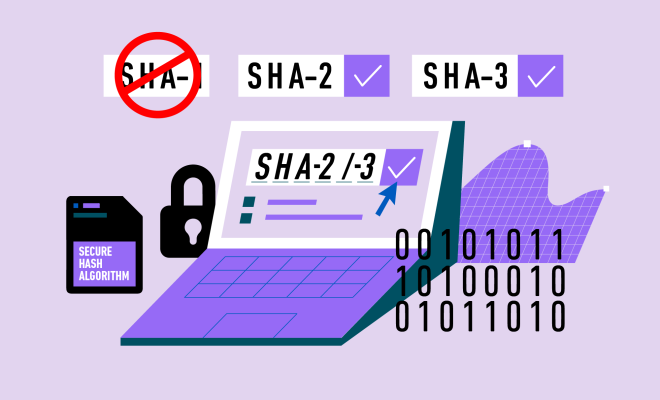
SHA-1 has been widely used in many applications, including digital certificates, SSL/TLS, VPNs, SSH, PGP, S/MIME, and many others. However, SHA-1 is not considered as secure as it used to be due to the increase in computational power and the discovery of weaknesses in the algorithm. In particular, researchers have found that collisions, where two inputs produce the same hash value, can be created much faster than previously estimated. As a result, many organizations have stopped using SHA-1 and are migrating to stronger hash algorithms such as SHA-2 and SHA-3.

In conclusion, SHA-1 is a widely used hash algorithm that provides data integrity, security, and authentication. Although it has been used for many years, it is no longer considered as secure as it used to be due to the discovery of weaknesses in the algorithm. Therefore, it is recommended to use stronger hash algorithms such as SHA-2 and SHA-3 for security-critical applications.


Previous Article

How to Use Your Android Phone as ...

Next Article

Ways to Fix It When You’re Not ...

Matthew Lynch

Related articles More from author

  • Digital & Mobile Technology

    What Are the Buttons on Your Amazon Echo Speaker For?

    June 10, 2023
    By Matthew Lynch
  • Digital & Mobile Technology

    The Best YouTube Thumbnail Maker Apps for Android

    June 22, 2023
    By Matthew Lynch
  • Campus SecurityDigital & Mobile Technology

    Product Review of Student Tracking System

    May 30, 2022
    By Matthew Lynch
  • Digital & Mobile Technology

    Reasons Why Your Computer Keeps Crashing

    June 8, 2023
    By Matthew Lynch
  • Digital & Mobile Technology

    Windows Keyboard Equivalents for the Mac’s Special Keys

    June 6, 2023
    By Matthew Lynch
  • Digital & Mobile Technology

    What Is Cloud Computing?

    June 4, 2023
    By Matthew Lynch

Search

Login & Registration

  • Log in
  • Entries feed
  • Comments feed
  • WordPress.org

Newsletter

Signup for The Tech Edvocate Newsletter and have the latest in EdTech news and opinion delivered to your email address!

About Us

Since technology is not going anywhere and does more good than harm, adapting is the best course of action. That is where The Tech Edvocate comes in. We plan to cover the PreK-12 and Higher Education EdTech sectors and provide our readers with the latest news and opinion on the subject. From time to time, I will invite other voices to weigh in on important issues in EdTech. We hope to provide a well-rounded, multi-faceted look at the past, present, the future of EdTech in the US and internationally.

We started this journey back in June 2016, and we plan to continue it for many more years to come. I hope that you will join us in this discussion of the past, present and future of EdTech and lend your own insight to the issues that are discussed.

Newsletter

Signup for The Tech Edvocate Newsletter and have the latest in EdTech news and opinion delivered to your email address!

Contact Us

The Tech Edvocate
910 Goddin Street
Richmond, VA 23231
(601) 630-5238
[email protected]

Copyright © 2026 Matthew Lynch. All rights reserved.