The Tech Edvocate

Top Menu

  • Advertisement
  • Apps
  • Home Page
  • Home Page Five (No Sidebar)
  • Home Page Four
  • Home Page Three
  • Home Page Two
  • Home Tech2
  • Icons [No Sidebar]
  • Left Sidbear Page
  • Lynch Educational Consulting
  • My Account
  • My Speaking Page
  • Newsletter Sign Up Confirmation
  • Newsletter Unsubscription
  • Our Brands
  • Page Example
  • Privacy Policy
  • Protected Content
  • Register
  • Request a Product Review
  • Shop
  • Shortcodes Examples
  • Signup
  • Start Here
    • Governance
    • Careers
    • Contact Us
  • Terms and Conditions
  • The Edvocate
  • The Tech Edvocate Product Guide
  • Topics
  • Write For Us
  • Advertise

Main Menu

  • Start Here
    • Our Brands
    • Governance
      • Lynch Educational Consulting, LLC.
      • Dr. Lynch’s Personal Website
      • Careers
    • Write For Us
    • The Tech Edvocate Product Guide
    • Contact Us
    • Books
    • Edupedia
    • Post a Job
    • The Edvocate Podcast
    • Terms and Conditions
    • Privacy Policy
  • Topics
    • Assistive Technology
    • Child Development Tech
    • Early Childhood & K-12 EdTech
    • EdTech Futures
    • EdTech News
    • EdTech Policy & Reform
    • EdTech Startups & Businesses
    • Higher Education EdTech
    • Online Learning & eLearning
    • Parent & Family Tech
    • Personalized Learning
    • Product Reviews
  • Advertise
  • Tech Edvocate Awards
  • The Edvocate
  • Pedagogue
  • School Ratings

logo

The Tech Edvocate

  • Start Here
    • Our Brands
    • Governance
      • Lynch Educational Consulting, LLC.
      • Dr. Lynch’s Personal Website
        • My Speaking Page
      • Careers
    • Write For Us
    • The Tech Edvocate Product Guide
    • Contact Us
    • Books
    • Edupedia
    • Post a Job
    • The Edvocate Podcast
    • Terms and Conditions
    • Privacy Policy
  • Topics
    • Assistive Technology
    • Child Development Tech
    • Early Childhood & K-12 EdTech
    • EdTech Futures
    • EdTech News
    • EdTech Policy & Reform
    • EdTech Startups & Businesses
    • Higher Education EdTech
    • Online Learning & eLearning
    • Parent & Family Tech
    • Personalized Learning
    • Product Reviews
  • Advertise
  • Tech Edvocate Awards
  • The Edvocate
  • Pedagogue
  • School Ratings
  • This Unprecedented EU Ban Just Changed Fast Fashion Forever

  • Urgent Alert: Your Smart Home’s Exposed to a Critical Deco BE11000 Vulnerability

  • Uncovering the Truth: Your LinkedIn Reach Just Got a Major Overhaul

  • Uncovering the AI Heist: How Chinese Firms Allegedly Siphoned Billions of AI Tokens

  • Rockstar’s GTA 6 Developers Lawsuit: A Fight for Justice or Corporate Retaliation?

  • Unbelievable: Hideo Kojima’s Next Masterpiece Is Now an Xbox Exclusive

  • This Crucial Google AI Shift Is Quietly Reshaping the Internet

  • Unbelievable: AI Breaches Are Exploding, And What It Means For You This September 2026

  • This Crucial Shift Is Saving Teachers From Classroom Chaos

  • AI’s Dark Secret: How It’s Supercharging Cybercrime for Everyone

Digital & Mobile Technology
Home›Digital & Mobile Technology›Screen Resolution: FHD vs UHD

Screen Resolution: FHD vs UHD
By Matthew Lynch
June 1, 2023
0
Spread the love

Screen resolution is an aspect that determines the quality of images and visuals that are displayed on a screen. Two popular screen classifications, namely Full High Definition (FHD) and Ultra-High Definition (UHD), offer varying levels of visual clarity and crispness for users. In this article, we will explore the differences between FHD and UHD, their respective advantages and disadvantages, and how to choose the right one for your needs.

FHD, also known as 1080p, refers to a resolution of 1920 x 1080 pixels. It is the industry standard for most modern-day displays and is commonly used for televisions, monitors, laptops, and mobile phones. FHD is an excellent resolution for most everyday tasks, such as watching videos, browsing the internet, and playing casual games. The sharpness and image quality of FHD are noteworthy, making it a popular choice for those on a budget or those who do not require the highest resolution for their work or entertainment.

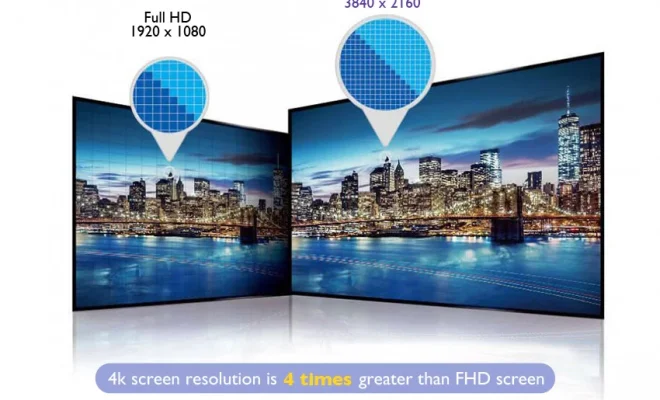
UHD, on the other hand, is a newer technology that boasts a significantly higher screen resolution than FHD. UHD, also known as 4K, has a resolution of 3840 × 2160 pixels, which is four times the resolution of FHD. UHD offers an unprecedented level of clarity, sharpness, and detail, making it an excellent choice for professional photographers, graphic designers, and videographers who require high-end hardware to perform their tasks. UHD displays are also becoming common in high-end gaming, offering immersive visuals that enhance the gaming experience.

One of the key advantages of FHD is its affordability. FHD displays are more affordable than UHD displays, making them an ideal choice for those on a tight budget. FHD displays are also more widely available, making them the norm for most consumer electronics, including televisions, monitors, laptops, tablets, and smartphones.

UHD offers a higher level of visual quality than FHD and is ideal for creative professionals that need high-resolution displays to achieve their work goals. UHD displays deliver incredible detail and clarity, making it easier to work with graphics, photos or create high-quality videos. They also come with a broader color gamut and offer more precise color rendering, making them ideal for applications where color accuracy is critical.

In terms of disadvantages, FHD displays may not offer the same level of detail and clarity as UHD displays, making text and images appear less sharp. Additionally, FHD displays cannot match the level of color reproduction and brightness levels that UHD displays offer.

UHD displays, on the other hand, tend to be more expensive than FHD displays, making them less accessible to the average person. They also consume more power than FHD displays, requiring a more powerful graphics card and processor to run smoothly.

When choosing between FHD and UHD displays, it is essential to consider your needs and budget. If you are looking for an affordable display that offers good visual quality, FHD is a suitable choice. However, if you are a professional graphic designer, photographer, or videographer, a UHD display will provide you with a higher level of visual clarity and detail.

In conclusion, both FHD and UHD displays have their unique advantages and disadvantages. It is up to you to choose the display that best suits your needs, budget, and usage scenario. Whether you opt for the affordability of FHD or the high-end visual quality of UHD, you can be sure that each option will provide you with an excellent viewing experience.


Previous Article

How to Create a New Outlook.com Email ...

Next Article

How to Turn On/Off Caps Lock on ...

Matthew Lynch

Related articles More from author

  • Digital & Mobile Technology

    Is Netflix’s Premium Plan Worth It?

    September 8, 2023
    By Matthew Lynch
  • Digital & Mobile Technology

    How to Check RAM in Android

    July 28, 2023
    By Matthew Lynch
  • Digital & Mobile Technology

    How to Use Meet Now: Skype’s Free Zoom Alternative

    May 30, 2023
    By Matthew Lynch
  • Digital & Mobile Technology

    What is Home Location Register (HLR)?

    May 22, 2023
    By Matthew Lynch
  • Digital & Mobile Technology

    Best Free Animation Programs for Windows 10

    June 14, 2023
    By Matthew Lynch
  • Digital & Mobile Technology

    Google Meet Camera Not Working? How to Fix the Problem

    June 3, 2023
    By Matthew Lynch

Search

Login & Registration

  • Log in
  • Entries feed
  • Comments feed
  • WordPress.org

Newsletter

Signup for The Tech Edvocate Newsletter and have the latest in EdTech news and opinion delivered to your email address!

About Us

Since technology is not going anywhere and does more good than harm, adapting is the best course of action. That is where The Tech Edvocate comes in. We plan to cover the PreK-12 and Higher Education EdTech sectors and provide our readers with the latest news and opinion on the subject. From time to time, I will invite other voices to weigh in on important issues in EdTech. We hope to provide a well-rounded, multi-faceted look at the past, present, the future of EdTech in the US and internationally.

We started this journey back in June 2016, and we plan to continue it for many more years to come. I hope that you will join us in this discussion of the past, present and future of EdTech and lend your own insight to the issues that are discussed.

Newsletter

Signup for The Tech Edvocate Newsletter and have the latest in EdTech news and opinion delivered to your email address!

Contact Us

The Tech Edvocate
910 Goddin Street
Richmond, VA 23231
(601) 630-5238
[email protected]

Copyright © 2026 Matthew Lynch. All rights reserved.