The Tech Edvocate

Top Menu

  • Advertisement
  • Apps
  • Home Page
  • Home Page Five (No Sidebar)
  • Home Page Four
  • Home Page Three
  • Home Page Two
  • Home Tech2
  • Icons [No Sidebar]
  • Left Sidbear Page
  • Lynch Educational Consulting
  • My Account
  • My Speaking Page
  • Newsletter Sign Up Confirmation
  • Newsletter Unsubscription
  • Our Brands
  • Page Example
  • Privacy Policy
  • Protected Content
  • Register
  • Request a Product Review
  • Shop
  • Shortcodes Examples
  • Signup
  • Start Here
    • Governance
    • Careers
    • Contact Us
  • Terms and Conditions
  • The Edvocate
  • The Tech Edvocate Product Guide
  • Topics
  • Write For Us
  • Advertise

Main Menu

  • Start Here
    • Our Brands
    • Governance
      • Lynch Educational Consulting, LLC.
      • Dr. Lynch’s Personal Website
      • Careers
    • Write For Us
    • The Tech Edvocate Product Guide
    • Contact Us
    • Books
    • Edupedia
    • Post a Job
    • The Edvocate Podcast
    • Terms and Conditions
    • Privacy Policy
  • Topics
    • Assistive Technology
    • Child Development Tech
    • Early Childhood & K-12 EdTech
    • EdTech Futures
    • EdTech News
    • EdTech Policy & Reform
    • EdTech Startups & Businesses
    • Higher Education EdTech
    • Online Learning & eLearning
    • Parent & Family Tech
    • Personalized Learning
    • Product Reviews
  • Advertise
  • Tech Edvocate Awards
  • The Edvocate
  • Pedagogue
  • School Ratings

logo

The Tech Edvocate

  • Start Here
    • Our Brands
    • Governance
      • Lynch Educational Consulting, LLC.
      • Dr. Lynch’s Personal Website
        • My Speaking Page
      • Careers
    • Write For Us
    • The Tech Edvocate Product Guide
    • Contact Us
    • Books
    • Edupedia
    • Post a Job
    • The Edvocate Podcast
    • Terms and Conditions
    • Privacy Policy
  • Topics
    • Assistive Technology
    • Child Development Tech
    • Early Childhood & K-12 EdTech
    • EdTech Futures
    • EdTech News
    • EdTech Policy & Reform
    • EdTech Startups & Businesses
    • Higher Education EdTech
    • Online Learning & eLearning
    • Parent & Family Tech
    • Personalized Learning
    • Product Reviews
  • Advertise
  • Tech Edvocate Awards
  • The Edvocate
  • Pedagogue
  • School Ratings
  • A Visitors Guide to Long Beach (CA), United States

  • A Visitor’s Guide to Fresno (CA), United States

  • A Visitors Guide to New Orleans (LA), United States

  • A Visitors Guide to Sacramento (CA), United States

  • A Visitors Guide to Lyon, France

  • JisuLife Ultra2 Portable Fan: A Powerful Multi-Function Cooling Solution

  • A Visitors Guide to Viña del Mar, Chile

  • A Visitors Guide to Århus, Denmark

  • A Visitors Guide to Bakersfield (CA), United States

  • A Visitors Guide to Aurora (CO), United States

Digital & Mobile Technology
Home›Digital & Mobile Technology›RGB vs. CMYK: Understanding the Differences

RGB vs. CMYK: Understanding the Differences
By Matthew Lynch
July 14, 2023
0
Spread the love

When it comes to digital and print design, understanding the differences between RGB and CMYK is crucial. RGB and CMYK are color models used to represent colors in digital and print media, respectively. In this article, we’ll take a closer look at RGB and CMYK, and the key differences between them.

RGB Color Model

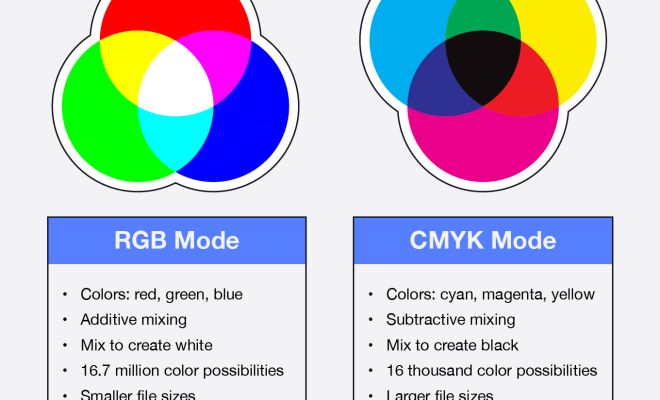
RGB stands for Red, Green, Blue, and it is the color model used for digital displays such as computer screens, televisions, and mobile devices. In the RGB color model, colors are created by combining different amounts of red, green, and blue light. This model is called an “additive” color model because the more light that is added, the brighter the color becomes.

For example, if you mix red and blue light, you get magenta. If you mix green and blue light, you get cyan. And if you mix all three colors together, you get white. RGB is an important color model for digital design because it allows designers to create vibrant, bright colors that can be displayed on a backlit screen.

CMYK Color Model

CMYK stands for Cyan, Magenta, Yellow, and Key (black), and it is the color model used for print media such as newspapers, magazines, and brochures. In the CMYK color model, colors are created by mixing different amounts of cyan, magenta, yellow, and black ink. This model is called a “subtractive” color model because the more ink that is added, the darker the color becomes.

For example, if you mix cyan and magenta ink, you get blue. If you mix yellow and magenta ink, you get red. And if you mix all four colors together, you get black. CMYK is an important color model for print design because it allows designers to create a wide range of colors using only four printing inks.

Key Differences

The key difference between RGB and CMYK is the way colors are created. RGB is an additive color model, which means that colors are created by adding light together. CMYK is a subtractive color model, which means that colors are created by absorbing light.

Another key difference between RGB and CMYK is the color gamut. RGB has a wider color gamut than CMYK, which means that it can display a wider range of colors. This is because RGB can create brighter, more vibrant colors than CMYK.

Finally, it’s important to note that colors can look different when viewed on a screen versus in print. This is because screens use RGB colors, while print media uses CMYK colors. When designing for print, it’s important to convert RGB colors to CMYK to ensure that the colors look the same in print as they do on screen.

Conclusion

In conclusion, understanding the differences between RGB and CMYK is essential for any designer working in both digital and print media. RGB is an additive color model used for digital displays, while CMYK is a subtractive color model used for print media. The key differences between RGB and CMYK are the way colors are created and the color gamut. By understanding these differences, designers can create designs that look great both on screen and in print.


Previous Article

How to Enable or Disable the New ...

Next Article

How to Stop Political Texts

Matthew Lynch

Related articles More from author

  • Digital & Mobile Technology

    What Is Guided Access on iPhone and How Do You Use It?

    June 14, 2023
    By Matthew Lynch
  • Digital & Mobile Technology

    What’s Draining Your Android Battery

    June 22, 2023
    By Matthew Lynch
  • Digital & Mobile Technology

    5 Fixes for a Broken Car Heater

    June 12, 2023
    By Matthew Lynch
  • Digital & Mobile Technology

    How to Make Your Instagram More Private: Useful Tips

    June 13, 2023
    By Matthew Lynch
  • Digital & Mobile Technology

    How to Perform a Startup Repair in Windows 7

    September 7, 2023
    By Matthew Lynch
  • Digital & Mobile Technology

    Rubber Stamp Text Effect Photoshop Tutorial

    June 23, 2023
    By Matthew Lynch

Search

Login & Registration

  • Register
  • Log in
  • Entries feed
  • Comments feed
  • WordPress.org

Newsletter

Signup for The Tech Edvocate Newsletter and have the latest in EdTech news and opinion delivered to your email address!

About Us

Since technology is not going anywhere and does more good than harm, adapting is the best course of action. That is where The Tech Edvocate comes in. We plan to cover the PreK-12 and Higher Education EdTech sectors and provide our readers with the latest news and opinion on the subject. From time to time, I will invite other voices to weigh in on important issues in EdTech. We hope to provide a well-rounded, multi-faceted look at the past, present, the future of EdTech in the US and internationally.

We started this journey back in June 2016, and we plan to continue it for many more years to come. I hope that you will join us in this discussion of the past, present and future of EdTech and lend your own insight to the issues that are discussed.

Newsletter

Signup for The Tech Edvocate Newsletter and have the latest in EdTech news and opinion delivered to your email address!

Contact Us

The Tech Edvocate
910 Goddin Street
Richmond, VA 23231
(601) 630-5238
[email protected]

Copyright © 2025 Matthew Lynch. All rights reserved.