Dyslexia & Phonemic Awareness: Early Intervention Strategies
“`html
Dyslexia affects approximately 5 to 10 percent of the population, yet many remain unaware of the profound impact it has on learning and literacy. One of the critical factors contributing to dyslexia is phonemic awareness, which is the ability to recognize and manipulate individual sounds in spoken words. Understanding the role of phonemic awareness and implementing effective interventions can significantly enhance literacy outcomes for those with dyslexia. In this article, we’ll explore the relationship between phonemic awareness deficits and dyslexia, delve into early intervention strategies that work, and discuss the current relevance of these methods in educational settings.
Understanding Phonemic Awareness and Its Importance
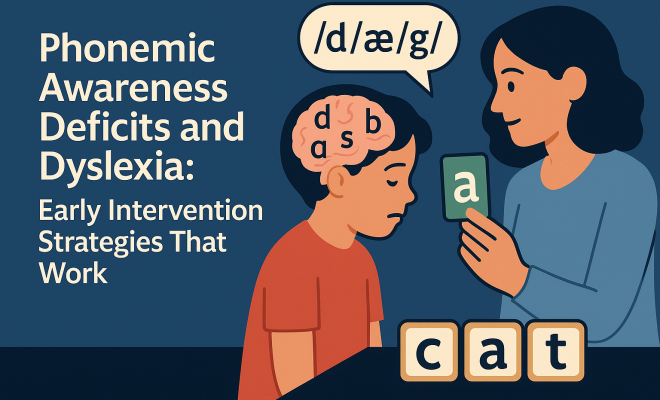
Phonemic awareness is a foundational skill in reading development. It involves understanding that words are made up of individual sounds, or phonemes, and being able to manipulate these sounds to form words. For instance, a child with strong phonemic awareness can identify that the word “cat” consists of three distinct sounds: /k/, /æ/, and /t/. This skill is crucial because it serves as a precursor to successful reading and spelling.
Research indicates that deficits in phonemic awareness are a significant predictor of reading difficulties, particularly in children diagnosed with dyslexia. In fact, studies have shown that individuals with dyslexia often struggle to process phonological information, affecting their ability to decode words effectively. This connection underscores the necessity of addressing phonemic awareness in early interventions aimed at mitigating the challenges associated with dyslexia.
The Link Between Phonemic Awareness and Dyslexia
Dyslexia is characterized by difficulties with accurate and/or fluent word recognition, often resulting from a deficit in the phonological component of language. Children with dyslexia may experience trouble with phonemic awareness, leading to obstacles in recognizing and processing the sounds in words. This phonological processing deficit can manifest in various ways, including difficulty with rhyming, segmenting words into sounds, and blending sounds to form words.
Moreover, the National Institute of Child Health and Human Development has identified phonemic awareness as a critical skill that correlates strongly with reading success. Without sufficient phonemic awareness, children are less likely to develop the necessary decoding skills, which can severely impact their reading comprehension and overall academic performance. Related reading: understanding phonemic awareness.
Identifying Phonemic Awareness Deficits
Detecting phonemic awareness deficits early is crucial for effective intervention. Educators and parents should be on the lookout for signs that may indicate a child is struggling with phonemic awareness. These signs can include:
- Difficulty rhyming words or recognizing rhyming patterns.
- Challenges in breaking words down into their individual sounds.
- Inability to blend sounds together to form recognizable words.
- Struggles with spelling, particularly with phonetic spelling.
- Delayed speech or language development.
When these signs are observed, it is imperative to conduct further assessments to gauge the child’s phonemic awareness skills. Various screening tools and assessments can help pinpoint specific areas of difficulty, allowing for tailored interventions.
Effective Early Intervention Strategies
The earlier a child receives intervention, the better their chances of overcoming phonemic awareness deficits and improving their reading abilities. Here are several effective strategies that educators and parents can implement:
1. Phonological Awareness Training
Phonological awareness training involves teaching children to recognize and manipulate sounds in spoken language. Activities might include:
- Rhyming games that encourage recognition of sound patterns.
- Sound matching exercises where children identify words that start or end with the same sound.
- Segmenting phonemes by using finger tapping or blocks to represent sounds.
These activities help build a child’s ability to manipulate sounds, laying the groundwork for improving their phonemic awareness.
2. Multi-Sensory Approaches
Multi-sensory instruction engages multiple senses to enhance learning. Techniques might involve using visual, auditory, and tactile methods simultaneously. For example, while teaching a child to read the word “mat,” an educator could: (See: National Institute of Child Health on reading treatment.)
- Show them the written word.
- Say the individual sounds (/m/, /æ/, /t/) aloud.
- Have the child use letter tiles to physically build the word.
This approach reinforces learning by creating connections across different sensory modalities, which can be particularly beneficial for children with dyslexia.
3. Structured Literacy Programs
Structured literacy programs, such as the Orton-Gillingham approach, are specifically designed to address the needs of individuals with dyslexia. These programs typically include explicit, systematic instruction in phonics and phonemic awareness. Key components of structured literacy include: (best practices for dyslexia)
- Direct instruction in the relationship between sounds and letters.
- Emphasis on decoding skills through phonics-based activities.
- Frequent practice and review to solidify learning.
By providing a clear framework for teaching reading, structured literacy programs can effectively support children with phonemic awareness deficits.
4. Reading Aloud and Shared Reading
Engaging children in reading aloud and shared reading experiences can significantly boost their phonemic awareness. During these activities, parents and educators can:
- Model expressive reading to capture children’s attention.
- Encourage children to predict outcomes or identify sounds in words.
- Discuss the story’s elements to enhance comprehension.
These interactions not only foster a love for reading but also encourage phonemic exploration through spoken language.
The Role of Technology in Intervention
In today’s digital age, technology has become an essential tool in literacy intervention. A variety of apps and software programs are designed to support phonemic awareness development. These tools often incorporate engaging visuals and interactive elements to help children learn in a fun and motivating way.
For instance, programs like Reading Rockets and Starfall provide phonics games and activities that enhance phonemic awareness. Additionally, some platforms offer personalized learning experiences, adapting to a child’s specific needs and progress, which can be particularly beneficial for those with dyslexia.
Collaborating with Educators and Specialists
Collaboration between parents, educators, and specialists is vital for effective phonemic awareness dyslexia intervention. When a child’s needs are identified, bringing together a team—including special education teachers, speech-language pathologists, and reading specialists—can create a comprehensive intervention plan. This collaborative approach ensures that the child receives targeted support tailored to their unique learning profile.
Regular communication among team members helps monitor progress and adjust strategies as needed. By fostering a supportive environment, children can thrive and build their phonemic awareness skills more effectively.
Current Research and Future Directions
Ongoing research continues to explore the complexities of phonemic awareness and its relationship to dyslexia. Recent studies emphasize the importance of early detection and intervention, advocating for the incorporation of phonemic awareness training into standard literacy instruction. Additionally, researchers are investigating the efficacy of various instructional strategies, seeking to identify the most effective approaches for diverse learners.
Looking ahead, as our understanding of dyslexia and phonemic awareness evolves, it is likely that new methodologies and interventions will emerge. Staying informed about the latest research and being open to innovative practices will be essential for educators and parents aiming to support children with dyslexia.
Understanding the Science Behind Phonemic Awareness
Understanding the cognitive processes involved in phonemic awareness can shed light on why certain interventions are effective. When children develop phonemic awareness, they engage in cognitive tasks like segmenting and blending sounds, which translate to reading skills. Research from the International Dyslexia Association indicates that phonemic awareness is closely linked to a child’s ability to perform tasks that involve phonological processing. This relationship underscores why phonemic awareness interventions are critical for children with dyslexia.
Neuroscience has also provided insights into how phonemic awareness skills develop in the brain. Studies using neuroimaging techniques have shown that the left hemisphere of the brain is primarily responsible for language processing. For children with dyslexia, activation in specific regions associated with phonological processing may differ from typical development, which could contribute to their reading difficulties. (See: CDC on reading and child development.) This builds on building blocks of early reading.
Common Myths About Phonemic Awareness and Dyslexia
Despite the growing understanding of dyslexia and phonemic awareness, several myths persist that can hinder effective intervention. Here are a few common misconceptions:
- Myth 1: Phonemic awareness is the same as phonics.
- Myth 2: Only children with severe reading difficulties need phonemic awareness training.
- Myth 3: Phonemic awareness can be learned overnight.
While both are essential for reading, phonemic awareness focuses on the sounds of spoken language, whereas phonics involves connecting these sounds to written letters and words.
In reality, all children benefit from strengthening their phonemic awareness skills, as this foundation supports future reading success.
Developing phonemic awareness is a gradual process that requires consistent practice and reinforcement.
Statistics on Dyslexia and Phonemic Awareness
Statistics reveal the magnitude of dyslexia and demonstrate the importance of phonemic awareness in literacy development. According to the National Institute of Child Health and Human Development, children with dyslexia are more likely to struggle with reading comprehension and spelling, and approximately 40% of children identified as having reading difficulties also face challenges with phonemic awareness.
Another study indicates that early intervention in phonemic awareness can lead to a 50% reduction in reading difficulties later in life. This highlights the crucial timing of implementing effective interventions before children fall too far behind in their reading development.
Expert Perspectives on Phonemic Awareness Interventions
Experts in the field of education emphasize the need for targeted phonemic awareness interventions. Dr. Sally Shaywitz, a leading researcher in dyslexia, notes that “early and explicit instruction in phonemic awareness is essential for all children, particularly those at risk for reading difficulties.” Her research underscores the importance of monitoring a child’s progress and adapting interventions to ensure that they meet each child’s unique learning needs.
In addition, Dr. Timothy Shanahan, a literacy expert, states that “phonemic awareness is not just an early skill for young children; it’s vital for all students as they become proficient readers.” His views affirm that even older students struggling with reading can benefit from revisiting and strengthening their phonemic awareness skills.
Frequently Asked Questions (FAQ)
What is phonemic awareness?
Phonemic awareness is the ability to identify, hear, and manipulate individual sounds (phonemes) in spoken words. It’s a critical skill necessary for developing reading and spelling abilities.
How can I help my child improve their phonemic awareness at home?
Engage in fun activities like rhyming games, singing songs, and playing sound-based games. You can also read aloud and encourage your child to identify sounds in words.
Is phonemic awareness the same as phonological awareness?
No, phonemic awareness is a subset of phonological awareness. While phonological awareness includes the ability to hear and manipulate larger units of sound, such as syllables, phonemic awareness specifically focuses on individual phonemes.
At what age should phonemic awareness skills be developed?
Phonemic awareness typically begins to develop in preschool and is crucial during the early elementary years. However, it’s beneficial to continue reinforcing these skills throughout a child’s literacy development.
How can schools support children with phonemic awareness deficits?
Schools can implement structured literacy programs, provide targeted phonemic awareness instruction, and utilize multi-sensory teaching methods to support students. Collaboration between teachers, special education staff, and parents is essential to tailor interventions effectively.
What role does home literacy play in developing phonemic awareness?
Home literacy experiences are crucial. Parents who read regularly with their children, engage in discussions about stories, and play sound-related games foster a rich language environment that enhances phonemic awareness.
Are there specific books or resources that can aid in developing phonemic awareness?
Yes, many children’s books focus on rhymes and sounds which can be helpful. Resources like “The Phonemic Awareness Handbook for Kindergarten and Primary Teachers” offer structured activities and guidance for developing phonemic skills.
Can phonemic awareness be developed in older children and adults?
Absolutely! While it’s often beneficial to instill these skills early, older children and even adults can improve their phonemic awareness through targeted strategies and practice. We covered online dyslexia summit details in more detail.
How does phonemic awareness relate to overall academic success?
Phonemic awareness is strongly linked to reading proficiency, which in turn affects overall academic performance. Children who struggle with phonemic awareness often face challenges across various subjects due to difficulties in understanding written material.
Conclusion: Empowering Children Through Phonemic Awareness Intervention
Phonemic awareness dyslexia intervention is an essential component in helping children with reading difficulties achieve literacy success. By understanding the link between phonemic awareness and dyslexia, identifying deficits early, and implementing effective intervention strategies, we can empower children to overcome challenges and flourish in their reading abilities. As we continue to advocate for better resources and understanding in education, we pave the way for a future where every child has the opportunity to reach their full literacy potential.
“`
Trending Now
Frequently Asked Questions
What is the connection between phonemic awareness and dyslexia?
Phonemic awareness is the ability to recognize and manipulate sounds in words, which is crucial for reading. Deficits in this skill are significant predictors of dyslexia, as individuals with dyslexia often struggle with phonological processing, impacting their reading and spelling abilities.
How can early intervention help children with dyslexia?
Early intervention strategies targeting phonemic awareness can significantly improve literacy outcomes for children with dyslexia. By focusing on developing sound recognition and manipulation skills, these interventions help address the underlying challenges of dyslexia, enhancing reading and spelling abilities.
What are effective strategies for improving phonemic awareness?
Effective strategies include phonemic games, sound matching activities, and explicit instruction in sound manipulation. These approaches help children recognize and work with individual sounds in words, building a strong foundation for reading and spelling.
What percentage of the population is affected by dyslexia?
Dyslexia affects approximately 5 to 10 percent of the population. Despite its prevalence, many remain unaware of its impact on learning and literacy, highlighting the importance of awareness and effective intervention strategies.
Why is phonemic awareness important for reading development?
Phonemic awareness is a foundational skill for reading development as it enables children to understand that words are made up of individual sounds. This skill is essential for decoding words effectively, which is crucial for reading fluency and overall literacy success.
Have you experienced this yourself? We'd love to hear your story in the comments.