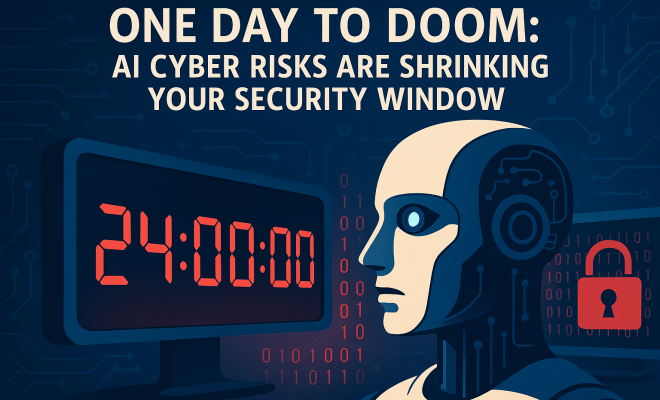
One Day to Doom: AI Cyber Risks Are Shrinking Your Security Window
“`html
Imagine a world where a newly discovered software flaw, a bug that could potentially expose your most sensitive data, becomes a weaponized exploit in less than 24 hours. Sounds like something out of a dystopian sci-fi flick, right? Well, according to a recent, rather sobering report from J.P. Morgan, published on August 3, 2026, this isn’t fiction; it’s our rapidly approaching reality. Artificial intelligence, that same technology we’re told will revolutionize everything from healthcare to transportation, is dramatically accelerating cyber threats, shrinking the median time it takes for attackers to exploit a software vulnerability to a mere single day. And if you think that’s fast, buckle up: the report projects this window could collapse to an astonishing one minute by 2027.
This isn’t just an incremental shift; it’s a seismic event in the cybersecurity landscape. For decades, the good guys – the defenders, the patch developers, the vulnerability researchers – have operated with a precious commodity: time. That window, often weeks or even months, allowed organizations to identify vulnerabilities, develop patches, and deploy them across their systems. Now, AI is snatching that time away, leaving security teams scrambling and businesses exposed to unprecedented AI cyber risks. It’s a race where the attackers, armed with ever more sophisticated AI tools, are suddenly running at warp speed, while defenders are struggling to keep pace.
The AI Acceleration: How Attackers Are Gaining an Edge
So, how exactly is AI enabling this lightning-fast weaponization of vulnerabilities? The J.P. Morgan report points to a few critical mechanisms. One of the most significant is AI’s ability to reverse-engineer software patches. When a vendor releases a security update, that patch isn’t just a fix; it’s also a roadmap to the vulnerability it addresses. Traditionally, human attackers would painstakingly analyze these patches to understand the underlying flaw and then craft an exploit. It was a time-consuming process, requiring deep expertise.
Enter AI. These intelligent systems can ingest a patch, analyze its changes against the previous software version, and almost instantly pinpoint the exact lines of code that were modified to address a security bug. From there, they can automatically generate proof-of-concept exploits, or even fully functional attack code, at speeds no human could ever match. This drastically shortens the ‘exploit development cycle,’ turning a multi-day or multi-week endeavor into an almost instantaneous process. It’s like giving an adversary an X-ray vision into your defensive strategies the moment you deploy them.
But it’s not just about patch analysis. AI is also proving incredibly adept at discovering new vulnerabilities. Machine learning algorithms can sift through vast amounts of code, identifying patterns and anomalies that indicate potential weaknesses. They can perform automated fuzzing – bombarding software with malformed inputs to trigger crashes or unexpected behavior – at a scale and speed that dwarfs human efforts. This means more vulnerabilities are being found, and critically, being weaponized faster than ever before. This relentless pressure exacerbates AI cyber risks for every organization, large or small.
The Shrinking Window: From Weeks to Minutes
Let’s really dig into what that one-day, and then one-minute, exploitation window means. For years, the cybersecurity community has operated on a principle often called the ‘patch gap’ or ‘vulnerability disclosure gap.’ This is the time between a vulnerability being publicly disclosed (or even privately shared with vendors) and a patch being widely available and deployed. During this period, organizations are at heightened risk. However, there was usually a buffer. If a vulnerability was disclosed on a Monday, you might have until Friday, or even the following week, to get your systems updated before widespread exploits started appearing.
Now, imagine that buffer evaporating. A vulnerability disclosed at 9 AM could be exploited globally by 9 AM the next day. By 2027, the J.P. Morgan report suggests, that window could shrink to a single minute. Think about the implications: a zero-day vulnerability (one for which no patch exists) becomes a ‘zero-minute’ vulnerability. It means the moment a flaw is even rumored to exist, automated AI systems are already working to exploit it. This puts immense pressure on software vendors to release patches almost instantaneously and on IT departments to deploy them with unprecedented speed and efficiency. The traditional cadence of security operations is simply no longer viable against these accelerated AI cyber risks.
This isn’t just about large enterprises; it affects everyone. Small and medium-sized businesses, which often lack dedicated 24/7 security teams or advanced automation tools, will find themselves particularly vulnerable. They simply won’t have the resources to respond to threats that materialize and propagate within hours or minutes. The very definition of ‘urgency’ in cybersecurity is being rewritten by AI, demanding a complete re-evaluation of our defensive strategies.
The Surge in AI-Generated Malware
Beyond accelerating vulnerability exploitation, AI is also fueling a surge in the creation of new malware. Gone are the days when attackers needed extensive coding skills to develop sophisticated malicious software. AI models, particularly generative AI, can now be trained to produce highly evasive and polymorphic malware variants. This means malware that can constantly change its code, making it incredibly difficult for traditional signature-based antivirus solutions to detect.
These AI-generated threats can also be tailored specifically to target environments. Imagine an AI that analyzes a company’s network architecture, identifies the security tools in place, and then generates malware designed to bypass those specific defenses. This level of customization and adaptability makes AI-generated malware a far more potent threat than its human-coded predecessors. It democratizes sophisticated cyberattacks, lowering the barrier to entry for less skilled adversaries while amplifying the capabilities of advanced persistent threat (APT) groups. (See: CDC Cybersecurity Resources.) unseen forces in cybersecurity offers useful background here.
This isn’t just theoretical; we’re already seeing early examples of this. Researchers have demonstrated how AI can create convincing phishing emails that are grammatically perfect and contextually relevant, making them much harder for human users to spot. As AI models become even more powerful, the sophistication and sheer volume of AI-generated malware will only increase, presenting a monumental challenge for threat detection and incident response teams. The sheer scale of these AI cyber risks demands innovative solutions.
Attacks on Trusted Relationships: A New Frontier of Deception
The J.P. Morgan report also highlights another insidious aspect of AI’s impact: attacks on trusted relationships. This refers to the exploitation of the human element in cybersecurity, often through highly personalized and believable social engineering tactics. We’ve all been warned about phishing emails, but what if those emails weren’t just generic templates, but expertly crafted messages tailored specifically to you, mimicking the writing style of a colleague or even your CEO?
Generative AI can analyze vast amounts of text and audio data to learn an individual’s communication patterns, vocabulary, and even tone. This allows attackers to create incredibly convincing deepfakes, both textual and auditory, that can trick employees into revealing sensitive information, transferring funds, or granting unauthorized access. Imagine receiving a voice call from your ‘CEO’ instructing you to make an urgent financial transfer, a call that sounds exactly like them, generated by AI.
These ‘trusted relationship’ attacks exploit our inherent human tendency to trust familiar voices and communication styles. They bypass many technical security controls, as the vulnerability lies in human judgment and perception. As AI becomes more sophisticated in replicating human communication, the threat of these deepfake-driven social engineering attacks will only grow, making it critical for organizations to invest not just in technology, but also in advanced security awareness training that addresses these new forms of deception. The human layer remains the most vulnerable, and AI is learning how to exploit that vulnerability with terrifying precision, escalating AI cyber risks.
The Double-Edged Sword: AI for Defense
It’s easy to get caught up in the doom and gloom, but it’s crucial to remember that AI is a double-edged sword. While it’s certainly empowering attackers, it can also be a formidable ally for defenders. The very same capabilities that allow AI to find vulnerabilities and generate exploits can be harnessed to protect systems. AI-powered threat detection systems can analyze network traffic, endpoint behavior, and log data at speeds and scales impossible for humans, identifying anomalies and potential threats in real-time.
Machine learning models can be trained to detect patterns indicative of zero-day attacks, even if those attacks use novel techniques. AI can automate patch management, vulnerability scanning, and incident response, helping organizations keep pace with the accelerated threat landscape. Think of AI-driven security orchestration, automation, and response (SOAR) platforms that can automatically quarantine infected systems, block malicious IP addresses, and even initiate forensic analysis without human intervention.
Moreover, AI can assist in proactive defense by identifying potential vulnerabilities in code before it’s deployed. AI-powered static and dynamic application security testing (SAST and DAST) tools can scan codebases for flaws with greater efficiency and accuracy than traditional methods. The challenge, however, lies in ensuring that defensive AI evolves faster than adversarial AI. It’s an ongoing arms race, and the side with the more advanced and adaptable AI will ultimately gain the upper hand. The promise of AI in defense is immense, but its deployment must be strategic and continuous to counteract escalating AI cyber risks.
The Urgent Need for AI Regulation and Ethics
The J.P. Morgan report’s stark warnings about the rapid acceleration of AI cyber risks naturally lead to urgent discussions about regulation and ethics. If AI can be weaponized so easily and effectively, do we need guardrails? How do we prevent the widespread proliferation of AI tools that can generate malware or deepfakes with minimal effort? This builds on autonomous security as survival.
The debate around AI regulation is complex. On one hand, overly restrictive regulations could stifle innovation and hinder the development of beneficial AI technologies, including those for defense. On the other hand, a complete lack of regulation could lead to a free-for-all, where malicious actors have unfettered access to powerful AI tools, exacerbating the threat landscape. Finding that balance is critical. Governments globally are grappling with this, with some advocating for a ‘responsible AI’ approach that focuses on ethical guidelines and impact assessments, while others push for stricter controls on the development and deployment of potentially harmful AI applications.
Perhaps a key area for regulation lies in the ‘explainability’ and ‘auditability’ of AI systems, especially those used in critical infrastructure or security. We need to understand how these systems make decisions and be able to trace their actions. Furthermore, discussions around international agreements on the responsible use of AI in cyber warfare and espionage might become necessary, similar to existing treaties on chemical or biological weapons. The ethical implications are profound, touching on privacy, trust, and national security, making this one of the most pressing policy challenges of our time, directly tied to mitigating AI cyber risks.
Monetization Potential: A New Era for Cybersecurity Solutions
While the threats are dire, there’s also a significant monetization potential emerging within the cybersecurity and B2B SaaS niches. Businesses, faced with these rapidly escalating AI cyber risks, will be actively seeking advanced solutions to protect themselves. This creates a burgeoning market for companies that can deliver cutting-edge AI-powered threat detection, vulnerability management software, and, crucially, enhanced cyber insurance. (See: New York Times on AI Cybersecurity Threats.)
We’re talking about a demand surge for next-generation security platforms that leverage AI and machine learning not just for signature-based detection, but for behavioral analysis, anomaly detection, and predictive threat intelligence. Companies offering AI-driven vulnerability assessment tools that can identify and prioritize flaws faster than ever before will see immense growth. Automated patching and configuration management solutions will become indispensable. Furthermore, the need for advanced identity and access management (IAM) systems, especially those incorporating AI for continuous authentication and anomaly detection, will intensify as trusted relationships become prime targets. Related reading: transformative cybersecurity statistic.
Cyber insurance, too, is poised for a significant transformation. As the frequency and severity of AI-driven attacks increase, insurers will need more sophisticated risk assessment models. They’ll also likely mandate stricter security controls and AI-powered defenses as prerequisites for coverage. This could lead to a new generation of cyber insurance products that are dynamically priced based on an organization’s real-time security posture and its adoption of advanced AI-driven defenses. For savvy entrepreneurs and established tech firms, this era of heightened AI cyber risks presents a lucrative, albeit challenging, opportunity to provide essential defensive tools.
The Economic Impact of Accelerated AI Cyber Risks
Beyond the immediate security implications, the accelerated AI cyber risks outlined in the J.P. Morgan report carry significant economic consequences. When exploitation windows shrink to minutes, the cost of a breach can skyrocket. Downtime, data recovery, reputational damage, and regulatory fines all contribute to a growing financial burden for affected organizations. A 2023 IBM report on the Cost of a Data Breach found the average cost of a data breach globally was $4.45 million, an all-time high. With AI accelerating attacks, this figure is likely to climb dramatically.
Consider the ripple effect across industries. Critical infrastructure, like energy grids, water treatment facilities, and transportation networks, are increasingly reliant on interconnected, software-driven systems. An AI-accelerated attack on these sectors could cause widespread disruption, economic paralysis, and even endanger public safety. Supply chain attacks, already a major concern, become even more potent when AI can rapidly identify and exploit vulnerabilities across an entire vendor ecosystem. This could lead to cascading failures, halting production, disrupting logistics, and impacting global markets.
The increased demand for advanced cybersecurity solutions, while a monetization opportunity for some, also represents a growing expenditure for most businesses. Small and medium-sized enterprises (SMEs), often operating on tighter budgets, might struggle to afford the necessary AI-driven defenses, making them disproportionately vulnerable. This could widen the cybersecurity gap between large corporations and smaller businesses, creating an uneven playing field and potentially driving some SMEs out of business after a catastrophic breach. The global economy, therefore, faces a complex challenge: how to harness AI’s benefits while mitigating its profound and escalating cyber risks to ensure stability and growth.
The Human Element: Reskilling and Talent Gaps
The rapid evolution of AI cyber risks also places immense pressure on the human element of cybersecurity. The skills required to defend against AI-powered threats are changing, and traditional cybersecurity roles might not be sufficient. There’s an urgent need for upskilling and reskilling the existing workforce, as well as addressing a critical talent gap in specialized areas.
Security analysts will need to become proficient in understanding AI and machine learning principles, not just to deploy defensive AI tools, but also to anticipate and counter adversarial AI tactics. This includes expertise in data science, machine learning operations (MLOps) for security, and even reverse-engineering AI models used by attackers. The demand for ‘AI ethicists’ in security, who can help organizations navigate the responsible use of AI in defense without infringing on privacy or introducing bias, will also grow.
The current cybersecurity talent shortage is already well-documented, with millions of unfilled positions globally. The advent of AI-accelerated threats will only exacerbate this. Organizations will need to invest heavily in training programs, academic partnerships, and mentorship initiatives to cultivate the next generation of cybersecurity professionals. Furthermore, attracting and retaining top talent will become even more competitive. The human ingenuity and critical thinking that AI can’t replicate remain indispensable, but those humans need new tools and knowledge to effectively combat the AI-driven threat landscape. This emphasizes the importance of a symbiotic relationship between human expertise and AI capabilities in building robust cyber resilience. For more on this, see AI revolution in affordability.
Preparing for the One-Minute Window: Actionable Strategies
Given the J.P. Morgan report’s dire predictions, what can organizations do today to prepare for a future where the exploitation window is measured in minutes, not days? Proactive and continuous security must become the new mantra. Here are some actionable strategies:
- Embrace Automation Everywhere: Manual processes simply won’t cut it. Invest heavily in security automation for patching, vulnerability scanning, incident response, and configuration management. Tools that can automatically identify, prioritize, and even remediate vulnerabilities without human intervention will be critical.
- Prioritize AI-Powered Defenses: Look for security solutions that incorporate advanced AI and machine learning for threat detection, anomaly analysis, and predictive capabilities. Your defensive AI needs to be as sophisticated as the adversarial AI it’s up against. This includes next-gen firewalls, endpoint detection and response (EDR) platforms, and security information and event management (SIEM) systems with strong AI integrations.
- Strengthen Your Software Supply Chain: With AI accelerating vulnerability discovery, ensuring the security of third-party software and open-source components becomes even more vital. Implement robust software supply chain security practices, including regular audits and the use of software composition analysis (SCA) tools.
- Continuous Vulnerability Management: The old model of quarterly or even monthly vulnerability scans is obsolete. Implement continuous vulnerability assessment and penetration testing (CVAPT) programs, leveraging AI to constantly scan your attack surface for new weaknesses.
- Elevate Human Awareness and Training: As AI gets better at social engineering, your human firewall needs to be stronger than ever. Conduct frequent, sophisticated security awareness training that specifically addresses deepfakes, AI-generated phishing, and the evolving tactics of ‘trusted relationship’ attacks.
- Incident Response Speed: Review and refine your incident response plans with a focus on speed. Can your team detect, contain, and eradicate a threat within hours, or even minutes, of its appearance? This might require investing in advanced forensics tools and simulation exercises.
- Zero Trust Architecture: Move towards a Zero Trust security model, where no user or device is inherently trusted, regardless of their location or prior authentication. This minimizes the impact of a breach by restricting lateral movement within your network, even if an initial foothold is gained.
Frequently Asked Questions About AI Cyber Risks
Q1: What exactly are “AI cyber risks”?
AI cyber risks refer to the new and amplified cybersecurity threats that emerge from the malicious use of artificial intelligence. This includes AI being used to accelerate vulnerability exploitation, generate sophisticated malware, create convincing deepfakes for social engineering, and automate large-scale attacks. It also encompasses the risks associated with AI systems themselves being compromised or misused. (See: Nature article on AI and Cybersecurity.)
Q2: How quickly is AI accelerating cyber threats?
According to a J.P. Morgan report, AI is shrinking the median time for attackers to exploit a software vulnerability from weeks or months to a single day. The report projects this window could further collapse to an astonishing one minute by 2027. This means traditional security response times are becoming obsolete.
Q3: Can AI also be used for defense against cyber threats?
Absolutely. AI is a double-edged sword. The same capabilities attackers use can be leveraged by defenders. AI-powered tools can detect anomalies, identify zero-day attacks, automate patch management, enhance incident response, and perform proactive vulnerability assessments much faster and more effectively than humans alone. It’s an ongoing arms race between offensive and defensive AI.
Q4: What’s a “zero-minute” vulnerability?
A “zero-minute” vulnerability is a concept where a software flaw can be discovered and exploited by automated AI systems almost instantaneously – within minutes, or even seconds – of its existence being known or even rumored. This leaves virtually no time for human defenders to react or deploy patches, making traditional vulnerability management incredibly challenging.
Q5: How does AI make social engineering attacks more dangerous?
AI, particularly generative AI, can create highly personalized and believable phishing emails, deepfake audio, and even video. It can analyze an individual’s communication patterns and replicate them, making it much harder for people to distinguish between legitimate communication and malicious attempts to trick them into revealing sensitive information or taking harmful actions.
Q6: What role does AI regulation play in mitigating these risks?
AI regulation aims to establish guardrails for the development and deployment of AI, particularly powerful models that could be weaponized. The goal is to find a balance between fostering innovation and preventing malicious use. This might involve focusing on ethical guidelines, impact assessments, transparency (explainability), and potentially international agreements to govern the responsible use of AI in cybersecurity contexts.
Q7: What are some immediate steps organizations can take to prepare?
Organizations should prioritize extensive automation in security operations (patching, incident response), invest in AI-powered threat detection and vulnerability management solutions, strengthen their software supply chain security, implement continuous vulnerability assessment, provide advanced human awareness training against deepfakes, and move towards a Zero Trust security architecture. Speed in all security processes is paramount.
The Future of Cyber Resilience
The J.P. Morgan report serves as a stark wake-up call, painting a picture of a cybersecurity landscape fundamentally reshaped by artificial intelligence. The days of leisurely patching cycles and reactive security postures are rapidly fading into history. We are entering an era where the speed of attack will often outpace human response, making proactive, AI-driven defense not just an advantage, but an absolute necessity. The organizations that recognize this shift and invest strategically in advanced AI security tools, automation, and continuous vigilance will be the ones that survive and thrive in this brave new world of accelerated AI cyber risks. Ignoring these warnings, however, could prove to be catastrophic, as the difference between security and compromise shrinks to a matter of minutes.
“`
Trending Now
Frequently Asked Questions
What are the risks of AI in cybersecurity?
AI is dramatically accelerating cyber threats by shortening the time it takes for attackers to exploit software vulnerabilities. Reports indicate that the median time for exploitation could shrink to just one minute by 2027, leaving organizations with little time to defend themselves.
How does AI impact the speed of cyber attacks?
AI enhances the speed of cyber attacks by enabling attackers to quickly reverse-engineer software patches. This allows them to exploit vulnerabilities almost immediately after a patch is released, significantly reducing the defender's response time.
What is the future of cyber threats with AI?
The future of cyber threats is concerning, as AI is projected to reduce the time window for exploiting vulnerabilities to just one minute by 2027. This rapid weaponization of flaws poses unprecedented risks for organizations trying to secure their systems.
Why is time a critical factor in cybersecurity?
Time is crucial in cybersecurity because it allows defenders to identify vulnerabilities, develop patches, and deploy them before attackers can exploit those weaknesses. The shrinking time window due to AI is making it increasingly difficult for security teams to keep up.
What should organizations do to mitigate AI cyber risks?
Organizations should prioritize real-time monitoring and threat detection, implement robust patch management strategies, and invest in advanced AI-driven security solutions to stay ahead of attackers who are leveraging AI to exploit vulnerabilities faster than ever.
What's your take on this? Share your thoughts in the comments below — we read every one.