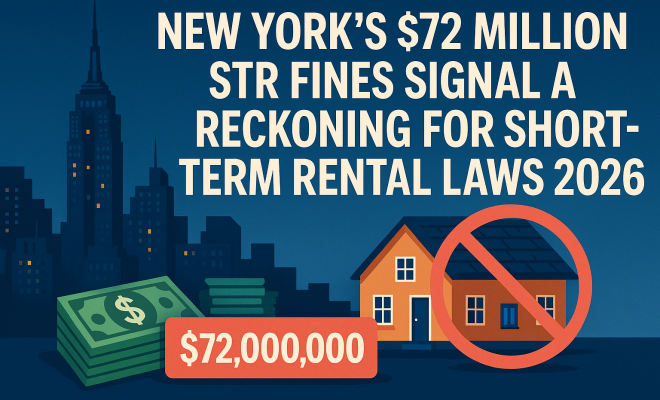
New York’s $72 Million STR Fines Signal a Reckoning for Short-Term Rental Laws 2026
“`html
If you’re a short-term rental (STR) host, or even just considering dipping your toes into the market, you’re likely feeling the ground shift beneath your feet. The regulatory landscape for STRs is transforming at a dizzying pace, making what was once a relatively straightforward side hustle into a complex legal minefield in some areas, and a golden opportunity in others. We’re not just talking about minor tweaks; we’re seeing wholesale overhauls that could redefine property ownership and investment strategies. The year 2026, in particular, is shaping up to be a critical juncture, with new enforcement, court rulings, and legislative battles painting a vivid, if sometimes confusing, picture of where the industry is headed. Understanding these evolving short-term rental laws 2026 isn’t just smart business; it’s essential for survival.
The tension here is palpable. On one side, you have property owners who believe they should have the right to do what they want with their investment, including renting it out for short stays. On the other, residents and local governments are often grappling with issues like housing affordability, neighborhood character, and the commercialization of residential zones. This clash of ideologies isn’t just playing out in council chambers; it’s hitting courtrooms and legislative floors across the country, leading to a fragmented and often contradictory set of rules. For anyone operating in this space, keeping abreast of these changes, state by state, city by city, is no longer optional.
1. The New York City Crackdown: A Blueprint for Strict Enforcement?
Let’s kick things off with arguably the biggest headline-grabber in the STR world: New York City. The Big Apple has become the poster child for stringent regulation, and its approach offers a stark glimpse into what other major cities might consider. Under Local Law 18, enacted with the stated goal of preserving long-term housing stock and curbing what officials deemed illegal hotels, the city has really cranked up the heat. We’re talking about a serious financial impact here, with New York City levying more than $72 million in STR fines. That’s not pocket change; that’s a substantial enforcement effort designed to send a clear message.
What does Local Law 18 actually do? In essence, it effectively prohibits many entire-unit rentals for stays shorter than 30 days unless the host is present. If you’re renting out a spare bedroom in your primary residence, you might still be okay, provided you register with the city and meet specific safety requirements. But if you own an investment property that you planned to rent out exclusively on Airbnb or Vrbo for short stays, your business model likely just evaporated. This isn’t just about fines; it’s about making it practically impossible for many traditional STR operations to exist. The move has sparked fierce debate, with hosts decrying it as an infringement on property rights and an overreach of government power, while affordable housing advocates applaud it as a necessary step to ease the housing crisis. It’s a complex issue with no easy answers, but NYC’s actions are certainly a bellwether for what might come next in other dense urban centers.
2. Idaho’s HOA Ruling: A Win for Existing Property Rights
Now, let’s swing to the other end of the spectrum and look at a significant development out of Idaho that provides a glimmer of hope for some STR owners. The Idaho Supreme Court recently handed down a ruling that could have widespread implications, particularly for properties within Homeowners Associations (HOAs). The court decided that HOAs cannot enforce new STR restrictions on existing property owners without their consent. This is huge, as it essentially protects property owners who bought into an HOA community when STRs were permitted and later faced new, more restrictive rules.
Think about the fairness argument here. If you purchased a condo or a home in a community with the understanding that you could rent it out short-term, only for the HOA to change its bylaws years later, that feels like a bait-and-switch. The Idaho ruling acknowledges this, prioritizing the rights of existing owners over retroactive rule changes. This doesn’t mean HOAs can’t regulate STRs at all; it just means they might have a harder time applying new, stricter rules to current owners. This ruling highlights the fragmented nature of STR laws and the ongoing battle between individual property rights and community-level governance. It’s a key precedent to watch as other states and municipalities grapple with similar issues regarding short-term rental laws 2026.
3. The Fragmented Legal Environment: A Patchwork Quilt of Regulations
One of the biggest challenges for anyone involved in the short-term rental market is the sheer inconsistency of the legal landscape across the United States. There isn’t a single, overarching federal law governing STRs (though federal agencies might touch on related areas like taxation or anti-discrimination). Instead, you’re dealing with a complex hierarchy of state, county, and municipal laws, often overlaid with HOA bylaws. What’s perfectly legal in one town might be strictly prohibited just a few miles down the road.
This fragmentation creates a massive headache for hosts and property managers, especially those operating across different jurisdictions. Imagine trying to keep track of varying definitions of ‘short-term,’ different licensing requirements, occupancy limits, tax rates, and safety regulations. It’s like trying to navigate a maze blindfolded. This patchwork quilt of regulations means that due diligence is absolutely paramount. You can’t assume that what you know about STRs in Miami applies to Montana, or even to the next county over. For investors looking at short-term rental laws 2026, this means a granular approach to market analysis is more critical than ever. (affordability challenges ahead)
4. The Housing Affordability Debate: Fueling Regulation
At the heart of much of the new regulation is the fervent debate surrounding housing affordability. Many cities and states argue that the proliferation of STRs removes valuable housing stock from the long-term rental market, driving up rents and making it harder for residents to find homes. The argument is simple: if a landlord can make significantly more money renting a unit on a nightly basis than on a monthly basis, they’ll convert it to an STR, reducing the supply of traditional rentals. This supply reduction, in turn, pushes up prices for everyone else.
While the direct causal link and the extent of STRs’ impact on housing affordability are still subjects of intense academic and public debate, the perception alone is a powerful motivator for policymakers. When local residents feel priced out of their communities, they often look for culprits, and STRs frequently become a convenient target. This political pressure is a significant force driving new legislation, particularly in desirable tourist destinations and rapidly growing urban areas. Understanding this underlying motivation helps explain why some areas are adopting such aggressive short-term rental laws 2026, even in the face of strong opposition from the STR industry. (See: short-term rental regulations.)
5. Property Rights vs. Local Control: The Core Conflict
This is where the philosophical rubber meets the road. On one side, you have the deeply held American principle of private property rights – the idea that if you own something, you should largely be free to use it as you see fit. For many STR hosts, this means they should be able to rent out their property for any duration they choose, provided they aren’t creating a nuisance or breaking existing laws. To them, regulation feels like an infringement on fundamental freedoms and an overreach of government power.
On the other side, local governments and communities assert their right to control land use within their jurisdictions. They argue that unrestricted STRs can fundamentally alter the character of residential neighborhoods, leading to increased noise, traffic, security concerns, and a loss of community cohesion as long-term residents are replaced by transient visitors. This concept of local control is powerful, allowing municipalities to enact zoning ordinances, licensing requirements, and other rules to shape their communities. The ongoing tension between these two powerful forces – property rights and local control – is the engine driving many of the legal challenges and legislative battles we’re seeing today and will continue to see with short-term rental laws 2026.
6. The Rise of Registration and Licensing Requirements: A Bureaucratic Hurdle
Even in areas where STRs aren’t outright banned, a growing trend is the implementation of mandatory registration and licensing systems. This might sound like a minor detail, but it can be a significant bureaucratic hurdle. Many cities now require hosts to obtain a specific permit or license, often involving an application fee, proof of insurance, adherence to safety codes (like smoke detectors and carbon monoxide detectors), and even a business license. Some jurisdictions even require annual renewals, adding ongoing administrative tasks and costs.
The purpose behind these systems is multi-faceted. From the government’s perspective, it allows for better oversight, helps track STRs for taxation purposes, and ensures a baseline level of safety and accountability. For hosts, it means more paperwork, more fees, and the risk of penalties if they fail to comply. It also creates a ‘paper trail’ that can be used for enforcement. If you’re operating an STR, assuming you can just list it online without checking local registration requirements is a recipe for trouble. Ignorance of the law is rarely an excuse, especially when it comes to short-term rental laws 2026.
7. Taxation: A Growing Revenue Stream for Municipalities
Beyond the regulatory fees, taxation is another area where STRs are increasingly under the microscope. Many states and localities are recognizing STRs as a significant, and often untapped, revenue source. This means that in addition to standard property taxes, hosts are often required to collect and remit various occupancy taxes, tourism taxes, and sales taxes. These can range from a few percentage points to well over 10% or even 15% in some popular destinations.
For example, a host in a tourist-heavy city might be subject to a state sales tax, a county tourism tax, and a city occupancy tax, all of which need to be accurately calculated, collected from guests, and remitted to the appropriate government agencies. Platforms like Airbnb and Vrbo often handle some of these taxes automatically in certain jurisdictions, but it’s crucial for hosts to understand their full tax obligations and verify what’s being covered. Failure to correctly manage STR taxes can lead to significant penalties, audits, and legal issues. As governments look for ways to fund public services, expect taxation on STRs to become even more prevalent and complex as we move into short-term rental laws 2026.
8. The Role of Technology in Enforcement and Compliance
It’s not just new laws; it’s also about how those laws are enforced. Technology is playing an increasingly critical role on both sides of the STR debate. For regulators, advanced data analytics and monitoring software allow cities to identify unregistered STRs, track booking patterns, and pinpoint potential violations. Some municipalities even employ dedicated teams to scour listing sites and cross-reference them with public records to catch non-compliant hosts. The days of flying under the radar are rapidly coming to an end in many places.
On the flip side, technology is also helping hosts and property managers navigate the complex compliance landscape. Property management software can help automate tax collection, manage booking calendars to ensure adherence to minimum stay requirements, and even provide tools for noise monitoring in properties to address neighbor complaints. Legal tech platforms are emerging to help hosts understand the specific short-term rental laws 2026 in their area. The interplay between regulatory tech and host tech will continue to evolve, creating both new challenges and new solutions for the STR market.
9. Navigating the Future: Tips for Hosts and Investors
So, what does all of this mean for you, whether you’re an existing host or considering investing in an STR? First and foremost, due diligence is non-negotiable. Before you even think about listing a property, thoroughly research the specific state, county, and municipal laws that apply. Don’t rely on anecdotal evidence or what your neighbor is doing; check official government websites, zoning ordinances, and speak with local planning departments. If your property is in an HOA, scrutinize the bylaws and potentially even get legal advice on their applicability.
Secondly, be prepared for change. The regulatory environment is dynamic, and what’s legal today might not be tomorrow. Build flexibility into your business model and financial projections. Consider alternative strategies, like offering mid-term rentals (30 days to 6 months), which often fall outside the stricter short-term rental laws. Finally, stay informed. Join local host groups, subscribe to industry newsletters, and keep an eye on proposed legislation. Being proactive and adaptable will be key to thriving in this ever-changing landscape. The future of short-term rentals in 2026 and beyond belongs to those who are well-informed and ready to pivot. (See: housing affordability issues.)
10. The Evolving Definition of “Short-Term Rental”
One of the subtle yet impactful shifts we’re seeing is how different jurisdictions actually define “short-term rental.” This isn’t just semantics; it’s critical because the definition often determines which set of regulations applies. Historically, an STR might have simply meant “less than 30 days.” But now, some areas are getting much more granular, distinguishing between “hosted” and “unhosted” rentals, or even tying the definition to the number of nights rented per year. For instance, a city might define an STR as any rental for fewer than 30 consecutive nights, but then introduce a separate category for properties rented for more than 90 nights total in a calendar year, imposing stricter commercial licensing on the latter.
Other places are focusing on the “primary residence” aspect. They’re defining STRs as something you can only do in your main home, and even then, often only when you’re present. This kind of nuanced definition aims to allow residents to earn a little extra cash from a spare room while preventing investment properties from being converted into full-time transient accommodations. For hosts, this means you can’t just assume the old 30-day rule applies everywhere. You really need to dig into the local ordinance’s specific language. These evolving definitions directly impact who can host, where they can host, and under what conditions, making a deep dive into local short-term rental laws 2026 critical for every operator.
11. Insurance Implications: Beyond Standard Homeowner’s Policies
Many STR hosts make the dangerous mistake of assuming their standard homeowner’s insurance policy will cover them if something goes wrong during a short-term rental. This is almost never the case. Most homeowner policies specifically exclude commercial activities, and renting out your property on a short-term basis is typically seen as a commercial venture. This oversight can lead to catastrophic financial losses if a guest is injured, causes significant property damage, or if your property becomes uninhabitable due to an event not covered by your policy.
As short-term rental laws 2026 become more sophisticated, so too do the insurance requirements. Many municipalities now mandate that STR hosts carry specific commercial liability insurance, often with minimum coverage amounts. Some require proof of this insurance as part of the licensing or registration process. Fortunately, specialized STR insurance policies are becoming more common, offering coverage for liability, property damage, and even lost income. Platforms like Airbnb and Vrbo offer some host protection, but these are often secondary to a host’s primary insurance and have specific limitations. Understanding and securing proper insurance isn’t just a good idea; it’s increasingly a legal requirement and a fundamental safeguard for your investment.
12. The Impact of Climate Change and Natural Disasters on STR Regulations
While not immediately obvious, the increasing frequency and intensity of natural disasters are subtly influencing short-term rental laws. Coastal areas prone to hurricanes, wildfire-prone regions, and flood zones are all grappling with how STRs fit into disaster preparedness and recovery efforts. For instance, after a major hurricane, local governments might impose temporary bans on STRs to prioritize housing for displaced residents and aid workers. They might also implement stricter building codes for new STRs in vulnerable areas, adding to development costs.
Furthermore, some regulations are starting to consider the environmental impact. Are STRs contributing to over-tourism in sensitive ecosystems? Are they putting a strain on local resources like water or waste management in areas already stressed by climate change? While still nascent, these environmental considerations could lead to caps on STR numbers, requirements for sustainable practices, or even higher taxes in certain vulnerable regions. This adds another layer of complexity for investors, who must now factor in not just traditional market risks but also climate-related regulatory shifts when evaluating potential STR locations under short-term rental laws 2026.
Frequently Asked Questions about Short-Term Rental Laws 2026
Q1: What’s the biggest trend for short-term rental laws in 2026?
The most significant trend we’re seeing is a move towards stricter local control and more comprehensive regulation. This often means mandatory registration/licensing, higher taxes, and a focus on limiting non-owner-occupied STRs, particularly in dense urban areas and popular tourist destinations. The aim is often to preserve housing stock and address community concerns.
Q2: Will federal laws impact short-term rentals by 2026?
It’s unlikely we’ll see a single, overarching federal law directly governing STRs. The regulation of property use is traditionally a state and local matter. However, federal agencies might influence STRs indirectly through existing laws related to taxation, fair housing, or consumer protection, or through grants that incentivize certain local housing policies. Related reading: economic pressures on housing.
Q3: How can I find out the specific STR laws for my property?
You need to check multiple levels: state, county, and city/municipal. Start with your city’s planning or zoning department website, as well as their municipal code. Then check your county’s equivalent. If your property is in a Homeowners Association (HOA), you absolutely must review their bylaws and Covenants, Conditions, and Restrictions (CC&Rs). Don’t rely on third-party sites alone; always go to the official source. (See: legal battles over short-term rentals.)
Q4: What if my city doesn’t have any specific STR laws?
Even if there isn’t a dedicated “short-term rental law,” your property is still subject to existing zoning ordinances, business licensing requirements, and tax laws that might apply to any commercial activity. It’s crucial not to mistake a lack of specific STR regulation for permission to operate without any oversight. It’s always best to contact your local planning department for clarification.
Q5: Is it possible for STR laws to change retroactively, affecting my existing operation?
Yes, it is possible, though courts sometimes push back against purely retroactive applications, as seen in the Idaho HOA ruling. However, local governments can and do enact new laws that apply to all existing and future STRs. This means your previously legal operation could become non-compliant overnight. That’s why staying informed and having a flexible business model is so important.
Q6: What’s the difference between “hosted” and “unhosted” STRs in terms of regulation?
“Hosted” STRs typically mean the host is present on the property during the guest’s stay, often renting out a spare room. “Unhosted” STRs are entire units rented out where the host is not present. Many jurisdictions are enacting stricter rules, or even outright bans, on unhosted STRs, while often allowing more leeway for hosted rentals, as they are seen as less impactful on housing supply and neighborhood character.
Q7: What kind of taxes should I expect to pay as an STR host?
Beyond federal and state income taxes, you might be responsible for state sales tax, local occupancy or transient lodging taxes (often called hotel or tourism taxes), and potentially a local business tax. These can vary significantly by location. Some platforms collect and remit these on your behalf, but it’s your responsibility to verify and ensure all obligations are met.
Q8: Can HOAs ban short-term rentals?
Generally, yes, HOAs can regulate or ban STRs through their bylaws and CC&Rs. However, as the Idaho ruling shows, there can be legal challenges to new restrictions if they are applied retroactively to existing owners who purchased their property when STRs were permitted. Always review your HOA documents before purchasing or operating an STR.
Q9: What are mid-term rentals, and are they a good alternative to STRs given new laws?
Mid-term rentals typically refer to stays between 30 days and 6 months. These often fall outside the strict definitions and regulations of short-term rentals, making them a potential alternative in highly regulated markets. They can appeal to traveling professionals, digital nomads, or people relocating. However, they still have their own set of considerations, including different tenant laws and market demands.
Q10: What role do community complaints play in STR regulation?
Community complaints are a huge driver of new STR regulations. Issues like noise, parking, trash, and a general feeling of neighborhoods losing their residential character often galvanize local residents to pressure their elected officials for stricter rules. Many cities even have dedicated hotlines or reporting systems for STR violations, which directly feed into enforcement actions and future policy decisions.
“`
Trending Now
Frequently Asked Questions
What are the new short-term rental laws in New York City?
New York City's new short-term rental laws, particularly Local Law 18, focus on preserving long-term housing stock and curbing illegal rentals. These regulations aim to create stricter enforcement measures, impacting how property owners can legally operate short-term rentals in the city.
How much are the fines for short-term rentals in New York?
Short-term rental hosts in New York City are facing fines totaling $72 million due to violations of the newly enforced regulations. This significant financial penalty highlights the serious consequences of non-compliance with the city's strict rental laws.
Why are short-term rental laws changing in 2026?
The regulatory landscape for short-term rentals is evolving rapidly, especially as cities like New York implement stricter laws. By 2026, various enforcement measures and court rulings are expected to reshape the industry, focusing on issues like housing affordability and neighborhood integrity.
What impact do short-term rental laws have on property owners?
Short-term rental laws significantly affect property owners by limiting their ability to rent out homes for short stays. Owners must navigate a complex legal environment that varies by location, making compliance essential to avoid hefty fines and legal issues.
How can short-term rental hosts stay compliant with new regulations?
To stay compliant with new short-term rental regulations, hosts should regularly review local laws and guidelines, consult legal experts if needed, and ensure their rental practices align with the latest enforcement measures to avoid penalties.
What's your take on this? Share your thoughts in the comments below — we read every one.