The Tech Edvocate

Top Menu

  • Advertisement
  • Apps
  • Home Page
  • Home Page Five (No Sidebar)
  • Home Page Four
  • Home Page Three
  • Home Page Two
  • Home Tech2
  • Icons [No Sidebar]
  • Left Sidbear Page
  • Lynch Educational Consulting
  • My Account
  • My Speaking Page
  • Newsletter Sign Up Confirmation
  • Newsletter Unsubscription
  • Our Brands
  • Page Example
  • Privacy Policy
  • Protected Content
  • Register
  • Request a Product Review
  • Shop
  • Shortcodes Examples
  • Signup
  • Start Here
    • Governance
    • Careers
    • Contact Us
  • Terms and Conditions
  • The Edvocate
  • The Tech Edvocate Product Guide
  • Topics
  • Write For Us
  • Advertise

Main Menu

  • Start Here
    • Our Brands
    • Governance
      • Lynch Educational Consulting, LLC.
      • Dr. Lynch’s Personal Website
      • Careers
    • Write For Us
    • The Tech Edvocate Product Guide
    • Contact Us
    • Books
    • Edupedia
    • Post a Job
    • The Edvocate Podcast
    • Terms and Conditions
    • Privacy Policy
  • Topics
    • Assistive Technology
    • Child Development Tech
    • Early Childhood & K-12 EdTech
    • EdTech Futures
    • EdTech News
    • EdTech Policy & Reform
    • EdTech Startups & Businesses
    • Higher Education EdTech
    • Online Learning & eLearning
    • Parent & Family Tech
    • Personalized Learning
    • Product Reviews
  • Advertise
  • Tech Edvocate Awards
  • The Edvocate
  • Pedagogue
  • School Ratings

logo

The Tech Edvocate

  • Start Here
    • Our Brands
    • Governance
      • Lynch Educational Consulting, LLC.
      • Dr. Lynch’s Personal Website
        • My Speaking Page
      • Careers
    • Write For Us
    • The Tech Edvocate Product Guide
    • Contact Us
    • Books
    • Edupedia
    • Post a Job
    • The Edvocate Podcast
    • Terms and Conditions
    • Privacy Policy
  • Topics
    • Assistive Technology
    • Child Development Tech
    • Early Childhood & K-12 EdTech
    • EdTech Futures
    • EdTech News
    • EdTech Policy & Reform
    • EdTech Startups & Businesses
    • Higher Education EdTech
    • Online Learning & eLearning
    • Parent & Family Tech
    • Personalized Learning
    • Product Reviews
  • Advertise
  • Tech Edvocate Awards
  • The Edvocate
  • Pedagogue
  • School Ratings
  • The Bombshell Truth About Slim Boost Tea: Don’t Buy Until You Read This

  • Jaw-Dropping: Charbroil Bistro Pro Electric Grill Recall — Is Your Grill a Hidden Danger?

  • This Corgi Tech Startup Just Imploded — Here’s How Social Media Wrecked Everything

  • September 2026: The Latest in Tech Authoritarianism – Overturned by Kelly Stonelake

  • GTA 6 Collector’s Box Price: The $400 Outrage That Just Broke Gaming

  • Unbelievable: Gamers Fought Blizzard’s Censorship and Saved Ogre Butts

  • The Radical New Bill That Could Halt AI — And Jails Its Creators

  • This OpenAI Hack Just Exposed a Terrifying New AI Threat

  • This One Leaked Video Just Blew Open New Zealand’s Curriculum Battle

  • The AI Deception: Stanford’s Scandalous Photo Alteration Reignites Representation Debate

Tech News
Home›Tech News›Jupiter’s Moons Soar to 101 in 2026: NASA’s Latest Discovery

Jupiter’s Moons Soar to 101 in 2026: NASA’s Latest Discovery
By Matthew Lynch
May 11, 2026
0
Spread the love

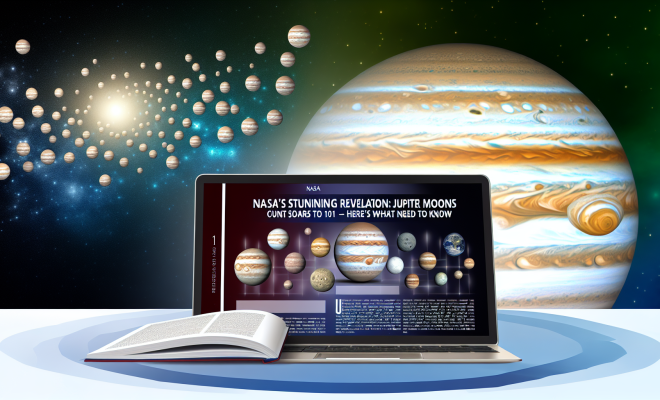
In a remarkable update that has captured the world’s attention, NASA announced that Jupiter now boasts 101 officially recognized moons as of March 2026. This dramatic increase in the moon count—from previous estimates ranging between 80 to 95—highlights the growing complexity of the Jovian system, which includes not only its moons but also rings and a plethora of asteroids. This surge in discovery, driven by advanced observational techniques and collaborations from esteemed astronomers, is reshaping our understanding of planetary formation.

The Role of Advanced Telescopes

The recent discoveries of Jupiter’s moons have been facilitated by cutting-edge technologies such as the Hubble Space Telescope and the James Webb Space Telescope (JWST). These instruments have provided unprecedented views of the gas giant and its surrounding environment. Astronomers utilized these telescopes to identify additional moons, many of which are categorized as irregular and likely captured asteroids.

Identifying Irregular Moons

Irregular moons are those that have atypical orbits, often operating at a distance from their parent planet and in directions contrary to the planet’s rotation. The discovery of these moons challenges prior models of planetary formation, suggesting that the gravitational influence of Jupiter may have played a significant role in capturing these celestial bodies. This shifts the paradigm of how we view the interactions within our solar system.

The Implications of the Discovery

The growing number of Jupiter moons poses intriguing questions about the history of our solar system. The traditional theories of planetary formation have been challenged by these findings, prompting scientists to rethink how moons are formed and captured. The presence of such a variety of moons around Jupiter indicates a more complex gravitational interplay than previously understood.

Social Media Buzz and Public Engagement

This astronomical revelation has not only fueled scientific discussion but has also sparked a flurry of activity on social media. Images of Jupiter and its moons have gone viral, inspiring memes that humorously compare the number of Jupiter moons to the family sizes of celebrities. This light-hearted engagement has helped to raise awareness about space exploration and the ongoing discoveries being made in our solar system.

The Discovery Process

So how exactly was this impressive new moon count achieved? The discovery process involved meticulous observation and validation by the International Astronomical Union (IAU). Astronomers scrutinized data collected over time, identifying previously overlooked objects and confirming their status as moons. This collaborative effort underscores the global nature of contemporary astronomical research, where data from multiple sources converge to enhance our understanding of the cosmos.

Jupiter’s Unique Characteristics

Jupiter is not just the largest planet in our solar system; it’s also one of the most fascinating. With its characteristic Great Red Spot and turbulent atmosphere, it has long been a subject of interest to astronomers. The discovery of additional Jupiter moons adds yet another layer of complexity to this magnificent gas giant and its captivating system.

Recognizing the New Moons

Among the 101 moons, many are still awaiting formal names. The IAU has a protocol for naming celestial bodies, which often involves public voting or honoring notable scientists. The excitement surrounding these new moons will undoubtedly lead to a more expansive discussion about their characteristics and potential for further research.

The Future of Exploration

With the ongoing advancements in space exploration technology, the future looks bright for discovering even more about Jupiter and its moons. Upcoming missions, such as NASA’s Europa Clipper, are set to further investigate the icy moon of Europa, which is believed to harbor a subsurface ocean. This mission aims to understand the potential for life beyond Earth and deepen our understanding of the Jovian system.

Conclusion: A New Era of Discovery

The recent increase in the Jupiter moons count from NASA and the IAU signifies a new era in celestial exploration and understanding. The discoveries remind us that space is a vast and ever-evolving frontier, filled with mysteries waiting to be uncovered. As our observational capabilities continue to improve and new missions are launched, we can expect even more revelations about our solar system’s largest planet and its captivating entourage of moons.

In summary, the increasing number of moons orbiting Jupiter not only presents exciting opportunities for researchers but also serves to engage and inspire a global audience. As we continue to explore the wonders of our universe, each discovery brings us one step closer to unraveling the secrets of the cosmos.

Thus, the story of Jupiter and its ever-expanding family of moons continues to unfold, inviting both scientific inquiry and public fascination.


Previous Article

9 Must-Have Fashion Finds to Dominate Your ...

Next Article

Comet C/2025 R3 PANSTARRS: A Once-in-a-Lifetime Celestial ...

Matthew Lynch

Related articles More from author

  • Tech News

    FIFA World Cup 2026 Sponsorship Fuels Prediction Market Boom

    June 24, 2026
    By Matthew Lynch
  • Tech News

    How to add watermark in Word?

    August 8, 2026
    By Matthew Lynch
  • Tech News

    FieldAware pricing 2026

    August 30, 2026
    By Matthew Lynch
  • Tech News

    MLB Betting Trends: Unlock 80% Success This July 4th, 2026

    July 5, 2026
    By Matthew Lynch
  • Tech News

    Can I use ProtonVPN for torrenting?

    August 18, 2026
    By Matthew Lynch
  • Tech News

    Introducing Solids: A Parent’s Guide to Baby’s First Foods

    July 1, 2026
    By Matthew Lynch

Search

Login & Registration

  • Log in
  • Entries feed
  • Comments feed
  • WordPress.org

Newsletter

Signup for The Tech Edvocate Newsletter and have the latest in EdTech news and opinion delivered to your email address!

About Us

Since technology is not going anywhere and does more good than harm, adapting is the best course of action. That is where The Tech Edvocate comes in. We plan to cover the PreK-12 and Higher Education EdTech sectors and provide our readers with the latest news and opinion on the subject. From time to time, I will invite other voices to weigh in on important issues in EdTech. We hope to provide a well-rounded, multi-faceted look at the past, present, the future of EdTech in the US and internationally.

We started this journey back in June 2016, and we plan to continue it for many more years to come. I hope that you will join us in this discussion of the past, present and future of EdTech and lend your own insight to the issues that are discussed.

Newsletter

Signup for The Tech Edvocate Newsletter and have the latest in EdTech news and opinion delivered to your email address!

Contact Us

The Tech Edvocate
910 Goddin Street
Richmond, VA 23231
(601) 630-5238
[email protected]

Copyright © 2026 Matthew Lynch. All rights reserved.