Mars’ Dying Breath: Why a Shocking New Discovery and NASA’s Blunder Just Blew Open Investing Opportunities
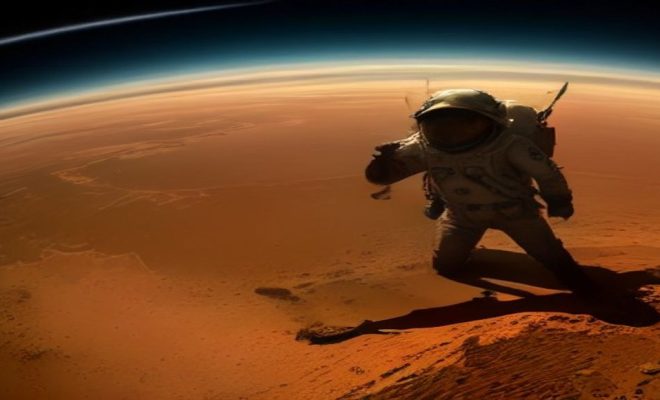
“`html
You know, for decades, Mars has been this tantalizing enigma, a dusty red marble in our cosmic backyard that whispers promises of ancient oceans and perhaps, just perhaps, the faint echoes of life. But today, August 3, 2026, we’re looking at Mars through a new lens, one sharpened by a truly astonishing scientific revelation that simultaneously deepens the mystery and, quite frankly, throws some conventional wisdom out the window. Researchers from Boston University, poring over data from NASA’s MAVEN and China’s Tianwen-1 missions, have just dropped a bombshell: Mars’ atmosphere isn’t just passively escaping into space. No, it’s being actively ripped away by what they’re calling “giant rolling waves” of solar wind. Think of it like a cosmic tsunami, relentlessly eroding the very air a planet needs to sustain liquid water, and by extension, life.
This isn’t some minor tweak to our understanding; it’s a counterintuitive, dynamic process that fundamentally reshapes our theories about how Mars, once potentially habitable, dried out and became the desolate world we see today. It’s a powerful, almost tragic, narrative playing out in real-time, one that has profound implications for planetary habitability across the universe and our relentless search for extraterrestrial life. And here’s where it gets even more complicated, and perhaps, more intriguing for those of us with an eye on the future: this scientific marvel lands squarely in the wake of NASA’s rather controversial decision in January 2026 to effectively cancel the Mars Sample Return (MSR) program. Yes, you heard that right. Perseverance’s meticulously collected samples, rocks that could hold the definitive proof of ancient Martian life, are currently sitting on the red planet, effectively orphaned, with no confirmed retrieval plan. This confluence of a breathtaking discovery and a high-profile programmatic failure creates a fascinating, if sometimes frustrating, landscape for anyone interested in the future of space, and especially for those keen on investing in Mars exploration opportunities.
The Solar Wind’s Unseen Fury: Understanding the New Discovery
Let’s talk about these “giant rolling waves” for a moment, because they truly are the star of today’s scientific show. We’ve long known that Mars’ thin atmosphere is vulnerable to the solar wind – a constant stream of charged particles emanating from the Sun. Without a strong global magnetic field like Earth’s to deflect it, Mars is exposed. However, the prevailing understanding was largely one of a steady, gradual erosion. The new Boston University research, drawing on the incredibly detailed data from both MAVEN and Tianwen-1, paints a far more dramatic picture.
Instead of a gentle breeze, imagine a tempest. The solar wind, interacting with the Martian ionosphere, creates these massive, turbulent waves that literally sweep away atmospheric gases. It’s not a passive leakage; it’s an active, almost violent, stripping process. This finding is so significant because it provides a much more robust explanation for Mars’ desiccation. It suggests that the planet’s atmospheric loss wasn’t just a slow bleed over billions of years, but perhaps a more vigorous, episodic process driven by these dynamic interactions. This changes how we model planetary evolution and, crucially, how we assess the long-term habitability of exoplanets orbiting stars with similar stellar winds. If a planet loses its atmosphere this way, its window for sustaining liquid water – and thus, life as we know it – might be far narrower than previously assumed.
The Ghost of Mars Sample Return: A Program’s Untimely End
Now, let’s pivot to the human element, specifically NASA’s very human struggle with ambition versus reality. The Mars Sample Return program was, for a long time, the jewel in the crown of robotic Mars exploration. The idea was elegantly simple, yet technologically daunting: send a rover (Perseverance) to collect scientifically compelling samples, launch them into orbit around Mars, rendezvous with another spacecraft, and bring them back to Earth for unparalleled analysis. Scientists have literally been dreaming of these samples for decades, believing they hold the key to understanding Mars’ past habitability and potentially confirming ancient microbial life.
But the dream hit a wall. In January 2026, after years of ballooning costs and escalating delays, NASA made the agonizing decision to effectively cancel the MSR program. The price tag had become astronomical, projected to potentially exceed $10 billion, and the timelines stretched far into the future. It was a politically untenable situation, leaving Perseverance’s precious cargo sitting on Mars, a poignant symbol of what could have been. This cancellation has left a gaping hole in NASA’s long-term Mars strategy and has sparked a fierce debate within the scientific community and among space enthusiasts. Was it a pragmatic decision given budgetary realities, or a shortsighted abandonment of a crucial scientific endeavor? Regardless of where you stand, it undeniably shifts the landscape for future Mars missions and, by extension, the opportunities for investing in Mars exploration opportunities.
The Vacuum of Leadership: What MSR’s Cancellation Means for Future Missions
The MSR cancellation isn’t just about a few rocks; it’s about the entire trajectory of Mars exploration. Flagship missions like MSR often serve as anchors, driving technological development, fostering international collaboration, and setting the pace for subsequent missions. Without that anchor, there’s a certain vacuum. It means a re-evaluation of priorities, a scrambling for new, more cost-effective approaches, and perhaps a greater reliance on commercial partners to pick up some of the slack.
This situation forces us to ask: what comes next? Will NASA pivot to smaller, more focused missions? Will they seek to re-engage with international partners on a scaled-down sample return, or perhaps shift focus entirely to human exploration preparations? The uncertainty, while frustrating for scientists, actually creates a fascinating dynamic for investors. When the established order is disrupted, new players and innovative solutions often emerge to fill the void. This could mean a surge in demand for more agile, affordable technologies, or entirely new mission architectures that didn’t fit into the previous, rigid framework.
The Silver Lining: Commercial Opportunities in a New Mars Era
Despite the scientific heartbreak of MSR and the stark reality of Mars’ atmospheric loss, this new era isn’t without its silver linings, especially when you’re thinking about investing in Mars exploration opportunities. In fact, these very challenges are creating fertile ground for commercial innovation. The need for more cost-effective solutions, the push for faster development cycles, and the inherent public interest in Mars combine to form a compelling market for private enterprise. (See: Mars overview and characteristics.)
Think about it: if NASA struggles with multi-billion-dollar programs, who steps in to offer more nimble alternatives? This is where the burgeoning NewSpace sector truly shines. Companies specializing in everything from advanced propulsion to miniaturized scientific instruments, from autonomous robotics to sophisticated data analysis, stand to gain. The demand for capabilities that can achieve scientific goals at a fraction of the traditional cost is only going to grow. We’re entering a phase where ingenuity, efficiency, and a lean operational model will be prized above all else.
Online Education and Astrobiology: The Knowledge Economy of Space
One immediate, and perhaps less obvious, area ripe for growth is the knowledge economy surrounding space. The new discovery about Mars’ atmospheric stripping and the ongoing saga of MSR have ignited public curiosity like never before. People want to understand what’s happening on Mars, what it means for our search for life, and why it’s so difficult to get there and back. This translates directly into a massive opportunity for online education platforms.
Imagine courses on planetary science, astrobiology, space engineering, or even the economics of space exploration. Companies that can deliver engaging, accurate, and accessible content – from interactive simulations to expert-led lectures – are poised for significant growth. We’re not just talking about traditional university courses; think about platforms offering micro-credentials, virtual reality experiences of Mars, or even gamified learning modules. The thirst for knowledge about Mars is insatiable, and the digital realm is the perfect conduit for quenching it. Investing in companies that are at the forefront of this educational revolution is a smart play.
Affiliate Opportunities: Cashing in on Mars Mania
Beyond direct investment in space companies, there’s a more accessible, and often overlooked, avenue: affiliate marketing. The renewed public fascination with Mars, fueled by both the scientific breakthroughs and the programmatic drama, translates into heightened interest in all things space-related. This is fantastic news for anyone with an online presence or a knack for content creation.
Consider the market for astronomy equipment: telescopes for amateur stargazers, high-quality binoculars, astrophotography gear. Every new Mars image, every scientific paper, every documentary sparks a fresh wave of interest. Then there are Mars-themed books – from popular science to science fiction, educational materials for kids, documentaries, and even merchandise. Websites, blogs, and YouTube channels that review or promote these products, linking to retailers via affiliate programs, can generate substantial revenue. The key is to create compelling content that taps into the public’s excitement and then strategically integrate affiliate links. It’s a low-barrier entry point into the commercial ecosystem surrounding space exploration.
Future Commercial Mars Technologies: Beyond Rockets and Rovers
When we talk about investing in Mars exploration opportunities, it’s easy to immediately think of rocket companies or rover manufacturers. But the future commercial landscape is far broader and more nuanced. The challenges of Mars – the thin atmosphere, extreme temperatures, radiation, and vast distances – necessitate a whole host of innovative technologies that go beyond just getting there.
Consider advanced robotics for autonomous construction and maintenance, crucial for setting up habitats or resource extraction sites without human intervention. Think about closed-loop life support systems, essential for long-duration missions and eventual settlements. What about in-situ resource utilization (ISRU) technologies, designed to extract water, oxygen, and fuel from Martian soil and atmosphere? Companies developing advanced materials capable of withstanding the harsh Martian environment, or cutting-edge communication systems for transmitting vast amounts of data across interplanetary distances, are all potential goldmines. The future isn’t just about reaching Mars; it’s about staying there, and that requires an entire ecosystem of specialized, commercially viable technologies.
The Long Game: Speculative Investing in Resource Utilization and Colonization
Now, let’s talk about the truly speculative, long-term plays – the kind of investing that requires vision and a high tolerance for risk. This is where the grander visions of resource utilization and eventual human colonization come into focus. While these are decades, if not centuries, away from full realization, the foundational technologies are being developed today.
Imagine companies pioneering asteroid mining techniques, which could eventually be applied to Mars’ moons or even Mars itself. Think about firms developing sustainable closed-loop agricultural systems for off-world environments, or advanced manufacturing techniques like 3D printing with Martian regolith. These are not immediate returns, but investments in the very building blocks of an interplanetary civilization. For those with a long-term perspective, and who believe in the inevitable expansion of humanity into space, these early-stage companies, often with venture capital backing, represent the ultimate moonshot – or rather, Mars-shot – opportunity. The risk is high, but the potential rewards, should any of these ventures succeed in paving the way for a Martian economy, are truly astronomical.
Ethical Considerations and the Future of Martian Exploration
As we get more serious about investing in Mars exploration opportunities, we also need to confront the ethical dimensions of our ambitions. The new discovery about atmospheric stripping, while purely scientific, underscores the fragility of planetary environments. Our past failures, like the MSR cancellation, remind us of the immense resources involved and the public trust at stake. As private companies gain more prominence, questions of planetary protection – preventing Earth microbes from contaminating Mars, and vice-versa – become even more critical.
Who owns the resources on Mars? What are the implications of commercial entities operating independently on another planet? These aren’t just philosophical questions; they are legal and regulatory challenges that will need to be addressed as we move closer to permanent presence. Responsible investment in this sector isn’t just about financial returns; it’s about supporting ventures that are committed to sustainable practices, scientific integrity, and an ethical approach to humanity’s expansion into the cosmos. The future of Mars exploration, whether driven by public agencies or private enterprise, demands a thoughtful and principled approach. (See: NASA's MAVEN mission details.)
Expert Perspectives on Mars Investment Trends
To truly understand the landscape of investing in Mars exploration opportunities, it helps to hear from the experts who are shaping the future. Many venture capitalists and space industry analysts are keenly watching the shifts in government funding and the rise of private companies. For instance, Dr. Mae Jemison, the first African American woman in space and a vocal advocate for sustainable space development, often emphasizes the need for a holistic approach, where scientific goals and commercial viability are intertwined. She might highlight companies focusing on closed-loop systems, not just for Mars, but for Earth too, creating dual-use technologies that have immediate market appeal.
Then there are economists like Dr. Gordon R. Woodcock, who has extensively studied the economic rationale for space industrialization. His work suggests that while initial investments are high, the long-term returns from resource extraction and new industries created off-world could be staggering. He often points to historical precedents, like the development of new frontiers on Earth, to illustrate the potential. When looking at companies, experts often scrutinize their intellectual property, their team’s experience, and their ability to pivot in a rapidly changing environment. They’re not just looking for a good idea; they’re looking for a robust business model that can withstand the unique challenges of space.
Another perspective comes from planetary scientists themselves. While they often lament budget cuts for pure science, many recognize the necessity of commercial partnerships. Dr. Abigail Fraeman, a research scientist at NASA’s Jet Propulsion Laboratory, often speaks about the synergy between scientific discovery and technological advancement. She might suggest that companies developing miniaturized, hardened sensors for planetary environments, or AI-driven data analysis tools, are crucial for both scientific missions and future commercial endeavors. These expert opinions paint a picture of an investment space that is complex, high-risk, but potentially incredibly rewarding for those who choose wisely.
Comparisons with Other Space Investment Areas
When considering investing in Mars exploration opportunities, it’s helpful to contextualize it against other sectors in the broader space industry. For example, satellite constellations for Earth observation or internet provision are a relatively mature segment, with established players and clearer revenue streams. Companies like SpaceX (Starlink) and Amazon (Kuiper) are investing billions, but the market is becoming crowded. Investment here is often about scale, efficiency, and market share.
Then you have lunar exploration. With NASA’s Artemis program aiming for a human return to the Moon, there’s significant government funding flowing into lunar landers, habitats, and resource extraction technologies. This area presents a more immediate, albeit still high-risk, opportunity compared to Mars, given the Moon’s proximity and the active government programs. Companies like Intuitive Machines and Astrobotic are already making strides here.
Mars, however, sits at a different point on the spectrum. It’s further away, the engineering challenges are greater, and the immediate commercial applications are less defined. This makes it a higher-risk, higher-reward proposition. Investing in Mars is often about believing in the long-term vision of humanity becoming a multi-planetary species. It requires a different kind of patience and a deeper understanding of foundational technologies that will enable that future, rather than just optimizing existing services or participating in government-led programs. It’s less about incremental gains and more about disruptive innovation.
The Regulatory Landscape: Shaping Future Mars Investments
The regulatory environment for space exploration, particularly for private entities, is still very much in its infancy, and this will significantly shape opportunities for investing in Mars exploration. Currently, international space law, primarily the Outer Space Treaty of 1967, prohibits national appropriation of outer space, including celestial bodies. However, it doesn’t explicitly address private property rights or resource extraction by commercial entities.
Countries like the United States have passed national legislation, such as the SPACE Act of 2015, which grants U.S. citizens the right to own resources they obtain in space. This creates a legal framework for American companies, but international consensus is still lacking. As private companies become more capable of reaching Mars and utilizing its resources, the need for clear international regulations will become paramount. This includes frameworks for property rights, environmental protection (planetary protection protocols), liability for space operations, and dispute resolution. Companies that actively engage with and help shape these emerging legal frameworks, or those that operate in jurisdictions with clear, supportive space laws, might have a distinct advantage. Investors should monitor developments in international space law and national space policies, as these will directly impact the viability and profitability of Mars ventures.
Frequently Asked Questions About Investing in Mars Exploration
Q1: Is investing in Mars exploration truly viable right now, or is it too speculative?
It’s definitely speculative, but increasingly viable. While direct returns from Mars colonization are decades away, many companies are developing foundational technologies with near-term applications on Earth, the Moon, or in Earth orbit. Investing now means backing the infrastructure and innovation that will make future Mars missions possible. Think of it as investing in the early days of the internet – the full potential wasn’t immediately clear, but the underlying tech was revolutionary. (See: Research on Mars' atmospheric loss.)
Q2: What are the biggest risks associated with investing in Mars-related companies?
The risks are significant. They include technical hurdles (space is hard!), immense capital requirements, long development cycles, regulatory uncertainty, and the potential for mission failures. Government funding changes, like the MSR cancellation, also pose a risk. It’s a market for investors with a high-risk tolerance and a long-term outlook.
Q3: What types of companies are currently involved in Mars exploration opportunities?
A wide range! Beyond the obvious rocket and rover companies, you’ll find firms specializing in advanced propulsion, autonomous robotics, closed-loop life support systems, in-situ resource utilization (ISRU), advanced materials, space-based communication, and even AI for mission control and data analysis. The ecosystem is much broader than just launch providers.
Q4: How can a small investor get involved in this sector?
Direct investment in early-stage Mars companies often requires significant capital and access to venture capital funds. However, smaller investors can consider publicly traded companies that are major contractors for space agencies (like defense contractors with space divisions), ETFs focused on aerospace and defense, or even ETFs specifically tracking the “NewSpace” economy. Affiliate marketing for space-related products is another accessible entry point.
Q5: What’s the timeline for human missions to Mars, and how does that affect investment?
Current estimates for human missions to Mars vary, but most experts project the late 2030s to mid-2040s for a first crewed landing. This long timeline means that many investments today are in technologies that will enable these future missions. The closer we get to human missions, the more concrete the commercial opportunities for things like habitats, support services, and resource extraction will become. Patient capital is key here.
Q6: What role do international partnerships play in Mars exploration and investment?
A crucial one! Mars exploration is incredibly expensive and complex, often requiring international collaboration to pool resources and expertise. NASA frequently partners with ESA (European Space Agency), JAXA (Japan Aerospace Exploration Agency), and other agencies. For investors, this means looking at companies that are well-positioned to benefit from these international collaborations, perhaps by offering specialized components or services that are in demand globally.
The red planet continues to be a canvas for both scientific wonder and human endeavor. Today’s revelation about solar wind’s relentless assault on its atmosphere adds another layer to that complexity, reminding us of the immense forces at play in our universe. Coupled with the MSR program’s unexpected demise, it’s clear that the path to Mars is anything but straightforward. Yet, within these challenges lie incredible opportunities – for innovation, for education, and for those astute enough to see the commercial potential in a future that increasingly looks beyond Earth. It’s a high-stakes game, but one that promises to redefine humanity’s place in the cosmos, and perhaps, generate some impressive returns along the way.
“`
Trending Now
Frequently Asked Questions
What did the new discovery about Mars reveal?
A recent study by Boston University revealed that Mars' atmosphere is not just passively escaping but is being actively stripped away by 'giant rolling waves' of solar wind. This discovery challenges previous notions about Mars' climate and its potential to support life.
How does solar wind affect Mars?
Solar wind is eroding Mars' atmosphere, much like a cosmic tsunami, which impacts the planet's ability to sustain liquid water and life. This dynamic process is crucial for understanding how Mars transitioned from a potentially habitable world to its current desolate state.
What happened to NASA's Mars Sample Return program?
In January 2026, NASA controversially canceled the Mars Sample Return (MSR) program. This decision leaves samples collected by the Perseverance rover on Mars without a confirmed plan for retrieval, raising concerns about the potential loss of crucial evidence of ancient Martian life.
What are the implications of the Mars discovery for extraterrestrial life?
The findings about Mars' atmosphere and solar wind dynamics have significant implications for the search for extraterrestrial life. They reshape our understanding of planetary habitability and suggest that similar processes could affect other celestial bodies in the universe.
Why is Mars considered a 'tantalizing enigma'?
Mars is often described as a 'tantalizing enigma' due to its history of potential habitability, ancient oceans, and ongoing mysteries about its climate. The recent discoveries further deepen this intrigue, highlighting the planet's complex evolution and the factors that may have hindered the development of life.
What did we miss? Let us know in the comments and join the conversation.