
The Tech Edvocate

Top Menu

  • Advertisement
  • Apps
  • Home Page
  • Home Page Five (No Sidebar)
  • Home Page Four
  • Home Page Three
  • Home Page Two
  • Home Tech2
  • Icons [No Sidebar]
  • Left Sidbear Page
  • Lynch Educational Consulting
  • My Account
  • My Speaking Page
  • Newsletter Sign Up Confirmation
  • Newsletter Unsubscription
  • Our Brands
  • Page Example
  • Privacy Policy
  • Protected Content
  • Register
  • Request a Product Review
  • Shop
  • Shortcodes Examples
  • Signup
  • Start Here
    • Governance
    • Careers
    • Contact Us
  • Terms and Conditions
  • The Edvocate
  • The Tech Edvocate Product Guide
  • Topics
  • Write For Us
  • Advertise

Main Menu

  • Start Here
    • Our Brands
    • Governance
      • Lynch Educational Consulting, LLC.
      • Dr. Lynch’s Personal Website
      • Careers
    • Write For Us
    • The Tech Edvocate Product Guide
    • Contact Us
    • Books
    • Edupedia
    • Post a Job
    • The Edvocate Podcast
    • Terms and Conditions
    • Privacy Policy
  • Topics
    • Assistive Technology
    • Child Development Tech
    • Early Childhood & K-12 EdTech
    • EdTech Futures
    • EdTech News
    • EdTech Policy & Reform
    • EdTech Startups & Businesses
    • Higher Education EdTech
    • Online Learning & eLearning
    • Parent & Family Tech
    • Personalized Learning
    • Product Reviews
  • Advertise
  • Tech Edvocate Awards
  • The Edvocate
  • Pedagogue
  • School Ratings

logo

The Tech Edvocate

  • Start Here
    • Our Brands
    • Governance
      • Lynch Educational Consulting, LLC.
      • Dr. Lynch’s Personal Website
        • My Speaking Page
      • Careers
    • Write For Us
    • The Tech Edvocate Product Guide
    • Contact Us
    • Books
    • Edupedia
    • Post a Job
    • The Edvocate Podcast
    • Terms and Conditions
    • Privacy Policy
  • Topics
    • Assistive Technology
    • Child Development Tech
    • Early Childhood & K-12 EdTech
    • EdTech Futures
    • EdTech News
    • EdTech Policy & Reform
    • EdTech Startups & Businesses
    • Higher Education EdTech
    • Online Learning & eLearning
    • Parent & Family Tech
    • Personalized Learning
    • Product Reviews
  • Advertise
  • Tech Edvocate Awards
  • The Edvocate
  • Pedagogue
  • School Ratings
  • This One Skill Is Quietly Reshaping Every Career — And How to Master It Now

  • The Silent Threat: How AI Is Reshaping Recent College Graduates’ Job Prospects

  • This Crucial Shift in AI Will Devastate Millions of College Grads

  • The Brutal Truth: Zero-Day Exploit Analysis vs. Traditional Cybersecurity Careers — Which Path Pays $300,000?

  • The Urgent Truth: Why These Certifications Are Your Only Defense Against Zero-Day Attacks

  • The FBI Investigates a Zero-Day Attack on Your Job Applications

  • The Startling Truth About AI’s Impact on Your Coding Job by 2026

  • The Shocking Truth About Your Code: AI Is Already Rewriting Your Future

  • Is This Why Code Review Is Dead? AI’s Staggering Impact on Tech Jobs

  • The Shocking Truth About CogniBoost vs Focus Drugs: What No One Is Telling You

How To
Home›How To›How to Make a Database Using MS Access

How to Make a Database Using MS Access
By Matthew Lynch
March 5, 2024
0
Spread the love

Creating a database is an essential skill for anyone looking to manage, store, and organize information efficiently. Microsoft Access is a powerful relational database management system (RDBMS) that makes it easy to create and maintain databases. In this article, we’ll guide you through the process of creating a database using MS Access.

1. Launch Microsoft Access

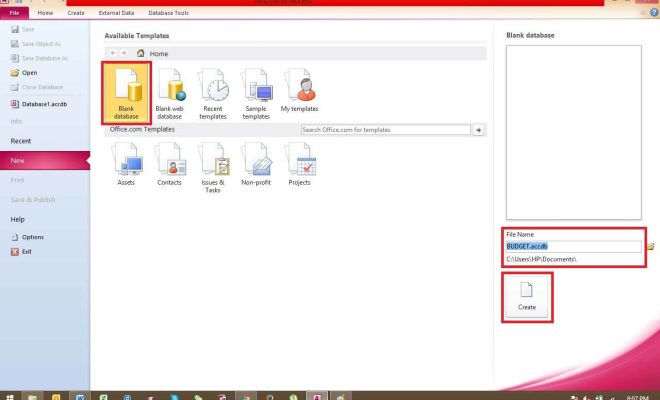
To begin, start Microsoft Access either by clicking its icon on the desktop or in your Start menu. Once launched, you’ll see the opening screen with several template options.

2. Choose a template or create from scratch

If one of the templates fits your needs, click on it to create a new database based on that template. Alternatively, click on “Blank Database” in the upper-left corner to create a new empty database.

3. Name your database

Before you start building your database, you should give it a name by entering the desired file name in the “File Name” field, followed by clicking “Create.” Make sure to choose a descriptive name which reflects the purpose of your database.

4. Create your first table

Once you have created your blank database, MS Access will automatically open up a new table for you to start entering data into. To customize this table, click on the “Design View” option under the “View” menu.

5. Define fields and data types

In Design View, you can define fields (columns) and their corresponding data types for your table. For each field, enter a field name, select the appropriate data type from the dropdown menu (e.g., Text, Number, Date/time), and specify additional properties if necessary.

6. Set primary key

A primary key is a unique identifier for each record in your table. To set one, right-click on the desired field and select “Primary Key.” This ensures that no two records can share the same value in this field.

7. Save your table

Once you’ve finished defining fields and setting the primary key, click on the “Save” button and give your table a name. This will store the table structure in your database.

8. Enter data

Now you can enter data into your newly created table. Switch back to “Datasheet View” by clicking on the “View” menu. Start entering data into the fields by clicking in each cell and typing.

9. Create relationships between tables (optional)

If you have multiple tables within your database, you may wish to create relationships between them. You can do this by clicking on the “Database Tools” tab and selecting “Relationships.” Drag and drop the fields which you want to link between tables, making sure the related fields share the same data type.

10. Create forms and reports

To make it easier to view, enter, or analyze data in your database, you can create forms and reports in MS Access. To create a form or report, click either “Form Design” or “Report Design” under the “Create” tab and then customize it according to your requirements.

By following these steps, you now have a functioning database created using MS Access! With experience and practice, you’ll be able to build more complex databases tailored to fit any of your data management needs!


Previous Article

When an Active Pause Is the Best ...

Next Article

The best hair growth products for your ...

Matthew Lynch

Related articles More from author

  • How To

    4 Ways to Cook Spaghetti Squash

    October 6, 2023
    By Matthew Lynch
  • How To

    4 Ways to Wash Hockey Gear

    January 30, 2024
    By Matthew Lynch
  • How To

    How to Paint a Piano: 14 Steps

    November 14, 2023
    By Matthew Lynch
  • How To

    3 Ways to Add an Extra Hard Drive

    October 8, 2023
    By Matthew Lynch
  • How To

    11 Ways to Keep an Aquarius Man Hooked

    November 14, 2023
    By Matthew Lynch
  • How To

    3 Ways to Know if Someone Is Talking Behind Your Back

    October 17, 2023
    By Matthew Lynch

Search

Login & Registration

  • Log in
  • Entries feed
  • Comments feed
  • WordPress.org

Newsletter

Signup for The Tech Edvocate Newsletter and have the latest in EdTech news and opinion delivered to your email address!

About Us

Since technology is not going anywhere and does more good than harm, adapting is the best course of action. That is where The Tech Edvocate comes in. We plan to cover the PreK-12 and Higher Education EdTech sectors and provide our readers with the latest news and opinion on the subject. From time to time, I will invite other voices to weigh in on important issues in EdTech. We hope to provide a well-rounded, multi-faceted look at the past, present, the future of EdTech in the US and internationally.

We started this journey back in June 2016, and we plan to continue it for many more years to come. I hope that you will join us in this discussion of the past, present and future of EdTech and lend your own insight to the issues that are discussed.

Newsletter

Signup for The Tech Edvocate Newsletter and have the latest in EdTech news and opinion delivered to your email address!

Contact Us

The Tech Edvocate
910 Goddin Street
Richmond, VA 23231
(601) 630-5238
[email protected]

Copyright © 2026 Matthew Lynch. All rights reserved.