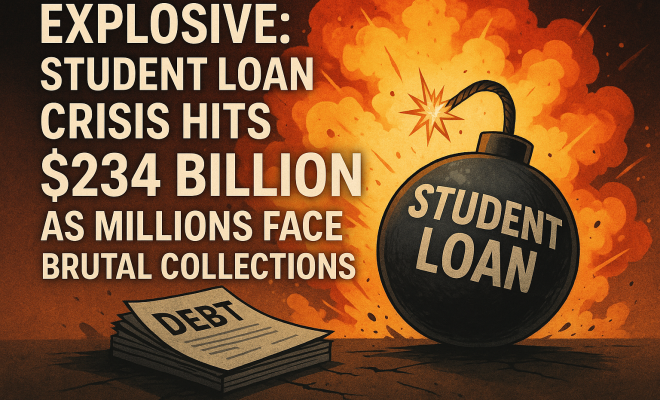
Explosive: Student Loan Crisis Hits $234 Billion as Millions Face Brutal Collections
“`html
You might have thought the student loan crisis was a problem for ‘other people’ — perhaps recent graduates, or those who pursued particularly expensive degrees. But new data from the Education Department is pulling back the curtain on a situation far more pervasive, and frankly, far more terrifying than many realize. We’re not just talking about a few missed payments here and there; we’re witnessing a full-blown financial catastrophe unfolding across millions of American households, with the federal government now gearing up for collection tactics that could fundamentally reshape the lives of nearly one in five borrowers.
The numbers are stark, and they paint a grim picture. By June 2026, an additional 400,000 borrowers had slipped into default on their federal student loans. Add them to the existing rolls, and you get a staggering total of over 9.3 million Americans now officially in default. These aren’t just abstract figures; these are individuals, families, and communities caught in a financial vise. And the collective burden they carry? A mind-boggling $234 billion. To put that in perspective, that’s roughly 14% of the entire federal student loan portfolio now sitting in a state of default. This isn’t just a bump in the road; it’s a massive, systemic crack in the foundation of personal finance for millions, and it’s deepening the student loan crisis with alarming speed.
The Avalanche Effect: How We Got Here After the Freeze
To truly grasp the gravity of this situation, we need to rewind a bit. For years, during the height of the COVID-19 pandemic, federal student loan payments were effectively paused. It was a necessary relief measure, offering a much-needed financial breather to millions of Americans grappling with unprecedented economic uncertainty, job losses, and health crises. This payment freeze, initially temporary, was extended multiple times, creating a prolonged period where borrowers didn’t have to worry about making monthly payments or accruing interest.
While this provided immediate relief, it also, in a way, lulled many into a false sense of security or, at the very least, allowed them to reallocate those funds to other pressing needs. When the payment pause finally ended, and subsequent delays pushed the actual resumption date, many borrowers found themselves unprepared for the sudden reintroduction of what, for some, were substantial monthly obligations. The transition back to repayment was far from smooth. Many loans, particularly those that had already been struggling before the pandemic, quickly reached the 360-day delinquency threshold for default between October and December 2025. This lag, from the end of the pause to the official default mark, created a delayed but inevitable avalanche of defaults, illustrating a critical failure in the transition strategy.
Defining Default: More Than Just a Missed Payment
It’s crucial to understand what ‘default’ actually means in the context of federal student loans, because it’s far more severe than simply being a few weeks late on a credit card bill. When a federal student loan goes into default, it typically means payments haven’t been made for at least 270 days (though the Education Department’s recent data points to the 360-day mark being a key trigger for many of these new defaults). Once you hit that point, the entire unpaid balance of your loan, including any accrued interest, becomes immediately due.
This isn’t just a bureaucratic penalty; it triggers a cascade of severe consequences. Your credit score will take a massive hit, making it incredibly difficult to secure future loans for a car, a house, or even a simple credit card. You’ll lose eligibility for further federal student aid, meaning if you wanted to go back to school to improve your job prospects, that door slams shut. And perhaps most chillingly, the federal government gains significant power to collect the debt, powers that private lenders simply don’t possess. This distinction is vital because it explains why the coming collection tactics are so uniquely potent and, frankly, terrifying for those affected.
The Looming Threat: Aggressive Federal Collection Tactics
Here’s where the student loan crisis gets truly personal and incredibly difficult for millions. With nearly 20% of federal student loan borrowers now officially delinquent, the federal government isn’t just going to send polite reminders. They are preparing to unleash aggressive collection tactics that can fundamentally destabilize a person’s financial life. We’re talking about powers that few other creditors in the nation possess.
First on the list: withholding tax refunds. Imagine expecting a significant refund check, perhaps to pay down other debts, cover an much-needed expense, or even just save, only for it to be completely intercepted by the government to cover your defaulted student loans. This isn’t a hypothetical; it’s a very real and immediate threat. Beyond that, the government can also garnish your wages. This means a portion of your paycheck can be legally seized before it even hits your bank account. For individuals already struggling, losing a percentage of their take-home pay can be the difference between making rent and facing eviction, or putting food on the table versus going hungry. These aren’t just inconveniences; they are life-altering blows that can push already vulnerable households over the edge. (See: Student loan defaults statistics.)
The Human Cost: Beyond the Billions
While the $234 billion figure is staggering, it’s crucial to remember that behind every dollar is a person, a family, and a story. The student loan crisis isn’t just an economic statistic; it’s a deeply emotional issue. Think about the dreams tied to those loans: the aspiration for a better life, a more secure future, the pursuit of knowledge. For many, taking out student loans was seen as an investment, a necessary step towards upward mobility. For more context, see The Staggering Truth About Student Loan Forgiveness Delays.
Now, those investments have become liabilities that threaten to unravel those very dreams. The stress of constant debt, the fear of wage garnishment, and the impact on credit scores can lead to severe mental health challenges. We see increased anxiety, depression, and a pervasive sense of hopelessness among those buried under student debt. It impacts their ability to start families, buy homes, or even save for retirement. This isn’t just about financial numbers; it’s about the erosion of the American dream for millions, replaced by a constant, gnawing worry that permeates every aspect of their lives.
Why This Matters to Everyone: The Broader Economic Ripple Effect
You might be thinking, “Well, I paid off my loans,” or “I never took out student loans.” And while that’s great for you, the student loan crisis isn’t confined to just those directly affected; it has significant ripple effects across the entire economy. When millions of people are struggling under the weight of debt, their spending power diminishes dramatically. They’re less likely to buy cars, put down payments on houses, or even engage in everyday consumer spending that drives local economies. This slowdown in consumer spending can stifle economic growth on a much broader scale.
Furthermore, the inability of so many to build wealth – through homeownership, investments, or starting businesses – creates a drag on overall economic dynamism. It widens the wealth gap and can contribute to economic stagnation. The sheer volume of this defaulted debt also puts a strain on federal resources, as the government has to expend significant effort and cost in collection activities, resources that could otherwise be allocated to other public services or investments. This isn’t just a personal finance problem; it’s a national economic challenge that demands broader attention and solutions.
Targeted Solutions: Refinancing, Consolidation, and Debt Relief
Given the immense financial pressure and the controversial resumption of aggressive collections, the demand for practical solutions is soaring. For those caught in the maelstrom of the student loan crisis, exploring options for refinancing, consolidation, and debt relief isn’t just advisable; it’s often essential. But it’s also a complex landscape to navigate, fraught with potential pitfalls and predatory actors.
Refinancing, for instance, involves taking out a new loan, usually from a private lender, to pay off your existing student loans. The goal is typically to secure a lower interest rate or more favorable terms. However, refinancing federal loans into private ones means losing access to valuable federal benefits like income-driven repayment plans, forbearance, and deferment options. It’s a trade-off that requires careful consideration. Consolidation, on the other hand, allows you to combine multiple federal student loans into a single new federal loan, often simplifying payments and potentially offering a longer repayment period, though it doesn’t always lower your interest rate.
Then there’s the broader category of debt relief services. This can range from legitimate programs like income-driven repayment (IDR) plans, which adjust your monthly payment based on your income and family size, to more specialized options for public service workers or those with specific disabilities. However, this is also an area where scams unfortunately proliferate. Borrowers need to be incredibly vigilant, scrutinizing any offer that sounds too good to be true and always starting with official government resources or reputable non-profit credit counseling agencies. The Department of Education provides extensive information on official programs, and consulting with a certified financial planner specializing in student debt can offer invaluable, personalized guidance.
The Path Forward: Policy Debates and Borrower Advocacy
The student loan crisis isn’t just a personal struggle; it’s a hot-button political issue that continues to fuel intense debate in Washington and across the country. There are fundamental disagreements on who is responsible, what the government’s role should be, and how to best alleviate the burden without creating moral hazard or undue taxpayer expense. (See: Youth risk behavior survey data.)
On one side, you have advocates pushing for more expansive debt cancellation, arguing that the current system is fundamentally broken and that a significant portion of debt should be forgiven to stimulate the economy and provide a fresh start for millions. They point to the disproportionate impact on marginalized communities and the sheer scale of the problem as evidence that incremental solutions aren’t enough. On the other side, critics of widespread forgiveness argue that it’s unfair to those who have diligently paid their loans, could be inflationary, and doesn’t address the root causes of rising tuition costs. They often advocate for stricter lending practices, more transparency from educational institutions, and better financial literacy education for students.
Beyond the philosophical debates, there’s a practical need for clearer, more accessible pathways for borrowers to understand and utilize existing relief programs. The complexity of the federal student loan system itself is a major barrier for many. Simplifying applications for income-driven repayment, improving communication about options, and enhancing support services are all critical steps that don’t require sweeping legislative changes but could significantly help millions of struggling borrowers. The conversation needs to shift from just ‘what went wrong?’ to ‘how do we genuinely fix this for good?’ For more context, see How AI Finance Tools 2026 Are Taking Over Your Money.
The Role of Higher Education Institutions in the Student Loan Crisis
It’s easy to point fingers at borrowers or the government, but higher education institutions themselves play a significant, often overlooked, role in the student loan crisis. Tuition costs have consistently outpaced inflation and wage growth for decades. Universities, particularly private ones, have seen administrative bloat, lavish facilities, and sometimes questionable spending habits contribute to these skyrocketing expenses. When students face tuition bills that are tens of thousands of dollars a year, with little transparency on how those costs are determined or what the actual return on investment will be, it creates an environment ripe for accumulating unsustainable debt.
Moreover, the incentives within the higher education system are often misaligned. Institutions have little financial risk when students take out federal loans; they get their money regardless of whether the student graduates, gets a job, or can repay the debt. This lack of accountability can lead to programs being offered that have poor employment outcomes, leaving graduates with degrees that don’t justify the cost. Some argue that a shift toward performance-based funding for institutions, or requiring universities to share some of the financial risk of student loan defaults, could incentivize more responsible pricing and better student support services.
Additionally, many institutions don’t do enough to educate prospective students about the true cost of attendance, the long-term implications of student debt, or the various repayment options available. Financial literacy should be a mandatory component of college admission and ongoing student support, helping individuals make informed decisions about their educational investments. Without addressing the supply side of the education equation, any debt relief efforts will only be temporary fixes, as new generations of students continue to face the same unsustainable cost structure.
Disproportionate Impact: Who Suffers Most from the Student Loan Crisis?
While the student loan crisis affects millions, its burden isn’t evenly distributed. Certain demographics and communities bear a disproportionately heavy load. Data consistently shows that Black and Hispanic borrowers, for example, tend to borrow more for their education, have higher default rates, and struggle more with repayment compared to their white counterparts. This isn’t just about individual choices; it reflects systemic inequalities, including wealth disparities, differences in access to generational wealth, and labor market discrimination that often leads to lower wages for graduates of color.
Women also carry a significant portion of student loan debt, often borrowing more to achieve similar educational outcomes as men, and then facing a persistent gender wage gap that makes repayment more challenging. Single parents, those who attended for-profit colleges (which often have higher tuition and lower graduation rates), and individuals from low-income backgrounds are also particularly vulnerable. These groups often have less financial cushion to absorb unexpected expenses, are more likely to work in lower-paying jobs, and have fewer resources to navigate complex repayment systems. Recognizing these disparities is crucial for developing equitable and effective solutions, ensuring that policies are designed to uplift the most vulnerable rather than inadvertently exacerbating existing inequalities.
The student loan crisis isn’t just a financial challenge; it’s a social justice issue, revealing deep cracks in economic mobility and equity within American society. Ignoring these demographic realities means overlooking the very communities that need help the most, perpetuating a cycle of debt and limited opportunity. (See: New York Times on student loan defaults.)
Expert Perspectives: Economists Weigh In
Economists from across the political spectrum offer varied, yet often converging, insights into the student loan crisis. Liberal economists frequently emphasize the macroeconomic drag caused by student debt, arguing that widespread debt forgiveness could act as a powerful fiscal stimulus, boosting consumer spending and entrepreneurship. They often highlight the intergenerational wealth transfer aspect, where older generations benefited from lower tuition costs and robust job markets, while younger generations face crushing debt and stagnant wages. Solutions from this perspective often involve substantial federal investment, either through direct debt cancellation or universal tuition programs.
Conservative economists, while acknowledging the problem, tend to focus on the moral hazard of widespread forgiveness and the importance of market mechanisms. They argue that debt cancellation could incentivize future reckless borrowing and that the root cause lies in unchecked tuition inflation. Their proposed solutions often center on greater accountability for universities, encouraging vocational training alternatives, and reforming the federal lending program to be more fiscally responsible. They might advocate for more robust counseling, stricter lending criteria, and a shift towards private sector involvement in student financing, believing that market forces would naturally bring down costs.
Despite these differences, there’s a growing consensus among many economists that the current system is unsustainable. Many agree on the need for increased transparency in higher education costs, better alignment between degrees and labor market needs, and simplifying existing repayment options. The debate often boils down to how much government intervention is appropriate versus relying on market corrections, and how to balance immediate relief with long-term structural reforms to prevent a recurrence of the student loan crisis.
Preparing for the Storm: Actionable Steps for Borrowers
If you’re one of the millions facing the brunt of the student loan crisis, burying your head in the sand is not an option. The federal government is not waiting, and neither should you. Here are some immediate, actionable steps you can take to mitigate the impact of potential defaults and aggressive collection tactics:
- Understand Your Loan Status: First and foremost, know exactly where you stand. Log into your Federal Student Aid account (studentaid.gov) to check your loan balances, interest rates, and, critically, your repayment status. Are you delinquent? Are you in default? Knowing the precise situation is the first step towards a solution.
- Contact Your Loan Servicer: This can feel daunting, but it’s essential. Your loan servicer is the first point of contact for exploring options. Ask about income-driven repayment plans (IDR), which can significantly lower your monthly payments based on your income and family size. Don’t assume you can’t afford it; IDR plans can sometimes reduce payments to as low as $0 per month.
- Explore Deferment or Forbearance: These options temporarily pause your payments, but interest may still accrue. They are generally short-term solutions for temporary financial hardship, but they can buy you crucial time to get back on your feet.
- Beware of Scams: As mentioned, the demand for relief has created a fertile ground for scammers. Never pay for services you can get for free from your loan servicer or the Department of Education. Be wary of companies promising instant forgiveness or asking for your FSA ID.
- Seek Professional Advice: If your situation is complex, consider reaching out to a non-profit credit counseling agency or a financial advisor specializing in student loan debt. They can help you understand your options and develop a personalized strategy.
- Know Your Rights: Understand what the government can and cannot do regarding collections. While they have significant power, there are still rules and regulations they must follow.
The student loan crisis is a monumental challenge, but proactive engagement, informed decision-making, and persistent advocacy are the best defenses against its most brutal impacts. Don’t wait for the collection notices to arrive; take action now to protect your financial future.
Frequently Asked Questions About the Student Loan Crisis
- What exactly is the “student loan crisis”?
- The student loan crisis refers to the alarming increase in student loan debt in the United States, which now totals over $1.7 trillion. Millions of borrowers struggle to repay their loans, leading to high default rates, negative impacts on personal finances, and broader economic consequences. It’s characterized by rising tuition costs, stagnant wages, and complex repayment systems that trap many in a cycle of debt.
- How many people are affected by the student loan crisis?
- Roughly 43 million Americans hold federal student loan debt. As of recent data, over 9.3 million of those borrowers are in default, representing about 14% of the federal student loan portfolio. Many more are delinquent or struggling with payments, even if not yet in default.
- What are the main causes of the student loan crisis?
- Several factors contribute: rapidly increasing tuition costs (outpacing inflation and wage growth), a greater reliance on loans rather than grants, a lack of financial literacy among students, aggressive lending practices for some institutions (especially for-profit colleges), and a job market that doesn’t always provide salaries sufficient to cover large loan payments.
- What happens if my federal student loan goes into default?
- Default is serious. The entire unpaid balance of your loan becomes due immediately. Your credit score will drop significantly, you’ll lose eligibility for federal student aid, and the government can take aggressive collection actions like wage garnishment (taking money directly from your paycheck), tax refund offset (intercepting your tax refund), and even seizing Social Security benefits in some cases.
- Are there any programs to help me if I’m struggling with student loan payments?
- Yes, several federal programs exist. Income-Driven Repayment (IDR) plans adjust your monthly payment based on your income and family size, potentially reducing it to $0. Deferment and forbearance can temporarily pause payments. There are also specific forgiveness programs for public service workers (PSLF) and borrowers with total and permanent disabilities. You should contact your loan servicer or visit studentaid.gov for official information.
- Should I refinance my federal student loans with a private lender?
- Be very cautious. While private refinancing might offer a lower interest rate, it means giving up crucial federal protections like IDR plans, deferment, forbearance, and access to federal forgiveness programs. This decision should only be made after careful consideration and understanding the trade-offs.
- What’s the difference between federal and private student loans?
- Federal student loans are offered by the U.S. government and come with more borrower protections, such as IDR plans, deferment, forbearance, and potential forgiveness options. Private student loans are offered by banks, credit unions, and other private lenders; they generally have fewer protections and stricter repayment terms, but might offer competitive rates to borrowers with excellent credit.
- How does the student loan crisis affect the broader economy?
- When millions are burdened by student debt, they have less disposable income for major purchases like homes and cars, stifling economic growth. It also delays life milestones, reduces wealth accumulation, and can contribute to a widening wealth gap. The sheer volume of defaulted debt also strains federal resources.
- What is the government doing to address the student loan crisis?
- The government has implemented various measures, including expanding IDR plans, simplifying PSLF, and targeted debt cancellation for specific groups (like those defrauded by institutions or with disabilities). There are ongoing policy debates about broader debt forgiveness, tuition reform, and improved accountability for higher education institutions. The pause on payments during the pandemic was also a significant, albeit temporary, relief measure.
- Where can I get legitimate help with my student loans?
- Always start with official sources: your federal loan servicer, the Federal Student Aid website (studentaid.gov), or a reputable non-profit credit counseling agency. Be extremely wary of any company that asks for an upfront fee for services you can get for free or promises immediate, guaranteed forgiveness.
“`
Trending Now
Frequently Asked Questions
What is the current status of the student loan crisis?
The student loan crisis has reached a staggering $234 billion, with over 9.3 million Americans in default as of June 2026. This crisis affects nearly one in five borrowers, highlighting a significant systemic issue in personal finance for millions of households.
How did the COVID-19 pandemic impact student loan payments?
During the COVID-19 pandemic, federal student loan payments were paused to provide financial relief to borrowers facing economic uncertainty. This pause was extended multiple times, resulting in a prolonged period without monthly payments, which has contributed to the current crisis.
What happens to borrowers who default on student loans?
Borrowers who default on student loans may face aggressive collection tactics from the federal government, which can significantly impact their financial stability and credit scores. This situation can lead to long-lasting repercussions for individuals and their families.
How many borrowers are currently in default on student loans?
As of June 2026, over 9.3 million borrowers are officially in default on their federal student loans, representing a significant portion of the student loan population and indicating a severe financial crisis affecting many Americans.
What is the total amount of student loan debt in default?
The total amount of student loan debt in default has reached approximately $234 billion, which constitutes around 14% of the entire federal student loan portfolio, showcasing the magnitude of the ongoing crisis.
Agree or disagree? Drop a comment and tell us what you think.