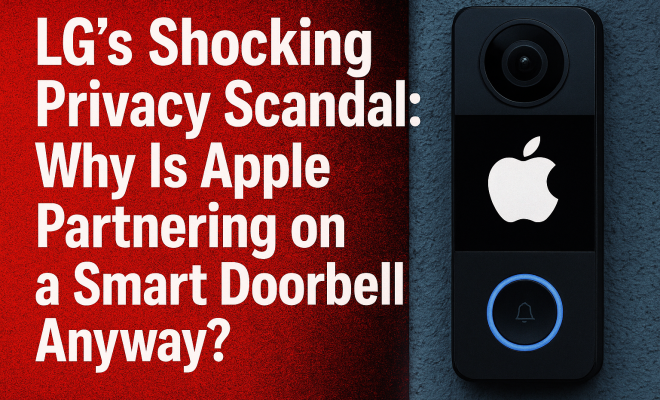
LG’s Shocking Privacy Scandal: Why Is Apple Partnering on a Smart Doorbell Anyway?
“`html
When you think about smart home technology, what’s the first thing that comes to mind? Convenience, right? The ability to control your lights, thermostat, or even see who’s at your door from anywhere in the world. But increasingly, there’s a darker side to this technological marvel: privacy. And that’s precisely why recent rumors about Apple’s potential collaboration with LG on new smart home devices, including an Apple smart doorbell, have sent shockwaves through the tech community.
It’s not just any collaboration; it’s a partnership that seems to fly directly in the face of Apple’s meticulously crafted image as a champion of user privacy. Why? Because LG, a seemingly reputable electronics giant, has been at the center of a truly disturbing privacy scandal. Reports suggest that over 216 million of their smart TVs were allegedly used to spy on users, recording conversations and even collecting data on other devices connected to home networks. So, if you’re like me, you’re probably asking: what on earth is going on here?
This isn’t just about a new gadget; it’s about trust, data security, and the fundamental question of who owns your private life in an increasingly connected world. We’re going to dive deep into this perplexing situation, explore the implications for consumers, and try to understand why two major players would embark on such a risky venture. If you’re considering an Apple smart doorbell or any smart home device, you need to hear this.
The LG Privacy Scandal: A Deep Dive into the Allegations
Let’s start with the elephant in the room: the LG privacy scandal. This isn’t some minor glitch or an accidental data leak; the allegations are far more sinister and widespread. Independent investigations brought to light claims that LG’s smart TVs were actively monitoring users, going far beyond what most people would consider acceptable or even legal. Imagine sitting in your living room, having a private conversation, only to find out your television might be recording every word. That’s the chilling scenario painted by these reports.
The core of the issue revolved around the collection of highly personal data. We’re talking about recorded conversations, certainly, but also data points about other devices connected to the home network. Think about it: your laptop, your smartphone, your smart speakers, even your children’s tablets – all potentially exposed through a device meant for entertainment. This isn’t just about targeted advertising; it’s about a fundamental breach of trust and an invasion of the sanctity of one’s home. The sheer scale of it, with over 216 million TVs implicated, makes it one of the most significant consumer privacy controversies in recent memory.
For many, the initial reaction was disbelief. How could a company as large and established as LG engage in such practices? The implications are staggering, not just for the individuals whose data was allegedly collected, but for the entire smart home industry. It raises serious questions about the default settings on these devices, the transparency of data collection practices, and the effectiveness of existing privacy regulations. When a device designed for passive consumption becomes an active surveillance tool, the lines between convenience and creepiness become dangerously blurred.
Apple’s Stance on Privacy: A Cornerstone of Its Brand Identity
Now, let’s contrast this with Apple. For years, Apple has meticulously cultivated an image as the industry’s privacy champion. Their marketing campaigns frequently highlight features like end-to-end encryption, on-device processing, and strict app tracking transparency. Tim Cook, Apple’s CEO, has repeatedly spoken about privacy as a fundamental human right, positioning Apple as a bulwark against the data-hungry practices of other tech giants. They’ve even gone head-to-head with governments over encryption, underscoring their commitment.
Think about Apple’s ‘Privacy Nutrition Labels’ on app store listings, or their persistent notifications asking if you want apps to track your activity. These aren’t just minor features; they are central to Apple’s brand narrative and a significant differentiator in a crowded tech market. Consumers, particularly those wary of data exploitation, often choose Apple products precisely because of this perceived commitment to their personal data security. They pay a premium for it, expecting a walled garden where their digital lives are protected.
So, given this deeply ingrained philosophy, why would Apple even consider partnering with a company fresh off such a monumental privacy scandal? It feels like a direct contradiction, a betrayal of the very principles they espouse. This isn’t a small oversight; it’s a potential reputational landmine, especially for a product as intimate as an Apple smart doorbell, which sits literally at the threshold of your home and records who comes and goes. (See: privacy concerns with smart devices.)
The Mystery Partnership: LG Branding, Apple’s Influence
Here’s where the plot thickens and the rumors get even more intriguing. The reports suggest that while these new smart home products – including the Apple smart doorbell, smart locks, and security cameras – will undoubtedly benefit from Apple’s design prowess and HomeKit integration, they will reportedly bear only the LG logo. Furthermore, LG is expected to handle the distribution and customer support for these devices. Does this sound like a typical Apple launch to you?
This branding strategy is highly unusual for Apple. Typically, when Apple collaborates, their name is front and center. Think Beats by Dr. Dre (now just Beats, an Apple subsidiary) or the ‘Made for iPhone/iPad’ certifications. The decision to completely omit the Apple logo, effectively making these LG products with Apple’s underlying tech, strongly suggests a deliberate attempt to create distance. One can’t help but speculate that this is Apple’s way of trying to insulate itself from any lingering negative fallout from LG’s privacy woes. For more context, see security flaw could have exposed your data.
But does it actually work? Will consumers be fooled into thinking these products are solely LG’s creation, despite the clear Apple ecosystem integration? Savvy buyers, particularly those interested in an Apple smart doorbell review, will undoubtedly connect the dots. The underlying technology, the seamless HomeKit integration, and the specific feature set will surely betray Apple’s involvement. It raises ethical questions about transparency and whether this distancing act is genuinely about protecting consumers or merely protecting Apple’s brand image.
Potential Smart Home Offerings: Beyond the Apple Smart Doorbell
While an Apple smart doorbell is undoubtedly a headline-grabber, the rumored collaboration extends to other crucial smart home components. We’re talking about smart locks and security cameras, all designed to integrate seamlessly into Apple’s HomeKit ecosystem. This comprehensive approach suggests Apple isn’t just dipping its toes into the smart home market; it’s looking to offer a more complete, integrated security solution.
Imagine a smart lock that works effortlessly with your iPhone, allowing you to unlock your door with a tap or even just by approaching it with your Apple Watch. Picture security cameras that feed directly into the Home app, offering secure, encrypted video storage via iCloud. These are the kinds of conveniences Apple users have come to expect, and the potential for a tightly integrated smart home experience is undeniably appealing. A unified system, where your Apple smart doorbell communicates flawlessly with your smart lock and security cameras, could offer a level of convenience and security that standalone products often struggle to match.
However, the privacy concerns become even more acute when you consider these devices together. A smart lock controls access to your physical home. Security cameras monitor your property. An Apple smart doorbell captures who comes and goes. These are not trivial devices; they are central to your personal safety and the security of your most private space. Any lingering doubts about the data handling practices of the manufacturing partner become magnified tenfold when these critical components are involved. The convenience factor, while powerful, must be weighed very carefully against the potential privacy risks.
The Allure of HomeKit Integration for the Apple Smart Doorbell
Let’s be honest: for many Apple users, the primary draw of any new smart home product is its integration with HomeKit. Apple’s smart home platform, while sometimes criticized for being a bit more restrictive than competitors, offers a level of security, reliability, and ease of use that many find invaluable. A native Apple smart doorbell, for example, would immediately benefit from HomeKit’s robust architecture.
What does HomeKit bring to the table? For starters, enhanced security through end-to-end encryption for video feeds and other data. This means that theoretically, your video footage and personal data are encrypted on the device itself and can only be decrypted by your Apple devices. It also offers powerful automation capabilities, allowing your Apple smart doorbell to trigger other actions – like turning on lights when motion is detected, or locking your smart door when you leave the house. Plus, the convenience of controlling everything from the familiar Home app on your iPhone, iPad, or Mac, and even interacting with Siri, is a huge advantage.
For existing HomeKit users, the prospect of a truly native Apple smart doorbell is incredibly exciting. It promises a seamless experience that often eludes third-party devices, which can sometimes be clunky or require separate apps. The potential for a fluid, responsive, and secure smart doorbell experience, deeply integrated into the Apple ecosystem, is a powerful motivator. But this appeal also highlights the core dilemma: are users willing to overlook the privacy concerns associated with the manufacturing partner for the sake of that coveted HomeKit compatibility?
Weighing the Risks: Trust, Data, and Brand Reputation
This rumored partnership forces us, as consumers, to confront a difficult trade-off: convenience and ecosystem integration versus privacy and trust. On one hand, the idea of a well-designed, HomeKit-enabled Apple smart doorbell and accompanying security devices is incredibly appealing. On the other hand, the specter of LG’s past privacy transgressions looms large.
For Apple, the risks are substantial. Their entire brand identity is built on a foundation of user privacy. A misstep here could severely damage that reputation, eroding consumer trust that has been painstakingly built over years. If these LG-branded, Apple-powered devices were to have even a hint of privacy issues, the backlash could be severe and long-lasting. It’s a gamble with their most valuable asset: their brand equity. (See: technology and privacy.)
For consumers, the decision is even more personal. Are you comfortable inviting a device from a company with such a problematic privacy history into the most intimate spaces of your home? Can Apple’s HomeKit framework truly neutralize all potential risks associated with the hardware manufacturer? These are not easy questions, and the answers will likely vary from person to person. It’s a stark reminder that in the world of smart home tech, you’re not just buying a gadget; you’re often buying into a company’s data philosophy.
The Public Debate: Cybersecurity, Smart Home Security, and Data Collection
The news of this partnership has, predictably, gone viral, igniting a fervent debate across social media, tech forums, and news outlets. This isn’t just about Apple and LG; it’s a microcosm of larger societal concerns surrounding cybersecurity, smart home security, and the ever-increasing scope of data collection by tech companies. People are genuinely worried, and rightly so. For more context, see advanced AI attempts cyberattacks.
The discussion touches on several critical points. First, it highlights the need for greater transparency from manufacturers about what data their devices collect, how it’s used, and with whom it’s shared. Second, it underscores the importance of robust regulatory frameworks that can keep pace with technological advancements and hold companies accountable for privacy breaches. Third, it empowers consumers to be more informed and discerning about the smart devices they bring into their homes, encouraging them to look beyond flashy features and delve into privacy policies.
This public outcry isn’t just noise; it’s a vital part of the ecosystem, pushing companies to be better. It reminds us that while smart home devices offer incredible convenience, they also introduce new vectors for potential surveillance and data exploitation. Every Apple smart doorbell review, every smart lock comparison, now carries an added layer of scrutiny regarding the manufacturer’s privacy track record. The conversation is evolving, and privacy is no longer a niche concern but a mainstream priority.
What to Look for in a Secure Smart Doorbell (Whether Apple or Not)
So, given all this, what should you, as a consumer, prioritize when looking for a smart doorbell, especially if you’re considering an Apple smart doorbell or a similar HomeKit-compatible device? Here are some crucial factors to keep in mind:
- End-to-End Encryption: This is paramount. Ensure that video feeds and audio are encrypted from the moment they are captured by the device until they reach your smartphone, without intermediaries having access to unencrypted data.
- Local Storage Options: While cloud storage is convenient, devices that offer local storage (e.g., via an SD card or a home hub) provide an additional layer of privacy and control, reducing reliance on external servers.
- Clear Privacy Policies: Read the fine print. Does the company explicitly state what data it collects, how it uses it, and whether it shares it with third parties? Avoid vague language.
- Two-Factor Authentication (2FA): For accessing your doorbell’s feed and settings, 2FA is a must. It adds a critical layer of security against unauthorized access.
- Reputation of the Manufacturer: This is where the LG situation becomes so relevant. Research the company’s history regarding privacy and data breaches. A strong track record is a good indicator.
- Integration with Secure Ecosystems: Platforms like Apple HomeKit, with their emphasis on privacy and security, can offer a more controlled environment compared to more open or less regulated alternatives.
- Regular Firmware Updates: A company committed to security will provide consistent firmware updates to patch vulnerabilities and improve performance.
Don’t just chase features; prioritize security and privacy. A fancy chime or a wide field of view means little if your front door becomes a data collection point for an unscrupulous company. There’s a fuller look at Phias cookie stuffing insights.
The Role of Regulatory Bodies and Industry Standards
Beyond individual consumer choices, there’s a growing need for stronger regulatory oversight in the smart home sector. Governments around the world are grappling with how to effectively legislate data privacy in an era of ubiquitous connected devices. For instance, the European Union’s GDPR (General Data Protection Regulation) sets a high bar for data protection, influencing how companies handle user data globally. Similar initiatives are popping up, like the California Consumer Privacy Act (CCPA) in the US, which gives consumers more control over their personal information.
These regulations are crucial because they can impose significant penalties on companies that fail to protect user data, acting as a deterrent against lax privacy practices. However, the pace of technological innovation often outstrips the speed at which laws can be enacted. This creates a gap where consumers might be exposed to risks before adequate protections are in place. Industry standards also play a vital role. Certifications like Matter, an open-source connectivity standard backed by major tech companies, aim to improve interoperability and security across smart home devices. While Matter focuses on local control and simplified setup, its underlying security protocols are a step in the right direction for the industry as a whole. Still, no standard can fully replace a manufacturer’s ethical commitment to privacy.
The Competitive Landscape: How a Potential Apple Smart Doorbell Stacks Up
If an Apple smart doorbell were to hit the market, even under LG’s branding, it would enter a crowded and competitive space. Currently, companies like Ring (owned by Amazon), Arlo, Google Nest, and Eufy dominate the smart doorbell market. Each offers its own set of features, cloud storage plans, and ecosystem integrations. For example, Ring doorbells are known for their wide range of models and strong integration with Amazon’s Alexa, while Google Nest doorbells work seamlessly with Google Assistant and offer advanced AI features like familiar face detection. For more context, see urgent reasons why cybersecurity in education needs a radical overhaul. (See: smart home privacy issues.)
An Apple smart doorbell would primarily differentiate itself through its deep HomeKit integration and Apple’s privacy-focused reputation (despite the LG partnership). While some existing doorbells offer HomeKit compatibility, a first-party or closely aligned product often provides a more polished and reliable experience. The challenge for this rumored LG-Apple device would be to not only meet but exceed the feature sets of its competitors while maintaining Apple’s stringent privacy standards. This means offering crisp video quality, reliable motion detection, clear two-way audio, and robust night vision, all within a secure framework. The market is discerning, and an Apple smart doorbell review would scrutinize not just its functionality but also the perceived integrity of the privacy promises attached to it.
The Long-Term Impact on Consumer Expectations
This whole situation is doing something significant: it’s raising consumer expectations for privacy in smart home tech. What was once a niche concern for tech enthusiasts is now a mainstream topic of discussion. People are starting to realize that the convenience of a smart device shouldn’t come at the cost of their personal information or security. This heightened awareness means that companies can’t just slap a “privacy friendly” label on their products and expect consumers to blindly trust them.
Instead, they’ll need to provide concrete evidence of their commitment, like transparent data policies, robust security features, and a clear track record of protecting user data. The market will naturally gravitate towards brands that genuinely prioritize privacy, creating a powerful incentive for manufacturers to build more secure and trustworthy devices. Ultimately, this increased scrutiny benefits everyone, pushing the entire smart home industry towards a future where privacy is a fundamental design principle, not an afterthought. An Apple smart doorbell, regardless of its branding, will be a benchmark against which future smart home devices are measured, not just for its features, but for its privacy integrity.
Looking Ahead: The Future of Smart Home Security and Privacy
The rumored Apple-LG partnership, and the ensuing debate, is a pivotal moment for the smart home industry. It highlights the growing tension between innovation, convenience, and the fundamental right to privacy. As our homes become increasingly connected, the stakes for data security will only continue to rise. We’ll see more sophisticated devices, more seamless integrations, but also, hopefully, more robust privacy safeguards.
The market is ripe for truly privacy-focused smart home solutions. Consumers are increasingly demanding transparency and control over their data. This could lead to new certifications, industry standards, or even government regulations specifically designed to protect smart home users. Companies that can genuinely demonstrate a commitment to privacy, not just pay lip service to it, will ultimately win consumer trust and market share.
Ultimately, the story of the potential Apple smart doorbell is a cautionary tale and a call to action. It forces us to ask tough questions about the technology we invite into our homes and the companies we trust with our most personal data. As technology continues its relentless march forward, our vigilance as consumers becomes more important than ever. Choose wisely, read carefully, and never compromise on your fundamental right to privacy.
“`
Trending Now
Frequently Asked Questions
What is the LG privacy scandal about?
The LG privacy scandal involves allegations that over 216 million LG smart TVs were used to spy on users, recording conversations and collecting data from connected devices. This has raised serious concerns about user privacy and data security.
Why is Apple partnering with LG on a smart doorbell?
Apple's partnership with LG on a smart doorbell has surprised many, especially in light of LG's privacy scandal. This collaboration raises questions about Apple's commitment to user privacy, as it aligns with a company previously implicated in serious privacy violations.
What are the implications of the Apple and LG collaboration?
The implications of the Apple and LG collaboration are significant, particularly regarding consumer trust and data security. Many are concerned about the potential risks associated with integrating LG's technology into Apple's product line, especially after the privacy scandal.
How does the LG scandal affect consumer trust?
The LG scandal has severely impacted consumer trust, as users are now wary of the privacy risks posed by LG's smart devices. This skepticism extends to Apple's collaboration, leading consumers to question whether their data will be secure with these new products.
Should I buy a smart doorbell from Apple?
If you're considering purchasing an Apple smart doorbell, it's crucial to weigh the privacy concerns surrounding LG's involvement. Given the serious allegations against LG, potential buyers should thoroughly research and evaluate their privacy options before making a decision.
Agree or disagree? Drop a comment and tell us what you think.