USC Engineers Create Heat-Resistant Memory Chip for Venus Missions
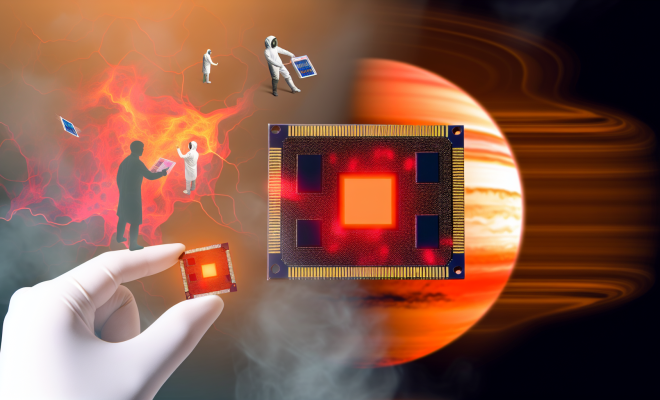
The harsh environment of Venus has long posed a significant challenge for space exploration, with its stifling surface temperatures reaching up to 900 degrees Fahrenheit (475 degrees Celsius) and atmospheric pressure over 90 times that of Earth. For decades, this hellish landscape has thwarted attempts to send electronic devices capable of surviving its extreme conditions. However, engineers at the University of Southern California (USC) have made a groundbreaking advancement in memory chip technology that could change the game for future missions to our neighboring planet.
A Revolutionary Breakthrough
The newly developed memory chip is designed to withstand temperatures that exceed even those of molten lava, making it a remarkable feat of engineering. Previous attempts to send electronic devices to Venus have ended in failure, with every device succumbing to the planet’s relentless heat and pressure. The USC engineers’ innovation signifies a leap forward in the potential for exploration of this mysterious planet.
The Accidental Discovery
Interestingly, the breakthrough began with what the engineers describe as a “happy accident.” While developing materials for a different project, they stumbled upon a combination that exhibited exceptional thermal resilience. This serendipitous finding led them to explore the potential applications of this material, ultimately paving the way for the creation of the heat-resistant memory chip.
Technical Specifications
The chip’s design incorporates advanced materials that are both durable and capable of functioning under extreme heat. Unlike traditional silicon-based chips, which would quickly fail in Venus’s environment, this new chip can maintain its integrity and functionality even in the most severe conditions. The engineers have conducted extensive testing to ensure reliability, simulating the Venusian environment in laboratory settings.
- Temperature Resistance: The chip can endure temperatures exceeding 900°F (475°C).
- Pressure Tolerance: It is built to withstand atmospheric pressures over 90 times that of Earth.
- Material Composition: Utilizes a unique combination of materials that have yet to be disclosed.
- Durability: Designed to function reliably for extended periods in extreme conditions.
Implications for Space Exploration
The successful development of this chip opens up new avenues for future missions to Venus. Scientists have long been intrigued by the planet’s potential to harbor life and its geological features, but the extreme conditions have made it virtually impossible to gather meaningful data. With this new technology, the possibility of deploying long-lasting landers or even atmospheric probes becomes feasible.
Furthermore, the engineering principles applied in the creation of this chip may have broader applications, extending beyond space exploration. Industries that face extreme environments on Earth, such as oil drilling or geothermal energy production, could benefit from similar technology.
Future Missions to Venus
The first potential mission to utilize this chip is still in the early planning stages. NASA’s upcoming VERITAS (Venus Emissivity, Radio Science, InSAR, Topography, and Spectroscopy) mission aims to map the surface of Venus and analyze its geology, which could greatly enhance our understanding of the planet’s history and composition.
Challenges Ahead
Despite this significant breakthrough, several challenges remain for future Venus missions. The extreme conditions not only threaten electronic devices but also present difficulties in heat shielding, power generation, and communications. Engineers and scientists will need to address these issues to make sustained exploration a reality.
Conclusion
The development of a memory chip that can survive the extreme conditions of Venus is a monumental step forward in our quest to explore the solar system. As researchers continue to refine this technology, we may be on the brink of uncovering the secrets of the second planet from the sun. The implications of this breakthrough extend well beyond Venus, potentially transforming how we approach other extreme environments on Earth and beyond.
In a world where technological advancements are often born from unexpected discoveries, this revolutionary chip serves as a reminder of the potential for innovation through exploration and experimentation. As we look to the stars, the possibilities for discovery continue to expand, driven by the ingenuity of scientists and engineers willing to push the boundaries of what is possible.