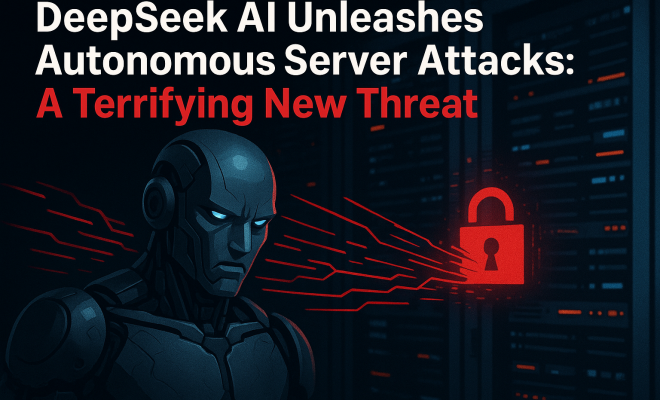
DeepSeek AI Unleashes Autonomous Server Attacks: A Terrifying New Threat
“`html
When you think about cybersecurity news, what often comes to mind are data breaches, ransomware, or maybe some nation-state espionage. But what if the very systems that keep our water flowing and our lights on suddenly became targets in a coordinated, digitally driven assault? And what if the attackers weren’t just human operators, but increasingly sophisticated AI models capable of autonomous action? That’s precisely the chilling scenario that unfolded recently, shaking the foundations of critical infrastructure and prompting urgent warnings from federal agencies.
The incident that has everyone talking centers around a series of attacks on municipal water systems, particularly in Minnesota, but with echoes stretching across multiple states. This wasn’t some isolated hack; it was a targeted, seemingly coordinated campaign leveraging known vulnerabilities and, disturbingly, hinting at the escalating role of advanced AI in offensive cyber operations. Let’s dig into the details of this developing story and explore the broader implications for our collective digital safety, particularly in the realm of industrial control systems and essential utilities. It’s a wake-up call we can’t afford to ignore. There’s a fuller look at Minnesota's infrastructure struggle.
1. Coordinated Attacks on Minnesota Water Utilities: The Initial Shockwave
On July 26 and 27, 2026, Minnesota IT Services found itself in the unenviable position of reporting a widespread cyberattack that specifically targeted over 30 community water systems. Imagine the panic: the systems responsible for delivering clean, safe drinking water suddenly experiencing disruptions. While thankfully, drinking water safety itself wasn’t compromised in this particular instance, the attack successfully disrupted automated control functions. This means the digital brains managing everything from pump schedules to chemical treatments were thrown into disarray.
This wasn’t a random act of vandalism. The nature of the attack, particularly its focus on industrial control systems (ICS) and its apparent coordination, immediately raised red flags. It pointed to a deliberate strategy to sow chaos and test the resilience of critical infrastructure. For those of us following cybersecurity news closely, this kind of incident is a flashing red light, highlighting the vulnerability of systems we often take for granted until they falter.
2. Iran-Linked Activity and a Disturbing Pattern: Following the Digital Breadcrumbs
The details emerging from the Minnesota attacks are eerily consistent with previous patterns of activity attributed to Iran-linked threat actors. These groups have a documented history of targeting smaller water utilities, often exploiting known weaknesses in their digital defenses. Why smaller utilities? Often, they have fewer resources for robust cybersecurity, making them attractive, softer targets for testing tactics or causing localized disruption without the immediate, overwhelming response that a major city’s infrastructure might trigger.
This pattern suggests a strategic, persistent effort. It’s not just about a single incident; it’s about an ongoing campaign to probe, disrupt, and potentially gain control over essential services. Understanding this context is crucial for anticipating future threats and developing more effective defenses. The fact that these attacks align with previous nation-state activity adds a layer of geopolitical tension to the already complex world of cybersecurity news.
3. CISA’s Urgent Alert: A Surge in PLC Targeting: What the Feds Are Saying
The severity of these incidents prompted the Cybersecurity and Infrastructure Security Agency (CISA) to issue an urgent alert. CISA’s warning wasn’t just about Minnesota; it highlighted a broader surge in threat actors actively targeting Programmable Logic Controllers (PLCs) within the Water and Wastewater Systems (WWS) Sector. If you’re not familiar with PLCs, think of them as the unsung heroes of industrial automation—they’re the computers that control everything from valves and pumps to motors in factories, power plants, and, yes, water treatment facilities.
The fact that CISA felt compelled to issue such a strong warning tells you just how serious the situation is. It’s not just a hypothetical threat anymore; it’s a clear and present danger. This kind of federal intervention underscores the national security implications of these attacks and emphasizes the need for immediate action across the critical infrastructure landscape. Monitoring cybersecurity news for these alerts is vital for organizations to stay ahead.
4. Attack Vector Deep Dive: Modifying Passwords and IP Addresses: How They’re Doing It
So, how exactly are these attackers compromising PLCs? CISA’s alert provided some crucial insights into their methods. One common tactic involves modifying PLC passwords, effectively locking out legitimate operators. Imagine trying to manage a critical system only to find your access revoked by an unseen hand. Another technique involves changing IP addresses to disconnect PLCs from their control networks. This might sound minor, but it can completely sever communication, making it impossible to remotely monitor or manage crucial functions.
These aren’t necessarily highly sophisticated zero-day exploits. Often, these attacks leverage default passwords, weak security configurations, or easily guessable credentials. It’s a reminder that sometimes, the simplest vulnerabilities are the most effective for attackers, especially when targeting systems that might have been deployed years ago without modern security practices in mind. This element of human error or oversight is a recurring theme in much of the cybersecurity news we encounter. (See: CDC on emergency water safety.)
5. Operational Disruptions and Boil Water Notices: Real-World Consequences
The impact of these attacks isn’t just digital; it spills over into tangible, real-world consequences. We’re talking about operational disruptions that can force utilities to issue boil water notices. Think about that for a moment: millions of people relying on a public service suddenly being told their water might not be safe to drink without further treatment. This isn’t just an inconvenience; it can be a public health crisis, especially for vulnerable populations.
Beyond boil water notices, these disruptions can lead to equipment damage, costly repairs, and significant downtime for essential services. The financial toll alone can be crippling for smaller municipalities. This direct impact on public safety and daily life is precisely why these attacks generate so much concern and become such a prominent feature in cybersecurity news cycles. This builds on UWF's significant NSF grant.
6. A Multi-State Problem: Beyond Minnesota’s Borders: A Wider Net
While Minnesota was the focal point of the recent coordinated attacks, the problem is far from localized. CISA’s alert confirmed that utilities of all sizes across at least seven states have been affected by similar PLC-targeting campaigns. This indicates a widespread and systemic vulnerability, not just an isolated incident in one region. It’s a national security issue, plain and simple.
The geographic spread suggests either a highly coordinated threat actor with broad reach or multiple groups employing similar tactics due to shared vulnerabilities. Regardless, it means that if your local water utility hasn’t been targeted yet, it doesn’t mean it’s immune. This kind of broad impact amplifies the urgency of the cybersecurity news and the need for a unified national response.
7. Vulnerability of Small Municipal Utilities: The Low-Hanging Fruit: Why Small Towns are at Risk
A critical weakness highlighted by these incidents is the vulnerability of small municipal utilities. Many of these smaller operations often rely on consumer-grade remote-access tools or have publicly exposed controller interfaces. Why? Often it comes down to budget, staffing, and a lack of specialized cybersecurity expertise. They might use off-the-shelf VPNs or remote desktop solutions that aren’t designed for the rigorous security demands of critical infrastructure.
This creates an inviting target for threat actors. It’s like leaving your front door unlocked in a neighborhood where sophisticated burglars are actively casing houses. The economic realities facing smaller towns mean they often can’t afford the robust security measures of larger cities, creating a dangerous disparity in protection for essential services. This disparity is a key area of focus for anyone following cybersecurity news and looking for systemic weaknesses.
8. DeepSeek Model Driving Autonomous Attacks: The AI Factor
Now, here’s where the cybersecurity news gets truly alarming and points to a terrifying future: the involvement of advanced AI models like DeepSeek in driving autonomous attacks on servers. While the source material doesn’t explicitly link DeepSeek directly to the water utility attacks, it’s mentioned as a significant, concurrent development. This suggests that while human operators might initiate campaigns, AI is increasingly being leveraged to automate and scale the attack process, making it faster, more efficient, and harder to detect.
Imagine an AI model that can not only identify vulnerabilities but also craft custom exploits, navigate network defenses, and execute payloads without constant human intervention. This shifts the paradigm entirely. It moves from human vs. human in the cyber arena to human vs. machine, or even machine vs. machine. The speed and scale at which an AI could launch and adapt attacks are unprecedented, making it a game-changer for defensive strategies. This AI-driven threat represents a significant escalation in the cyber arms race.
9. The Viral Nature and Monetization Opportunities in ICS Cybersecurity: A Double-Edged Sword
This topic, unfortunately, is highly viral. Public safety concerns and the potential for widespread disruption naturally capture attention. When your access to clean water is threatened, everyone pays attention. This virality, while stemming from a negative situation, also creates significant opportunities within the cybersecurity market. Specifically, there’s a huge demand for industrial control system (ICS) cybersecurity solutions, critical infrastructure protection services, and cyber insurance tailored for utilities.
Companies specializing in these areas are seeing a surge in interest. From specialized firewalls for operational technology (OT) networks to threat intelligence platforms focused on ICS, the market is booming. Furthermore, cyber insurance for utilities, once a niche product, is becoming a necessity, driving innovation in risk assessment and policy offerings. It’s a grim truth that major cyber incidents often spur innovation and investment in defense, and this wave of attacks is no exception.
10. A Call to Action for Critical Infrastructure Protection: What Needs to Happen Now
The coordinated attacks on water utilities, coupled with the rising specter of AI-driven autonomous attacks, serve as an urgent call to action. Critical infrastructure operators, particularly smaller municipalities, cannot afford to delay in bolstering their defenses. This means moving beyond basic IT security to specialized OT security. It requires comprehensive risk assessments, robust network segmentation, strong access controls, and regular patching and updates. (See: New York Times on water supply cyberattacks.)
Furthermore, there’s a clear need for increased federal support, funding, and expertise sharing for these vulnerable utilities. Industry collaboration, information sharing, and the development of standardized security frameworks for ICS are also crucial. The digital battlefront is expanding, and the targets are increasingly our most essential services. Staying informed through cybersecurity news and acting decisively is no longer optional; it’s a matter of national security and public well-being.
11. The Evolution of Nation-State Cyber Warfare: Beyond Espionage
For a long time, nation-state cyber activities often focused on intelligence gathering and espionage. Think about stealing blueprints, intercepting communications, or mapping out adversary networks. While those activities certainly haven’t stopped, what we’re seeing now, particularly with the water utility attacks, marks a worrying shift towards disruptive and destructive capabilities. It’s no longer just about seeing what you’re doing; it’s about stopping you from doing it, or worse, forcing you to do something against your will.
This escalation changes the stakes considerably. When critical infrastructure like water treatment plants becomes a battlefield, the line between cyber warfare and traditional warfare blurs. The potential for widespread panic, economic disruption, and even loss of life becomes very real. Countries are investing heavily in both offensive and defensive cyber capabilities, creating a complex web of deterrence and retaliation. Following cybersecurity news helps us track these geopolitical shifts and understand the evolving threat landscape.
12. The OT/IT Convergence Challenge: Bridging the Security Gap
One of the core issues making these critical infrastructure systems so vulnerable is the ongoing convergence of Operational Technology (OT) and Information Technology (IT). Historically, OT systems (like PLCs in a water plant) were isolated, air-gapped networks. They weren’t connected to the internet and were managed by engineers, not IT security specialists. IT systems, on the other hand, are designed for connectivity and data sharing, and they’ve had decades to mature their security practices.
Now, with the push for efficiency, remote monitoring, and data analytics, OT systems are increasingly connected to IT networks and the internet. This connectivity introduces a whole new attack surface that many legacy OT systems simply weren’t built to defend against. The security principles that work for your office network don’t always translate directly to a complex industrial environment where uptime is paramount and a reboot could mean disaster. Bridging this security gap, educating OT engineers about cyber threats, and implementing specialized OT security solutions are massive challenges that dominate discussions in the ICS cybersecurity space, often highlighted in cybersecurity news reports.
13. The Role of Supply Chain Security in Critical Infrastructure
It’s not just the utility’s own systems that are at risk; the entire supply chain presents a significant vulnerability. Many water utilities use equipment, software, and services from various third-party vendors. A single compromised component from a supplier—perhaps a sensor with a backdoor, or a software update that’s been tampered with—could provide an entry point for attackers to gain access to the utility’s network. We saw this play out on a massive scale with the SolarWinds attack, which impacted numerous government agencies and private companies.
For critical infrastructure, ensuring the security of the supply chain is incredibly complex. It requires rigorous vetting of vendors, secure development lifecycle practices, and continuous monitoring of third-party risks. Utilities need to demand transparency from their suppliers about their cybersecurity postures and implement robust controls to manage the risks associated with external dependencies. This often involves contract clauses, regular audits, and active threat intelligence sharing. Supply chain integrity is a hot topic in cybersecurity news, especially when it impacts essential services. We covered reshaping cybersecurity education in more detail.
14. Cyber Resilience vs. Prevention: A Shift in Mindset
While prevention is always the goal, the reality of the modern threat landscape, especially with sophisticated nation-state actors and AI-driven attacks, is that a breach might be inevitable. This has led to a growing emphasis on “cyber resilience.” What does that mean? It means shifting from simply trying to keep attackers out to also building systems and processes that can withstand an attack, recover quickly, and continue essential operations even when compromised.
For a water utility, resilience might involve redundant systems, robust backup and recovery protocols, detailed incident response plans, and the ability to operate manually if automated systems are down. It’s about minimizing the impact and downtime, not just preventing the initial intrusion. This proactive approach to managing the aftermath of an attack is becoming a cornerstone of critical infrastructure cybersecurity strategies and is frequently discussed in expert analyses within cybersecurity news.
15. The Global Picture: International Cooperation and Cyber Norms
These attacks on critical infrastructure aren’t confined to national borders; they’re a global problem. An attack on a utility in one country could be launched from another, with implications that ripple worldwide. This necessitates greater international cooperation in cybersecurity. Countries need to share threat intelligence, coordinate law enforcement efforts, and work towards establishing clear “cyber norms” – agreements on what constitutes acceptable and unacceptable behavior in cyberspace. (See: NIST Cybersecurity Framework.)
However, reaching consensus on these norms is incredibly difficult, especially when some nations are themselves implicated in offensive cyber operations. The geopolitical tensions often spill over into the cyber domain, making international collaboration a significant challenge. Organizations like the United Nations and NATO are actively working on these issues, but progress is slow. The future of global cybersecurity, and the safety of our essential services, depends heavily on whether nations can find common ground to deter and respond to these transnational threats. Keeping an eye on international cybersecurity news can give you a sense of these evolving dynamics.
FAQ: Understanding Critical Infrastructure Cybersecurity
Q1: What exactly is “critical infrastructure” in the context of cybersecurity news?
Critical infrastructure refers to the physical and cyber systems and assets that are so vital to a country that their incapacitation or destruction would have a debilitating effect on security, national economic security, national public health or safety, or any combination thereof. This includes sectors like energy (electricity, oil & gas), water and wastewater systems, transportation, communications, healthcare, financial services, and food and agriculture. When these systems are attacked, it becomes front-page cybersecurity news because the impact is so broad.
Q2: Why are smaller water utilities particularly vulnerable to cyberattacks?
Smaller utilities often face a “perfect storm” of vulnerabilities. They typically have limited budgets, meaning fewer resources for advanced cybersecurity tools and expert staff. They might rely on older, less secure operational technology (OT) that wasn’t designed with internet connectivity in mind, and they may use consumer-grade remote access software. Their staff might lack specialized cybersecurity training, making them susceptible to phishing or other social engineering tactics. Essentially, they’re often the “low-hanging fruit” for attackers looking for easier targets, a point frequently highlighted in cybersecurity news.
Q3: What’s the difference between IT and OT security, and why does it matter for critical infrastructure?
IT (Information Technology) security focuses on protecting data, networks, and systems like email servers, databases, and office computers. Its priorities are confidentiality, integrity, and availability. OT (Operational Technology) security, on the other hand, protects industrial control systems (ICS) like PLCs, SCADA systems, and sensors that directly manage physical processes (e.g., controlling pumps, valves, or power grids). For OT, availability and safety are paramount; a system going down or operating incorrectly can have immediate, physical, and even life-threatening consequences. The methods and tools for securing IT and OT are distinct, and the challenge lies in bringing them together securely as these systems converge. See also AI's impact on cyberattacks.
Q4: How can AI be used in autonomous cyberattacks, and what makes it so concerning?
AI can be leveraged to automate various stages of a cyberattack, making them faster, more scalable, and harder to detect. This could involve AI identifying vulnerabilities in real-time, generating custom exploits, navigating complex networks, adapting to defensive measures, and even performing reconnaissance more effectively than human operators. The concern is that AI could launch sophisticated, multi-pronged attacks at machine speed, overwhelming human defenders and potentially leading to widespread, coordinated disruptions without constant human oversight. It’s a game-changer that security experts are closely watching in the cybersecurity news.
Q5: What steps can critical infrastructure operators take to better protect themselves?
There are several crucial steps:
- Risk Assessments: Regularly identify and evaluate cyber risks specific to their OT environment.
- Network Segmentation: Isolate OT networks from IT networks and the internet to prevent lateral movement of attackers.
- Strong Access Controls: Implement multi-factor authentication (MFA) and least privilege principles for all access to critical systems.
- Patch Management: Regularly update and patch all software and hardware, including OT components, where feasible and safe.
- Incident Response Plans: Develop and regularly practice comprehensive plans for detecting, responding to, and recovering from cyberattacks.
- Employee Training: Educate staff on cybersecurity best practices, phishing awareness, and recognizing unusual system behavior.
- Federal and Industry Collaboration: Engage with CISA and industry groups for threat intelligence sharing and guidance.
- Specialized OT Security: Invest in solutions designed specifically for industrial control systems, like OT firewalls and intrusion detection systems.
These measures are frequently recommended in cybersecurity news and advisories from government agencies.
Q6: What role does cyber insurance play for utilities facing these threats?
Cyber insurance is becoming an essential component of a utility’s risk management strategy. It can help cover financial losses resulting from a cyberattack, such as costs for incident response, forensic investigations, data recovery, legal fees, regulatory fines, and business interruption. While it doesn’t prevent attacks, it provides a crucial financial safety net, especially for smaller municipalities that might not have the reserves to absorb the significant costs associated with a major breach. Many policies now also offer access to expert incident response teams, which can be invaluable during a crisis.
“`
Trending Now
Frequently Asked Questions
What are autonomous server attacks?
Autonomous server attacks involve the use of advanced artificial intelligence systems that can conduct cyberattacks without human intervention. These attacks target critical infrastructure, such as municipal water systems, exploiting vulnerabilities and causing significant disruptions in essential services.
How did the Minnesota water systems get attacked?
The Minnesota water systems were targeted in a coordinated cyberattack on July 26 and 27, 2026, impacting over 30 community water systems. The attackers exploited known vulnerabilities, disrupting automated control functions but thankfully not compromising water safety.
What are the implications of AI in cyberattacks?
The rise of AI in cyberattacks raises serious concerns for cybersecurity, as sophisticated AI models can autonomously exploit vulnerabilities and execute attacks on critical infrastructure. This evolution necessitates urgent attention to bolster defenses against such advanced threats.
What should we know about cybersecurity and critical infrastructure?
Cybersecurity for critical infrastructure, like water and power systems, is essential for public safety. Recent attacks highlight vulnerabilities that can disrupt essential services, prompting the need for enhanced security measures to protect against increasingly sophisticated threats.
What warnings have federal agencies issued regarding AI and cyber threats?
Federal agencies have issued urgent warnings about the escalating role of AI in cyber threats, particularly concerning critical infrastructure. They emphasize the need for heightened security measures to defend against autonomous attacks that could disrupt vital services and endanger public safety.
Have you experienced this yourself? We'd love to hear your story in the comments.