Billionaires’ Climate Loophole: Why the Global Tax Treaty Draft Is a Betrayal
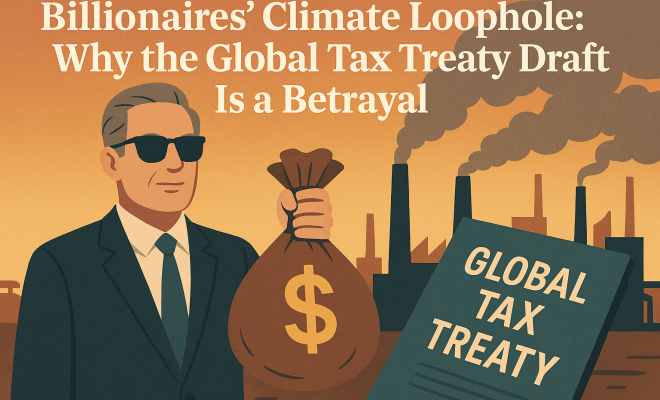
Imagine a world where the biggest polluters and the wealthiest individuals, those most responsible for accelerating our climate crisis, could easily sidestep their financial obligations to fix the mess. Sounds pretty infuriating, right? Well, that’s precisely the concern brewing around the latest draft of the UN Framework Convention on International Tax Cooperation, often dubbed the ‘global tax treaty.’ As the fifth round of negotiations kicked off on August 3, 2026, a loud and clear alarm bell was rung by Greenpeace International, accusing the current proposal of being a massive missed opportunity – a betrayal, some might say – that lets the super-rich and environmentally destructive corporations off the hook.
This isn’t just about technical tax jargon; it’s about fundamental fairness. It’s about whether we, as a global society, are truly committed to tackling the intertwined crises of climate change, nature degradation, and staggering inequality. The controversy has, predictably, exploded across social media. Activists and advocacy groups are demanding stronger, more robust global tax rules that would not only ensure fair contributions from the wealthiest but also actively disincentivize investments in industries that continue to pump out emissions and destroy our planet. This isn’t just a dry policy debate; it’s deeply emotional, connecting the dots between climate justice and economic disparity, and sparking vital discussions about corporate responsibility on a global scale. Let’s dig into why this global tax treaty draft is causing such a stir.
1. The Missed Trillions: A Failure to Fund Climate Action
Greenpeace’s primary criticism zeroes in on the sheer volume of potential revenue being left on the table. We’re talking about trillions within reach, funds that could be channeled directly into climate mitigation, adaptation, and nature restoration efforts. The current draft of the global tax treaty, according to critics, simply doesn’t contain the teeth necessary to ensure these funds are collected. It’s like having a leaky bucket when you desperately need to put out a fire.
Think about the sheer scale of the climate crisis: rising sea levels, extreme weather events, biodiversity loss. Each of these demands significant financial investment to address. Developing nations, often the hardest hit by climate impacts despite contributing the least to historical emissions, are in dire need of financial support. A truly effective global tax treaty could be a game-changer, providing a stable, substantial funding mechanism. Instead, what we have is a draft that appears to prioritize accommodating existing financial structures over generating urgently needed revenue for global good.
1.1 The Economic Impact of Climate Inaction
The cost of inaction on climate change is staggering, dwarfing even the trillions proposed by a robust global tax treaty. The World Economic Forum, for example, has estimated that climate change could cost the global economy over $178 trillion by 2070 if current warming trends continue. This isn’t just about future projections; we’re already seeing the economic fallout from extreme weather events. In 2023 alone, major climate disasters caused over $250 billion in damages worldwide. These figures represent destroyed infrastructure, lost agricultural output, disrupted supply chains, and enormous human suffering. If we could recoup even a fraction of the missed tax revenue from corporations and the super-rich, it could be strategically deployed to build resilience, innovate green technologies, and support communities on the front lines of climate change. The global tax treaty isn’t just about fairness; it’s about smart economics and preventing even larger financial catastrophes down the road.
2. Corporate Polluters: A License to Evade?
One of the most damning accusations leveled against the proposed global tax treaty is its alleged leniency towards corporate polluters. For years, multinational corporations have employed sophisticated strategies to minimize their tax liabilities, often exploiting loopholes across different national jurisdictions. When these corporations are also the primary drivers of environmental destruction, the problem compounds dramatically.
Greenpeace argues that the draft text maintains significant gaps that allow these environmentally destructive industries to continue their practices without bearing their fair share of the societal and environmental costs. This isn’t just about lost tax revenue; it’s about a perverse incentive structure. If polluting remains financially advantageous, where’s the motivation to transition to cleaner, more sustainable practices? A strong global tax treaty should, by design, make it more expensive and less attractive to engage in environmentally harmful activities.
2.1 The Shell Game of Corporate Tax Avoidance
To understand the depth of this issue, let’s consider how corporate tax avoidance often works. Multinational corporations, especially those in resource-intensive or polluting sectors, can shift profits from high-tax jurisdictions where real economic activity (like mining or manufacturing) occurs, to low-tax or no-tax havens where only a shell company exists. This is done through complex internal accounting tricks, such as charging exorbitant fees for intellectual property or management services between subsidiaries, or by strategically locating their headquarters in tax-friendly locales. The result is that the profits generated from environmentally destructive activities in one country are taxed minimally, if at all, in another. This “shell game” effectively allows polluters to externalize their environmental costs onto society while minimizing their financial contributions to the very governments struggling to mitigate those costs. A truly effective global tax treaty would implement mechanisms like unitary taxation or a global minimum corporate tax rate that applies to consolidated profits, making it much harder for companies to play these jurisdictional games.
3. The Super-Rich: Shielding Wealth from Responsibility
It’s not just corporations; the super-rich are also a significant part of this equation. Wealthy individuals, often with complex financial arrangements spanning multiple countries, have long been adept at minimizing their tax burdens. This isn’t necessarily illegal, but it certainly raises ethical questions when juxtaposed with the immense societal challenges we face. mass migration and climate impact offers useful background here.
The global tax treaty, in its current form, is seen by many as failing to adequately address the mechanisms by which these individuals shield their wealth from taxation. This perpetuates a cycle where the burden of funding public services and addressing global crises falls disproportionately on ordinary citizens, while those at the very top contribute comparatively less. It’s a fundamental issue of equity and social contract, one that the current draft seems to largely sidestep, much to the frustration of activist groups.
3.1 The Offshore Labyrinth and Wealth Inequality
The wealth of the super-rich is frequently hidden within an intricate global network of trusts, foundations, and offshore accounts. Panama Papers, Paradise Papers, and Pandora Papers investigations have repeatedly exposed the scale of this hidden wealth. Estimates suggest that hundreds of billions, possibly trillions, of dollars belonging to the ultra-wealthy are held offshore, largely untaxed. This isn’t just about avoiding taxes; it’s about a system that allows extreme wealth to accumulate and insulate itself from societal obligations, creating a widening chasm of inequality. When wealth is concentrated at the top and untaxed, it means less funding for education, healthcare, infrastructure, and crucial environmental protection programs that benefit everyone. A global tax treaty needs provisions for greater transparency, automatic exchange of information between tax authorities, and potentially a global wealth tax or a minimum tax on high-net-worth individuals to truly tackle this issue. Without such measures, the current system risks undermining democracy and exacerbating social unrest. (See: CDC's Climate and Health Program.)
4. Hindering the Fight Against Multiple Crises
The implications of a weak global tax treaty extend far beyond just tax collection. Greenpeace highlights how the current text hinders efforts to combat not just the climate crisis, but also the nature crisis and deepening inequality. These aren’t isolated problems; they’re deeply interconnected, a complex web of challenges that demand a holistic approach.
Consider how a lack of funding impacts conservation efforts, or how economic inequality can exacerbate vulnerabilities to climate change. When governments lack the resources to invest in sustainable development, social safety nets, or environmental protection, all three crises worsen. A robust global tax treaty could provide the foundational financial stability needed for countries to implement comprehensive strategies, making it a pivotal instrument in addressing these multifaceted global challenges.
4.1 The Nexus of Crises: Interdependence and Amplification
It’s crucial to understand how these crises amplify each other. Take, for example, deforestation. A lack of government funding (due to tax avoidance) can weaken environmental protection agencies, making it easier for illegal logging or unsustainable agricultural expansion to occur. This deforestation not only releases significant carbon emissions (contributing to climate change) but also destroys biodiversity (the nature crisis) and often displaces indigenous communities, pushing them into further poverty (exacerbating inequality). Similarly, extreme weather events fueled by climate change disproportionately impact low-income communities and developing nations, who have fewer resources to rebuild or adapt, deepening existing inequalities. A global tax treaty that generates substantial, reliable revenue could fund initiatives at this nexus: sustainable land management, renewable energy access in vulnerable communities, and social safety nets that build resilience against environmental shocks. Ignoring these interdependencies is like trying to fix a complex machine by only looking at one broken part.
5. The Viral Outcry: Social Media as a Catalyst
In our hyper-connected world, complex policy debates rarely stay confined to diplomatic meeting rooms. The controversy surrounding this global tax treaty has become a viral sensation, particularly across social media platforms. Environmental activists, climate justice advocates, and anti-inequality groups have seized upon the issue, using hashtags and campaigns to amplify their demands.
This widespread engagement isn’t accidental; it’s fueled by the potent emotional charge of the topic. People inherently understand the unfairness of a system where the planet is burning, yet those who profited most from its destruction are not being asked to contribute their fair share to the solution. This public pressure is crucial, as it pushes the debate out of niche policy circles and into mainstream discourse, forcing negotiators to consider the broader public sentiment and the implications of their decisions.
5.1 The Power of Digital Advocacy and Shifting Narratives
Social media platforms like X (formerly Twitter), Instagram, and TikTok have transformed advocacy. What once took months of traditional lobbying and media outreach can now explode into public consciousness overnight. Hashtags like #GlobalTaxJustice and #PollutersPay allow diverse groups to coalesce around a common message, sharing infographics, personal stories, and calls to action. This digital activism is vital for several reasons: it democratizes access to information, bypasses traditional media gatekeepers, and creates a sense of collective power. When thousands, or even millions, of voices demand change, it becomes harder for policymakers to ignore. This isn’t just about making noise; it’s about shifting the narrative, demonstrating broad public support for bolder action, and holding decision-makers accountable in real-time. The viral outcry ensures that the global tax treaty negotiations aren’t just an elite discussion, but a topic of genuine public concern and scrutiny.
6. Demands for Stronger Global Tax Rules
What exactly are these activist groups demanding? It’s not just about vague criticisms; there are concrete proposals for strengthening the global tax treaty. At its core, the call is for truly binding international rules that prevent profit shifting, close tax havens, and ensure that multinational corporations and the super-rich pay taxes where economic activity and wealth creation actually occur.
Specifically, advocates are pushing for mechanisms that disincentivize investments in fossil fuels and other polluting industries. This could involve higher taxes on carbon-intensive activities, or a ‘polluter pays’ principle that is genuinely enforceable across borders. They also want to see greater transparency in corporate financial reporting and stronger enforcement mechanisms to hold wealthy polluters accountable, ensuring that the global tax treaty isn’t just a set of suggestions, but a framework with real teeth.
6.1 Specific Policy Mechanisms for a Robust Treaty
To give the global tax treaty real teeth, advocates are pushing for several key policy mechanisms. Firstly, they demand a global minimum corporate tax rate that genuinely applies to the consolidated profits of multinational corporations, not just a carve-out that allows for continued profit shifting. This would effectively end the “race to the bottom” in corporate taxation. Secondly, they call for enhanced country-by-country reporting, making it mandatory for companies to disclose their profits, taxes paid, and economic activities in every jurisdiction where they operate. This transparency is crucial for identifying profit-shifting schemes. Thirdly, there’s a strong push for a robust framework to tackle individual wealth hiding, including a global asset register and stricter penalties for financial institutions facilitating tax evasion. Fourthly, specific environmental taxes, like a global carbon tax or a tax on fossil fuel extraction, could be integrated, with revenues earmarked for climate and nature solutions. Finally, a truly independent and well-resourced UN tax body, rather than relying solely on OECD frameworks which tend to favor wealthier nations, is seen as essential for equitable global tax governance.
7. Connecting Climate Justice with Economic Inequality
Perhaps the most powerful aspect of this debate is how it inextricably links climate justice with economic inequality. For too long, these issues have often been discussed in separate silos. However, the global tax treaty negotiations are forcing a recognition that they are two sides of the same coin.
Climate change disproportionately affects the poorest and most vulnerable communities, who have contributed the least to the problem. Meanwhile, the wealthiest individuals and corporations often benefit from systems that exacerbate both climate change and economic disparity. A truly progressive global tax treaty would not only fund climate action but also help to rebalance global wealth, creating a more just and resilient world for everyone. It’s about recognizing that you can’t solve one crisis without addressing the other, and that the financial architecture of our world plays a critical role in both.
7.1 Historical Responsibility and Reparations
The concept of climate justice extends deeply into historical responsibility. Developed nations, having industrialized earlier, have historically contributed the most greenhouse gas emissions. Many developing nations, often former colonies, are now bearing the brunt of climate impacts – droughts, floods, sea-level rise – despite having contributed minimally to the problem. This historical context makes the demand for a fair global tax treaty even more urgent. It’s not just about future funding; it’s about a form of climate reparations, recognizing that those who profited most from carbon-intensive development have a moral and ethical obligation to help those suffering the consequences. A global tax treaty, by raising substantial revenue from those historically responsible, could directly fund loss and damage mechanisms, adaptation projects, and technology transfer to developing countries, thereby addressing both current and historical injustices.
8. The High-Stakes Investment Landscape: Sustainable vs. Fossil Fuels
The conversation around the global tax treaty also has significant implications for the investment world. For those in the high-CPC niches of investing, particularly sustainable finance versus fossil fuels, this treaty represents a potential pivot point. If robust global tax rules are implemented, they could fundamentally alter the financial calculus for investors.
Imagine a scenario where polluting industries face significantly higher tax burdens or where carbon emissions are priced into their operations globally. This would naturally make investments in sustainable and green technologies far more attractive, accelerating the transition away from fossil fuels. Conversely, a weak global tax treaty allows the status quo to persist, inadvertently subsidizing environmentally destructive practices through tax avoidance. This isn’t just about ethics; it’s about the cold, hard numbers that drive investment decisions, and the treaty has the power to shift those numbers dramatically.
8.1 De-risking Green Investments and Stranded Assets
A strong global tax treaty can de-risk green investments in two ways. Firstly, by making polluting industries less profitable through higher taxes, it reduces their competitive advantage, making clean energy and sustainable solutions comparatively more attractive. This encourages capital flow into renewable energy, sustainable agriculture, and circular economy initiatives. Secondly, by signaling a global commitment to addressing climate change, it creates policy certainty that investors crave. This stability can unlock massive private sector investment in the green economy. Conversely, a weak treaty perpetuates the risk of “stranded assets” for fossil fuel companies. If global policies eventually force a rapid decarbonization, fossil fuel reserves and infrastructure could become worthless, leaving investors with significant losses. A strong global tax treaty accelerates the inevitable transition, helping investors avoid these future pitfalls and instead allocate capital towards truly future-proof industries.
9. Corporate Sustainability and ESG Reporting: A New Era?
For businesses, particularly in the B2B SaaS sector dealing with ESG (Environmental, Social, and Governance) reporting and carbon accounting, a strong global tax treaty could usher in a new era of corporate sustainability. Currently, many companies engage in ESG reporting as a voluntary measure, often driven by investor demand or reputational concerns. However, if global tax rules begin to penalize polluters or reward sustainable practices, ESG performance moves from a ‘nice-to-have’ to a ‘must-have’ with direct financial implications.
This could spur innovation in carbon accounting technologies, demand for robust ESG reporting platforms, and a genuine shift in corporate strategy towards environmental responsibility. Companies that proactively adapt to such a framework would likely gain a competitive advantage, while those clinging to old, polluting models might find themselves increasingly isolated and financially disadvantaged. The global tax treaty, therefore, isn’t just a tax document; it’s a potential catalyst for a more sustainable business landscape, driven by tangible financial incentives and penalties.
9.1 The Evolution of ESG from Disclosure to Impact
The global tax treaty has the potential to push ESG reporting beyond mere disclosure and towards tangible impact. Currently, many companies report on their ESG metrics, but these often lack direct financial consequences if performance is poor. A treaty that links tax liabilities to environmental impact – for example, a higher tax rate for companies with poor carbon intensity or a lower rate for those investing heavily in sustainable practices – would fundamentally change the game. This would create a powerful incentive for companies to not just report their emissions, but actively reduce them. For the B2B SaaS sector, this translates into a booming market for advanced carbon accounting software, supply chain transparency tools, and impact measurement platforms. Companies wouldn’t just be tracking their ESG for investors; they’d be optimizing it for their bottom line. This shift could accelerate the development of innovative green technologies and business models, driving real-world environmental improvements.
10. Geopolitical Dynamics and Sovereignty Concerns
The negotiations around a global tax treaty are not just about economics; they are deeply intertwined with geopolitical dynamics and concerns about national sovereignty. Many nations, particularly those with existing low-tax regimes or those heavily reliant on attracting foreign investment through tax incentives, are wary of ceding control over their tax policies to an international body. This tension is a major hurdle in reaching a truly comprehensive and binding agreement.
Wealthier nations, often home to the parent companies of multinationals, have historically preferred softer, non-binding agreements or frameworks developed within forums like the OECD, where their influence is stronger. Developing nations, on the other hand, advocate for a UN-led process, believing it offers a more equitable platform for negotiating rules that truly benefit all countries, particularly those losing significant revenue to tax avoidance. Balancing these competing interests – the desire for national fiscal autonomy versus the need for global cooperation to solve global problems – is arguably the biggest challenge facing the global tax treaty negotiations. It requires a willingness to compromise and a recognition that collective action can yield greater benefits than isolated national policies.
11. The Role of International Institutions and Civil Society
The global tax treaty negotiations highlight the evolving roles of international institutions and civil society. While the UN is hosting these discussions, the influence of existing bodies like the OECD (Organisation for Economic Co-operation and Development) remains significant. The OECD has historically been the primary forum for international tax policy discussions, but its frameworks have often been criticized for not adequately addressing the needs and perspectives of developing countries.
This is where civil society organizations, think tanks, and advocacy groups become critical. Groups like Greenpeace, Oxfam, and the Tax Justice Network are not just critics; they are active participants, providing alternative policy proposals, conducting research to expose tax abuses, and mobilizing public support. They act as watchdogs, ensuring that the voices of the most vulnerable are heard and that the discussions don’t become solely driven by powerful states and corporate lobbyists. Their sustained pressure helps to legitimize the push for a truly inclusive and equitable global tax framework, moving beyond the traditional confines of inter-governmental diplomacy.
Frequently Asked Questions About the Global Tax Treaty
What exactly is the “global tax treaty”?
The “global tax treaty” is the informal name for the UN Framework Convention on International Tax Cooperation. It’s a proposed international agreement aiming to establish common rules for how countries tax multinational corporations and wealthy individuals, with the goal of preventing tax avoidance and ensuring fair contributions to public funds globally.
Why is Greenpeace calling it a “missed opportunity” or “betrayal”?
Greenpeace argues the current draft of the treaty is too weak. They say it lacks the strong, binding mechanisms needed to effectively collect trillions in potential tax revenue from corporate polluters and the super-rich. This missed revenue could otherwise fund crucial climate action, nature restoration, and poverty reduction efforts, making the draft a failure to address pressing global crises.
How does a global tax treaty relate to climate change?
A robust global tax treaty can combat climate change by generating significant revenue that can be earmarked for climate mitigation, adaptation, and biodiversity protection. It can also disincentivize environmentally destructive activities by making polluting industries pay their fair share, thus shifting financial incentives towards sustainable practices and green investments.
What is “profit shifting,” and why is it a problem?
Profit shifting is a strategy used by multinational corporations to move their taxable profits from high-tax countries (where their actual economic activity occurs) to low-tax or no-tax jurisdictions (tax havens) through accounting maneuvers. This reduces their overall tax bill, depriving governments of revenue needed for public services and making it harder to fund climate action or social programs.
Will this treaty affect ordinary citizens?
While the treaty primarily targets multinational corporations and the super-rich, its success would indirectly benefit ordinary citizens. By ensuring fair taxation, governments would have more resources to invest in public services, infrastructure, education, healthcare, and climate resilience, alleviating the burden that often falls disproportionately on average taxpayers.
What are “tax havens,” and how would the treaty address them?
Tax havens are countries or jurisdictions that offer very low or no corporate and individual taxes, often with strict financial secrecy laws. A strong global tax treaty would aim to address them through measures like a global minimum corporate tax, enhanced transparency (e.g., country-by-country reporting), and automatic exchange of financial information between tax authorities, making it harder to hide wealth or profits there.
What is the difference between an OECD-led and a UN-led tax agreement?
The OECD (Organisation for Economic Co-operation and Development) is a group primarily of wealthy, developed nations. Its tax frameworks have historically been criticized for favoring the interests of these nations. A UN-led process is seen as more inclusive, giving all 193 member states, including developing countries, an equal voice in shaping global tax rules, which advocates believe will lead to a more equitable outcome.
What are the main obstacles to getting a strong global tax treaty passed?
Key obstacles include resistance from countries that benefit from current tax loopholes or act as tax havens, lobbying from powerful corporations and wealthy individuals, and concerns about national sovereignty over tax policy. Reaching consensus among nearly 200 diverse nations with differing economic interests is a monumental challenge.
How can individuals get involved or support a stronger global tax treaty?
Individuals can get involved by supporting civil society organizations like Greenpeace, Oxfam, or the Tax Justice Network, which actively campaign for tax justice. This can involve signing petitions, participating in online campaigns, contacting elected officials, and sharing information on social media to raise awareness and pressure negotiators for a more ambitious agreement.
As the negotiations on this global tax treaty continue, the pressure from civil society and environmental groups is only going to intensify. This isn’t just a technical discussion among diplomats; it’s a battle for the future of our planet and the fairness of our economic systems. The choices made in these negotiations will determine whether we truly rise to the challenge of our interconnected crises, or if we allow the wealthiest few to continue sidestepping their responsibility while the rest of the world grapples with the consequences.
Trending Now
Frequently Asked Questions
What is the global tax treaty draft?
The global tax treaty draft is a proposal under the UN Framework Convention on International Tax Cooperation aimed at creating standardized tax rules globally. It seeks to address issues of tax evasion and ensure fair contributions from wealthy individuals and corporations, particularly in light of the climate crisis.
Why is Greenpeace criticizing the global tax treaty?
Greenpeace criticizes the global tax treaty for being a missed opportunity to secure significant funding for climate action. They argue that the current draft allows the wealthiest individuals and corporations to avoid their financial responsibilities in addressing climate change, potentially leaving trillions in funding untapped.
How does the global tax treaty relate to climate change?
The global tax treaty is directly related to climate change as it aims to establish fair tax contributions from those who are major polluters. By securing adequate funding through taxation, the treaty could support climate mitigation and adaptation efforts necessary to combat the ongoing climate crisis.
What are the concerns about corporate responsibility in the tax treaty?
Concerns regarding corporate responsibility in the tax treaty revolve around its potential to let environmentally harmful corporations evade financial obligations. Critics argue that without robust rules, the treaty may fail to disincentivize investments in industries contributing to climate degradation.
What impact could the global tax treaty have on inequality?
The global tax treaty could significantly impact inequality by ensuring that the wealthiest individuals and corporations contribute fairly to global efforts in combating climate change. If implemented effectively, it could help redistribute resources to support vulnerable communities affected by climate-related issues.
Have you experienced this yourself? We'd love to hear your story in the comments.