The Tech Edvocate

Top Menu

  • Advertisement
  • Apps
  • Home Page
  • Home Page Five (No Sidebar)
  • Home Page Four
  • Home Page Three
  • Home Page Two
  • Home Tech2
  • Icons [No Sidebar]
  • Left Sidbear Page
  • Lynch Educational Consulting
  • My Account
  • My Speaking Page
  • Newsletter Sign Up Confirmation
  • Newsletter Unsubscription
  • Our Brands
  • Page Example
  • Privacy Policy
  • Protected Content
  • Register
  • Request a Product Review
  • Shop
  • Shortcodes Examples
  • Signup
  • Start Here
    • Governance
    • Careers
    • Contact Us
  • Terms and Conditions
  • The Edvocate
  • The Tech Edvocate Product Guide
  • Topics
  • Write For Us
  • Advertise

Main Menu

  • Start Here
    • Our Brands
    • Governance
      • Lynch Educational Consulting, LLC.
      • Dr. Lynch’s Personal Website
      • Careers
    • Write For Us
    • The Tech Edvocate Product Guide
    • Contact Us
    • Books
    • Edupedia
    • Post a Job
    • The Edvocate Podcast
    • Terms and Conditions
    • Privacy Policy
  • Topics
    • Assistive Technology
    • Child Development Tech
    • Early Childhood & K-12 EdTech
    • EdTech Futures
    • EdTech News
    • EdTech Policy & Reform
    • EdTech Startups & Businesses
    • Higher Education EdTech
    • Online Learning & eLearning
    • Parent & Family Tech
    • Personalized Learning
    • Product Reviews
  • Advertise
  • Tech Edvocate Awards
  • The Edvocate
  • Pedagogue
  • School Ratings

logo

The Tech Edvocate

  • Start Here
    • Our Brands
    • Governance
      • Lynch Educational Consulting, LLC.
      • Dr. Lynch’s Personal Website
        • My Speaking Page
      • Careers
    • Write For Us
    • The Tech Edvocate Product Guide
    • Contact Us
    • Books
    • Edupedia
    • Post a Job
    • The Edvocate Podcast
    • Terms and Conditions
    • Privacy Policy
  • Topics
    • Assistive Technology
    • Child Development Tech
    • Early Childhood & K-12 EdTech
    • EdTech Futures
    • EdTech News
    • EdTech Policy & Reform
    • EdTech Startups & Businesses
    • Higher Education EdTech
    • Online Learning & eLearning
    • Parent & Family Tech
    • Personalized Learning
    • Product Reviews
  • Advertise
  • Tech Edvocate Awards
  • The Edvocate
  • Pedagogue
  • School Ratings
  • 100 Best Apps for Data Backup

  • 100 Best Apps for Data Migration

  • 100 Best Apps for Data Transformation

  • 100 Best Apps for Data Cleaning

  • 100 Best Apps for Data Entry

  • 100 Best Apps for Business Process Automation

  • 100 Best Apps for Operational Efficiency

  • 100 Best Apps for Improving Processes

  • 100 Best Apps for Scaling Operations

  • 100 Best Apps for Community-Led Growth

Digital & Mobile Technology
Home›Digital & Mobile Technology›Beginner’s Guide to Asynchronous Transfer Mode (ATM)

Beginner’s Guide to Asynchronous Transfer Mode (ATM)
By Matthew Lynch
June 12, 2023
0
Spread the love

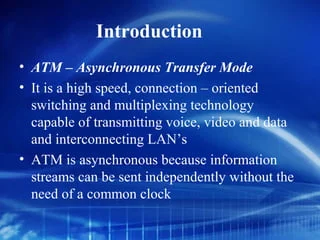
Asynchronous Transfer Mode (ATM) is a networking technology used for transmitting data, voice, and video over a network. ATM is known for its high-speed transmission, low delay, and low jitter. It is often used in large networks such as in businesses, universities, and governments due to its efficiency and reliability.

For a beginner, learning about ATM can seem overwhelming, but this guide will provide you with the foundational knowledge to get started.

ATM Architecture

The ATM architecture consists of hardware and software components. The hardware includes switches, routers, and network adapters, while the software includes the protocols and interfaces that allow communication between devices.

Virtual Circuit

ATM uses virtual circuits, which are logical connections between two or more devices. Virtual circuits can be either permanent or switched. Permanent virtual circuits (PVCs) are pre-established and serve as a dedicated connection between devices. Switched virtual circuits (SVCs) are established on-demand and are used for occasional data transfer between devices.

ATM Cell

The basic unit of data transmission in ATM is the ATM cell. ATM cells are 53 bytes long and consist of five parts: header, payload, checksum, and a virtual channel identifier (VCI) and virtual path identifier (VPI). The VCI and VPI are used to identify the virtual circuit over which the cell is transmitted.

Quality of Service (QoS)

ATM provides Quality of Service (QoS), which ensures that data transfer is efficient and reliable. QoS includes priority settings, traffic shaping, and bandwidth allocation to ensure that important data is transmitted first and that data transfer does not overwhelm the network.

ATM Signaling

ATM signaling is used to establish and maintain virtual circuits. Several signaling protocols exist, including UNI (User-Network Interface) and NNI (Network-Network Interface). UNI signaling is used between end devices and a switch, while NNI signaling is used between switches.

ATM Switching

ATM switches are used to forward ATM cells from one virtual circuit to another. Switches use the VCI and VPI to determine the correct virtual circuit to forward the cell. ATM switches can be either centralized or distributed, with distributed switches being more common.

ATM Application

ATM is used in various applications, including Voice over IP (VoIP), video conferencing, internet access, and LAN interconnection. ATM is used in businesses and organizations that require high-speed and reliable data transfer.

Conclusion

ATM is a powerful networking technology that provides high-speed and reliable data transfer. By understanding the basic concepts of ATM architecture, virtual circuits, ATM cells, QoS, signaling, switching, and applications, you can begin to explore and use ATM technology in your network environment.


Previous Article

How to Report Spam in Gmail

Next Article

Simple Ways to Share Your Location Using ...

Matthew Lynch

Related articles More from author

  • Digital & Mobile Technology

    How to Set up and Manage Google Reminders

    September 7, 2023
    By Matthew Lynch
  • Digital & Mobile Technology

    Best UPS Battery Backups of 2023

    May 30, 2023
    By Matthew Lynch
  • Digital & Mobile Technology

    What Is the Mr. Krabs Meme? Examples

    June 23, 2023
    By Matthew Lynch
  • Digital & Mobile Technology

    How to Watch the Lord of the Rings Movies in Order

    June 1, 2023
    By Matthew Lynch
  • Digital & Mobile Technology

    The Best Mini Drones

    June 22, 2023
    By Matthew Lynch
  • Digital & Mobile Technology

    Best Free GPS Turn-By-Turn Navigation Apps

    June 10, 2023
    By Matthew Lynch

Search

Login & Registration

  • Log in
  • Entries feed
  • Comments feed
  • WordPress.org

Newsletter

Signup for The Tech Edvocate Newsletter and have the latest in EdTech news and opinion delivered to your email address!

About Us

Since technology is not going anywhere and does more good than harm, adapting is the best course of action. That is where The Tech Edvocate comes in. We plan to cover the PreK-12 and Higher Education EdTech sectors and provide our readers with the latest news and opinion on the subject. From time to time, I will invite other voices to weigh in on important issues in EdTech. We hope to provide a well-rounded, multi-faceted look at the past, present, the future of EdTech in the US and internationally.

We started this journey back in June 2016, and we plan to continue it for many more years to come. I hope that you will join us in this discussion of the past, present and future of EdTech and lend your own insight to the issues that are discussed.

Newsletter

Signup for The Tech Edvocate Newsletter and have the latest in EdTech news and opinion delivered to your email address!

Contact Us

The Tech Edvocate
910 Goddin Street
Richmond, VA 23231
(601) 630-5238
[email protected]

Copyright © 2026 Matthew Lynch. All rights reserved.