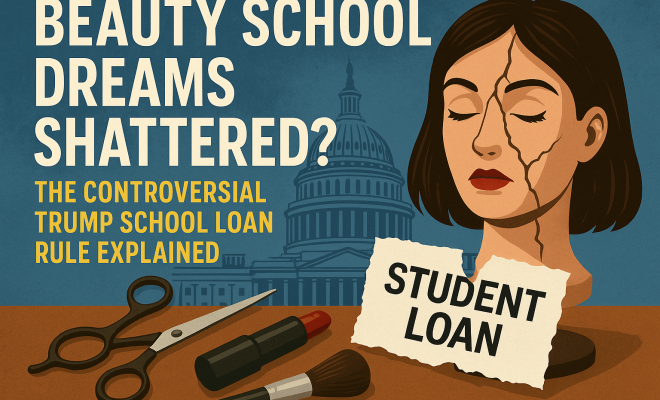
Beauty School Dreams Shattered? The Controversial Trump School Loan Rule Explained
Imagine you’re a young aspiring stylist, a future barber, or an esthetician with a vision of owning your own salon. You’ve found the perfect vocational program, it’s accredited, and you’re ready to dive in. Your biggest hurdle? Affording tuition. For decades, federal Pell Grants and student loans have been the bedrock for millions like you, opening doors to careers that don’t always require a four-year degree. But what if that bedrock suddenly crumbles?
That’s the looming question for students and schools across the country, particularly those in the beauty and cosmetology sectors, thanks to a controversial new directive. A new Trump school loan rule, implemented by the Education Department, aims to tighten the reins on federal funding for non-degree vocational programs. The core idea is simple, at least on the surface: if these programs aren’t delivering a clear path to gainful employment and earnings that justify the student debt, they shouldn’t receive federal dollars. While the stated goal is to protect students from predatory programs, the practical effect could be devastating, potentially cutting off the very lifelines that make these career paths accessible to thousands.
This isn’t just an abstract policy debate; it’s a direct threat to the financial viability of beauty schools and similar career-focused training centers. It also puts a significant squeeze on the talent pipeline for an entire industry. We’re talking about an industry that employs millions, from local barbershops to high-end spas. If students can’t get the funding to attend, these programs could shrink, or even vanish, leaving a gaping hole in career opportunities and a shortage of skilled professionals. Let’s unpack what this Trump school loan rule really means, who it impacts, and why it’s sparking such intense debate.
Understanding the ‘Gainful Employment’ Standard and Its Evolution
The concept of ‘gainful employment’ isn’t new. It’s been a regulatory cornerstone for vocational and for-profit programs receiving federal student aid for years. The basic premise is that if a program receives federal funding, it should prepare students for employment in a recognized occupation. Furthermore, students should be able to earn enough to pay back their loans and not be left with crippling debt.
The Obama administration had its own iteration of gainful employment rules, which were often seen as quite stringent, leading to some programs losing eligibility. These rules focused on debt-to-earnings ratios and repayment rates. If graduates’ median loan debt exceeded a certain percentage of their discretionary income or annual earnings, or if too many defaulted, the program could face sanctions. This was a direct attempt to curb what critics called predatory practices by some for-profit institutions that allegedly left students with massive debt and few job prospects.
However, when the Trump administration came into office, they moved to repeal and replace these rules. The argument was that the Obama-era regulations were too burdensome, stifled innovation, and unfairly targeted vocational schools. They contended that a more streamlined approach was needed, one that still protected students but didn’t penalize legitimate institutions. The new Trump school loan rule we’re discussing now is the culmination of that effort, a re-envisioned standard that seeks to address the same core problem but with a different methodology.
The ‘Do No Harm’ Test: A Closer Look at the New Metrics
So, what exactly does this new Trump school loan rule entail? It introduces what’s often referred to as a ‘do no harm’ test, a more stringent set of metrics designed to evaluate the financial outcomes of graduates from non-degree vocational programs. Under this new framework, a program could lose access to crucial federal funding – including Pell Grants and federal student loans – if it fails this earnings test two out of three consecutive years. This isn’t a minor tweak; it’s a significant tightening of the screws.
The test primarily focuses on two key ratios. First, it looks at whether the average annual earnings of graduates from a particular program exceed the average annual earnings of a typical high school graduate in their state who didn’t attend college. This is a baseline measurement, ensuring that the program is at least providing an earnings boost compared to a high school diploma alone. Second, and perhaps more impactful for many vocational programs, it assesses the debt-to-earnings ratio. Specifically, the rule dictates that graduates’ median annual loan payments should not exceed 8% of their total annual earnings, or 20% of their discretionary income. If a program’s graduates consistently fall short on these metrics, the consequences are severe.
It’s worth noting that the rule also has provisions for transparency, requiring schools to disclose more information about program costs, potential earnings, and graduation rates to prospective students. While transparency is generally a positive, the real teeth of this Trump school loan rule lie in the earnings test, which directly links federal funding to student financial outcomes in a way that many in the vocational sector find deeply concerning.
Why Beauty Schools Are Particularly Vulnerable
You might wonder why beauty schools are so prominently featured in discussions about this new rule. It boils down to a few key factors inherent to the cosmetology industry. First, entry-level salaries in many beauty professions, such as hairdressing, barbering, and esthetics, can be modest, especially right out of school. While experienced professionals can build lucrative careers, those initial years often involve building a client base, working on commission, and sometimes supplementing income with other jobs.
This reality makes it harder for graduates to meet the strict debt-to-earnings ratios outlined in the Trump school loan rule. Even if a program costs a reasonable amount, say $15,000 to $20,000 for a cosmetology license, and a graduate earns $25,000 in their first year, their loan payments could easily push them over that 8% annual earnings threshold. Remember, the rule doesn’t just look at high earners; it considers the median. If a significant portion of graduates are starting at lower pay, it drags the median down, making the program appear to fail the test. (See: U.S. Department of Education.)
Second, the nature of work in the beauty industry often involves self-employment, part-time hours, or a mix of both. This can complicate income reporting and make it challenging to accurately track earnings for the purposes of these federal metrics. Many stylists, for example, work as independent contractors, renting chairs in salons, which means their reported income might fluctuate or be harder to standardize compared to a salaried position in another field. This variability can make it difficult for schools to consistently demonstrate that their programs meet the new, more rigid standards, even if their graduates are successfully employed and building fulfilling careers.
The Broader Impact on Vocational Training and Career Pathways
While beauty schools are a prominent example, the implications of this Trump school loan rule extend far beyond cosmetology. Think about other non-degree vocational programs: welding, culinary arts, automotive repair, paralegal studies, medical assisting, HVAC technology. These are all vital trades and professions that contribute significantly to our economy and provide excellent career opportunities for individuals who may not be interested in or suited for a traditional four-year college degree. For more context, see impact on job prospects for graduates.
If these programs are deemed to fail the ‘do no harm’ test, they too could lose access to federal funding. This isn’t just about individual students; it’s about the entire ecosystem of vocational training. Many trade schools, particularly smaller ones, rely heavily on federal aid to keep their doors open and tuition affordable. Without these funds, they might be forced to raise tuition, reduce enrollment, or even close down. This would create a ripple effect, shrinking the pipeline of skilled workers needed across various industries.
Consider the potential for a skills gap to widen. If fewer people can afford to train as welders or auto mechanics, who will fill those essential jobs? We already face shortages in many skilled trades. This rule, while well-intentioned in its goal to protect students, could inadvertently exacerbate these problems by making vocational training less accessible, rather than more. It’s a complex balancing act, trying to prevent exploitation without stifling legitimate and vital educational pathways.
Student Debt vs. Career Opportunity: A Tricky Balance
At the heart of this debate is the perennial tension between student debt and career opportunity. No one wants to see students burdened with unmanageable debt for a degree or certificate that doesn’t lead to a viable job. That’s a legitimate concern, and it’s what drives the impulse behind regulations like the Trump school loan rule.
However, the pursuit of a career, especially in creative or service-oriented fields like cosmetology, often involves an initial investment that might not immediately yield a high income. The value of a beauty school education isn’t just in the first year’s salary; it’s in the long-term potential for entrepreneurship, client building, and skill mastery. Many stylists eventually open their own salons, become educators, or specialize in high-demand areas, earning significantly more over time.
The challenge with a strict earnings test is that it can fail to capture this long-term value. It’s a snapshot, not a movie. It also doesn’t account for the intrinsic value of pursuing a passion, or the value that these services bring to communities. Are we saying that if a program leads to a fulfilling career that provides a decent, but not high, income, it’s not worthy of federal support? That’s the question many are grappling with, and it highlights the difficulty of applying a one-size-fits-all financial metric to such a diverse range of educational pathways.
The Economic Ripple Effect: Local Businesses and Workforce Development
Let’s think about the broader economic impact. Beauty schools aren’t just educational institutions; they are often local businesses themselves, employing instructors, administrators, and support staff. When these schools face existential threats, it ripples through local economies. If a school closes, those jobs are lost. Furthermore, the graduates of these programs go on to staff countless small businesses – salons, spas, barbershops – which are often cornerstones of local communities.
Imagine a small town where the local beauty school has been a steady source of talent for decades. If that school suddenly loses federal funding and is forced to close, what happens to the pipeline of new stylists and barbers for the local businesses? They’ll struggle to find qualified staff, potentially leading to longer wait times for clients, reduced services, or even business closures. This isn’t theoretical; it’s a very real concern for business owners in the beauty sector and other trades.
Beyond direct employment, vocational programs play a crucial role in workforce development. They provide specialized skills that are in constant demand, adapting to market needs much faster than traditional universities often can. By potentially hobbling these programs, the Trump school loan rule could inadvertently undermine local workforce development efforts and make it harder for communities to maintain a vibrant, skilled labor force.
Advocacy and the Push for Reconsideration
Predictably, this Trump school loan rule hasn’t gone unchallenged. Industry associations, vocational school leaders, and student advocacy groups are actively campaigning for reconsideration or modification of the rule. Their arguments often center on the unique economics of vocational fields, the long-term value of these careers, and the potential for unintended consequences.
They point out that the rule might disproportionately affect minority students and those from lower-income backgrounds, who often rely most heavily on federal aid to access vocational training. For many, these programs are their most direct and affordable path to a stable, skilled career. Cutting off that access could exacerbate economic inequality rather than alleviate it.
The push for reconsideration often suggests alternative approaches: perhaps a more nuanced earnings test that accounts for regional variations in cost of living and starting salaries, or a longer look-back period for earnings data to capture career progression. There’s also a strong argument for recognizing the non-monetary benefits of these careers – the satisfaction of creative work, the ability to be self-employed, and the community service aspect of many beauty professions. (See: CDC on education and workforce.)
What’s Next for Students and Schools?
For current and prospective students, this situation creates significant uncertainty. If you’re considering a beauty program or another vocational path, it’s more important than ever to do your homework. Research schools thoroughly, understand their accreditation, and ask direct questions about how they anticipate being affected by the Trump school loan rule. Inquire about alternative funding sources, scholarships, and payment plans. Don’t assume federal aid will always be available in the same way it has been.
For schools, the immediate future involves a period of intense adaptation. They’ll need to meticulously track graduate outcomes, potentially revise program offerings, and explore new strategies for student recruitment and financial aid. Some might invest more in career services to help graduates secure higher-paying initial jobs, or focus on programs that demonstrably lead to better financial outcomes under the new metrics. It might also push schools to innovate in how they structure tuition and offer financing, perhaps relying more on private loans or school-funded scholarships if federal aid becomes less reliable. For more context, see shift in vocational training and its implications.
Ultimately, this isn’t just about a single rule; it’s about the future of accessible vocational education in America. The debate surrounding the Trump school loan rule forces us to confront fundamental questions about how we value different career paths, how we support diverse learners, and what role the federal government should play in ensuring both educational quality and economic opportunity. The coming years will reveal whether this tighter regulatory approach truly protects students, or inadvertently closes doors for many who are simply trying to build a better life through skill and hard work.
The Role of Data Collection and Its Challenges
Implementing the Trump school loan rule hinges heavily on data – specifically, the earnings and debt repayment data of graduates. But collecting this information accurately and consistently across thousands of diverse vocational programs presents significant challenges. The Education Department relies on various federal datasets, like those from the Social Security Administration and the Treasury Department, to track earnings and loan repayment status. However, vocational students often have unique employment patterns that these datasets might struggle to capture fully.
For instance, a significant portion of beauty and trade professionals are self-employed or work as independent contractors. Their income can be seasonal, project-based, or fluctuate widely from year to year. They might report income differently than a salaried employee, making it harder to get a precise median annual earning figure. Additionally, some graduates might work part-time while building their business, or combine their vocational work with other jobs, which can skew the initial earnings data. The current data collection methods might not be agile enough to reflect the true economic realities and career trajectories of these skilled workers, leading to potentially inaccurate assessments of program efficacy.
There’s also the question of how long after graduation earnings are tracked. The immediate post-graduation period often sees lower earnings as individuals gain experience and build their client base. If the ‘snapshot’ is too early, it might unfairly penalize programs whose graduates see significant earnings growth over a few years. This lag in recognizing career progression could paint an incomplete picture of a program’s long-term value, making data interpretation a critical point of contention in this whole debate.
Comparison to International Approaches to Vocational Training
It’s interesting to look at how other countries approach vocational training and funding, especially those with highly successful apprenticeship models. Countries like Germany and Switzerland, for example, have robust vocational education and training (VET) systems that are deeply integrated with industry. Their models often involve a dual system where students split their time between vocational schools and on-the-job training with companies. This hands-on experience often leads directly to employment, and the financial burden on students can be significantly lower due to employer investment.
While the U.S. has its own apprenticeship programs, they’re not as widespread or centrally funded as in some European nations. The Trump school loan rule, by focusing strictly on post-graduation earnings and debt repayment, contrasts with systems that prioritize direct industry partnership and subsidized training. In a German vocational system, the success of a program is measured not just by earnings, but by the direct transition into a skilled workforce where the demand for those skills is already established and supported by employers. This broader perspective on ‘gainful employment’ might offer valuable lessons for the U.S. in how to support vocational pathways without solely relying on student debt metrics.
Perhaps a more holistic approach, blending industry partnerships, subsidized training, and a nuanced understanding of career progression, could offer a path forward that protects students while still fostering a robust skilled workforce. The current rule feels very much like an American-centric solution to an American problem, without considering models that have proven successful elsewhere.
The Future Landscape of Accreditation and Quality Control
Beyond federal funding, accreditation bodies play a crucial role in ensuring the quality of vocational programs. These independent agencies review curricula, facilities, and faculty qualifications. The Trump school loan rule could indirectly influence accreditation standards. If programs are losing federal funding due to poor earnings outcomes, accreditors might feel pressure to adjust their own criteria to better align with federal expectations, even if their traditional focus has been more on educational inputs and institutional health.
This could lead to a shift where accreditors place a heavier emphasis on graduate employment rates and salary data, pushing schools to prioritize these metrics to maintain their accredited status. While some level of outcome-based assessment is beneficial, an overemphasis might inadvertently discourage innovative programs or those serving niche markets where initial earnings are lower but career satisfaction or long-term potential is high. It raises questions about who defines “quality” in vocational education – the federal government through financial metrics, or independent bodies based on broader educational and industry standards? (See: New York Times on student loan policies.)
The interplay between federal regulations and accreditation standards will be a dynamic area to watch. Schools might find themselves navigating conflicting pressures, trying to satisfy both the financial benchmarks of the Trump school loan rule and the comprehensive quality assessments of their accrediting agencies. This could add another layer of complexity for institutions already struggling to adapt.
FAQ: Navigating the Trump School Loan Rule
What is the core purpose of the Trump school loan rule?
The rule aims to ensure that non-degree vocational programs receiving federal student aid prepare students for jobs where their earnings justify their student loan debt. It’s intended to protect students from programs that leave them with high debt and poor job prospects.
Which types of educational programs are most affected by this rule?
It primarily impacts non-degree vocational programs, including those at for-profit colleges and public community colleges. Beauty schools, trade schools (like welding or HVAC), culinary arts programs, and medical assisting programs are prominent examples.
What are the key metrics used in the ‘do no harm’ test?
The test has two main components:
- Graduates’ average annual earnings must exceed the average annual earnings of a typical high school graduate in their state.
- Graduates’ median annual loan payments should not exceed 8% of their total annual earnings, or 20% of their discretionary income.
What happens if a program fails the ‘do no harm’ test?
If a program fails these earnings tests two out of three consecutive years, it risks losing access to all federal student aid, including Pell Grants and federal student loans. This can be devastating for the program and its students.
Why are beauty schools particularly vulnerable to this rule?
Many beauty professions have modest entry-level salaries, making it challenging for graduates to meet the strict debt-to-earnings ratios. The prevalence of self-employment and fluctuating income in the industry also complicates accurate earnings tracking for federal metrics.
Does this rule apply to four-year college degrees?
No, this rule specifically targets non-degree vocational programs and certain for-profit institutions. Traditional four-year degree programs at non-profit universities are generally not subject to these specific gainful employment regulations.
What should prospective students do to prepare for these changes?
Prospective students should thoroughly research any vocational program they’re considering. Ask schools directly about their graduation rates, job placement statistics, and how they anticipate being affected by the Trump school loan rule. Inquire about alternative financial aid options and scholarships. Always understand the total cost of the program and potential earnings in your desired field.
Trending Now
Frequently Asked Questions
What is the Trump school loan rule?
The Trump school loan rule is a directive from the Education Department aimed at tightening federal funding for non-degree vocational programs. It focuses on ensuring that these programs provide a clear path to gainful employment, which could impact funding for beauty schools and similar vocational training programs.
How does the Trump school loan rule affect beauty schools?
The rule could significantly impact beauty schools by restricting access to federal funding, making it harder for students to afford tuition. This could lead to program closures and a shortage of skilled professionals in the beauty industry, as students may no longer have the financial means to enroll.
What is the 'Gainful Employment' standard?
The 'Gainful Employment' standard is a regulatory measure that assesses whether vocational programs prepare students for jobs that enable them to repay their student loans. The Trump school loan rule emphasizes this standard to determine eligibility for federal funding, affecting many non-degree programs.
Are there benefits to the Trump school loan rule?
Proponents argue that the Trump school loan rule aims to protect students from predatory programs that leave them with debt and no job prospects. By enforcing stricter standards, the rule seeks to ensure that federal funds support programs that truly lead to gainful employment.
What are the potential consequences of the Trump school loan rule?
The potential consequences include reduced access to vocational training for students, possible closures of beauty schools, and a talent shortage in the beauty and cosmetology industry. This could hinder career opportunities for aspiring stylists and barbers who rely on federal funding to pursue their education.
What's your take on this? Share your thoughts in the comments below — we read every one.