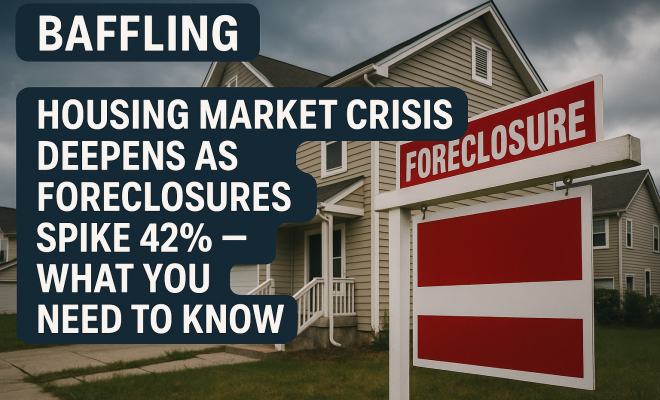
Baffling: Housing Market Crisis Deepens as Foreclosures Spike 42% — What You Need to Know
“`html
You feel it, don’t you? That subtle, growing unease about the housing market. Maybe you’re a homeowner watching your equity, a hopeful buyer frustrated by prices and rates, or perhaps you’re simply reading the headlines and wondering what on earth is going on. Well, you’re not alone. The U.S. housing market is currently flashing some serious warning signs, suggesting we might be teetering on the edge of a significant downturn, if not already in one. We’re seeing a confluence of factors – soaring mortgage rates, stubbornly high prices, a dramatic drop in sales, and, perhaps most tellingly, a sharp increase in foreclosures. It’s a potent cocktail that’s stirring up a very real housing market crisis for many Americans.
Let’s talk numbers, because they paint a stark picture. Pending home sales, a forward-looking indicator, took a brutal 4% dive in September. That’s not just a little dip; it’s the steepest monthly decline we’ve seen in over three years. Think about that for a moment: we haven’t witnessed such a rapid cooling of buyer interest since the early days of the pandemic, a period marked by profound economic uncertainty. This isn’t just a blip; it’s a trend that suggests a fundamental shift in buyer behavior, driven largely by the skyrocketing cost of borrowing money. And when we look at foreclosures, the situation becomes even more stark. Foreclosure filings jumped 13% year-over-year in August, and completed bank repossessions – the ultimate outcome of a foreclosure process – surged by a staggering 42%. These aren’t just statistics; they represent families losing their homes, dreams deferred, and a market under immense strain.
The Crushing Weight of Mortgage Rates
If there’s one villain in this story, it’s undoubtedly the relentless ascent of mortgage rates. For years, we enjoyed a period of historically low rates, a golden age for borrowers that fueled a significant portion of the recent housing boom. Buyers could stretch their budgets, affording more home for their money, and refinancers could lock in incredibly favorable terms. But those days are long gone. Mortgage rates recently punched through the 7% barrier, climbing to 7.40%, a level not seen since November 2023. To put that in perspective, just a couple of years ago, rates were often half that. This isn’t just an incremental increase; it’s a seismic shift that has fundamentally altered the affordability landscape.
What does a jump from, say, 3% to 7.4% actually mean for the average homebuyer? Let’s consider a hypothetical $400,000 mortgage. At 3%, your monthly principal and interest payment would be roughly $1,686. At 7.4%, that same payment rockets to about $2,773. That’s an extra $1,087 every single month, or over $13,000 more per year, just in interest. For many households, that kind of increase is simply unsustainable. It prices out a significant chunk of potential buyers, pushing homeownership further out of reach. Suddenly, a dream home becomes an unaffordable fantasy, and even a modest starter home feels like an insurmountable financial hurdle. This dramatic increase in the cost of borrowing is the primary catalyst behind the sharp retreat in buyer activity and the plummeting pending sales figures. Related reading: shift in mortgage rates.
Why Home Prices Haven’t Budged Enough
You’d think, wouldn’t you, that with such high mortgage rates and so many buyers sidelined, home prices would start to tumble dramatically? After all, basic economics dictates that when demand falls, prices should follow. But that hasn’t quite happened in the way many anticipated, adding another layer of complexity to the housing market crisis. While we are seeing some price adjustments, particularly in certain markets, the overall decline hasn’t been nearly as steep as the rise in interest rates might suggest. This stubbornness in pricing is a key factor keeping many potential buyers on the sidelines, creating a frustrating standoff.
One major reason for this resilience in prices is the ‘lock-in effect’. Millions of homeowners refinanced or purchased homes during the low-interest-rate era, securing mortgages at 3% or 4% (or even lower!). Why would they sell now, only to buy another home with a mortgage at 7.4% or higher, significantly increasing their monthly payments? For many, the financial disincentive to move is simply too great. This has led to a scarcity of homes for sale, keeping inventory levels relatively low. Fewer homes on the market means less competition among sellers, giving them less pressure to drop prices aggressively. So, while buyers are facing higher borrowing costs, they’re still contending with a limited supply of homes, preventing a widespread price collapse and prolonging the affordability challenge.
The Unsettling Rise of Foreclosures
The 42% jump in completed bank repossessions is arguably the most alarming statistic emerging from the current housing market crisis. It signals a shift from potential distress to actual, tangible loss for thousands of homeowners. A 13% year-over-year increase in foreclosure filings in August is concerning enough, but the surge in properties actually taken back by lenders suggests that many of these struggling homeowners are reaching the end of their options. This isn’t just an abstract economic indicator; it’s a deeply personal tragedy for every family involved.
What’s driving this increase? While the immediate aftermath of the pandemic saw various government moratoriums and forbearance programs that temporarily shielded many homeowners, those protections have largely expired. Now, those who were on the brink are facing the full force of their financial obligations. Add to that the inflationary pressures that have squeezed household budgets, making it harder to cover mortgage payments alongside rising costs for groceries, gas, and utilities. For some, job losses or unexpected expenses can be the final straw. It’s a stark reminder that even with equity in a home, if you can’t make the monthly payment, the risk of losing it remains very real. This uptick in repossessions also suggests a potential increase in housing inventory down the line, as foreclosed properties eventually hit the market, which could, paradoxically, put downward pressure on prices. (See: CDC housing statistics and trends.)
Seller Desperation and Buyer Retreat
The current market dynamics are creating a fascinating, if somewhat grim, tug-of-war between sellers and buyers. On one side, we have homeowners who want to sell, but are increasingly finding that the heady days of multiple offers above asking price are a distant memory. The data shows that nearly one in five sellers (a full 20%) are now being forced to reduce their asking prices. This isn’t a sign of a healthy, robust market; it’s a clear indication that sellers are having to adjust their expectations to meet the new reality of diminished buyer demand and affordability constraints. For more context, see reshaping the global property market.
On the other side, buyers are not only facing exorbitant mortgage rates but are also becoming more cautious and demanding. The record-high cancellation rate for home purchase agreements – 14.5% of deals falling through – speaks volumes. This means that nearly one in seven contracts are being terminated before closing. Why? It could be anything from buyers getting cold feet after seeing their interest rate lock expire, to stricter lending standards, to buyers finding issues during inspections and not wanting to overpay for a property that needs significant work. Whatever the reason, it signifies a market where buyers have more leverage and are less willing to commit to a purchase unless the terms are absolutely right. This dynamic is making transactions incredibly challenging and adding to the overall volatility of the housing market crisis.
The Ripple Effect on the Broader Economy
The health of the housing market isn’t just important for homeowners and aspiring buyers; it’s a foundational pillar of the broader economy. When the housing sector falters, the ripples are felt far and wide. Think about it: a strong housing market stimulates construction, creates jobs for real estate agents, lenders, inspectors, appraisers, and generates demand for home furnishings, appliances, and renovation services. When home sales plummet, all those associated industries feel the pinch.
The decline in pending sales and the overall slowdown in transactions mean fewer commissions for real estate professionals, less business for mortgage brokers, and a potential slowdown in new home construction. This can lead to job losses in related sectors, which then reduces consumer spending, creating a negative feedback loop. Furthermore, the psychological impact of a declining housing market can’t be underestimated. When people feel their primary asset – their home – is losing value or is difficult to sell, it can erode consumer confidence, making them less likely to spend on other goods and services. This widespread impact underscores why the current housing market crisis is a concern for everyone, not just those directly involved in buying and selling homes.
Is This a Repeat of 2008? Comparing Crises
Whenever we talk about a housing market crisis, the specter of 2008 inevitably looms large. It’s a natural comparison, given the devastating impact of the subprime mortgage crisis. However, it’s crucial to understand that while there are similarities in terms of rising foreclosures and slowing sales, there are also significant differences that make the current situation distinct. This isn’t necessarily a repeat, but rather a different beast with its own unique challenges.
The fundamental difference lies in the underlying cause. The 2008 crisis was primarily driven by a collapse in lending standards, predatory loans, and a proliferation of toxic assets like subprime mortgages that allowed unqualified buyers to purchase homes they couldn’t afford. When those adjustable-rate mortgages reset, millions defaulted, leading to a flood of foreclosures and a dramatic market crash. Today, lending standards are significantly tighter. We’re not seeing a widespread issuance of ‘liar loans’ or highly speculative mortgages. The current challenge stems more from a severe affordability crunch caused by high interest rates colliding with elevated home prices, rather than a systemic failure of the financial system due to reckless lending. While the current situation is undoubtedly painful for many, it’s not characterized by the same level of systemic risk that defined 2008. We’re seeing distress, but perhaps not the same kind of foundational instability.
Navigating the Current Housing Market Crisis: Advice for Buyers and Sellers
So, what does all this mean for you, whether you’re hoping to buy or needing to sell? Navigating this particular housing market crisis requires a different strategy than what worked even a year or two ago. The ‘wait and see’ approach can be tempting, but a more proactive and informed stance is usually more effective. For more on this, see impact of high mortgage rates.
For Prospective Buyers:
- Re-evaluate Your Budget: With rates where they are, your purchasing power has likely diminished. Get pre-approved and understand exactly what you can comfortably afford, not just what a lender says you qualify for. Factor in all costs, including property taxes, insurance, and potential maintenance.
- Be Patient but Prepared: The market is slow, but good deals can still emerge, especially as more sellers reduce prices. Have your finances in order so you can act quickly when the right opportunity arises. Don’t be afraid to negotiate; buyers now have more leverage.
- Consider an Adjustable-Rate Mortgage (ARM) with Caution: While ARMs often offer lower initial rates, they come with the risk of future payment increases. Understand the terms thoroughly and ensure you can handle potential rate hikes down the line.
- Expand Your Search: You might need to look in different neighborhoods or consider different types of properties than you initially envisioned. Flexibility is key in a challenging market.
For Homeowners Looking to Sell:
- Price Realistically from Day One: Overpricing in this market is a recipe for sitting on the market, eventually leading to multiple price reductions that can make your property look stale. Work with a knowledgeable agent to price your home competitively based on current market conditions, not on what your neighbor got six months ago.
- Focus on Presentation: With fewer buyers, your home needs to stand out. Invest in decluttering, minor repairs, and staging to make the best possible impression. Buyers are less forgiving of flaws when they’re paying high interest rates.
- Be Open to Negotiations: Expect offers that are below asking price and be prepared to negotiate on terms like closing costs or repairs. The days of ‘take it or leave it’ are largely over.
- Understand Your ‘Why’: If your reason for selling isn’t urgent, you might consider waiting for more favorable market conditions. If you absolutely need to sell, be prepared for a longer process and potentially a lower sale price than you might have hoped for previously.
The Broader Implications for Homeownership
Beyond the immediate transactions, this housing market crisis has deeper implications for the very concept of homeownership in America. For generations, owning a home has been synonymous with achieving the American Dream, a primary vehicle for building wealth and securing financial stability. But with affordability deteriorating so rapidly, that dream is becoming increasingly elusive for a growing segment of the population, particularly younger generations and first-time buyers. (See: HUD foreclosure statistics report.)
If high interest rates and elevated prices persist, we could see a long-term shift where homeownership rates decline, and a larger portion of the population remains renters. This has significant societal consequences, affecting everything from wealth distribution to community stability. It also means that for those who do manage to buy, the path to building equity might be slower and more challenging than it was for previous generations. Policymakers and economists will need to grapple with how to address this widening gap in housing accessibility, as it impacts not just individual finances but the overall economic health and social fabric of the nation.
Looking Ahead: What Could Change?
The big question, of course, is what happens next. The future of the housing market crisis hinges on several key factors, primarily the trajectory of inflation and the Federal Reserve’s monetary policy. If inflation cools significantly and consistently, the Fed might begin to ease its aggressive interest rate hikes, or even consider rate cuts down the line. Lower interest rates would undoubtedly provide much-needed relief to the housing market, improving affordability and potentially reigniting buyer demand. For more context, see revolutionizing mortgage lending.
However, predicting the future is notoriously difficult. The economy is a complex beast, and unexpected global events or domestic policy shifts could easily alter the current course. We also need to watch inventory levels closely. If the number of homes for sale significantly increases – either through new construction finally catching up, or more homeowners being forced to sell – that could put more downward pressure on prices. Conversely, if inventory remains tight, even with high rates, prices might continue to hold relatively firm in many areas. It’s a delicate balance, and we’re currently in a period of significant uncertainty. What’s clear is that the easy money days are over, and the market is undergoing a painful but necessary correction, forcing everyone involved to adapt to a new, more challenging reality.
The Role of New Construction and Supply Chains
It’s easy to focus solely on demand and interest rates when discussing the housing market crisis, but the supply side plays an equally critical role. For years, particularly after the 2008 crash, new home construction lagged significantly behind population growth and household formation. Builders were cautious, and zoning regulations in many desirable areas made it difficult and expensive to build new housing, especially affordable starter homes. This created a persistent housing shortage that helped push prices up, even with lower interest rates.
Now, with higher rates, new construction faces a double whammy. On one hand, the cost of borrowing for builders has also gone up, making projects less profitable. On the other hand, the demand for new homes has cooled as buyers pull back. Supply chain issues, while easing from pandemic highs, still present challenges, affecting the cost and availability of materials like lumber, concrete, and appliances. Labor shortages in construction also contribute to slower build times and higher costs. If builders significantly reduce new projects in response to the current slowdown, it could exacerbate the long-term supply problem, potentially leading to another surge in prices once interest rates eventually come down. So, while a lack of inventory is currently helping keep prices from plummeting, a sustained lack of new housing will only deepen the affordability crisis in the years to come.
Expert Perspectives on Market Stabilization
What do the pros think about when the housing market might stabilize? Economists and real estate analysts offer a range of perspectives, but a common thread points to interest rate stability as the primary driver for any significant shift. Many believe that until the Federal Reserve signals a clear end to rate hikes, or even begins to consider cuts, the market will remain volatile and challenging. Some experts predict a “soft landing,” where prices flatten or see modest single-digit declines rather than a dramatic crash, particularly if inventory remains tight and the overall economy avoids a severe recession. Others are more pessimistic, suggesting that a significant correction is still needed to bring prices back into line with historical affordability metrics, especially given wage stagnation for many workers. See also higher interest rates threat.
For example, some analysts at major financial institutions suggest we might see a prolonged period of stagnant prices, a “time correction,” where incomes gradually catch up to home values, making housing more affordable over time without a sharp drop in nominal prices. This scenario would be less painful for existing homeowners but frustrating for hopeful buyers. The consensus, if there is one, seems to be that a return to the frenzied market conditions of 2020-2021 is highly unlikely in the near future. Instead, prepare for a slower, more deliberate market where negotiation is key, and patience is a virtue for both buyers and sellers.
FAQ: Understanding the Housing Market Crisis
Given the complexities, it’s natural to have questions about what’s happening. Here are some common inquiries: (See: New York Times on housing market foreclosures.)
Q: How long do experts expect this housing market crisis to last?
A: Most experts agree that the market will remain challenging as long as interest rates stay elevated and inflation persists. Predicting an exact timeline is difficult, but many anticipate at least another 12-18 months of volatility. A significant shift would likely require the Federal Reserve to begin cutting interest rates, which is not expected until inflation is firmly under control. There’s a fuller look at what's crushing the housing market.
Q: Should I wait to buy a home, or buy now?
A: This is a highly personal decision. Waiting might mean lower prices or lower rates in the future, but it also means missing out on potential equity growth if prices stabilize. Buying now means higher monthly payments, but you lock in a home you need. If you have stable finances and find a home that meets your needs and budget, buying now with the intention to refinance later could be an option. However, if you’re stretching your budget, waiting for more favorable conditions might be wiser.
Q: Are home prices going to crash like in 2008?
A: Most economists believe a crash on the scale of 2008 is unlikely. Lending standards are much stricter today, and homeowners generally have more equity. We’re seeing price adjustments and declines in some markets, but a widespread collapse isn’t the base case. Instead, a more gradual decline or flattening of prices is more probable.
Q: What does the ‘lock-in effect’ mean for me if I want to sell?
A: The lock-in effect means fewer people are willing to sell their homes because they have a low mortgage rate. This keeps inventory low. If you’re selling, you’ll face less competition from other sellers, but also fewer buyers due to high rates. You’ll likely need to price competitively and be prepared for negotiations, as buyers have more leverage in this environment.
Q: What if I’m struggling to make my mortgage payments?
A: If you’re having trouble, don’t wait. Contact your lender immediately to discuss options like loan modification, forbearance, or repayment plans. Explore government assistance programs if available. Ignoring the problem will only make it worse and increase your risk of foreclosure.
“`
Trending Now
- this guide on this ai company’s staggering 14 million record data leak is just the beginning
- New York Rep Introduces Bill That Could Keep Games Playable for Longer – PCMag
- Mind-Blowing: These AI Investment Funds Are…
- this guide on the ai detector deception: why universities are pulling the plug
Frequently Asked Questions
What is causing the current housing market crisis?
The current housing market crisis is driven by a combination of soaring mortgage rates, high home prices, and a significant drop in sales. Additionally, there has been a sharp increase in foreclosures, with filings rising 13% year-over-year, indicating many families are struggling to keep their homes.
How much have foreclosures increased recently?
Foreclosures have seen a dramatic increase, with filings jumping 13% year-over-year in August and completed bank repossessions rising by an astonishing 42%. This surge highlights the severe strain the housing market is under and the challenges many homeowners face.
What impact do rising mortgage rates have on homebuyers?
Rising mortgage rates significantly affect homebuyers by increasing the cost of borrowing. This has led to a cooling in buyer interest, as evidenced by a 4% drop in pending home sales, the steepest decline in over three years, making homes less affordable for many.
Are home prices still high despite economic concerns?
Yes, home prices remain stubbornly high despite the economic concerns and rising mortgage rates. This persistent high pricing, combined with increased costs of borrowing, is creating a challenging environment for potential buyers and contributing to the overall market crisis.
What does a drop in pending home sales indicate?
A drop in pending home sales, like the recent 4% decline, indicates a significant cooling in buyer interest and market activity. This trend suggests that potential buyers are becoming increasingly hesitant to enter the market, largely due to rising costs and economic uncertainty.
What did we miss? Let us know in the comments and join the conversation.