Astronomers Unveil the Largest 3D Map of the Universe: 47 Million Galaxies and Quasars Mapped
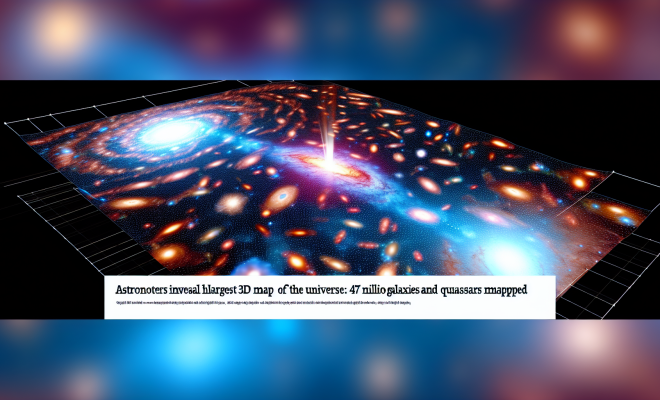
In a groundbreaking achievement, astronomers have completed the most comprehensive 3D map of the universe to date, successfully charting over 47 million galaxies and quasars. This ambitious project, known as the Dark Energy Spectroscopic Instrument (DESI) survey, has been conducted using the Nicholas U. Mayall 4-meter telescope located at the Kitt Peak National Observatory in Arizona.
Milestone Completion Ahead of Schedule
The DESI project, which initially spanned a five-year timeframe, was completed a full year ahead of schedule, marking a significant milestone in astronomical research. The survey’s early completion is a testament to the dedication and expertise of the team involved, as well as the advanced technology employed in mapping the cosmos.
The Significance of the 3D Map
This monumental map provides an unprecedented view into the distribution and clustering of galaxies across space and time. By analyzing how galaxies are organized and their movements throughout the universe, scientists aim to gain deeper insights into the mysterious phenomenon known as dark energy.
Understanding Dark Energy
Dark energy is a fundamental component of our universe, believed to be responsible for its accelerated expansion. Despite its significance, dark energy remains one of the greatest enigmas in modern cosmology. With the data collected from the DESI survey, researchers will be able to investigate how galaxies clustered at various epochs in cosmic history.
The first major findings related to dark energy are expected to be published in 2027, with scientists eager to unveil new insights that could reshape our understanding of the universe’s expansion.
Technological Innovations Behind DESI
The success of the DESI survey is largely attributed to cutting-edge technological advancements. DESI is equipped with a unique system of fiber-optic spectrographs that can capture the light from thousands of galaxies simultaneously. This allows for an extensive amount of data to be collected in a fraction of the time that traditional methods would require.
Using this technology, DESI is capable of measuring the redshift of galaxies, which indicates how fast they are moving away from us. This data is critical in calculating the distance to these galaxies and understanding their distribution in the universe.
Future Plans for Expansion
Even after the initial survey’s completion, DESI’s work is not finished. The instrument is set to continue its observations through 2028, with plans to expand the 3D map by an additional 20 percent. This expansion will focus on filling in areas closer to the Milky Way, providing a more detailed and comprehensive cosmic dataset.
Implications for Cosmology
The implications of the DESI survey are vast. Understanding the clustering of galaxies will not only shed light on dark energy but also provide critical insights into the formation and evolution of the universe itself. The survey’s findings could lead to breakthroughs in answering fundamental questions about the structure of the cosmos.
Collaboration Across Borders
The DESI project is a collaborative effort involving scientists and astronomers from around the globe. This international partnership reflects the unifying nature of scientific inquiry, where researchers pool their resources and expertise to tackle some of the most pressing questions in the field of astronomy.
A New Era in Cosmic Mapping
The completion of this extensive 3D map marks a new era in cosmic mapping and exploration. As scientists continue to analyze the data, there is immense anticipation surrounding what new discoveries lie ahead. The study of dark energy, galaxy formation, and the overall structure of the universe stands to benefit significantly from this monumental effort.
Conclusion
The creation of the largest 3D map of the universe is not just an achievement in astronomical research; it represents a major leap forward in our understanding of the cosmos. As we await the first major results on dark energy in 2027, the astronomical community remains excited about the potential revelations that will emerge from this extraordinary endeavor.