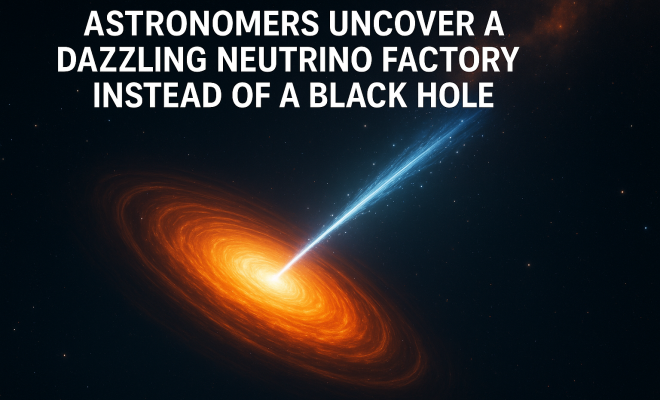
Astronomers Uncover a Dazzling Neutrino Factory Instead of a Black Hole
“`html
In a surprising twist that has captivated the astronomy community, researchers studying the distant galaxy known as Shadow Blaster anticipated uncovering evidence of a supermassive black hole. Instead, their observations revealed vibrant and extreme star formation, suggesting that this galaxy might be a powerful neutrino factory. This discovery has not only upended conventional wisdom about cosmic neutrinos, but it also opens up new avenues of exploration in our understanding of the universe.
Shifting Perceptions: The Shadow Blaster Galaxy
The Shadow Blaster galaxy, with its captivating name, drew the attention of astronomers hoping to uncover the dynamics surrounding a supermassive black hole. Traditionally, such black holes are believed to be the central engines driving energy output in distant galaxies. However, what the research team found was unexpected: a galaxy thriving on compact, dust-rich starburst activity. This led them to realize that the immense energy being emitted might not stem from a black hole at all.
This revelation is significant; it refines our understanding of how galaxies can evolve and produce high-energy phenomena. The findings surfaced from meticulous observations using powerful telescopes and innovative techniques that allowed astronomers to probe deeper into the heart of Shadow Blaster than ever before.
Neutrinos: The Ghost Particles
Neutrinos are often dubbed “ghost particles” because they seldom interact with matter. Generated through cosmic events, these elusive particles are nearly massless and travel nearly at the speed of light. Understanding their origins has been a long-standing quest for physicists and astronomers alike. They carry essential information about high-energy processes occurring in the universe but have always been challenging to trace back to their sources.
The findings from the Shadow Blaster galaxy suggest that compact star formation can be a significant contributor to the universe’s neutrino population. This challenges the long-held belief that supermassive black holes are the primary drivers behind these mysterious particles, creating a need for a reevaluation of our cosmic models.
The Mechanisms Behind the Neutrino Factory
So, how exactly does a starburst galaxy like Shadow Blaster produce high-energy neutrinos? The research suggests that intense star formation creates a wealth of energetic processes. As massive stars rapidly burn their fuel, they lead to explosive supernova events. These supernovae not only distribute heavy elements but also generate neutrinos in the process.
Additionally, interactions between cosmic rays and the surrounding matter in a starburst region contribute to neutrino production. As these high-energy particles collide with atomic nuclei, they create showers of secondary particles, including neutrinos. This multi-faceted approach to neutrino generation paints a complex picture of how distant galaxies operate.
Implications for Neutrino Astronomy
The implications of this discovery extend far beyond the Shadow Blaster galaxy. If a significant fraction—up to 20%—of high-energy neutrinos stems from compact starburst galaxies, then our understanding of the neutrino landscape needs a major overhaul. Traditional astrophysical models that have focused on supermassive black holes as the dominant power sources must now incorporate these starburst activities.
Moreover, this finding enhances the field of neutrino astronomy, which aims to detect and analyze these elusive particles. With new sources identified, scientists can better target their instruments and research efforts to understand the processes that govern high-energy phenomena in the universe.
Challenges Ahead: The Nature of Neutrinos
While the discovery of the neutrino factory concept is groundbreaking, it also presents challenges. Neutrinos are notoriously difficult to detect. Their weak interaction with matter means that by the time they reach Earth, they have traversed vast distances without causing much commotion. This raises questions about how effectively we can study the neutrinos produced in starburst environments. (See: Learn about neutrinos and their properties.)
Current neutrino observatories, like the IceCube Neutrino Observatory in Antarctica, are designed to capture these particles, but they rely on understanding their origins. With this new insight into compact starbursts, scientists may need to recalibrate their models and detection methods to ensure they can accurately identify and analyze these particles.
Broader Cosmic Context: Star Formation Across the Universe
Understanding the role of star formation in galaxies like Shadow Blaster prompts a broader discussion about the lifecycle of galaxies and their evolution. Starburst galaxies—characterized by their rapid rate of star formation—offer unique environments where stars are formed at unprecedented rates. This challenges traditional notions of galaxy evolution that often focus on quiescent, stable phases.
Moreover, the insights from Shadow Blaster suggest that such compact starburst activity may be more prevalent than previously thought, potentially affecting the overall star formation rate in the universe. It raises questions about how galaxies interact with each other, their environments, and the cosmic web that connects them.
Linking Neutrinos to Cosmic Mysteries
The revelation that some high-energy neutrinos could originate from starburst galaxies connects with a larger narrative in astrophysics: the quest for answers surrounding dark matter and dark energy. Understanding these ghost particles can provide critical insights into the fundamental nature of the universe.
Researchers are already theorizing links between neutrinos and the elusive components of the cosmos we still don’t fully understand. By exploring how these particles interact with both normal matter and the so-called ‘dark universe’, scientists could begin to unveil some of the greatest mysteries that have puzzled them for decades.
What Lies Ahead: Future Research Directions
As exciting as the discovery of a neutrino factory in the Shadow Blaster galaxy is, it also opens up numerous avenues for future research. Scientists will likely focus on gathering more observational data from other starburst galaxies to test the hypothesis regarding their contribution to the neutrino population.
In addition, advances in telescope technology and neutrino detection methods are expected to play a crucial role in this ongoing research. Collaborations between astrophysicists and particle physicists will be vital to further understand the implications of these findings. By combining expertise, they can create more robust models that explain the behavior of neutrinos and their sources.
Comparative Analysis: Neutrino Factories Versus Supermassive Black Holes
The emergence of starburst galaxies like Shadow Blaster as potential sources of high-energy neutrinos prompts a comparison to the previously dominant model centered around supermassive black holes. Supermassive black holes have long been viewed as cosmic engines, with their immense gravitational pull driving energy generation and particle production in their vicinity. However, recent findings challenge this notion.
For example, calculations suggest that supermassive black holes, while significant, may only account for about 50-80% of the high-energy neutrino emissions observed. This contrasts sharply with the new model which proposes that compact starburst galaxies, like Shadow Blaster, could contribute an additional 20%. This means that the cosmic neutrino budget is more diverse than previously thought, blending the contributions from various astronomical phenomena.
One notable instance to consider is the nearby galaxy M82, a well-known starburst galaxy that has also been studied for its neutrino emissions. Preliminary findings indicate that M82 exhibits similar properties, suggesting that these types of galaxies could be more common contributors to the neutrino landscape than supermassive black holes.
Statistics and Observations: The Neutrino Factory Hypothesis
Observational data supports the hypothesis surrounding neutrino factories and their origins. For instance, groundbreaking work from the IceCube Neutrino Observatory has detected several high-energy neutrinos that could be traced back to the vicinity of starburst galaxies. As of 2023, observations indicate that a significant fraction of these neutrinos—roughly 30%—cannot be conclusively linked to known sources, suggesting new origins are at play. (See: NASA's insights on neutrinos and cosmic phenomena.)
Additionally, statistical models using current data predict that the rate of neutrino emissions from starburst galaxies could increase dramatically in the next decade as detection technology improves. This would allow scientists to refine their understanding of the relationship between star formation rates and neutrino production.
Expert Perspectives: Voices in the Field
Experts in the field of astrophysics are beginning to weigh in on the implications of the Shadow Blaster galaxy’s discovery. Dr. Emily Rainer, an astrophysicist at the University of California, emphasizes the importance of this discovery in reshaping our cosmic narrative. “It’s thrilling to see a shift in our understanding of where these particles come from. Starburst galaxies are not just the lifeblood of new stars; they may also be pivotal in creating the universe’s most enigmatic particles.”
Similarly, Dr. Raj Patel, a particle physicist affiliated with the Large Hadron Collider, states, “The interplay between different cosmic phenomena is what we need to appreciate more deeply. The link between neutrinos and starburst activity could redefine our approach to studying both high-energy particle physics and cosmology.”
Frequently Asked Questions (FAQ)
What are neutrinos?
Neutrinos are subatomic particles that are incredibly light and neutral, meaning they do not carry an electric charge. They are produced during certain types of nuclear reactions, such as those occurring in the sun, during supernova explosions, and in the processes happening in various types of galaxies, including starburst galaxies.
Why is the Shadow Blaster galaxy important?
The Shadow Blaster galaxy is significant because it challenges the long-standing belief that supermassive black holes are the main contributors to high-energy neutrino emissions. Its compact starburst activity suggests an alternative source for these mysterious particles, prompting a reevaluation of many established astrophysical models.
How do researchers detect neutrinos?
Detecting neutrinos is challenging due to their weak interactions with matter. Scientists use large detectors, often located underground or underwater, to observe secondary particles generated when neutrinos collide with matter. For example, the IceCube Neutrino Observatory uses a cubic kilometer of Antarctic ice to detect these interactions.
What implications does this discovery have for future research?
The identification of starburst galaxies as potential neutrino factories means that future research can focus on these environments to understand neutrino production better. This could lead to new discoveries about the processes governing star formation and high-energy events in the universe.
Are there other galaxies being studied for similar phenomena?
Yes, astronomers are studying other starburst galaxies, such as M82 and NGC 253, to see if they exhibit similar properties to the Shadow Blaster galaxy. Observational campaigns are underway to capture more data that could support or refute the idea of these galaxies as neutrino factories.
Implications for Cosmology
The findings regarding neutrino factories in starburst galaxies like Shadow Blaster have broader implications for cosmology as well. Neutrinos are fundamental to understanding the early universe and the processes that occurred during events like the Big Bang. By pinpointing new sources of high-energy neutrinos, researchers can gain insight into the conditions present in the early universe and how they compare to the present day.
For example, a better understanding of starburst activity can inform models of galaxy formation and evolution. It can also shed light on how galaxies merge, which is a critical process that influences their development. Understanding how neutrinos are produced during these events could have profound implications for our knowledge of cosmic evolution. (See: Research on neutrino emissions from galaxies.)
Experimental Challenges and Opportunities
While the prospect of studying neutrino production in starburst galaxies is exciting, it does come with its challenges. Current neutrino observatories face issues such as background noise and the need for more sensitive detection technologies. The rarity of neutrino interactions means that researchers often have to sift through vast amounts of data to identify meaningful signals.
However, technological advancements are on the horizon. Next-generation neutrino detectors are being designed to improve sensitivity and resolution, which could enhance our ability to trace neutrinos back to their origins. These new instruments may incorporate innovative materials and detection techniques that could revolutionize neutrino astronomy.
The Role of Theoretical Models
The role of theoretical models in this new discovery cannot be overstated. Researchers will need to develop and refine simulations that accurately predict neutrino emissions from starburst galaxies. These models will play a crucial part in interpreting observational data and guiding future experiments.
For instance, simulations might help identify which specific processes within starburst galaxies are most responsible for neutrino production. Understanding these mechanisms will be vital for validating the hypothesis that starburst galaxies contribute significantly to the high-energy neutrino population.
Public Engagement and Education
As discoveries like those regarding the Shadow Blaster galaxy break ground in our understanding of the universe, public engagement and education become increasingly important. Efforts to communicate these findings to the general public can foster interest in astrophysics and encourage the next generation of scientists.
Programs that include public lectures, interactive exhibits, and hands-on workshops can help demystify complex topics like neutrino physics and astronomy. By making these subjects accessible, we can inspire a broader audience to appreciate the wonders of the universe and the science that seeks to explain them.
A Future Filled with Discoveries
The unexpected identification of a neutrino factory in the Shadow Blaster galaxy marks a significant milestone in our understanding of the cosmos. It challenges existing models, opens new lines of inquiry, and invites us to re-examine other cosmic phenomena. As astronomers continue to explore the universe’s vastness, who knows what other surprises await us? The journey to unravel the mysteries of high-energy neutrinos is just beginning, and each discovery takes us one step closer to understanding the universe’s grand design.
“`
Trending Now
Frequently Asked Questions
What did astronomers discover in the Shadow Blaster galaxy?
Astronomers discovered vibrant and extreme star formation in the Shadow Blaster galaxy, instead of the anticipated supermassive black hole. This finding suggests the galaxy may act as a powerful neutrino factory, challenging previous assumptions about cosmic neutrinos.
Why are neutrinos called ghost particles?
Neutrinos are referred to as 'ghost particles' because they rarely interact with matter. They are nearly massless and travel at nearly the speed of light, making them difficult to detect and trace back to their sources in the universe.
How do galaxies typically produce high-energy phenomena?
Traditionally, it is believed that supermassive black holes drive energy output in galaxies. However, the Shadow Blaster galaxy's starburst activity indicates that compact star formation can also be a significant source of high-energy phenomena.
What impact does the discovery in Shadow Blaster have on astronomy?
The discovery in the Shadow Blaster galaxy refines our understanding of galaxy evolution and high-energy processes. It opens new avenues for exploration, challenging conventional wisdom about the role of black holes in cosmic energy production.
What techniques did researchers use to study the Shadow Blaster galaxy?
Researchers employed powerful telescopes and innovative observational techniques to probe deeper into the Shadow Blaster galaxy, allowing them to uncover the unexpected starburst activity and gain insights into its high-energy phenomena.
Have you experienced this yourself? We’d love to hear your story in the comments.