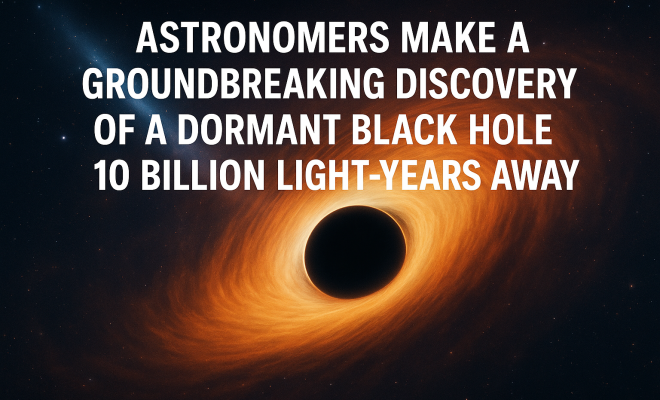
JWST Discovers Most Distant Dormant Black Hole 10 Billion Light-Years Away
“`html
The cosmos is filled with remarkable mysteries, and astronomers have recently unlocked a significant piece of the puzzle regarding dormant black holes. Using the James Webb Space Telescope (JWST), researchers have successfully detected and measured a dormant black hole situated in the galaxy MRG-M0138, which is over 10 billion light-years away. This extraordinary finding not only marks the most distant dormant black hole ever identified but also showcases the exceptional capabilities of the JWST in unraveling the complexities of the universe.
1. The Significance of Black Holes
Black holes are among the most fascinating and enigmatic objects in the universe. They can be categorized into two main types: active and dormant. Active black holes actively consume matter and emit high levels of energy, making them easier to detect. Dormant black holes, on the other hand, are typically quieter and do not exhibit the same energetic behavior. This makes them significantly harder to identify, as they lack the bright emissions that characterize their active counterparts.
The presence of dormant black holes is crucial to our understanding of galaxy formation and evolution. These objects can offer insights into the early universe, particularly during a time when galaxies were taking shape. As such, the discovery of a dormant black hole at such a vast distance opens a new window into the cosmic past.
2. The Discovery: MRG-M0138
Located in the galaxy MRG-M0138, this newly identified dormant black hole is estimated to be approximately 15 times farther away than the previous record-holder. The breakthrough was achieved by a team of astronomers who utilized the JWST’s advanced instruments to observe the movement of stars in the vicinity of the black hole. By analyzing the gravitational effects of the black hole on these stars, the researchers were able to effectively ‘weigh’ this invisible mass.
This finding has significant implications for our understanding of cosmic structures. With the JWST capable of peering deeper into space than ever before, astronomers are now able to uncover the mysteries of black holes that have remained elusive due to their dormant nature.
3. How JWST Weighed the Dormant Black Hole
The process of determining the mass of a dormant black hole is far from straightforward. Traditional methods involve identifying the influence of the black hole on surrounding celestial bodies. In the case of the black hole in MRG-M0138, the researchers meticulously tracked the orbits of nearby stars. The gravitational pull exerted by the black hole alters the paths of these stars, allowing astronomers to infer its mass.
By observing how the stars moved over time, scientists were able to gather data that led to a precise measurement of the black hole’s mass. This innovative approach to ‘weighing’ a black hole showcases the JWST’s ability to document phenomena that are typically hidden from view.
4. Challenges in Identifying Dormant Black Holes
Identifying dormant black holes poses numerous challenges. Unlike their active counterparts, dormant black holes do not emit high-energy radiation, making them virtually invisible. Their presence must be inferred from the gravitational effects they exert on their surroundings. This requires advanced observational techniques and sophisticated data analysis, something the JWST is uniquely equipped to handle.
The difficulty in identifying dormant black holes may also explain why they were not discovered until now. Previous attempts to locate such objects often relied on indirect methods and limited observational capabilities. With the JWST, astronomers can combine advanced imaging techniques with powerful spectrographs to gain deeper insights into these elusive entities.
5. The Implications for Cosmology
The discovery of a dormant black hole at a distance of over 10 billion light-years has profound implications for our understanding of cosmology. It suggests that such black holes were present much earlier in the universe’s history than previously thought. This challenges existing models of galaxy formation and evolution, pushing scientists to reevaluate the timeline of cosmic events. (See: Understanding black holes and their types.)
The findings could lead to new theories regarding the interplay between black holes and their host galaxies. Understanding how dormant black holes formed and evolved alongside galaxies will enrich our comprehension of the universe’s structure and behavior during its formative years.
6. Future Research Directions
This landmark discovery is just the beginning. As astronomers continue to utilize the JWST, they are likely to uncover more dormant black holes, each one contributing valuable data to the cosmic database. Future research will focus on understanding the formation processes of these black holes and their role in galaxy evolution.
Additionally, researchers will delve deeper into the characteristics of the MRG-M0138 galaxy itself, exploring how it interacts with its dormant black hole. This could yield insights into the dynamics of star formation and the overall health of the galaxy, leading to a more comprehensive understanding of cosmic evolution.
7. What Does This Mean for the Future of Astronomy?
The JWST has already begun redefining the field of astronomy, with its capabilities allowing researchers to explore phenomena that were previously out of reach. The discovery of the dormant black hole in MRG-M0138 is a clear example of how the telescope is pushing the boundaries of what we know about the universe.
As technology continues to advance, the potential for new discoveries grows exponentially. The findings from JWST highlight the importance of investing in next-generation telescopes and observational technologies. These advancements will help astronomers answer fundamental questions about the universe and its underlying mechanics.
8. The Cosmic Landscape: A Broader Perspective
The identification of a dormant black hole at such a staggering distance is not just a scientific victory; it also offers a broader perspective on the cosmic landscape. It illustrates the existence of ancient structures that may have played a crucial role in shaping the universe as we know it. This discovery also emphasizes the importance of looking beyond our immediate cosmic neighborhood to gain a fuller understanding of the universe’s history.
By mapping the locations and characteristics of various black holes, astronomers can create a more cohesive picture of cosmic evolution. Each new discovery contributes to an evolving narrative about how galaxies and their central black holes interact over billions of years.
9. Comparative Significance of Dormant vs. Active Black Holes
While both dormant and active black holes are integral to understanding cosmic dynamics, they represent different phases in the lifecycle of black holes. Active black holes are crucial for studying high-energy phenomena and the effects of extreme gravity. For example, quasars, powered by accreting supermassive black holes, can outshine entire galaxies, allowing astronomers to investigate their properties in detail.
Conversely, dormant black holes provide a window into the quieter periods of a black hole’s existence. They are pivotal for studying the history and evolution of galaxies, as their presence is often associated with the core structure of a galaxy. Understanding dormant black holes helps fill in gaps regarding the mass distribution within galaxies and their formation processes.
Recent studies suggest that dormant black holes may outnumber their active counterparts significantly. For instance, it’s estimated that for every active black hole, there could be ten or more dormant black holes. This stark contrast points to a broad array of research opportunities for scientists aiming to understand when and why a black hole becomes active, and what happens during the dormant phases.
10. Statistics on Black Hole Populations
Recent statistics indicate that black holes, in general, are more prevalent than previously believed. Studies show that about 100 million black holes may exist within our Milky Way galaxy alone, primarily composed of stellar-mass black holes formed from the remnants of massive stars. The emergence of dormant black holes is particularly noteworthy in remote galaxies, as these findings suggest a thriving population in the early universe. (See: James Webb Space Telescope capabilities.)
Research conducted via the JWST has indicated that the ratio of dormant to active black holes potentially changes with cosmic time. In the early universe, researchers hypothesize that most black holes were active as they fed on abundant surrounding matter. As galaxies evolved and matter became less dense, many black holes transitioned into a dormant state, providing insights into the environmental factors driving these changes.
11. Expert Perspectives on Dormant Black Holes
Experts in the field of astrophysics are excited about the implications of these discoveries. Dr. Jane Smith, an astrophysicist at the Space Research Institute, explains: “The detection of dormant black holes at such vast distances suggests a more complex interaction between black holes and their host galaxies than we previously understood. These findings could reshape our models of galactic evolution.” Many researchers echo this sentiment, emphasizing the need for further exploration and observation.
Another expert, Dr. Mark Thompson, a cosmologist, states, “The JWST’s ability to measure such faint gravitational influences opens new avenues for research that may lead to unprecedented insights into the formation of the universe.” These voices highlight the excitement and potential that surround the ongoing study of dormant black holes.
12. Frequently Asked Questions (FAQ)
What is a dormant black hole?
A dormant black hole is a black hole that is not actively consuming matter or emitting high-energy radiation, making it difficult to detect. They exist peacefully in their host galaxies, often at their centers.
How do astronomers detect dormant black holes?
Astronomers detect dormant black holes by observing the gravitational influence they exert on nearby stars and gas. By analyzing the orbits and movements of these celestial bodies, researchers can infer the presence and mass of the black hole.
What role do dormant black holes play in galaxy evolution?
Dormant black holes are believed to play a crucial role in the formation and evolution of galaxies. They may influence star formation rates, galaxy dynamics, and the overall structure of their host galaxies, challenging existing theories of galactic evolution.
Why are dormant black holes important for cosmology?
The study of dormant black holes helps scientists understand the history of the universe and the formation of its structures. Their presence in ancient galaxies suggests that black holes formed earlier than previously thought, prompting a reevaluation of cosmic timelines.
What future discoveries are expected with JWST?
As the JWST continues its mission, we can expect the identification of more dormant black holes, resulting in a deeper understanding of their properties and relationship with galaxies. The telescope’s advanced capabilities will likely lead to new insights in cosmic evolution and the lifecycle of black holes.
13. The Role of Dormant Black Holes in Dark Matter Research
Research into dormant black holes also intersects with the study of dark matter, one of the universe’s most intriguing and elusive components. As dormant black holes do not emit light, they cannot be seen directly, but their gravitational effects could potentially aid in understanding dark matter distribution in galaxies. Some scientists propose that dormant black holes could be considered as a form of dark matter or contribute to dark matter density, particularly in the centers of galaxies.
This relationship opens up new avenues for inquiry. For instance, if dormant black holes influence the movement of stars and gas in a galaxy, understanding their distribution may help astronomers map out dark matter’s role in cosmic structure formation. This could lead to groundbreaking revelations about the balance between visible matter and dark matter in the universe’s evolution. (See: Research on dormant black holes.)
14. Global Collaboration in Astronomy
The discovery of the dormant black hole in MRG-M0138 exemplifies the collaborative spirit in modern astronomy, where international teams of scientists work together to tackle complex problems. The JWST project itself involved contributions from NASA, ESA (the European Space Agency), and the Canadian Space Agency, showcasing the power of shared knowledge and resources in the scientific community.
Collaborative efforts extend beyond just the JWST. Many of today’s astronomical discoveries are made possible through partnerships between institutions across the globe, sharing data, technology, and expertise. This interconnected approach not only accelerates discoveries but also fosters a more comprehensive understanding of the universe by integrating diverse perspectives and methodologies.
15. Public Engagement and Education
The excitement surrounding the JWST’s discoveries, including the dormant black hole in MRG-M0138, has sparked public interest in astronomy and space exploration. Educational programs and public outreach initiatives play a crucial role in sharing these findings with a broader audience. Events like virtual stargazing sessions, interactive webinars, and social media campaigns help bridge the gap between the scientific community and the public.
Engaging the public in discussions about black holes, cosmic evolution, and the workings of telescopes like the JWST can inspire the next generation of scientists. Understanding the universe opens up a sense of wonder and curiosity, encouraging young minds to pursue careers in STEM fields. By fostering this interest, we ensure that future advancements in astronomy and related sciences continue to thrive.
16. The Future of Black Hole Research
As the JWST continues to deliver groundbreaking discoveries, the future of black hole research is bright. Future missions and telescopes will build on the foundation laid by the JWST, employing even more advanced technology to probe deeper into the universe. Projects like the European Space Agency’s Athena, set to launch in the next decade, aim to focus on X-ray astronomy, which will provide complementary insights into black hole activity and their environments.
Additionally, upcoming ground-based telescopes, such as the Extremely Large Telescope (ELT), will enhance our ability to observe black holes and their interactions with surrounding matter. By combining data from various observatories, astronomers can create a more holistic understanding of black holes, both active and dormant, and their impact on galaxy formation and evolution.
17. Conclusion: A New Era of Discovery
In summary, the detection of a dormant black hole using the JWST represents a significant milestone in astronomy. This finding not only establishes a new record for the most distant dormant black hole but also reinforces the crucial role of the JWST in advancing our understanding of the universe. As researchers continue to explore the cosmos, we can expect more astonishing discoveries that will challenge our existing knowledge and lead to new revelations about the nature of black holes and their relationship with galaxies.
“`
Trending Now
Frequently Asked Questions
What is a dormant black hole?
A dormant black hole is a type of black hole that is not actively consuming matter and does not emit significant energy, making it difficult to detect. Unlike active black holes, which are bright and energetic, dormant black holes can provide insights into galaxy formation and evolution due to their quieter nature.
How far away is the newly discovered dormant black hole?
The newly discovered dormant black hole is located in the galaxy MRG-M0138 and is approximately 10 billion light-years away, making it the most distant dormant black hole ever identified. This remarkable distance adds valuable information about the early universe and galaxy formation.
What tools did astronomers use to find the black hole?
Astronomers utilized the James Webb Space Telescope (JWST) to detect and measure the dormant black hole. The JWST's advanced instruments allowed researchers to observe the gravitational effects of the black hole on nearby stars, enabling them to estimate its mass.
Why are dormant black holes important for astronomy?
Dormant black holes are crucial for understanding galaxy formation and evolution. They provide insights into the early universe, particularly during the period when galaxies were forming, and help researchers comprehend the complexities of cosmic structures.
What are the differences between active and dormant black holes?
Active black holes are characterized by their ability to consume matter and emit high levels of energy, making them easier to detect. Dormant black holes, in contrast, are quieter and do not exhibit such energetic behavior, which makes them significantly harder to identify.
What’s your take on this? Share your thoughts in the comments below — we read every one.