The Tech Edvocate

Top Menu

  • Advertisement
  • Apps
  • Home Page
  • Home Page Five (No Sidebar)
  • Home Page Four
  • Home Page Three
  • Home Page Two
  • Home Tech2
  • Icons [No Sidebar]
  • Left Sidbear Page
  • Lynch Educational Consulting
  • My Account
  • My Speaking Page
  • Newsletter Sign Up Confirmation
  • Newsletter Unsubscription
  • Our Brands
  • Page Example
  • Privacy Policy
  • Protected Content
  • Register
  • Request a Product Review
  • Shop
  • Shortcodes Examples
  • Signup
  • Start Here
    • Governance
    • Careers
    • Contact Us
  • Terms and Conditions
  • The Edvocate
  • The Tech Edvocate Product Guide
  • Topics
  • Write For Us
  • Advertise

Main Menu

  • Start Here
    • Our Brands
    • Governance
      • Lynch Educational Consulting, LLC.
      • Dr. Lynch’s Personal Website
      • Careers
    • Write For Us
    • The Tech Edvocate Product Guide
    • Contact Us
    • Books
    • Edupedia
    • Post a Job
    • The Edvocate Podcast
    • Terms and Conditions
    • Privacy Policy
  • Topics
    • Assistive Technology
    • Child Development Tech
    • Early Childhood & K-12 EdTech
    • EdTech Futures
    • EdTech News
    • EdTech Policy & Reform
    • EdTech Startups & Businesses
    • Higher Education EdTech
    • Online Learning & eLearning
    • Parent & Family Tech
    • Personalized Learning
    • Product Reviews
  • Advertise
  • Tech Edvocate Awards
  • The Edvocate
  • Pedagogue
  • School Ratings

logo

The Tech Edvocate

  • Start Here
    • Our Brands
    • Governance
      • Lynch Educational Consulting, LLC.
      • Dr. Lynch’s Personal Website
        • My Speaking Page
      • Careers
    • Write For Us
    • The Tech Edvocate Product Guide
    • Contact Us
    • Books
    • Edupedia
    • Post a Job
    • The Edvocate Podcast
    • Terms and Conditions
    • Privacy Policy
  • Topics
    • Assistive Technology
    • Child Development Tech
    • Early Childhood & K-12 EdTech
    • EdTech Futures
    • EdTech News
    • EdTech Policy & Reform
    • EdTech Startups & Businesses
    • Higher Education EdTech
    • Online Learning & eLearning
    • Parent & Family Tech
    • Personalized Learning
    • Product Reviews
  • Advertise
  • Tech Edvocate Awards
  • The Edvocate
  • Pedagogue
  • School Ratings
  • The Brutal Truth: Why Your AI Skills Training Is Failing (And How to Fix It)

  • 8 Essential AI Upskilling Programs Your Business Needs to Thrive Now

  • One Critical Mistake Companies Make With AI Skills Training

  • The AI Career Showdown: Which Path Pays More And Fits You Best?

  • The Shocking Truth About the Highest Paying AI Jobs in 2026

  • The Staggering Truth About 5 AI Job Roles That Will Redefine Your Career by 2026

  • Crypto Crackdown: Is the FCA’s Iron Fist Crushing Innovation, or Just Protecting You?

  • 7 Critical Steps to Survive the Crypto Crackdown: How to Navigate FCA Regulations

  • This One Thing Is Quietly Reshaping Illegal Crypto Trading — And Regulators Are Panicking

  • The AI Cyberattack That Changed Everything: Top Autonomous Security Software Reviews 2026

Tech News
Home›Tech News›Asteroid 2026 FB: Earth’s Close Encounter on March 18, 2026

Asteroid 2026 FB: Earth’s Close Encounter on March 18, 2026
By Matthew Lynch
March 18, 2026
0
Spread the love

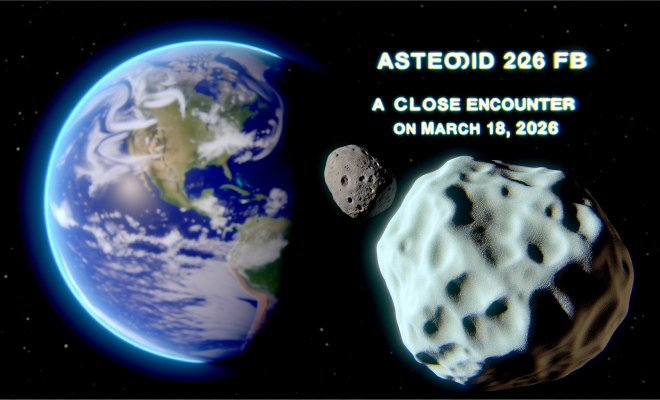
On March 18, 2026, a sizable asteroid named 2026 FB is set to make a close flyby of Earth, raising both interest and awareness among astronomers and space enthusiasts. Measuring approximately 69 feet in diameter—about the size of a small airplane—this near-Earth object (NEO) will pass at a distance that is nearly three times the distance between Earth and the Moon.

Understanding Asteroid 2026 FB

The asteroid 2026 FB is classified as a near-Earth object, a category that includes all comets and asteroids whose orbits bring them close to our planet. NASA’s extensive tracking systems monitor thousands of such bodies, enabling researchers to assess their trajectories and potential risks. Fortunately, NASA has confirmed that 2026 FB poses no threat to Earth during its upcoming flyby.

The Significance of the Flyby

The approach of 2026 FB serves as a reminder of the dynamic nature of our solar system. Every year, numerous small asteroids pass by Earth without incident, but each event provides valuable data that contributes to our understanding of planetary defense. Although 2026 FB is not expected to collide with Earth, its size is substantial enough that if it were to enter our atmosphere, it could potentially cause significant damage.

NASA’s Tracking and Monitoring Efforts

NASA has dedicated considerable resources to track NEOs, with the primary goal of identifying any potential threats to Earth. The agency employs a variety of telescopes and radar systems to observe the orbits of these celestial bodies, enhancing our ability to predict their paths. This proactive approach has enabled NASA to monitor the trajectories of thousands of asteroids, ensuring that any that might pose a risk are identified well in advance.

The Composition of Asteroids

Asteroids, including 2026 FB, are remnants from the early solar system, composed mainly of rock and metal. They vary in size and structure, with some being relatively small like 2026 FB, while others can be several hundred kilometers across. The composition of these celestial objects can provide insight into the formation of planets and the history of our solar system.

Potential Threats from Asteroids

While most asteroids pass by safely, the potential for impact remains a significant concern. A large enough asteroid entering Earth’s atmosphere could produce devastating effects, including:

  • Massive explosions upon impact
  • Destruction of infrastructure
  • Widespread environmental changes

The last notable asteroid impact event occurred in 2013 when a meteor exploded over Chelyabinsk, Russia, causing injuries to over a thousand people. This incident underscored the importance of monitoring NEOs closely.

Learning from Close Approaches

Close approaches like that of 2026 FB are not only a cause for scientific interest but also provide opportunities for research and preparation. Astronomers can study the asteroid’s trajectory, size, and composition, contributing to our knowledge of asteroid behavior and enhancing our planetary defense strategies. NASA and other space agencies around the world are continuously working to develop technologies that can deflect or redirect potentially hazardous asteroids.

The Role of International Collaboration

Addressing the challenges posed by NEOs requires a global effort. International cooperation is essential for sharing data, resources, and strategies to mitigate potential threats. Programs such as the NASA Planetary Defense Coordination Office (PDCO) work alongside other organizations to coordinate monitoring efforts and prepare for future asteroid encounters.

Conclusion: A Reminder of Our Cosmic Neighborhood

The upcoming flyby of asteroid 2026 FB serves as a fascinating reminder of our place in the cosmos. Events like this not only capture the imagination but also highlight the importance of vigilance in monitoring our celestial neighbors. As technology advances and we enhance our understanding of NEOs, we can better prepare for potential threats, ensuring the safety of our planet and its inhabitants.

As we look ahead to March 18, 2026, the flyby of 2026 FB is an opportunity for both scientists and the public to engage with the wonders of space and the ongoing efforts in planetary defense. The universe remains a dynamic and occasionally unpredictable place, but with ongoing research and collaboration, we can navigate these cosmic challenges with confidence.

Previous Article

AI Revolutionizes Software Stocks Amid Market Shifts

Next Article

Asteroid 2026 FB: A Close Encounter with ...

Matthew Lynch

Related articles More from author

  • Tech News

    China’s Green Wall: Halting Desertification & Restoring Ecosystems

    March 29, 2026
    By Matthew Lynch
  • Tech News

    Convert PDF to Word: Your Ultimate Guide to Editable Documents

    June 14, 2026
    By Matthew Lynch
  • Tech News

    75% of US Homes Unaffordable: Navigating the 2024 Housing Crisis

    June 7, 2026
    By Matthew Lynch
  • Tech News

    US Strikes Escalate: Trump Threatens Iran & Houthis, 2026

    July 24, 2026
    By Matthew Lynch
  • Tech News

    Ancient Stars (and a Thought on SETI)

    August 9, 2024
    By Matthew Lynch
  • Tech News

    Revitalizing Education: Making Schools Human Again

    April 22, 2026
    By Matthew Lynch

Search

Login & Registration

  • Log in
  • Entries feed
  • Comments feed
  • WordPress.org

Newsletter

Signup for The Tech Edvocate Newsletter and have the latest in EdTech news and opinion delivered to your email address!

About Us

Since technology is not going anywhere and does more good than harm, adapting is the best course of action. That is where The Tech Edvocate comes in. We plan to cover the PreK-12 and Higher Education EdTech sectors and provide our readers with the latest news and opinion on the subject. From time to time, I will invite other voices to weigh in on important issues in EdTech. We hope to provide a well-rounded, multi-faceted look at the past, present, the future of EdTech in the US and internationally.

We started this journey back in June 2016, and we plan to continue it for many more years to come. I hope that you will join us in this discussion of the past, present and future of EdTech and lend your own insight to the issues that are discussed.

Newsletter

Signup for The Tech Edvocate Newsletter and have the latest in EdTech news and opinion delivered to your email address!

Contact Us

The Tech Edvocate
910 Goddin Street
Richmond, VA 23231
(601) 630-5238
[email protected]

Copyright © 2026 Matthew Lynch. All rights reserved.