AI Just Launched on Wall Street — And It’s a Baffling Blow to Entry-Level Jobs
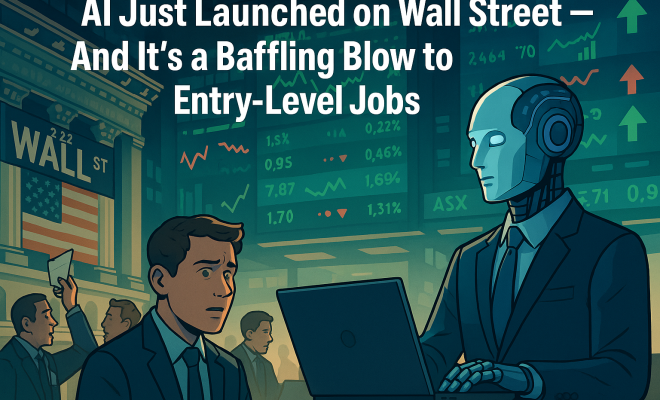
The financial world, famously resistant to radical change in its core apprenticeship model, just got a jolt straight from the future. In a development that will undoubtedly dominate the weekly business news cycle for months, OpenAI, the company that brought us the generative AI revolution, has officially launched an enterprise-grade version of ChatGPT specifically tailored for financial services. This isn’t just another tech gadget; it’s a meticulously crafted tool, developed in a strategic collaboration with titans like Morgan Stanley and Evercore, and it’s powered by the formidable GPT-6 Astra model. The announcement, hitting the airwaves around September 18, 2026, isn’t just about efficiency; it’s igniting a firestorm of discussion regarding the very bedrock of Wall Street’s talent pipeline: its entry-level positions.
Think about it: for decades, the path to becoming a dealmaker, an analyst, or a portfolio manager involved years of grueling, often repetitive, foundational work. You’d spend late nights poring over company reports, building intricate financial models in spreadsheets, and meticulously assembling presentation decks. These tasks, while essential, were also the crucible where young minds were forged, where they learned the nuances of an industry built on data and relationships. Now, with AI capable of automating much of this grunt work, a fundamental question is emerging: how exactly will Wall Street train its next generation if the traditional apprenticeship model, which relied on these foundational tasks, is being systematically dismantled?
The AI Invasion: ChatGPT’s New Financial Frontier
Let’s unpack what this new OpenAI offering actually means. We’re not talking about a consumer-facing chatbot here; this is an industrial-strength application designed for the high-stakes environment of global finance. Its capabilities are genuinely impressive: automating complex company research, performing granular financial data analysis with unprecedented speed, and even constructing polished presentation materials from raw data. Imagine the hours, the person-hours, that go into these tasks daily at a major investment bank or asset management firm. Now, imagine a significant portion of that being handled by an AI that doesn’t get tired, doesn’t make typos, and can process vast datasets in seconds.
The collaboration with financial heavyweights like Morgan Stanley and Evercore isn’t just a marketing ploy; it signals a deep integration. These firms aren’t just piloting the technology; they’ve been instrumental in shaping it, ensuring it meets the rigorous demands of regulatory compliance, data security, and analytical accuracy that are non-negotiable in finance. This isn’t a speculative future; it’s here, now, and it’s being deployed by some of the most influential players on the global stage. This move represents a significant leap from general-purpose AI to highly specialized, industry-specific applications, a trend we’re likely to see accelerate across other sectors.
The GPT-6 Astra Advantage: What Makes It Different?
At the heart of this new financial tool is OpenAI’s GPT-6 Astra model. While the specifics of this iteration are still emerging, the ‘Astra’ designation likely points to advancements in several key areas. We can infer it boasts enhanced reasoning capabilities, a deeper understanding of financial jargon and complex market dynamics, and perhaps even improved multimodal processing, allowing it to interpret not just text but also charts, graphs, and structured financial data with greater accuracy. Previous GPT models have shown remarkable aptitude for language generation and understanding, but a specialized financial model would need to go beyond that.
Think about the precision required. A misplaced decimal point or a misinterpretation of a balance sheet item can have catastrophic consequences in finance. GPT-6 Astra, developed with direct input from financial institutions, is engineered to minimize such errors, likely incorporating vast financial datasets for its training, along with expert-validated feedback loops. This isn’t just about generating plausible text; it’s about generating accurate, reliable, and actionable financial insights. That level of reliability is what makes it a genuine contender for tasks previously reserved for human analysts, further fueling the conversation around weekly business news and its implications.
Wall Street’s Apprenticeship Model Under Threat
This is where the emotional core of the discussion truly lies. Wall Street has always operated on an apprenticeship model. You join as an analyst, you work harder than you ever thought possible, you learn the ropes by doing the repetitive tasks, and gradually, you ascend. These entry-level roles—the M&A analysts, the research associates, the junior portfolio managers—are not just about output; they are about learning. They are about building a foundational understanding of how deals are structured, how markets move, and how to critically evaluate a company’s prospects.
If an AI can now conduct company research, analyze financial data, and even build presentation slides, what’s left for the human newcomers? Will they be relegated to higher-level, more strategic tasks from day one? Or will the sheer volume of entry-level positions simply shrink, making the path to Wall Street far more competitive and exclusive? The traditional learning curve, where you master the basics before moving to complexity, seems poised for a radical re-evaluation. This isn’t just about job displacement; it’s about the erosion of a time-honored training ground.
The Viral Discussion: Job Security and Accelerating Change
It’s no surprise this story is going viral. It touches on two deeply resonant themes: job security and the accelerating pace of technological change. For anyone considering a career in finance, or indeed, any knowledge-based industry, this news is a stark reminder that the landscape is shifting beneath our feet. The idea that a machine can perform tasks that once required years of human training and experience is both fascinating and unsettling. (See: AI's impact on Wall Street jobs.)
The emotional charge comes from the uncertainty. Will my job be next? What skills do I need to develop to remain relevant? This isn’t just about finance; it’s a microcosm of a broader societal anxiety. The rapid integration of AI into such a critical and high-paying sector like finance sends a clear signal that no industry, no role, is entirely immune to disruption. It forces a conversation not just about automation, but about human potential and adaptation in an increasingly AI-driven world. Keeping an eye on weekly business news will be crucial to track these ongoing shifts.
Beyond Finance: Implications for All Knowledge-Based Roles
While finance is the immediate focus, the implications of OpenAI’s move extend far beyond Wall Street. Many knowledge-based, entry-level roles across a multitude of industries share similar characteristics: they involve data gathering, analysis, synthesis, and presentation. Think about junior roles in consulting, legal services, market research, journalism, or even certain aspects of healthcare administration. If AI can automate financial research, it’s not a huge leap to imagine it automating legal discovery, market trend analysis, or even drafting initial reports in other professional services.
This development serves as a powerful case study for what’s coming. Companies are constantly seeking efficiency and cost reduction, and AI offers a compelling solution. The question for every industry, and for every individual in a knowledge-based role, becomes: what are the uniquely human contributions that AI cannot replicate? Where do empathy, creativity, nuanced judgment, and complex problem-solving intersect with technology? This isn’t about eliminating jobs entirely, but profoundly transforming them.
A Shifting Skillset: What Future Professionals Need
If the foundational, repetitive tasks are increasingly handled by AI, then the skills required for success in these industries will inevitably shift. Future professionals will need to be less focused on data entry and more on data interpretation, critical thinking, and strategic application. They’ll need to understand how to leverage AI tools, not just perform the tasks the AI can now do. This means a greater emphasis on:
- Prompt Engineering: The ability to articulate precise, effective queries to AI systems to get the desired output.
- AI Oversight and Validation: The skill to critically review AI-generated analyses, identify potential biases or errors, and ensure accuracy.
- Complex Problem-Solving: Tackling truly novel, unstructured problems that require human ingenuity and intuition.
- Strategic Thinking: Moving beyond analysis to synthesize insights and formulate actionable strategies.
- Interpersonal and Communication Skills: The ‘soft skills’ that AI struggles with – negotiation, client relations, team leadership, empathetic communication.
- Ethical AI Use: Understanding the ethical implications of AI and ensuring its responsible deployment.
The education system and corporate training programs will need to adapt rapidly to prepare the next generation for these evolving demands. This isn’t a minor tweak; it’s a fundamental reimagining of what it means to be a valuable professional in the digital age, a critical point in the ongoing weekly business news narrative.
The Silver Lining: Unleashing Human Potential?
It’s easy to focus on the potential downsides, but let’s consider the optimistic perspective. What if automating these foundational tasks frees up human talent to focus on higher-value activities? Imagine junior analysts spending less time building PowerPoint decks and more time on client engagement, creative problem-solving, or developing truly innovative financial products. By removing the drudgery, AI could potentially elevate the human experience in these roles, making them more intellectually stimulating and less prone to burnout.
This isn’t to say there won’t be disruption, but rather that the nature of work could evolve. If AI handles the mundane, humans can focus on the truly complex, the empathetic, the strategic, and the creative aspects that still define human intelligence. The goal isn’t necessarily fewer jobs, but different jobs, jobs that leverage uniquely human strengths. The challenge, of course, is managing this transition equitably and ensuring that individuals have the opportunity to reskill and adapt.
Navigating the AI Integration: A Roadmap for Firms and Individuals
For financial firms, the integration of AI like ChatGPT for financial services isn’t a choice; it’s an imperative to remain competitive. The firms that embrace and effectively deploy these tools will gain significant advantages in speed, accuracy, and cost efficiency. However, they also face the challenge of managing workforce transitions, retraining existing employees, and rethinking their talent acquisition strategies.
For individuals, the message is clear: continuous learning is no longer a luxury, but a necessity. Proactively seeking out opportunities to understand AI, learning how to work alongside it, and developing those uniquely human skills will be paramount. This isn’t about competing with AI; it’s about collaborating with it, and understanding where human intelligence adds irreplaceable value. The future of work, as highlighted in this week’s crucial weekly business news, will increasingly be a hybrid model, combining the best of human and artificial intelligence to drive unprecedented innovation and efficiency.
Regulatory Scrutiny and Ethical Considerations
The deployment of such powerful AI in finance doesn’t happen in a vacuum. Regulators, still grappling with the complexities of existing financial technologies, are undoubtedly watching this development with keen interest. Issues like algorithmic bias, data privacy, and accountability for AI-driven decisions are paramount. Imagine an AI identifying a pattern that leads to an investment decision, but that pattern is based on biased historical data, inadvertently discriminating against certain groups or markets. Who is responsible for the fallout?
There’s also the question of “explainability” – can the AI’s decision-making process be transparently understood and audited? In a highly regulated sector like finance, “black box” algorithms, where the internal workings are opaque, are a significant concern. Firms will need robust frameworks for AI governance, risk management, and ethical deployment to satisfy regulatory bodies and maintain public trust. This isn’t just about making money; it’s about operating responsibly within a complex legal and ethical landscape, a topic that will surely be a recurring theme in weekly business news. (See: AI and the future of finance.)
The Competitive Landscape: Who Else is Developing Financial AI?
While OpenAI’s collaboration with Morgan Stanley and Evercore is making headlines, they’re not the only players in this rapidly expanding field. Google, Amazon, and even smaller, specialized AI startups are all vying for a piece of the financial AI pie. Each brings its own strengths: Google with its vast search and data processing capabilities, Amazon with its cloud infrastructure and machine learning services, and startups often with niche expertise in specific financial domains.
The competition will likely drive further innovation, leading to even more sophisticated tools. We might see specialized AIs for fraud detection, personalized financial advisory, risk assessment, or even automated trading strategies. This competitive dynamic means financial institutions will have a growing array of choices, but also face the challenge of integrating diverse AI solutions seamlessly into their existing infrastructure. The speed and effectiveness of these integrations will be a key differentiator in the years to come, and a hot topic for weekly business news.
Impact on Financial Education and Academic Institutions
The traditional finance curriculum in universities and business schools is now under pressure to adapt. If entry-level tasks are being automated, what should aspiring finance professionals be learning? There’s a growing need for programs that blend traditional financial theory with advanced data science, AI literacy, and computational finance. Universities might need to rethink internship structures, focusing less on repetitive data tasks and more on projects that involve AI tool implementation, ethical AI analysis, and strategic problem-solving.
Furthermore, there’s an opportunity for academic institutions to become centers for AI research in finance, collaborating with industry to develop cutting-edge models and address complex challenges like explainable AI or robust risk modeling. This shift will require investment in new faculty, revised course materials, and a commitment to preparing students for a workforce that is fundamentally different from even a decade ago.
The Future of Investment Banking: A Glimpse
Let’s paint a picture of what investment banking might look like in a few years, as this AI integration matures. Junior bankers might spend significantly less time building pitch books or conducting basic due diligence. Instead, AI could generate initial company profiles, analyze market trends, and even draft preliminary deal structures based on vast datasets. The human role would then pivot to refining these outputs, applying nuanced judgment, and focusing on the relationship-building and negotiation aspects that remain distinctly human.
Senior bankers, freed from overseeing mundane tasks, could dedicate more time to complex strategic advisory, client relationship management, and identifying truly unique opportunities that require human intuition and network connections. The pace of deal-making could accelerate, and the capacity for analysis could expand exponentially. This doesn’t mean fewer bankers, but rather a redefinition of their value proposition, making them more strategic advisors and less data processors.
Expert Perspectives: What Industry Leaders Are Saying
Early reactions from industry leaders have been a mix of cautious optimism and strategic planning. Jamie Dimon, CEO of JP Morgan Chase, has repeatedly emphasized the transformative potential of AI while also highlighting the need for responsible deployment and upskilling the workforce. Others, like the heads of smaller boutique investment firms, see this as an opportunity to level the playing field, allowing them to access analytical power previously only available to bulge-bracket banks with massive staffing resources.
However, there’s also a recognition of the significant investment required, not just in technology, but in changing company culture and training programs. The human element, particularly in managing the anxieties of employees whose roles might change, is a critical challenge. The consensus seems to be that ignoring AI is not an option, and proactive engagement is key to navigating this shift successfully.
Frequently Asked Questions About AI in Finance
Q1: Will AI replace all entry-level finance jobs?
Probably not all, but many entry-level tasks that are repetitive and data-intensive are highly susceptible to automation. The roles themselves will transform, requiring new skills focused on AI oversight, critical thinking, and strategic application rather than rote execution. (See: The role of AI in finance.)
Q2: How accurate is AI like GPT-6 Astra in financial analysis?
With specialized training on vast financial datasets and expert-validated feedback, models like GPT-6 Astra are designed for high accuracy. However, human oversight and validation remain crucial to identify potential biases, errors, or misinterpretations that could have significant financial implications.
Q3: What are the biggest risks of using AI in finance?
Key risks include algorithmic bias (leading to unfair or inaccurate outcomes), data privacy and security concerns, the “black box” problem (lack of explainability in AI decisions), and potential for systemic risks if AI models interact in unexpected ways across markets. Regulatory and ethical frameworks are critical to mitigate these risks.
Q4: What skills should I focus on if I’m pursuing a career in finance now?
Beyond traditional financial knowledge, prioritize skills like prompt engineering, AI literacy, data science, critical thinking, complex problem-solving, strategic thinking, and strong interpersonal communication. Understanding how to leverage and oversee AI tools will be as important as understanding financial markets.
Q5: Is this just a trend, or a permanent shift?
This is widely regarded as a permanent and fundamental shift. The efficiencies and analytical capabilities offered by advanced AI are too significant for financial institutions to ignore. AI will become an integral part of the financial ecosystem, continually evolving and reshaping how work is done.
Q6: How will smaller firms compete with larger institutions that have more resources for AI?
AI tools can actually help level the playing field. Cloud-based AI services and specialized models can provide smaller firms with analytical power previously only accessible to larger players. Agility in adoption and niche specialization could be key competitive advantages for smaller entities.
The launch of ChatGPT for financial services marks a pivotal moment. It’s a clear signal that the AI revolution isn’t just coming; it’s already here, reshaping industries from the inside out. While the immediate focus is on the financial sector, the broader implications for job security, skill development, and the very nature of work itself are profound. We’re entering an era where human ingenuity will be defined not by what we can do that machines can’t, but by how effectively we can partner with machines to achieve what neither could do alone. The conversation has only just begun.
Trending Now
- our breakdown of the untapped goldmine: why ai certifications are crushing traditional degrees in 2026
- this guide on why your degree might be useless: the ai certifications quietly reshaping data careers
- Why Your Degree Might Be Obsolete:…
- this guide on this crucial shift in cybersecurity could double your salary
- read the full story
Frequently Asked Questions
How will AI impact entry-level jobs on Wall Street?
The introduction of AI tools like OpenAI's ChatGPT specifically for financial services is expected to automate many foundational tasks traditionally done by entry-level employees. This shift raises concerns about the future of these positions and how Wall Street will train its next generation of talent without the apprenticeship model that relies on these essential tasks.
What is the new AI tool launched by OpenAI for finance?
OpenAI has launched an enterprise-grade version of ChatGPT tailored for financial services, developed in collaboration with major firms like Morgan Stanley and Evercore. This tool is designed to automate complex research and financial data analysis, significantly changing how financial professionals operate in the industry.
What does the launch of AI on Wall Street mean for training?
The launch of AI tools in finance challenges the traditional training methods that rely on entry-level tasks. As these tasks become automated, the industry must rethink how to train new analysts and dealmakers, potentially reshaping the entire talent pipeline on Wall Street.
What capabilities does the new ChatGPT model have for financial services?
The new ChatGPT model, powered by GPT-6 Astra, is designed for high-stakes financial environments. It excels at automating complex company research and conducting detailed financial data analysis, which can enhance efficiency and accuracy in financial decision-making.
Why is the introduction of AI in finance considered a significant change?
The introduction of AI in finance represents a significant change because it disrupts the long-standing apprenticeship model that has defined Wall Street for decades. By automating essential tasks, AI is poised to transform how financial professionals learn and develop their skills in the industry.
What's your take on this? Share your thoughts in the comments below — we read every one.