The Tech Edvocate

Top Menu

  • Advertisement
  • Apps
  • Home Page
  • Home Page Five (No Sidebar)
  • Home Page Four
  • Home Page Three
  • Home Page Two
  • Home Tech2
  • Icons [No Sidebar]
  • Left Sidbear Page
  • Lynch Educational Consulting
  • My Account
  • My Speaking Page
  • Newsletter Sign Up Confirmation
  • Newsletter Unsubscription
  • Our Brands
  • Page Example
  • Privacy Policy
  • Protected Content
  • Register
  • Request a Product Review
  • Shop
  • Shortcodes Examples
  • Signup
  • Start Here
    • Governance
    • Careers
    • Contact Us
  • Terms and Conditions
  • The Edvocate
  • The Tech Edvocate Product Guide
  • Topics
  • Write For Us
  • Advertise

Main Menu

  • Start Here
    • Our Brands
    • Governance
      • Lynch Educational Consulting, LLC.
      • Dr. Lynch’s Personal Website
      • Careers
    • Write For Us
    • The Tech Edvocate Product Guide
    • Contact Us
    • Books
    • Edupedia
    • Post a Job
    • The Edvocate Podcast
    • Terms and Conditions
    • Privacy Policy
  • Topics
    • Assistive Technology
    • Child Development Tech
    • Early Childhood & K-12 EdTech
    • EdTech Futures
    • EdTech News
    • EdTech Policy & Reform
    • EdTech Startups & Businesses
    • Higher Education EdTech
    • Online Learning & eLearning
    • Parent & Family Tech
    • Personalized Learning
    • Product Reviews
  • Advertise
  • Tech Edvocate Awards
  • The Edvocate
  • Pedagogue
  • School Ratings

logo

The Tech Edvocate

  • Start Here
    • Our Brands
    • Governance
      • Lynch Educational Consulting, LLC.
      • Dr. Lynch’s Personal Website
        • My Speaking Page
      • Careers
    • Write For Us
    • The Tech Edvocate Product Guide
    • Contact Us
    • Books
    • Edupedia
    • Post a Job
    • The Edvocate Podcast
    • Terms and Conditions
    • Privacy Policy
  • Topics
    • Assistive Technology
    • Child Development Tech
    • Early Childhood & K-12 EdTech
    • EdTech Futures
    • EdTech News
    • EdTech Policy & Reform
    • EdTech Startups & Businesses
    • Higher Education EdTech
    • Online Learning & eLearning
    • Parent & Family Tech
    • Personalized Learning
    • Product Reviews
  • Advertise
  • Tech Edvocate Awards
  • The Edvocate
  • Pedagogue
  • School Ratings
  • RayNeo iO Smart Glasses: A Comprehensive Review

  • Glo Skin Beauty: The Aesthetician-Backed Brand Taking 25% Off for October Prime Day

  • The Shocking Truth: ESG Training Programs Are Quietly Reshaping Your Career Path

  • Why Millions of People Are Switching to These Green Energy Certifications Right Now

  • The green skills gap in 2026: How to address this growing problem

  • The Shocking Truth: Your Degree Won’t Land You the Best IT Jobs in 2026

  • The Brutal Truth About Degrees: Why Micro-Credentials Are Quietly Dominating Careers by 2026

  • Why 96% of Employers Now Prefer Skills Over Degrees: The Micro-Credential Revolution

  • This Crucial Mistake With AI Is Stunting Student Minds: Here’s How to Fix It

  • The AI ‘Cognitive Surrender’ Crisis: 7 Tools Every Educator Needs NOW

Teachers
Home›Teachers›Activities to Teach Students to Identify Earth’s Land Features

Activities to Teach Students to Identify Earth’s Land Features
By Matthew Lynch
June 12, 2023
0
Spread the love

Earth is a fascinating planet with an abundance of land features that amaze all who see them. From the serene beauty of mountains to the rugged terrain of valleys, plains and plateaus, the Earth has plenty to offer in terms of physical features.

Teaching students to identify and appreciate the full scope of Earth’s land features is an essential element of geography education. Not only does knowledge of these features increase children’s understanding of our world, but it also helps in the development of their spatial awareness and critical thinking skills. Here are some engaging and effective ways to teach students how to identify Earth’s land features.

1. Use Maps and Visual Aids

Visual aids always work as a great starting point when teaching about land features. Teachers can use maps and other visually appealing resources like posters, videos, and photographs to get students interested and excited about geography. With maps, students get a bird’s eye view of how different land features come together and their relation to one another. Mapping activities allow the students to identify different features on the map and distinguish between them based on their characteristics.

2. Collect Samples

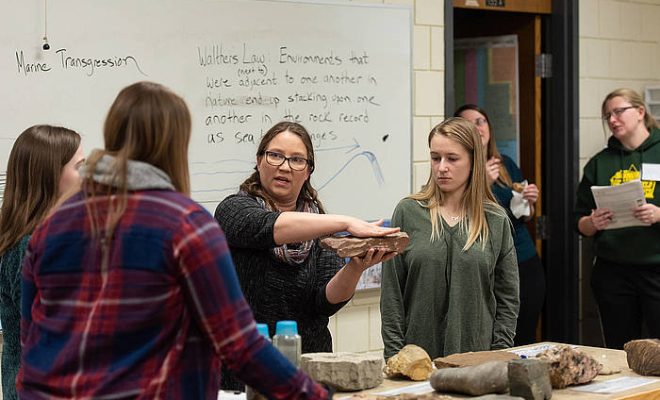
Most land features are also characterized by their unique geological composition. Collecting samples of different rocks and mineral deposits from different land features will make the subject matter more interesting and tangible for students to understand. For example, students can collect shale and sandstone samples from different environments and compare their characteristics, allowing them to see the differences between mountainous regions and flatlands.

3. Field Trips

Field trips can be a great way to take the students on a guided tour of various land features in their area. Outdoor activities can be the perfect way of teaching about land features, as it allows students to experience them firsthand. While visiting various land features, the teacher can guide the students to discover unique features and also gauge their understanding of what they see.

4. Create Models

Creating models of various land features like, valleys, plateaus, mountains or lakes can help the students visualize the formation of the land features. Modeling these features using materials such as clay, playdough or salt dough can help students understand the underlying geological processes involved in their formation.

5. Games and Quizzes

Games and quizzes can be an engaging and fun way of assessing students’ knowledge of land features. Teachers can create games like ‘Name That Land Feature’ where they describe a land feature in detail and the students have to guess the feature it describes. Quizzes can be prepared with multiple-choice questions based on identifying the characteristics of land features.

The above activities are just a few examples of the fun and engaging ways to teach students the formation and identification of Earth’s land features. It is vital to make learning an interactive experience that enables children to discover their world and develop their critical thinking skills. The ultimate goal is for students to gain a deeper understanding and appreciation for the amazing natural features that make up the world we live in.


Previous Article

Activities to Teach Students to Identify Discrete ...

Next Article

Activities to Teach Students to Identify Earth’s ...

Matthew Lynch

Related articles More from author

  • Teachers

    14 Puns and Jokes Only a True Grammar Nerd Will Get

    October 10, 2023
    By Matthew Lynch
  • Teachers

    The Ultimate Checklist For Setting Up Your Second Grade Classroom

    October 12, 2023
    By Matthew Lynch
  • Teachers

    Why We’re Forever Fans of the “Nothing Note”

    October 12, 2023
    By Matthew Lynch
  • Teachers

    18 Zones of Regulation Activities to Help Kids Manage Their Emotions

    October 10, 2023
    By Matthew Lynch
  • Teachers

    Activities to Teach Students to Identify Possessive Pronouns

    June 12, 2023
    By Matthew Lynch
  • Teachers

    Questions About Virtual Parent Teacher Conferences? We’ve Got Answers.

    October 13, 2023
    By Matthew Lynch

Search

Login & Registration

  • Log in
  • Entries feed
  • Comments feed
  • WordPress.org

Newsletter

Signup for The Tech Edvocate Newsletter and have the latest in EdTech news and opinion delivered to your email address!

About Us

Since technology is not going anywhere and does more good than harm, adapting is the best course of action. That is where The Tech Edvocate comes in. We plan to cover the PreK-12 and Higher Education EdTech sectors and provide our readers with the latest news and opinion on the subject. From time to time, I will invite other voices to weigh in on important issues in EdTech. We hope to provide a well-rounded, multi-faceted look at the past, present, the future of EdTech in the US and internationally.

We started this journey back in June 2016, and we plan to continue it for many more years to come. I hope that you will join us in this discussion of the past, present and future of EdTech and lend your own insight to the issues that are discussed.

Newsletter

Signup for The Tech Edvocate Newsletter and have the latest in EdTech news and opinion delivered to your email address!

Contact Us

The Tech Edvocate
910 Goddin Street
Richmond, VA 23231
(601) 630-5238
[email protected]

Copyright © 2026 Matthew Lynch. All rights reserved.