A Million Satellites: Why Our Night Sky May Vanish Forever
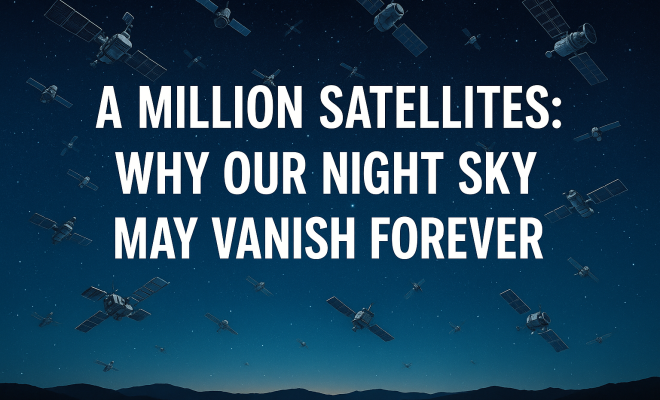
Imagine gazing up at a truly dark night sky, far from the city lights, and seeing the Milky Way stretch across the heavens like a river of diamonds. It’s a profound, almost spiritual experience, one that has connected humanity to the cosmos for millennia. But what if that view, a birthright we’ve largely taken for granted, were to disappear? What if the stars we know were to be overshadowed by a glittering, artificial haze?
That alarming prospect is exactly what a recent study by the European Southern Observatory (ESO) laid bare on July 30, 2026. Scientists are sounding the alarm about an astonishing 1.7 million new satellites planned for launch. This isn’t just about a few more dots in the sky; we’re talking about a potential astronomical revolution, one that could drastically alter our night sky, creating a novel form of space pollution and, quite possibly, obscuring our view of the universe forever. This isn’t science fiction; it’s a very real, very imminent threat, and it demands our attention.
The Looming Cloud: Over a Million New Satellites
To truly grasp the scale of what we’re facing, let’s put that number, 1.7 million, into perspective. For decades, the total number of operational satellites in orbit hovered in the low thousands. Even today, the active satellite count is still only around 10,000. So, adding another 1.7 million isn’t just an increase; it’s an exponential explosion. This isn’t a gradual growth; it’s a massive, unprecedented expansion, driven largely by the ambition to provide global internet access, primarily through so-called ‘mega-constellations.’
SpaceX’s Starlink, for instance, is perhaps the most well-known of these ventures, already having launched thousands of satellites and planning tens of thousands more. Other players, like Amazon’s Project Kuiper and OneWeb, have similar, though perhaps slightly less ambitious, plans. The idea is simple: blanket the Earth in a web of low-Earth orbit (LEO) satellites to deliver high-speed, low-latency internet to every corner of the globe, including remote and underserved areas. On paper, it sounds like a technological marvel, a democratizing force for information. But every technological leap, no matter how well-intentioned, can have unforeseen consequences, and in this case, those consequences are literally astronomical.
How Satellites Become Space Pollution in the Night Sky
When we talk about ‘space pollution’ in this context, we’re not just referring to the discarded debris that’s already a problem in orbit – old rocket stages, defunct satellites, fragments from collisions. That’s a different, though related, issue. Here, the concern is about active satellites, specifically their impact on the visual environment of the night sky. These satellites, even though they’re relatively small, become surprisingly bright. Why? Because they reflect sunlight.
Think about it: after sunset or before sunrise, when the ground is dark, objects high above the Earth can still catch the sun’s rays. These satellites, typically orbiting at altitudes between 300 and 1,200 miles, are perfectly positioned to do just that. As they zip across the sky, they appear as moving ‘stars’ – often brighter than many actual stars. The sheer number of these planned satellites means that instead of seeing a pristine, dark firmament punctuated by natural stars and planets, we could be looking at a sky crisscrossed by countless artificial streaks of light. It’s a fundamental alteration of a view that has remained largely unchanged for human civilization.
The Astronomical Impact: Blinding Our View of the Cosmos
For professional astronomers, this isn’t just an aesthetic problem; it’s an existential threat to their work. The ESO study’s findings are stark: this massive influx of reflective objects could increase the background brightness of the night sky by a staggering 200-300%. To put that into perspective, imagine trying to read a faint, handwritten note under a very bright floodlight. The floodlight doesn’t directly obscure the note, but its glare makes the faint details impossible to discern.
This increased sky brightness would effectively blind ground-based telescopes, particularly those designed to observe faint, distant galaxies. Many of these galaxies are billions of light-years away, their light taking eons to reach us, carrying crucial information about the early universe, dark matter, and cosmic evolution. When the background sky becomes significantly brighter, the faint signals from these distant objects get washed out, making their observation impossible. It’s like trying to hear a whisper during a rock concert – the signal is there, but the noise completely overwhelms it. This isn’t just an inconvenience; it represents a potential end to certain types of astronomical research from Earth, forcing astronomers to either build vastly more powerful (and expensive) instruments or move their operations to space, which comes with its own set of challenges and costs.
Beyond Professional Research: The Public’s Connection to the Stars
While the immediate impact on astronomical research is severe, the consequences of this space pollution extend far beyond the scientific community. For countless people around the world, the night sky is a source of wonder, inspiration, and a profound connection to something larger than themselves. From ancient navigators using the stars to guide their voyages, to modern stargazers simply enjoying a quiet moment under the vastness, the unblemished night sky has been a constant.
What happens when that view is permanently altered? When the Milky Way becomes a distant memory, replaced by a grid of artificial lights? This isn’t just about losing a pretty view; it’s about losing a cultural touchstone, a shared human experience that transcends borders and generations. It raises questions about our right to a natural night sky and whether technological advancement, however beneficial, should come at the cost of such a fundamental human experience. The emotional charge of this issue is palpable, sparking passionate debate among scientists, environmentalists, and the general public alike. (See: overview of satellites in orbit.)
The Call for Regulation: A Global Challenge
The controversy surrounding these mega-constellations boils down to a fundamental question: who owns the night sky, and who decides how it’s used? Currently, there are no strict international regulations governing the brightness or sheer number of satellites launched. While national space agencies like NASA or ESA have guidelines, the commercial space industry operates in a largely unregulated frontier, driven by market demands and technological capability.
The ESO study, along with other astronomical organizations, is urgently calling for the establishment of strict international regulations. These regulations would need to address several key aspects: limiting the number of satellites in orbit, mandating lower reflectivity (perhaps through darker coatings or altered designs), and even potentially restricting orbits to minimize visual impact during prime observing hours for astronomers. This is a complex diplomatic challenge, as it involves balancing the commercial interests of powerful corporations and nations with the scientific and cultural interests of humanity as a whole. It demands a global conversation and a willingness to compromise for the long-term benefit of everyone.
Mitigation Efforts: Can Technology Save the View?
It’s not all doom and gloom, and credit where credit is due: some satellite operators are engaging with the astronomical community to explore mitigation strategies. SpaceX, for example, has experimented with darker coatings on some of its Starlink satellites, such as ‘DarkSat’ and ‘VisorSat,’ which include sunshades. The goal is to reduce their albedo, or reflectivity, making them less visible from Earth.
However, these efforts are still in their early stages and their effectiveness is debated. Even if individual satellites can be made dimmer, the sheer volume of 1.7 million objects still presents a formidable challenge. A dimmer satellite multiplied by a million still adds up to a significant amount of space pollution. Furthermore, these mitigation techniques often add complexity and cost to satellite manufacturing and deployment, which can be a disincentive for companies driven by profit margins. The question remains: are these voluntary, piecemeal efforts enough to truly address the scale of the problem, or do we need a more systemic, regulated approach?
The Economic and Geopolitical Landscape of Space
It’s crucial to understand that this issue isn’t happening in a vacuum. The push for mega-constellations is deeply intertwined with significant economic and geopolitical interests. Companies like SpaceX, Amazon, and OneWeb are vying for dominance in the burgeoning global satellite internet market, which promises to be incredibly lucrative. This isn’t just about providing internet to remote villages; it’s about connecting everything from autonomous vehicles to IoT devices, and offering resilient, high-bandwidth communication for military and commercial applications.
Nations, too, see strategic advantages in controlling access to space and satellite-based communication. It’s a new frontier for economic growth, technological leadership, and national security. This complex web of interests makes international regulation particularly challenging. No single nation or corporation wants to be at a disadvantage by adopting stricter standards if competitors aren’t doing the same. It requires a level of global cooperation that has historically been difficult to achieve, especially when significant financial and strategic stakes are involved.
The Broader Impact: Space Debris and Orbital Congestion
While the visual pollution of the night sky is a primary concern, the sheer number of planned satellites also exacerbates another critical problem: space debris and orbital congestion. Even if these new satellites are active, they have finite lifespans. Once they cease to function, they become defunct, contributing to the growing cloud of space junk orbiting Earth. The European Space Agency (ESA) estimates there are already over 36,000 pieces of space debris larger than 10 cm, and millions of smaller, untrackable fragments. Each of these fragments poses a collision risk.
The Kessler Syndrome, a theoretical scenario where the density of objects in low Earth orbit (LEO) becomes so high that collisions generate enough debris to cause more collisions, creating a cascade, is a very real threat. If this cascade were to occur, certain orbital altitudes could become unusable for generations, effectively locking humanity out of a vital part of space. The addition of 1.7 million new satellites, even with plans for de-orbiting at the end of their lives, dramatically increases the probability of such catastrophic events. A single, uncontrolled collision could create thousands of new pieces of debris, further polluting the orbital environment and threatening not just astronomical observation, but all future space operations, including weather satellites, GPS, and scientific research missions.
The Role of Astronomy in a Changing Sky: Adapting and Advocating
Astronomers aren’t just raising alarms; they’re also actively working to adapt and advocate for solutions. Organizations like the International Astronomical Union (IAU) have established centers like the Centre for the Protection of the Dark and Quiet Sky from Satellite Constellation Interference (CPS) to coordinate research and policy efforts. They’re developing software to identify and remove satellite trails from astronomical images, though this is a computationally intensive and often imperfect solution, particularly for wide-field surveys.
New telescope designs are also being considered, potentially incorporating features that can better filter out satellite interference. However, these adaptations come with significant costs and may not fully mitigate the impact on all types of observations. The ultimate goal for astronomers remains the preservation of naturally dark and quiet skies, recognizing that technological workarounds are bandages, not cures. Their advocacy is crucial in pushing for policy changes that consider the long-term health of both the orbital environment and our view of the cosmos.
Space-Based Astronomy: A Partial Solution, Not a Panacea
One common suggestion to mitigate the impact of ground-based astronomy is to simply move more telescopes into space, mirroring the success of instruments like the Hubble Space Telescope or the James Webb Space Telescope. While space telescopes offer unparalleled views, free from atmospheric distortion and terrestrial light pollution, they are incredibly expensive to build, launch, and maintain. A single space telescope can cost billions of dollars, compared to ground-based observatories that, while still expensive, offer far greater capacity and flexibility for a fraction of the cost per instrument. (See: impact of light pollution on health.)
Furthermore, even space-based telescopes are not entirely immune to the problem of space pollution. LEO satellites can still interfere with observations from telescopes in higher orbits, especially if they cross the telescope’s field of view. And the increasing density of debris could pose a direct threat to the operational lifespan of these invaluable orbital assets. So, while space telescopes are vital for certain types of research, they cannot replace the breadth and depth of observations conducted by the global network of ground-based observatories. Relying solely on space-based astronomy would severely limit our collective ability to explore the universe.
The Ethical Dimension: A Right to the Night Sky?
The debate around space pollution touches upon profound ethical questions. Do humans have a fundamental right to an unimpeded view of the night sky? Is it a shared global commons, similar to the oceans or the atmosphere, that should be protected for all future generations? Or is the pursuit of technological advancement and universal connectivity a higher priority, even if it means altering a millennia-old natural phenomenon?
Many argue that the night sky is a heritage site, a source of cultural, scientific, and spiritual value that belongs to everyone. Indigenous cultures worldwide have deep, intricate connections to the stars, using them for storytelling, navigation, and understanding their place in the cosmos. Altering this view isn’t just a scientific inconvenience; it’s a disruption of cultural identity and a loss of an irreplaceable connection to our shared human history. Balancing these competing values – technological progress, commercial interests, and the preservation of a natural, cultural, and scientific resource – is at the heart of the ethical dilemma we face.
The Path Forward: International Cooperation and Innovation
Addressing space pollution requires a multi-faceted approach involving international cooperation, technological innovation, and strong regulatory frameworks. Here’s what a comprehensive strategy might look like:
- International Treaty or Protocol: Building on existing space law, a new international agreement is needed to specifically address mega-constellations. This could involve setting limits on the number of satellites in LEO, mandating de-orbiting timelines, and establishing brightness standards.
- Technological Innovation for Mitigation: Continued research and development into darker materials, anti-reflective coatings, and adaptive optics for ground-based telescopes are crucial. Satellite operators should be incentivized or mandated to adopt these technologies.
- Orbital Traffic Management: Developing sophisticated, globally coordinated systems for tracking, predicting, and managing orbital traffic to prevent collisions and optimize orbital slots.
- Data Sharing and Transparency: Satellite operators should be required to share detailed orbital parameters and brightness data with the astronomical community and regulatory bodies to aid in prediction and mitigation.
- Public Awareness and Advocacy: Educating the public about the issue of space pollution and mobilizing support for dark sky preservation can create the political will necessary for meaningful change.
This isn’t an easy task, but the stakes are incredibly high. The decisions made in the coming years will determine the future of our night sky and our ability to explore the universe from Earth.
Our Shared Future: A Call to Action
The prospect of a permanently altered night sky due to space pollution is a sobering one. It forces us to confront difficult questions about progress, responsibility, and our relationship with the natural world – even when that ‘world’ extends far beyond our atmosphere. Do we prioritize ubiquitous, low-latency internet at the expense of our ability to study the universe and connect with its ancient beauty?
This isn’t an either/or scenario where we must choose between technological advancement and preserving the night sky. There’s a middle ground, but finding it requires proactive engagement, scientific consensus, and robust international cooperation. We need to demand transparency from satellite operators, support research into effective mitigation strategies, and advocate for strong, enforceable regulations that protect this invaluable shared resource. The night sky is more than just a backdrop; it’s a window into our origins and our future, and it’s a window we cannot afford to close.
Frequently Asked Questions About Space Pollution and Mega-Constellations
What is space pollution, specifically in the context of mega-constellations?
In this context, space pollution refers primarily to the increase in artificial light and objects visible in the night sky due to large numbers of active satellites, known as mega-constellations. These satellites reflect sunlight, appearing as bright streaks or moving ‘stars’ that interfere with astronomical observations and alter the natural appearance of the night sky. It’s distinct from, though related to, space debris (defunct satellites, rocket parts, and fragments).
How many satellites are currently in orbit, and how many are planned?
As of late 2023/early 2024, there are roughly 10,000 active satellites in orbit. However, as highlighted by the ESO study, an astonishing 1.7 million new satellites are planned for launch by various companies and nations in the coming years, primarily for global internet provision.
Why are these satellites so bright?
Satellites become bright because they reflect sunlight. They orbit high above Earth, so after sunset or before sunrise on the ground, they can still catch the sun’s rays. Their metallic surfaces act like mirrors, scattering light back towards Earth, making them visible to the naked eye and especially to sensitive telescopes. (See: scientific study on light pollution.)
What is the impact of space pollution on professional astronomy?
The primary impact is increased sky brightness, which can overwhelm the faint light from distant celestial objects. This makes it incredibly difficult, and sometimes impossible, for ground-based telescopes to observe galaxies, nebulae, and other faint phenomena. It effectively blinds these instruments, hindering research into the early universe, dark matter, and cosmic evolution. Satellite streaks also contaminate astronomical images, requiring complex and often imperfect post-processing to remove.
Does space pollution only affect professional astronomers?
No, the impact extends to everyone. The natural night sky is a shared human heritage, a source of wonder, inspiration, and cultural significance for millennia. A sky filled with artificial satellite trails diminishes this experience for stargazers, amateur astronomers, and anyone who appreciates an unblemished view of the cosmos. It represents a loss of a fundamental human connection to the universe.
What is being done to mitigate this space pollution?
Some satellite operators, like SpaceX, are experimenting with mitigation strategies such as darker coatings and sunshades (e.g., ‘DarkSat’ and ‘VisorSat’) to reduce the reflectivity of their satellites. The astronomical community, through organizations like the IAU’s CPS, is engaging with operators, advocating for stronger regulations, and developing software to help remove satellite trails from data. However, these efforts are often voluntary and the effectiveness of current mitigation techniques for the sheer volume of planned satellites is still under evaluation.
Are there international regulations for satellite launches and brightness?
Currently, there are no specific, strict international regulations governing the number of satellites that can be launched or their mandated brightness. While existing space law (like the Outer Space Treaty) covers some aspects of space activity, it doesn’t adequately address the challenges posed by mega-constellations. This lack of robust regulation is a major concern for astronomers and space environmentalists, who are calling for new international agreements.
What is the Kessler Syndrome, and how do mega-constellations relate to it?
The Kessler Syndrome is a theoretical scenario where the density of objects in low Earth orbit (LEO) becomes so high that collisions between objects generate enough debris to cause more collisions, creating a self-sustaining cascade. This could render certain orbital regions unusable for generations. Mega-constellations, by dramatically increasing the number of objects in LEO, significantly raise the probability of such a catastrophic event, even if individual satellites have de-orbiting plans.
Why don’t we just move all telescopes into space?
Space telescopes, like Hubble and James Webb, offer incredible advantages, but they are astronomically expensive to build, launch, and maintain (billions of dollars per instrument). Ground-based telescopes, while affected by the atmosphere and light pollution, provide far greater capacity, flexibility, and cost-effectiveness for a wide range of observations. Relying solely on space-based astronomy would severely limit our collective ability to explore the universe and is not a practical or comprehensive solution.
What can individuals do to help address space pollution?
Individuals can help by raising awareness about the issue, supporting organizations that advocate for dark sky preservation and responsible space practices, and engaging with their elected officials to encourage international cooperation and regulation. Learning about the issue and sharing that knowledge is a powerful first step.
Trending Now
Frequently Asked Questions
What is the impact of satellites on the night sky?
The launch of 1.7 million new satellites could create a significant 'space pollution' effect, obscuring our view of the night sky and potentially drowning out the stars we cherish. This unprecedented increase poses a serious threat to our ability to experience a truly dark sky.
How many satellites are currently in orbit?
Currently, there are around 10,000 operational satellites in orbit. The proposed addition of 1.7 million new satellites represents a massive and exponential increase, fundamentally changing the landscape of space.
What are mega-constellations?
Mega-constellations are large groups of satellites designed to provide global internet coverage. Projects like SpaceX's Starlink and Amazon's Project Kuiper aim to deploy thousands of low-Earth orbit satellites to achieve this goal, contributing to the anticipated satellite surge.
Will the stars still be visible with more satellites?
With the planned launch of millions of new satellites, the visibility of stars may be severely compromised. The artificial light and haze created by these satellites could prevent us from seeing the Milky Way and other celestial wonders.
Why are so many satellites being launched?
The primary motivation behind the launch of millions of new satellites is to provide global internet access through mega-constellations. Companies like SpaceX and Amazon are leading this charge, aiming to connect underserved regions and enhance global communication.
Have you experienced this yourself? We'd love to hear your story in the comments.