The Tech Edvocate

Top Menu

  • Advertisement
  • Apps
  • Home Page
  • Home Page Five (No Sidebar)
  • Home Page Four
  • Home Page Three
  • Home Page Two
  • Home Tech2
  • Icons [No Sidebar]
  • Left Sidbear Page
  • Lynch Educational Consulting
  • My Account
  • My Speaking Page
  • Newsletter Sign Up Confirmation
  • Newsletter Unsubscription
  • Our Brands
  • Page Example
  • Privacy Policy
  • Protected Content
  • Register
  • Request a Product Review
  • Shop
  • Shortcodes Examples
  • Signup
  • Start Here
    • Governance
    • Careers
    • Contact Us
  • Terms and Conditions
  • The Edvocate
  • The Tech Edvocate Product Guide
  • Topics
  • Write For Us
  • Advertise

Main Menu

  • Start Here
    • Our Brands
    • Governance
      • Lynch Educational Consulting, LLC.
      • Dr. Lynch’s Personal Website
      • Careers
    • Write For Us
    • The Tech Edvocate Product Guide
    • Contact Us
    • Books
    • Edupedia
    • Post a Job
    • The Edvocate Podcast
    • Terms and Conditions
    • Privacy Policy
  • Topics
    • Assistive Technology
    • Child Development Tech
    • Early Childhood & K-12 EdTech
    • EdTech Futures
    • EdTech News
    • EdTech Policy & Reform
    • EdTech Startups & Businesses
    • Higher Education EdTech
    • Online Learning & eLearning
    • Parent & Family Tech
    • Personalized Learning
    • Product Reviews
  • Advertise
  • Tech Edvocate Awards
  • The Edvocate
  • Pedagogue
  • School Ratings

logo

The Tech Edvocate

  • Start Here
    • Our Brands
    • Governance
      • Lynch Educational Consulting, LLC.
      • Dr. Lynch’s Personal Website
        • My Speaking Page
      • Careers
    • Write For Us
    • The Tech Edvocate Product Guide
    • Contact Us
    • Books
    • Edupedia
    • Post a Job
    • The Edvocate Podcast
    • Terms and Conditions
    • Privacy Policy
  • Topics
    • Assistive Technology
    • Child Development Tech
    • Early Childhood & K-12 EdTech
    • EdTech Futures
    • EdTech News
    • EdTech Policy & Reform
    • EdTech Startups & Businesses
    • Higher Education EdTech
    • Online Learning & eLearning
    • Parent & Family Tech
    • Personalized Learning
    • Product Reviews
  • Advertise
  • Tech Edvocate Awards
  • The Edvocate
  • Pedagogue
  • School Ratings
  • 9 Critical Reasons Why Athexio Might Be The Investment You Need (Or Should Avoid)

  • A Single Breakthrough Could Finally Kill Range Anxiety for Millions of EV Owners

  • Your Money, Their AI: The Secret Agents Invading Bank Accounts

  • US Battery as a Service Market Shifts Toward Fleet-Based Energy

  • The Startling Truth: Why Americans Distrust AI with Their Health

  • This Crucial Deadline for Banks Is Closer Than You Think

  • Baffling: CrowdStrike’s $500 Million AI Bet Reshapes Cybersecurity

  • This Crucial Autonomous Driving Rule Could Cost You Everything

  • Baffling: Microsoft AI CEO Demands Halt to Conscious AI Development

  • O seară în ritmul tău: atmosfera divertismentului de cazinou pe internet

Assistive Technology
Home›Assistive Technology›How to Change Your DNS Settings to Increase Speed

How to Change Your DNS Settings to Increase Speed
By Matthew Lynch
June 14, 2023
0
Spread the love

The Domain Name System (DNS) is responsible for translating human-readable website addresses into their actual IP addresses, allowing us to access them on the internet. DNS servers can play a significant role in your internet speed, as they can affect how quickly your computer can connect to a website. If your current DNS server is not performing well, you might experience slow internet speeds and long loading times.

Fortunately, changing your DNS settings can be an easy way to improve your internet speed. This article will guide you through the steps to change your DNS settings on a computer running Windows 10.

Step 1: Open the Control Panel

Click on the “Start” button on your taskbar and type “Control Panel” in the search box. Open the Control Panel from the search results.

Step 2: Click on “Network and Sharing Center”

In the Control Panel window, click on “Network and Sharing Center”.

Step 3: Click on “Change adapter settings”

On the left side of the Network and Sharing Center window, click on “Change adapter settings”. This will show you a list of all the network connections available on your computer.

Step 4: Right-click on your network adapter

Right-click on the network adapter you are currently using to connect to the internet and select “Properties” from the drop-down menu.

Step 5: Select Internet Protocol Version 4 (TCP/IPv4)

In the Properties window, scroll down the list of items and select “Internet Protocol Version 4 (TCP/IPv4)”. Click on the “Properties” button.

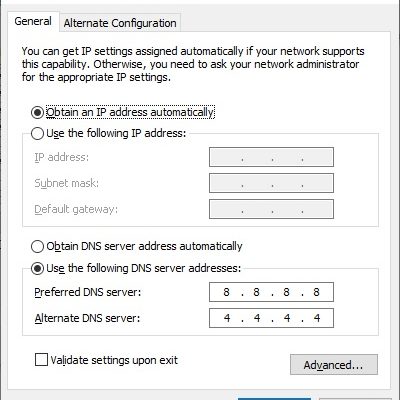
Step 6: Select “Use the following DNS server addresses”

In the Internet Protocol Version 4 (TCP/IPv4) Properties window, select “Use the following DNS server addresses”. Enter the following DNS addresses in the fields provided:

Preferred DNS server: 8.8.8.8

Alternate DNS server: 8.8.4.4

These addresses are Google’s public DNS servers, and they are known to provide fast and reliable connections.

Step 7: Click “OK”

Click on the “OK” button to save your changes.

Step 8: Test your internet speed

Now that you have changed your DNS settings, you can test your internet speed to see if it has improved. Visit any site that lets you check your internet speed, such as Speedtest.net or Fast.com, and measure your download and upload speeds. If you notice an improvement in your speed, you can be confident that your new DNS settings are working correctly.

Conclusion

Changing your DNS settings can significantly improve your internet speed and make your browsing experience more enjoyable. If you follow the steps outlined above, you can change your DNS settings in just a few minutes and start experiencing faster internet speeds. However, keep in mind that different DNS servers might work better for different users, so it’s worth experimenting with different options to find the best one for you.


Previous Article

How to Add Email Aliases to Gmail

Next Article

PSN Account Hacked? Here’s What to Do ...

Matthew Lynch

Related articles More from author

  • Assistive Technology

    Interesting Family Photoshoot Ideas Worth Trying

    June 15, 2023
    By Matthew Lynch
  • Assistive Technology

    How to Use the Friends Tab on TikTok

    June 22, 2023
    By Matthew Lynch
  • Assistive Technology

    How to Extend Wi-Fi Outdoors

    June 12, 2023
    By Matthew Lynch
  • Assistive Technology

    How to Keep the Screen Active on Android

    June 6, 2023
    By Matthew Lynch
  • Assistive Technology

    How to Automatically CC or BCC Yourself in Outlook and Gmail

    June 21, 2023
    By Matthew Lynch
  • Assistive Technology

    Ways to Flush the DNS Cache on Windows 11

    June 6, 2023
    By Matthew Lynch

Search

Login & Registration

  • Log in
  • Entries feed
  • Comments feed
  • WordPress.org

Newsletter

Signup for The Tech Edvocate Newsletter and have the latest in EdTech news and opinion delivered to your email address!

About Us

Since technology is not going anywhere and does more good than harm, adapting is the best course of action. That is where The Tech Edvocate comes in. We plan to cover the PreK-12 and Higher Education EdTech sectors and provide our readers with the latest news and opinion on the subject. From time to time, I will invite other voices to weigh in on important issues in EdTech. We hope to provide a well-rounded, multi-faceted look at the past, present, the future of EdTech in the US and internationally.

We started this journey back in June 2016, and we plan to continue it for many more years to come. I hope that you will join us in this discussion of the past, present and future of EdTech and lend your own insight to the issues that are discussed.

Newsletter

Signup for The Tech Edvocate Newsletter and have the latest in EdTech news and opinion delivered to your email address!

Contact Us

The Tech Edvocate
910 Goddin Street
Richmond, VA 23231
(601) 630-5238
[email protected]

Copyright © 2026 Matthew Lynch. All rights reserved.