Unprecedented: Tech Firm Offers Cash for Law Firm Emails – Is Privilege Dead?
“`html
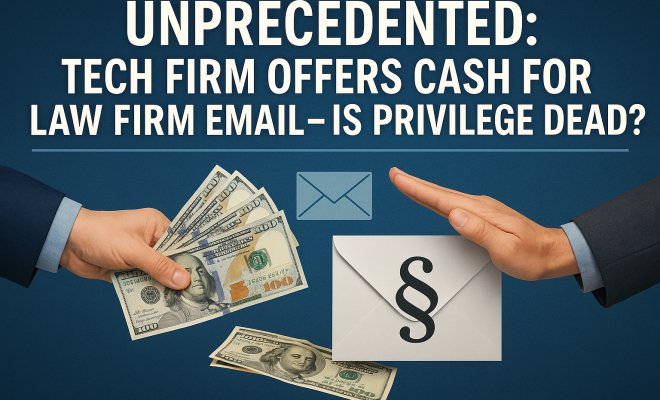
Imagine a scenario straight out of a dystopian legal thriller: a tech company, Mode.Inc, openly offering to pay law firms for their internal communications, including emails and other “historical operational records.” No, this isn’t a plot twist from a sci-fi novel; it’s the very real, and frankly, quite alarming, development that hit the legal world on October 16, 2026. Mode.Inc, through its new initiative BizBuyData.com, has ignited a firestorm of debate, raising critical questions about client privilege, data security, and the bedrock principles of legal confidentiality. This isn’t just about a new business model; it’s a direct challenge to the very soul of the legal profession and brings the issue of AI legal ethics to a terrifying new forefront.
The news spread like wildfire, particularly across legal forums and social media, and for good reason. The proposal to monetize what many consider sacred – the confidential internal workings of a law firm – has sent shivers down the spines of attorneys, clients, and anyone who values the sanctity of legal advice. The stated purpose? To train AI labs. While the allure of advanced AI is undeniable, the potential cost of feeding these hungry algorithms with sensitive, privileged information is almost too high to fathom. We’re talking about the potential exposure of client strategies, settlement discussions, proprietary business information, and even personal details that clients have entrusted to their legal counsel. It’s a move that begs the question: in the relentless pursuit of technological advancement, have we completely lost sight of fundamental ethical boundaries?
The BizBuyData.com Bombshell: What Exactly Is Being Offered?
Let’s break down what BizBuyData.com is proposing. Mode.Inc isn’t asking for public records or anonymized datasets; they’re explicitly seeking “historical operational records” from law firms. This includes, but isn’t limited to, internal messages and emails. The implication is clear: they want a deep, unfiltered look into the daily communications and decision-making processes within legal practices. Their goal is to feed this raw, rich data into AI models, presumably to help these models understand the nuances of legal reasoning, communication patterns, and perhaps even predict outcomes or draft legal documents with greater sophistication.
On the surface, one might argue that this could lead to groundbreaking AI tools that revolutionize legal services, making them more efficient and accessible. Imagine an AI that can instantly grasp the context of a complex legal argument based on millions of real-world legal communications. However, this optimistic outlook quickly crumbles under the weight of ethical and practical concerns. The data they’re seeking isn’t just administrative chatter; it’s interwoven with client matters, strategic decisions, and the very fabric of attorney-client relationships. The sheer volume and sensitivity of what they’re after make this proposition radically different from previous data-sharing initiatives, pushing the boundaries of what is acceptable in legal tech.
The Unsettling Collision with Attorney-Client Privilege
The concept of attorney-client privilege is one of the oldest and most hallowed tenets of the legal profession. It’s not just a nice-to-have; it’s a fundamental right designed to encourage full and frank communication between attorneys and their clients. Without the assurance that their confidences will be protected, clients would be hesitant to disclose all relevant facts, making it impossible for lawyers to provide effective representation. This principle is enshrined in rules of professional conduct and evidentiary law across jurisdictions, serving as the cornerstone of trust in the legal system.
Mode.Inc’s BizBuyData.com program seems to directly challenge this sacred trust. How can a law firm sell its internal emails, which inevitably contain privileged communications, without fundamentally breaching its duty of confidentiality? Even if a firm attempts to redact or anonymize data, the sheer volume and complexity of legal communications make it incredibly difficult to guarantee that no privileged information could be inadvertently revealed, especially when the data is being used to train sophisticated AI models designed to find patterns and connections. The very act of transmitting such data, even with the best intentions, could be seen as a waiver of privilege, opening a Pandora’s Box of potential legal repercussions for both the firm and its clients. This is where the discussion around AI legal ethics becomes extremely sharp and non-negotiable.
Data Security Nightmares and the Specter of Exposure
Beyond privilege, the security implications of this program are nothing short of terrifying. In an era rife with cyberattacks, data breaches, and the constant threat of sensitive information falling into the wrong hands, the idea of consolidating vast troves of law firm data with a third-party tech company is a recipe for disaster. Law firms are already prime targets for cybercriminals due to the valuable information they hold. Adding another layer of vulnerability by selling this data to an external entity, even one with robust security claims, amplifies the risk exponentially.
What if Mode.Inc’s systems are breached? What if a rogue employee accesses the data? What if the AI models themselves, in their learning process, inadvertently reveal patterns or specific pieces of information that could be reverse-engineered to expose privileged details? These aren’t far-fetched scenarios; they are legitimate concerns that cybersecurity experts grapple with daily. The potential fallout from such a breach could be catastrophic, leading to irreparable damage to client trust, massive financial penalties for firms, and perhaps even the erosion of public confidence in the legal system itself. This isn’t merely a hypothetical risk; it’s a quantifiable threat that must be addressed head-on when discussing AI legal ethics.
The Viral Outcry: Legal Community and Social Media React
It’s no surprise that this announcement caused an immediate uproar. Social media platforms became a battleground for legal professionals, ethicists, and privacy advocates. The reactions ranged from outrage and disbelief to deep concern about the future of the legal profession. Many attorneys voiced their unequivocal opposition, citing their ethical obligations to clients as non-negotiable. “My clients trust me with their most sensitive secrets,” one lawyer posted, “and that trust is not for sale, under any circumstances.” (See: law firm privilege and data security.)
The debate extended beyond individual practitioners. Bar associations and legal ethics committees are undoubtedly scrambling to assess the implications and issue guidance. This isn’t just about a few firms making a questionable business decision; it’s about a proposed practice that threatens to undermine foundational principles that govern the entire legal field. The viral traction of this story highlights the collective anxiety within the legal community about AI’s disruptive potential, particularly when it encroaches upon sacred ethical territory. It’s a stark reminder that while technology gallops forward, our ethical frameworks must keep pace, or risk being trampled.
The AI Job Displacement Anxiety: A Parallel Concern
Compounding the ethical concerns is the underlying anxiety about AI’s impact on legal jobs, particularly for junior lawyers. Many in the profession worry that as AI becomes more sophisticated, it will automate tasks traditionally performed by entry-level associates, such as legal research, document review, and even initial drafting. While some argue that AI will free up lawyers for more complex, strategic work, others fear a significant reduction in demand for human legal talent. For more context, see AI legal ethics and safety concerns.
The BizBuyData.com program, by seeking to train AI on the very operational data of law firms, inadvertently feeds into these anxieties. If AI can learn from the collective wisdom and communication patterns of thousands of lawyers, will it eventually become capable enough to perform many of their functions? The ethical implications aren’t just about client data; they also touch upon the professional livelihood of countless individuals. This dual threat – ethical compromise and job displacement – creates a powerful undercurrent of unease that fuels the intense debate surrounding Mode.Inc’s controversial offering. The broader conversation around AI legal ethics must also consider the human element of legal practice. See also boost your firm's AI presence.
What Does This Mean for Client Trust and the Future of Legal Confidentiality?
At its core, the BizBuyData.com program strikes at the heart of client trust. If clients begin to suspect that their law firm’s internal communications, even those seemingly innocuous, could be sold off to a tech company for AI training, their willingness to be fully candid will inevitably diminish. This erosion of trust isn’t a minor issue; it’s existential for the legal profession. A lawyer’s value proposition is built on trust, discretion, and an unwavering commitment to the client’s best interests.
Furthermore, this incident forces us to confront difficult questions about the future of legal confidentiality in an increasingly data-driven world. Are there limits to what can be monetized or analyzed for the sake of technological advancement? Where do we draw the line when the pursuit of innovation clashes with fundamental ethical duties? These aren’t easy questions, and the answers will define the legal landscape for decades to come. The debate around AI legal ethics isn’t just academic; it’s about safeguarding the very principles that make our legal system function.
The Monetization Opportunities and the Ethical Dilemma for Firms
It’s important to acknowledge that Mode.Inc’s offer isn’t without its allure for some firms. The legal services sector is highly competitive, and the promise of financial compensation for existing “historical operational records” could be tempting, especially for firms facing economic pressures or looking for new revenue streams. The potential monetization opportunities are indeed strong, not just for law firms selling data but also for companies offering solutions to the ethical and security issues raised.
This creates a profound ethical dilemma. Can a firm ethically accept payment for data that, even indirectly, could compromise client confidentiality or privilege? Most legal ethicists would argue a resounding no. The financial gain, however attractive, simply cannot outweigh the fundamental duties owed to clients. This situation highlights the need for robust ethical guidelines and, perhaps, even regulatory intervention to prevent firms from being placed in such a compromising position. It underscores the critical need for a strong framework for AI legal ethics that can withstand commercial pressures.
Secure Legal Tech Solutions and AI Ethics Consulting: The Path Forward
While the BizBuyData.com controversy is deeply unsettling, it also highlights an urgent need and, consequently, significant opportunities for ethical solutions. The market for secure legal tech solutions is poised for explosive growth. Firms need tools that can leverage AI’s power without sacrificing confidentiality or privilege. This includes AI-powered tools for secure document review, ethical legal research, and automated compliance checks that operate strictly within ethical boundaries.
Furthermore, the demand for AI ethics consulting will skyrocket. Legal professionals need guidance on how to ethically integrate AI into their practices, how to identify and mitigate risks, and how to ensure compliance with professional rules of conduct. Online education for lawyers adapting to new technologies will also become paramount, equipping them with the knowledge to navigate this complex landscape responsibly. The challenge presented by Mode.Inc isn’t just a problem; it’s a call to action for the legal tech industry to innovate responsibly, with AI legal ethics at the forefront of every development.
Reaffirming Core Principles in the Age of AI
The BizBuyData.com program is a stark reminder that as technology advances at an incredible pace, the core principles of the legal profession must remain steadfast. Attorney-client privilege, confidentiality, and unwavering client trust are not antiquated concepts; they are the bedrock upon which our justice system is built. Any innovation that threatens these principles, no matter how potentially transformative, must be met with extreme caution and, if necessary, outright rejection.
This incident serves as a crucial inflection point. It forces the legal community, tech developers, and policymakers to engage in a serious, honest dialogue about the ethical boundaries of AI. We must develop clear, enforceable guidelines for the responsible use of AI in legal practice, ensuring that technological progress never comes at the expense of justice, fairness, and the fundamental rights of individuals. The future of AI legal ethics hinges on our collective ability to uphold these values even as the digital frontier expands. (See: importance of data privacy.)
The Role of Regulatory Bodies and Bar Associations
The uproar sparked by Mode.Inc’s proposal puts a spotlight on the critical, and often reactive, role of regulatory bodies and bar associations. These organizations are the custodians of professional ethics and standards. When a disruptive technology like AI emerges with such profound implications, it’s their responsibility to provide clear guidance, and if necessary, updated rules of professional conduct. We’re talking about a landscape where existing rules, designed for a pre-AI world, might not fully address the nuances of large language models trained on sensitive data.
Expect to see a flurry of activity from these bodies. They’ll likely form special committees, hold public hearings, and solicit input from legal tech experts, ethicists, and practicing attorneys. The goal won’t just be to condemn practices like BizBuyData.com, but to proactively establish a framework for ethical AI integration. This could involve drafting model rules, issuing advisory opinions, or even advocating for legislative changes that specifically address data ownership, privacy in AI training, and the scope of attorney-client privilege in a digital, AI-driven context. Their response will largely dictate how quickly and safely AI can be adopted within the legal sector, balancing innovation with the protection of fundamental rights. For more context, see Microsoft Copilot's impact on the legal profession.
Comparative Ethical Frameworks: Lessons from Other Industries
While the legal profession has its unique ethical obligations, it’s not the only field grappling with AI ethics. We can look to other highly regulated industries for parallels and potential solutions. For instance, the medical field, with its strict patient confidentiality laws (like HIPAA in the US), offers a robust framework for handling sensitive data. When AI is used in healthcare, there are rigorous protocols for anonymization, data aggregation, and secure environments to prevent re-identification.
Similarly, the financial sector, under regulations like GDPR and various banking secrecy acts, has developed sophisticated methods for data governance and privacy protection when employing AI for fraud detection or algorithmic trading. These industries have learned that simply redacting names isn’t enough; true anonymization requires complex techniques to break correlations and patterns that AI might exploit. The legal sector can draw lessons from these established frameworks, adapting their best practices to develop its own robust standards for AI legal ethics, ensuring that client data is not just protected, but truly unidentifiable in AI training datasets.
The Long-Term Impact on Legal Education and Training
This incident also underscores a massive shift needed in legal education. Law schools and continuing legal education (CLE) providers can’t just teach traditional legal ethics anymore; they must integrate AI legal ethics as a core component of their curriculum. Future lawyers won’t just need to understand the nuances of the Federal Rules of Civil Procedure; they’ll need to grasp the ethical implications of using generative AI, the risks of data leakage from AI tools, and the professional responsibilities associated with AI-driven discovery or legal research platforms.
This means new courses on legal tech, data privacy, and algorithmic bias. It also means training practicing attorneys through CLE programs on how to audit AI tools for ethical compliance, understand vendor contracts for AI services, and advise clients on AI-related risks. The goal is to cultivate a generation of “ethically tech-savvy” lawyers who can leverage AI’s power responsibly, rather than being caught off guard by its pitfalls. Without this foundational shift in education, the legal profession risks being perpetually reactive to technological advancements, rather than proactively shaping an ethical future for legal AI.
The Nuance of “Anonymization” and Re-identification Risks
Mode.Inc, and similar companies, often claim they can “anonymize” data to protect privacy. However, the concept of anonymization, especially in the context of complex, richly detailed legal communications, is far more precarious than it sounds. Research has repeatedly shown that even seemingly anonymized datasets can often be re-identified when combined with other publicly available information. Think about it: specific legal cases, unique factual patterns, or even the phrasing of a particular internal memo could, with enough computational power and external data points, lead back to a specific client or firm.
Sophisticated AI models, particularly large language models, are designed to find subtle patterns and connections. Even if direct identifiers are removed, the contextual information, the “digital fingerprints” within the data, could still be rich enough for re-identification. This is a crucial distinction in AI legal ethics. It’s not just about removing names; it’s about ensuring that the combination of data points, even seemingly disparate ones, cannot be used to indirectly reveal privileged or confidential information. The current state of “anonymization” in AI training often falls short of the stringent requirements for legal confidentiality.
FAQ: Addressing Common Questions on AI Legal Ethics
Q1: Is it ever ethical for a law firm to share client data with an AI company?
Generally, no, not without explicit, informed consent from the client and robust safeguards ensuring no privileged or confidential information can be revealed. Even then, the risk of re-identification or inadvertent disclosure is so high that most ethicists would advise against it. Attorney-client privilege is paramount and cannot be casually waived or sold. (See: Harvard University on legal ethics.)
Q2: What is the primary concern with AI models being trained on law firm communications?
The main concern is the potential for breaching attorney-client privilege and client confidentiality. Internal communications are replete with sensitive client information, legal strategies, and private details. Training AI on this raw data risks exposing these secrets, either directly or through sophisticated re-identification techniques, undermining the trust fundamental to the legal profession.
Q3: Can’t law firms just redact sensitive information before sharing data?
Redaction is incredibly difficult to do perfectly, especially with vast amounts of unstructured data like emails. Sophisticated AI can often infer redacted information or identify patterns that, when combined with other data, could lead to re-identification. The sheer volume and complexity make complete and foolproof redaction virtually impossible, especially against an AI designed to find patterns.
Q4: What are the potential consequences for a law firm that sells client data?
The consequences could be severe, including disbarment for attorneys, significant financial penalties, lawsuits from clients for breach of contract and confidentiality, and irreparable damage to the firm’s reputation. It could also lead to a waiver of privilege, harming clients’ legal positions.
Q5: How can lawyers ensure they are using AI ethically in their practice?
Lawyers must prioritize client confidentiality and privilege above all else. This means carefully vetting AI vendors, understanding how AI tools handle and store data, ensuring client consent where necessary, and staying informed about evolving ethical guidelines from bar associations. They should also avoid feeding sensitive, unanonymized client data into public or general-purpose AI models.
Q6: Will AI eventually replace human lawyers?
While AI will undoubtedly automate many tasks currently performed by lawyers (like document review or basic research), it’s highly unlikely to fully replace human lawyers. The core aspects of legal practice – complex problem-solving, strategic thinking, client counseling, negotiation, and courtroom advocacy – require human judgment, empathy, and ethical reasoning that AI cannot replicate. AI is more likely to augment lawyers, making them more efficient.
Q7: What steps are regulatory bodies taking to address AI legal ethics?
Many bar associations and regulatory bodies are forming committees, issuing advisory opinions, and drafting new guidelines to address AI’s impact on legal ethics. They’re focusing on areas like confidentiality, competence, supervision of AI tools, and the unauthorized practice of law. The goal is to provide clear direction for lawyers navigating this new technological landscape.
“`
Trending Now
- the complete explanation
- our breakdown of this ai company’s staggering 14 million record data leak is just the beginning
- our breakdown of new york rep introduces bill that could keep games playable for longer – pcmag
- our breakdown of mind-blowing: these ai investment funds are crushing the market — here’s how
- the complete explanation
Frequently Asked Questions
What is Mode.Inc offering to law firms?
Mode.Inc is offering cash to law firms for their internal communications, specifically seeking 'historical operational records' such as emails and messages. This initiative, launched through BizBuyData.com, has raised significant concerns regarding client privilege and data security.
How does Mode.Inc's initiative affect client privilege?
The initiative threatens client privilege by monetizing confidential communications, potentially exposing sensitive information such as client strategies and settlement discussions. This development raises serious ethical questions about the sanctity of legal confidentiality.
Why are law firms concerned about selling their emails?
Law firms are alarmed by the prospect of selling their internal emails due to the risk of compromising client confidentiality and trust. The sale of privileged information could lead to legal repercussions and undermine the foundational principles of the legal profession.
What are the implications of training AI with law firm data?
Training AI with sensitive law firm data could lead to the exposure of confidential client information, including proprietary business strategies and personal details. This raises ethical concerns about the balance between technological advancement and the protection of client rights.
Is client confidentiality at risk with Mode.Inc's proposal?
Yes, client confidentiality is at significant risk with Mode.Inc's proposal. By acquiring sensitive internal communications for AI training, the firm could inadvertently expose privileged information, jeopardizing client trust and the ethical standards of the legal profession.
Have you experienced this yourself? We'd love to hear your story in the comments.