Moon’s Untold Riches: How Lunarpunk Foresaw Our Next Geopolitical Battle
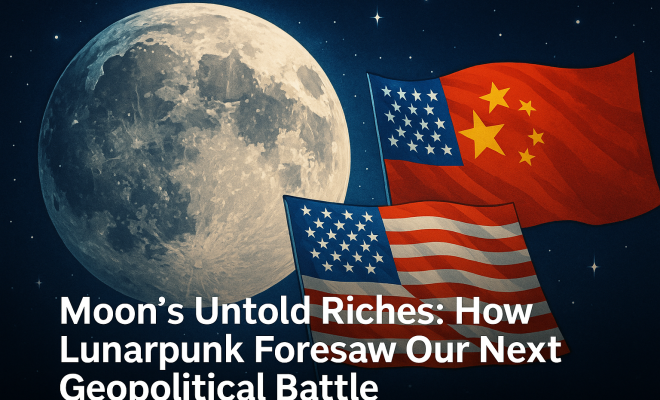
Imagine a future where humanity isn’t just gazing at the Moon, but living on it, working on it, and perhaps even fighting over it. This isn’t just science fiction anymore; it’s the very real, very complex landscape that the emerging concept of lunarpunk seeks to navigate. We’re on the cusp of an unprecedented expansion beyond Earth, particularly concerning the Moon. But as we reach for those lunar horizons, we’re confronted with a thorny thicket of cultural, ethical, and legal questions that demand answers now, not after the dust settles—or rather, after the regolith is churned.
The idea of ‘lunarpunk’ itself is gaining significant traction, evolving from a niche subgenre to a broader cultural discussion. At its heart, lunarpunk isn’t just about aesthetics or a cool new vibe; it’s a critical lens through which we can examine the practicalities and perils of lunar resource extraction. It forces us to ask: What kind of future do we want to build out there? And perhaps more pressingly, who gets to build it, and who benefits?
The stakes are incredibly high. The Moon isn’t just a desolate rock; it’s a treasure trove of resources. From water ice, crucial for life support and rocket fuel, to rare earth elements vital for modern technology, the Moon holds immense potential. This promise, however, brings with it a potent cocktail of opportunity and conflict, sparking what some are already calling a ‘space gold rush.’ The geopolitical implications are staggering, and the debate over who owns these cosmic riches is becoming one of the most emotionally charged discussions of our time.
The Unsettled Legacy of the 1979 Moon Agreement
For decades, humanity has grappled with the legal status of celestial bodies. Back in 1979, the United Nations drafted the Agreement Governing the Activities of States on the Moon and Other Celestial Bodies, more commonly known as the Moon Agreement. Its core tenet was revolutionary: it declared lunar resources the ‘common heritage of mankind.’ This meant that no nation, no corporation, and no individual could unilaterally claim ownership of any part of the Moon or its resources. It was a beautiful, idealistic vision of shared prosperity and equitable distribution.
Sounds perfect, right? A framework for peace and cooperation in space. The problem? Almost no one signed it. The Moon Agreement suffered from extremely limited ratification, with only 18 nations having signed and ratified it as of 2023. Crucially, none of the major spacefaring nations—the United States, Russia, China, or even the European Space Agency members—ever became parties to it. This lack of broad acceptance has left a gaping void in international space law, leaving questions of resource ownership and extraction not just unanswered, but highly contested.
The reasons for its failure are complex. Some argue that its ‘common heritage’ clause was too restrictive, disincentivizing private investment and national initiatives by removing the promise of exclusive gain. Others suggest it was simply ahead of its time, drafted before the technological capabilities for lunar resource extraction were anywhere near reality. Whatever the reasons, its limited reach means we’re heading into a new era of lunar exploration with an almost four-decade-old legal framework that most players simply disregard. This legal vacuum is precisely where the geopolitical tensions are brewing, creating an environment ripe for misunderstanding and potential conflict.
The Artemis Accords: A New Frontier for Space Governance?
Fast forward to the present, and we see a very different approach taking shape with the Artemis Accords. Initiated by the United States and NASA in 2020, these bilateral agreements establish a set of non-binding principles for civil space exploration and the peaceful use of the Moon, Mars, comets, and asteroids. Unlike the Moon Agreement, the Artemis Accords explicitly endorse the extraction and utilization of space resources, albeit with a commitment to doing so in a safe, transparent, and sustainable manner.
By September 2026, an impressive 76 nations had signed on to the Artemis Accords, signaling a clear shift in international consensus. This widespread adoption, especially among emerging space nations and traditional allies, indicates a strong desire for some form of regulatory framework, even if it’s not a universally ratified treaty. The Accords emphasize principles like transparency, interoperability, emergency assistance, and the registration of space objects. Crucially, they also include a provision for ‘deconfliction zones’ to prevent harmful interference between different nations’ lunar operations, a direct acknowledgment of the potential for overlapping claims and activities.
While the Artemis Accords represent a significant step towards establishing norms of behavior in space, they are not without controversy. Critics argue that they effectively bypass the UN framework and could lead to a ‘first come, first served’ mentality, favoring nations with advanced space capabilities. They also raise concerns about the potential for exclusion and the creation of a two-tiered system for space exploration. Despite these critiques, the rapid growth in signatory nations underscores the urgent need for clear international rules on lunar mining. Without them, the scramble for lunar resources could quickly devolve into a chaotic free-for-all, with serious implications for international stability.
The Lunar ‘Space Gold Rush’ Mentality
The phrase ‘space gold rush’ isn’t hyperbole; it accurately captures the current mindset surrounding lunar resources. The uneven distribution of valuable lunar resources, particularly water ice concentrated at the poles, creates an immediate and pressing ethical dilemma. Imagine a handful of nations or corporations gaining exclusive access to these critical reservoirs. What does that mean for nations without advanced space programs? What about the broader principle of equitable access to resources that could benefit all of humanity? (See: NASA's lunar exploration missions.)
Researchers and ethicists are sounding the alarm, warning that this ‘gold rush’ mentality is already fostering a competitive, rather than collaborative, environment. The allure of economic gain—from selling water ice for rocket fuel in orbit to mining rare earth elements for Earth-bound industries—is a powerful motivator. We’re seeing private companies, backed by national space agencies, developing sophisticated technologies for lunar prospecting, extraction, and processing. These ventures are driven by profit, and without robust international governance, the temptation to prioritize short-term gains over long-term sustainability and equitable access will be immense.
This isn’t just about economic advantage; it’s about strategic positioning. Control over lunar resources could translate into significant geopolitical power, influencing everything from space commerce to national security. The nation that controls the Moon’s gas stations, so to speak, could hold considerable sway over future space endeavors. This competitive landscape makes the need for clear, enforceable rules all the more urgent, before the ‘rush’ turns into a full-blown stampede, with consequences we can only begin to imagine. For more context, see the cultural and ethical implications of technology.
Ethical Quagmires of Off-World Extraction
Beyond the legal and geopolitical complexities, lunar resource extraction plunges us headfirst into profound ethical quagmires. What moral obligations do we have to the Moon itself? Is it merely a giant rock to be exploited, or does it hold intrinsic value as a celestial body, a symbol of human aspiration and scientific wonder? The concept of ‘lunarpunk’ often grapples with these very questions, positing futures where humanity might live in harmony with the lunar environment, or where unchecked exploitation leads to unforeseen ecological and social costs.
Consider the environmental impact. While the Moon lacks a biosphere in the traditional sense, extensive mining operations could irrevocably alter its surface, creating dust plumes, permanent scars, and potentially interfering with sensitive scientific instruments or future human habitats. How do we balance the imperative for resource utilization with the desire to preserve the Moon’s pristine scientific and cultural value?
Then there’s the question of intergenerational equity. Are we, in our current drive for resources, mortgaging the Moon’s future for generations yet unborn? Will our descendants look back at our actions and see responsible stewardship, or reckless depletion? These are not easy questions, and there are no simple answers. But ignoring them would be a profound ethical failing. The discussions around lunarpunk often serve as a cultural space to explore these dilemmas, pushing us to consider not just what we can do, but what we should do.
Lunarpunk as a Cultural Barometer for Space Futures
So, what exactly is lunarpunk, beyond a cool name? At its core, lunarpunk is more than just an aesthetic or a genre; it’s a cultural movement, a speculative framework, and a critical lens through which we can imagine—and perhaps even enact—futures beyond Earth. It often blends elements of punk DIY ethos, environmentalism, anti-capitalism, and a deep respect for celestial bodies, all set against a backdrop of lunar colonization or resource extraction.
Think of it as a counter-narrative to the glossy, corporate-driven vision of space exploration. Where some visions of space might present a sterile, high-tech utopia, lunarpunk often explores the gritty, practical realities of living and working on the Moon. It frequently depicts decentralized, community-driven lunar settlements, where inhabitants repurpose materials, cultivate sustainable closed-loop systems, and perhaps even push back against monolithic corporate or governmental control.
In many ways, lunarpunk acts as a cultural barometer for our anxieties and aspirations regarding space. It allows artists, writers, and thinkers to explore the ethical challenges of lunar development, the potential for exploitation, and the possibilities for more equitable, sustainable futures. It’s a space to ask uncomfortable questions: Who benefits from lunar resources? How do we prevent the same colonial patterns of exploitation that have plagued Earth from repeating on the Moon? By imagining these futures, lunarpunk helps us prepare for them, challenging us to build a better, more just cosmic society.
The Geopolitics of Lunar Claims and the ‘Tragedy of the Commons’
The geopolitical implications of lunar resource claims are immense and represent a modern-day ‘tragedy of the commons’ playing out on a cosmic scale. The ‘tragedy of the commons’ describes a situation where individual users, acting independently according to their own self-interest, behave contrary to the common good of all users by depleting or spoiling that resource through their collective action. In the context of the Moon, this means that without clear, enforceable rules, nations and corporations might rush to extract resources, prioritizing national or corporate gain over the collective, long-term benefit of humanity.
Consider the strategic value of lunar water ice. It’s not just for drinking; it can be electrolyzed into hydrogen and oxygen, which are critical rocket propellants. A nation or consortium that controls significant water ice reserves could effectively control access to the rest of the solar system, providing fuel for missions to Mars and beyond. This isn’t just about wealth; it’s about strategic leverage and power projection.
The current landscape, with the Moon Agreement largely ignored and the Artemis Accords gaining traction but still lacking universal consensus, creates a volatile environment. We’re seeing a race to establish a presence, to demonstrate capabilities, and implicitly, to lay claim. This competitive dynamic, fueled by national interests and commercial ambitions, makes the development of a truly inclusive and equitable international space law framework more critical than ever. Without it, the Moon could become the next flashpoint for international rivalry, rather than a symbol of shared human progress. (See: Scientific insights on lunar resources.)
Monetizing the Moon: Investment Opportunities and Ethical Quandaries
Beyond the geopolitical chess game, there’s a very real economic engine driving this lunar interest. The monetization angles are vast and varied, attracting significant investment and innovation. For instance, legal services for international space law and resource claims are becoming a burgeoning field. As nations and private entities contemplate lunar operations, they’ll need expert guidance to navigate the murky waters of current space law, negotiate agreements, and potentially litigate disputes.
Then there are the direct investment opportunities in nascent space mining companies. Firms like Planetary Resources (though now part of ConsenSys Space), Astrobotic, and Masten Space Systems (now part of Astrobotic) are developing technologies for everything from lunar prospecting to regolith processing and resource extraction. Investing in these companies, or in the infrastructure that supports them (launch services, in-space manufacturing, data analytics for lunar mapping), could yield significant returns for early adopters, though the risks are, of course, astronomical. For more context, see the future of intelligence and its impact on society.
Finally, there’s a growing market for online education programs focusing on space ethics and governance. As public awareness of these issues grows, there’s a demand for informed discussion and expertise. Universities and private institutions are offering courses that delve into the legal, ethical, and sociological implications of space expansion, preparing a new generation of policymakers, engineers, and citizens to grapple with these complex challenges.
However, each of these monetization angles comes with its own set of ethical quandaries. How do we ensure that the pursuit of profit doesn’t overshadow the principles of sustainability and equitable access? How do we prevent the monopolization of lunar resources by a select few, whether they be nations or corporations? These are not just theoretical questions; they are immediate concerns that demand proactive solutions as humanity extends its economic reach beyond Earth.
Crafting a Shared Future: The Role of International Cooperation
The urgency of creating clear, comprehensive international rules for lunar mining cannot be overstated. The current patchwork of agreements, declarations, and unilateral policies is simply insufficient to manage the complexities of a multi-stakeholder future on the Moon. What’s needed is a renewed commitment to international cooperation, perhaps building upon the spirit of the Outer Space Treaty of 1967, which declared space the ‘province of all mankind’ and prohibited national appropriation.
This means fostering dialogues that include all nations, not just those with advanced space capabilities. It means developing mechanisms for equitable benefit sharing, ensuring that the fruits of lunar exploration benefit humanity as a whole, and not just a privileged few. It means investing in technologies that minimize environmental impact and promoting transparency in all lunar operations.
The concept of lunarpunk, in its myriad interpretations, offers a powerful cultural touchstone for this dialogue. It reminds us that our future on the Moon isn’t just about rockets and robots; it’s about people, communities, and the values we choose to carry with us into the cosmos. Will we repeat the mistakes of Earth’s past—colonialism, resource wars, environmental degradation—or will we forge a new, more enlightened path? The choice is ours, and the time to make it is now, before the Moon becomes just another battleground in humanity’s endless quest for resources.
The Human Element: Identity and Culture in Lunar Settlements
When we talk about lunar exploration and resource extraction, it’s easy to focus on the technical, legal, and economic aspects. But what about the people? As we project humanity onto the Moon, we’re not just moving hardware; we’re transplanting cultures, identities, and the very fabric of human society. Lunarpunk, with its focus on decentralized and community-driven settlements, often explores this human element in depth. How will a distinctly lunar culture evolve, separate from Earth? Will new traditions, languages, or forms of governance emerge in these off-world outposts?
Consider the psychological impact of living in a low-gravity, high-radiation environment, isolated from Earth’s blue skies and natural rhythms. This extreme environment will undoubtedly shape the psychology and social dynamics of lunar inhabitants. Lunarpunk narratives frequently grapple with themes of adaptation, resilience, and the formation of new social contracts in these challenging conditions. Will these pioneers develop a collective identity that transcends national allegiances, or will terrestrial divisions simply be replicated on a new cosmic stage?
This isn’t just speculative fiction; it’s a practical consideration. Planning for sustainable lunar communities requires thinking about everything from mental health support to educational systems and artistic expression. What kind of art will be made on the Moon? What stories will be told? These cultural aspects, often overlooked in the rush for resources, are fundamental to building truly habitable and thriving lunar settlements. Lunarpunk encourages us to imagine these nuanced human experiences, reminding us that the Moon isn’t just a resource, but a potential home. For more context, see the role of AI in shaping our future. (See: BBC coverage of lunar resource debates.)
Beyond Water Ice: Other Valuable Lunar Resources
While water ice often grabs headlines due to its dual utility for life support and rocket fuel, the Moon holds many other resources that are incredibly valuable. Helium-3, for example, is a rare isotope on Earth but is relatively abundant in lunar regolith, deposited by solar winds over billions of years. Scientists believe Helium-3 could be a crucial fuel for future fusion power reactors, offering a clean, powerful energy source with minimal radioactive waste. The potential energy revolution driven by lunar Helium-3 is a huge driver for some nations’ lunar ambitions.
Beyond that, the Moon contains significant deposits of various metals and minerals. Iron, titanium, aluminum, and silicon are all present in lunar rocks and could be extracted for construction materials, manufacturing components, and even advanced electronics. Imagine 3D printing lunar habitats or spacecraft parts directly on the Moon, using locally sourced materials. This ‘in-situ resource utilization’ (ISRU) dramatically reduces the cost and complexity of space missions, making long-term lunar presence and further space exploration much more feasible.
Rare earth elements, which are essential for many modern technologies like smartphones, electric vehicles, and renewable energy systems, are also thought to exist on the Moon. While their exact concentration and economic viability for extraction are still being researched, the possibility of a non-terrestrial source for these critical minerals adds another layer to the ‘space gold rush’ mentality. Diversifying our supply chains for these elements could also reduce geopolitical tensions on Earth. So, while water ice is the immediate prize, the Moon’s full potential as a resource hub is far broader and more transformative.
The Role of Private Industry vs. State Actors
The landscape of lunar exploration has dramatically shifted from being solely the domain of national space agencies to a vibrant, and often competitive, arena involving private companies. This blend of state and private actors introduces new dynamics and complicates governance. On one hand, private companies bring innovation, efficiency, and a profit motive that can accelerate technological development. Companies like SpaceX, Blue Origin, and countless smaller startups are driving down launch costs, developing lunar landers, and pioneering new extraction techniques.
However, the involvement of private industry also raises questions about accountability and regulation. Who is responsible if a private company causes environmental damage on the Moon? How do we prevent monopolies from forming over critical lunar resources? The Artemis Accords try to address some of this by emphasizing transparency and adherence to international law, but the enforcement mechanisms for private entities in space are still largely undefined. Lunarpunk narratives often explore the tensions between corporate interests and the well-being of lunar communities, highlighting the potential for exploitation when profit is the primary driver.
State actors, meanwhile, continue to play a crucial role, providing foundational research, large-scale infrastructure, and strategic direction. National pride and geopolitical influence remain powerful motivators for countries like the U.S., China, and Russia. The challenge lies in finding a balance where private enterprise can thrive without undermining the principles of equitable access and sustainable development that many believe should govern space. The future of lunar activity will undoubtedly be a complex dance between these two powerful forces, requiring thoughtful policy to ensure a harmonious, rather than chaotic, expansion into the cosmos.
Ultimately, the Moon stands as a beacon, challenging us to rise above our terrestrial squabbles and embrace a truly shared future. How we choose to govern and utilize its immense potential will define not just our presence in space, but our very character as a species. The discussions surrounding lunarpunk are a vital part of this process, pushing us to imagine and enact futures that are not only technologically advanced but also ethically sound and socially just.
Trending Now
Frequently Asked Questions
What is lunarpunk and why is it important?
Lunarpunk is an emerging cultural concept that envisions a future where humanity lives and works on the Moon. It emphasizes the ethical, cultural, and legal implications of lunar resource extraction, prompting discussions about who benefits from these resources and the future we want to create in space.
What resources can be found on the Moon?
The Moon is believed to hold various valuable resources, including water ice essential for life support and rocket fuel, and rare earth elements crucial for modern technology. This potential has sparked a 'space gold rush' as nations and companies vie for access to these riches.
What are the geopolitical implications of lunar resource extraction?
The extraction of lunar resources raises significant geopolitical questions, particularly regarding ownership and control. The competition for these resources could lead to conflicts as different nations seek to establish their presence and claim their share of the Moon's wealth.
What was the Moon Agreement of 1979?
The Moon Agreement, drafted by the United Nations in 1979, aimed to establish the legal status of celestial bodies, declaring lunar resources as the 'common heritage of mankind.' It sought to prevent any single nation from claiming ownership over the Moon's resources.
How does lunarpunk address ethical questions about space exploration?
Lunarpunk addresses ethical questions by challenging us to consider the implications of lunar colonization and resource extraction. It encourages discussions about the responsibilities of humanity in space, including who gets to benefit from lunar resources and the environmental impact of our actions.
Agree or disagree? Drop a comment and tell us what you think.