One Chart Explains Why Metaverse Real Estate Is Facing a Reckoning
“`html
Remember the hype? Not so long ago, it felt like every other headline was screaming about the metaverse. We were told it was the next frontier, a digital wild west where fortunes would be made, and virtual land would be more valuable than physical plots in Manhattan. Major brands were buying in, celebrities were touting their digital mansions, and everyday investors, caught up in the frenzy, poured their hard-earned cash into what promised to be an unprecedented gold rush. But if you’ve been following the news, or even just casually observing the crypto markets, you’ve probably noticed a different narrative emerging.
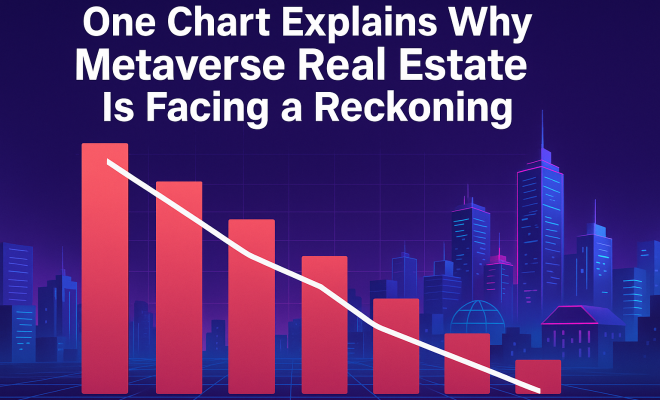
As of October 2, 2026, the dream of exponential gains in metaverse real estate has, for many, turned into a sobering reality check. Recent analyses paint a stark picture: the values of virtual land parcels have plummeted, in some cases by an astonishing 99.8% from their peak. Plots that once fetched millions of dollars are now worth mere fractions of their former glory. This isn’t just a minor correction; it’s a dramatic downturn that has left many investors questioning not only their decisions but also the very foundation of digital property as a lucrative asset. What happened? And what does this stunning collapse mean for the future of the metaverse, and for anyone still considering a foray into its virtual frontiers?
The Meteoric Rise and Precipitous Fall of Metaverse Real Estate
To understand the current state of metaverse real estate, we need to rewind a bit. The concept isn’t entirely new; virtual worlds like Second Life have existed for decades. However, the confluence of blockchain technology, NFTs (Non-Fungible Tokens), and a renewed interest from tech giants like Meta (formerly Facebook) supercharged the idea. Suddenly, owning a piece of digital land wasn’t just about playing a game; it was about owning a unique, verifiable asset on a decentralized ledger.
The peak of the metaverse real estate frenzy arrived in late 2021 and early 2022. During this period, platforms like Decentraland, The Sandbox, Somnium Space, and Axie Infinity saw land sales skyrocket. We saw reports of hundreds of thousands, even millions of dollars, being spent on single parcels of virtual land. Sotheby’s even opened a virtual gallery in Decentraland. It felt like a legitimate extension of the physical world, offering scarcity, location, and potential for development. Early adopters and crypto millionaires, flush with cash from other digital asset booms, saw it as a natural progression, a new frontier for investment that promised to outpace traditional markets.
But then came the crash. It wasn’t a sudden, cataclysmic event, but rather a slow, agonizing bleed. The broader crypto winter that began in mid-2022 certainly played a role, dragging down the value of associated tokens that often underpinned these virtual economies. However, the decline in metaverse real estate values has been even more severe and persistent than many other digital assets. The eye-watering figure of a 99.8% drop from peak values isn’t an exaggeration; it reflects the stark reality for many early investors. This dramatic deflation of the speculative bubble has left a lot of people reeling and has sparked intense debate across financial and tech circles.
The Core Problem: A Lack of Tangible Utility
One of the most critical factors contributing to the collapse of metaverse real estate values has been a fundamental lack of tangible utility. In the physical world, real estate derives its value from its use: shelter, commerce, agriculture, recreation. Even purely speculative land often has potential for future development that will serve a real-world purpose. In the metaverse, the promise was similar: virtual land would host digital experiences, shops, concerts, games, and social hubs. The reality, however, has fallen far short.
Many of these virtual worlds, despite their grand ambitions, remain largely empty or underdeveloped. You can buy a plot of land, but what can you actually do with it? For most investors, the answer has been very little beyond holding it and hoping its value appreciates. There hasn’t been a widespread adoption of the metaverse as a daily destination for work, entertainment, or social interaction in the way proponents envisioned. Without compelling reasons for people to spend significant time and money within these virtual spaces, the demand for virtual land, which is meant to be the canvas for these experiences, inevitably wanes.
Consider a physical shopping mall: its value is tied to foot traffic, tenant leases, and the revenue generated from businesses operating within it. A virtual mall, or a virtual concert venue, needs a similar level of engagement to justify its existence and the value of its underlying land. When the virtual foot traffic never materialized, or when the promised revenue streams remained theoretical, the speculative premium on that land evaporated, revealing its true, much lower, intrinsic value.
Over-Speculation and the ‘Greater Fool’ Theory in Action
The metaverse real estate boom was, in many ways, a textbook example of a speculative bubble, fueled by the ‘greater fool’ theory. This economic concept suggests that an overpriced asset can still generate a profit as long as there’s a ‘greater fool’ willing to pay an even higher price for it. During the peak, many investors weren’t buying virtual land because they had a concrete plan to develop it or saw immediate utility. They were buying it because they believed someone else would pay more for it tomorrow.
This speculative fervor was amplified by celebrity endorsements, media hype, and the fear of missing out (FOMO). When major brands like Adidas and JPMorgan Chase made headlines for buying virtual plots, it lent an air of legitimacy and inevitability to the trend. It made it seem like a no-brainer investment. However, these institutional purchases often represented marketing stunts or experimental forays, rather than a deep commitment to building out comprehensive virtual economies. Their relatively small investments, while generating significant buzz, didn’t create the widespread utility needed to sustain the inflated prices.
The problem with the ‘greater fool’ theory is that it eventually runs out of fools. When the supply of new buyers willing to pay ever-higher prices dwindles, the bubble bursts. And when it comes to metaverse real estate, the sheer volume of available digital land, even with artificial scarcity mechanisms, combined with the lack of actual users, meant the market was ripe for a correction of this magnitude. (See: BBC on metaverse hype and reality.)
The Metaverse’s Identity Crisis: A Fragmented and Uninteroperable Landscape
Another significant hurdle for metaverse real estate has been the fragmented and often incompatible nature of the various platforms. When we talk about ‘the metaverse,’ we often speak as if it’s a single, unified digital world. In reality, it’s a collection of distinct, siloed virtual environments: Decentraland, The Sandbox, Somnium Space, Axie Infinity, Otherside, and many more. Each has its own ecosystem, its own currency, and its own rules.
This lack of interoperability means that an asset or experience you build on one platform cannot easily be transferred or utilized on another. Your virtual land in Decentraland is useless in The Sandbox, and vice-versa. This fragmentation undermines the vision of a truly open and connected metaverse, where digital assets and identities flow seamlessly across different virtual spaces. It’s like buying a physical house that can only be accessed by one specific type of car, and that car only works on one specific type of road. For more context, see crypto hack losses.
For investors, this fragmentation adds another layer of risk. Which platform will ultimately gain mass adoption? Will any of them truly become the dominant player? Betting on one platform’s metaverse real estate is akin to betting on a single social media platform to become the only one that matters. While some platforms may eventually thrive, the current landscape makes it difficult to predict which ones will succeed, and the lack of a universal standard makes the overall investment proposition much riskier.
Lessons Learned: What This Means for Future Metaverse Investment Strategies
The dramatic downturn in metaverse real estate offers crucial lessons for anyone considering future digital asset investments. First and foremost, genuine utility and user adoption are paramount. Hype and speculation can drive prices up temporarily, but without a compelling reason for people to actually *use* the virtual space, those gains are unsustainable. Future metaverse investment strategies should prioritize projects that demonstrate clear roadmaps for utility, strong community engagement, and a growing user base, rather than just flashy marketing.
Secondly, diversification remains key, even within niche markets. If you are still interested in the metaverse, perhaps consider investing in infrastructure, tools, or content creators that can serve multiple platforms, rather than tying all your capital to a single virtual land parcel. Digital asset financial advisors are increasingly emphasizing a more cautious and analytical approach, moving away from pure speculation towards projects with clearer business models and long-term viability.
Thirdly, the importance of thorough due diligence cannot be overstated. Understand the underlying technology, the project team, the community, and the economic model of any metaverse platform before committing capital. Don’t simply follow the crowd or chase headlines. The comparison of metaverse platforms should involve deep dives into their development progress, active user numbers, and ecosystem health, not just their peak land prices.
The Road Ahead: Is There a Future for Metaverse Real Estate?
Does this collapse spell the end for metaverse real estate altogether? Not necessarily. While the speculative bubble has burst, the underlying technology and the vision of persistent, immersive digital worlds still hold potential. What we’re witnessing is a painful but perhaps necessary recalibration of expectations.
The future of metaverse real estate, if it is to have one, will likely be driven by organic growth, genuine innovation, and the development of compelling use cases. This might involve enterprises building functional virtual offices, educational institutions creating interactive learning environments, or artists crafting truly unique digital experiences that can only exist in these virtual spaces. It won’t be about simply owning a piece of digital dirt; it will be about what you can *do* with that dirt, and how many people want to engage with what you’ve built.
Platforms that can foster vibrant communities, offer rich interactive experiences, and perhaps even achieve some level of interoperability will be the ones that stand a chance. The current downturn is shaking out the purely speculative projects and forcing a focus on fundamental value. It’s a harsh lesson, but one that could ultimately lead to a more sustainable and functional metaverse in the long run.
Virtual Property Valuation Tools: A New Era of Scrutiny
In the wake of this market correction, the demand for sophisticated virtual property valuation tools is becoming more pronounced. During the boom, valuation was often a mix of guesswork, FOMO, and comparing to the last absurdly high sale. Now, investors and potential buyers are seeking more robust metrics. They want to understand factors like user traffic to adjacent parcels, the utility of existing structures, the rarity of the land based on its location within a specific metaverse, and even the engagement level of the platform’s overall community.
We’re seeing an emergence of analytical platforms attempting to bring traditional real estate valuation principles into the digital realm, albeit with significant modifications. These tools aim to track transaction histories, analyze floor prices, and even predict future demand based on platform development roadmaps and user activity. The goal is to move beyond speculative hype and towards data-driven decisions. However, it’s a nascent field, and the volatility of the underlying assets means that even the most advanced tools face significant challenges in providing consistently accurate valuations. It’s a constant effort to define what ‘value’ even means in a rapidly shifting digital landscape.
The Psychological Impact: Investor Sentiment and Trust
Beyond the financial losses, the collapse of metaverse real estate has had a significant psychological impact on investors. Many who bought into the hype, especially those new to digital assets, feel burned and betrayed. This erosion of trust isn’t just limited to metaverse projects; it can spill over into the broader perception of Web3 technologies and even cryptocurrency itself. The narrative of ‘digital gold’ or ‘the future of ownership’ takes a hit when an asset class sees such a dramatic devaluation.
Rebuilding this trust will be a slow and arduous process. It requires transparency from platform developers, a clear focus on delivering promised utility, and a more realistic portrayal of investment risks. For many, the sting of watching their multi-million dollar virtual plot become virtually worthless will serve as a powerful cautionary tale against chasing speculative bubbles without understanding the underlying fundamentals. This experience underscores the importance of education and critical thinking in any emerging market, especially one as prone to hype as the metaverse. (See: New York Times on metaverse real estate.)
The Broader Implications for Web3 and Digital Ownership
While the focus here has been on metaverse real estate, its struggles carry broader implications for the entire Web3 ecosystem and the concept of digital ownership via NFTs. If virtual land, one of the most tangible forms of digital assets, can crash so spectacularly, what does that say about other NFTs, digital collectibles, or even fractionalized ownership of various digital items?
It forces a re-evaluation of what constitutes ‘value’ in the digital realm. Is it scarcity alone? Is it the artistic merit? Or is it, once again, the utility and community that surrounds it? The metaverse real estate saga suggests that without a clear, demonstrable use case and a vibrant, engaged community, even seemingly scarce digital assets are susceptible to extreme market corrections. This doesn’t mean Web3 is dead, but it certainly signals a maturation phase, where unsustainable hype gives way to a more pragmatic pursuit of real-world (or real-digital-world) applications. For more context, see executive order's impact on technology.
The lessons learned from this virtual land collapse will undoubtedly shape how future Web3 projects are conceived, funded, and marketed. It’s a stark reminder that innovation, while exciting, doesn’t exempt an asset from fundamental economic principles. The metaverse is still evolving, but its real estate market has just received a brutal, undeniable lesson in the perils of pure speculation.
Expert Perspectives: What Industry Leaders Are Saying
It’s not just individual investors and analysts who are reflecting on the metaverse real estate downturn. Industry leaders and venture capitalists, once bullish on the space, are now offering more tempered and nuanced views. Many acknowledge the initial over-exuberance, attributing it to a classic ‘too much money chasing too few proven ideas’ scenario. For instance, some prominent figures in the crypto space have openly stated that the valuations reached were simply unsustainable given the nascent stage of metaverse development. They often compare it to the dot-com bubble of the late 90s, where the underlying internet technology was revolutionary, but many early business models and valuations were wildly speculative and ultimately failed.
Some experts, like venture capitalist Matthew Ball, a noted metaverse strategist, emphasize that the metaverse is a long-term vision, not a short-term investment vehicle. He’s consistently highlighted the need for robust infrastructure, open standards, and compelling content to truly unlock its potential. His view, shared by many, is that the current dip is a necessary cleansing, separating genuine innovation from pure hype. It forces builders to focus on creating value for users, rather than simply attracting speculators. This shift in sentiment from immediate profit to long-term development is a crucial indicator of a maturing industry.
Conversely, some skeptics remain unconvinced, arguing that the fundamental issues of utility and mass adoption are too challenging to overcome. They point to the high barriers to entry, the often clunky user experiences, and the ongoing fragmentation as reasons why the metaverse may never achieve the widespread integration its proponents envision. These contrasting views highlight the ongoing debate and the complex challenges that still face the metaverse as a whole.
The Role of Corporate Investment: Beyond Marketing Stunts
While early corporate forays into metaverse real estate were often seen as marketing exercises, there’s a growing discussion about the potential for more substantive institutional investment. Imagine corporations building virtual campuses for remote work, not just as a novelty, but as fully integrated parts of their operational infrastructure. Or retail giants creating persistent, interactive shopping experiences that generate actual sales, not just brand awareness. This shift requires a deeper commitment than simply buying a parcel of land and placing a logo on it.
We’re starting to see preliminary moves in this direction. Companies are experimenting with digital twin technology, creating virtual replicas of physical assets or environments for simulation, training, or product design. While not directly “metaverse real estate” in the speculative sense, these applications demonstrate tangible utility within virtual spaces. If these enterprise-level use cases prove successful and scalable, they could drive a more sustainable demand for virtual land and digital infrastructure, independent of speculative investor sentiment. This corporate adoption, driven by efficiency and revenue, could provide the stable foundation that the individual investor market currently lacks.
However, the challenge remains significant. Integrating these virtual environments into existing business workflows requires substantial investment in technology, talent, and change management. It’s a long road from a marketing activation to a core business function, and only time will tell if enough companies make that leap.
A Look at Alternative Metaverse Economies
It’s important to remember that not all metaverse projects focus exclusively on land ownership. Some platforms are exploring different economic models that might prove more resilient or offer alternative investment opportunities. For example, some prioritize tokenized in-game assets, virtual fashion, or unique digital art, where the value is tied more directly to creativity, rarity, or gameplay utility rather than a fixed plot of land. Others experiment with subscription models, play-to-earn mechanics (though these have also faced their own challenges), or decentralized autonomous organizations (DAOs) that govern shared virtual spaces. For more context, see startup funding challenges. (See: Scientific analysis of digital assets.)
These alternative approaches suggest that the future of metaverse economics might be more diverse than just a straightforward real estate market. Investors who are still interested in the space might find more stable ground in projects that offer clear utility for their digital assets within a defined ecosystem, or that focus on creating valuable digital experiences rather than just selling empty plots. This diversification of economic models is a healthy sign of innovation, indicating that creators are learning from the initial missteps of the speculative land boom.
FAQ: Understanding Metaverse Real Estate
What is metaverse real estate?
Metaverse real estate refers to digital parcels of land within virtual worlds, often represented as NFTs on a blockchain. Owners can typically develop these plots with virtual buildings, experiences, or content, and they can be bought, sold, or rented just like physical property.
Why did metaverse real estate values crash so dramatically?
The primary reasons include over-speculation fueled by the ‘greater fool’ theory, a significant lack of tangible utility and user adoption in most metaverse platforms, the broader crypto market downturn, and the fragmented, non-interoperable nature of different virtual worlds.
Is metaverse real estate completely worthless now?
Not necessarily. While many plots have seen extreme devaluation, particularly those bought at peak prices, the concept isn’t entirely dead. Value is now shifting away from pure speculation towards projects that can demonstrate genuine utility, active communities, and compelling experiences. Some platforms and parcels may still hold or regain value if they develop strong ecosystems.
Can I still invest in metaverse real estate?
You can, but it comes with significant risk. Future investment strategies should prioritize platforms with clear utility, strong user engagement, and robust development roadmaps, rather than chasing hype. Thorough due diligence is crucial, and diversification across different digital assets or metaverse-related infrastructure might be a more cautious approach.
What are the key differences between virtual and physical real estate?
While both involve ownership and development, virtual real estate lacks the inherent physical utility (shelter, agriculture) of physical land. Its value is almost entirely dependent on digital utility, community engagement, and the specific platform’s ecosystem. Virtual land also faces challenges with interoperability and the potential for unlimited digital supply (even with artificial scarcity).
What does “interoperability” mean in the context of the metaverse?
Interoperability refers to the ability to seamlessly move digital assets, identities, and experiences between different metaverse platforms. Currently, most metaverse platforms are siloed, meaning an asset or land owned in one platform can’t be used in another. Achieving true interoperability is a major goal for a unified metaverse vision.
What are some potential future use cases for metaverse real estate?
Future use cases could include virtual offices for remote work, immersive educational environments, digital storefronts that generate actual e-commerce sales, persistent art galleries or concert venues, and unique interactive gaming experiences. The key is to move beyond static, empty plots to dynamic, useful spaces.
“`
Trending Now
- the complete explanation
- our breakdown of the billionaire’s bombshell: why startup funding 2024 could be a minefield
- this guide on a hacker’s betrayal? inside the ‘rey’ detention that rocked shinyhunters
- this guide on the astonishing reason why china’s ai education will leave the west behind
Frequently Asked Questions
What caused the decline in metaverse real estate values?
The decline in metaverse real estate values can be attributed to a combination of market saturation, overvaluation during the initial hype, and a significant drop in interest from both investors and major brands. As of October 2026, many virtual land parcels have lost up to 99.8% of their peak value, leading to a reevaluation of digital property as a viable asset.
Is metaverse real estate still a good investment?
Investing in metaverse real estate carries significant risks, especially following the recent dramatic downturn in values. While some believe in its long-term potential, many investors are now questioning its viability as a lucrative asset. Caution and thorough research are recommended before entering this volatile market.
How did the metaverse real estate market surge in popularity?
The surge in metaverse real estate popularity was fueled by the intersection of blockchain technology, NFTs, and endorsements from tech giants like Meta. This led to a perception of digital land as unique, verifiable assets, sparking a frenzy among investors and celebrities eager to capitalize on the emerging trend.
What does the future hold for metaverse real estate?
The future of metaverse real estate remains uncertain after the recent value collapse. While some believe it may recover as technology and interest evolve, others are skeptical about its long-term viability. Ongoing developments in virtual worlds and user engagement will be crucial in determining its fate.
What lessons can investors learn from the metaverse real estate crash?
Investors can learn the importance of due diligence, understanding market dynamics, and avoiding hype-driven decisions from the metaverse real estate crash. It highlights the need for caution in emerging markets, as well as the potential volatility associated with digital assets.
What did we miss? Let us know in the comments and join the conversation.