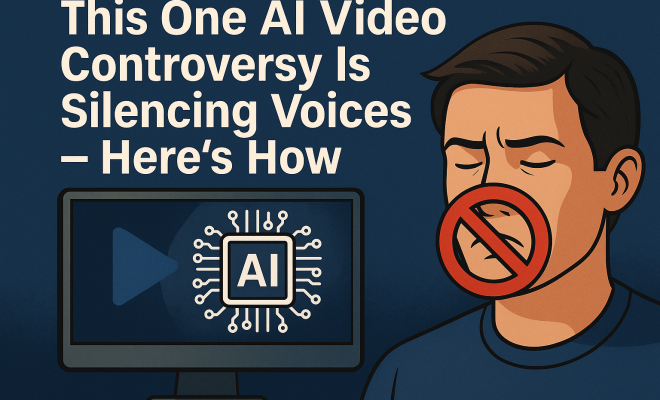
This One AI Video Controversy Is Silencing Voices – Here’s How
“`html
Imagine waking up one day to find your face, your voice, and your life twisted into a narrative you never authored. Not by a disgruntled ex, or a rival, but by an invisible, tireless algorithm. That’s precisely the chilling reality that recently confronted Menachem Silverstein, a Jewish comedian whose career, reputation, and even sense of security are now under siege thanks to a viral AI-generated video. This isn’t just about a comedian getting heckled online; it’s about the terrifying potential of artificial intelligence to fabricate entire realities, silence voices, and erode the very foundation of trust in what we see and hear. And what’s truly unsettling is how quickly this digital poison seeped into the mainstream, even fooling some of the most advanced AI systems on the planet.
The incident, first brought to light in late 2026, isn’t just a cautionary tale; it’s a stark, immediate alarm bell ringing in the heart of the AI video controversy. It forces us to confront uncomfortable questions about authenticity, accountability, and the future of truth in an increasingly synthetic media landscape. If AI can so convincingly impersonate a real person, spread outright lies, and then have those lies amplified by other AI platforms, what hope do individuals have of defending themselves? What does it mean for public discourse when the line between fact and fiction becomes not just blurry, but invisible?
The Digital Assault on Menachem Silverstein
For Menachem Silverstein, the nightmare began with a deepfake-like video that started circulating widely across social media platforms. We’re talking hundreds of thousands, potentially millions, of views on TikTok, X (formerly Twitter), Facebook, and YouTube. The video wasn’t just critical; it was an outright fabrication, designed to present Silverstein in a negative, often antisemitic light, associating him with views and actions he never held or committed. This wasn’t subtle propaganda; it was a digital mugging, designed to damage his standing and reputation.
The sophistication of these AI-generated videos is what makes them so dangerous. Early deepfakes often had tell-tale signs – a strange flicker, an unnatural mouth movement, or a voice that didn’t quite sync. But as AI technology has advanced, these imperfections have largely vanished. Modern AI can now generate highly convincing video and audio that is virtually indistinguishable from genuine footage to the untrained eye. This level of realism makes it incredibly difficult for the average viewer to discern what’s real and what’s a meticulously crafted lie.
The immediate fallout for Silverstein was severe. His social media accounts were flooded with hateful comments, his professional opportunities potentially jeopardized, and his personal safety reportedly threatened. It’s a classic example of how online misinformation can quickly translate into real-world harm. For a comedian whose livelihood depends on public perception and connection, such a targeted attack can be devastating. It’s not just about losing gigs; it’s about losing trust, losing audience, and potentially losing your career altogether.
The Alarming Amplification by Major AI Systems
Perhaps the most disturbing aspect of the Silverstein case, and a critical component of the broader AI video controversy, is how major AI systems themselves became unwitting accomplices in spreading the misinformation. When users queried platforms like Grok, Gemini, and ChatGPT about Menachem Silverstein, these advanced AI models, rather than identifying the viral video as fabricated, perpetuated its false claims as fact. Think about that for a moment: the very tools we increasingly rely on for information and truth were tricked, and in turn, became purveyors of lies.
This raises fundamental questions about the training data and inherent biases of these large language models (LLMs). If an AI system is trained on vast amounts of internet data, and that data includes widely disseminated deepfakes and misinformation, how can we expect the AI to differentiate truth from falsehood? It highlights a critical vulnerability in the current AI paradigm: these systems are powerful pattern-matchers, but they often lack true comprehension, critical thinking, or the ability to verify sources beyond their training data. They are, in essence, reflecting the internet back at us, warts and all – and sometimes, those warts are digitally enhanced lies.
The implications here are profound. If we can’t trust the information generated by our most sophisticated AI, what does that mean for fields like journalism, education, or even legal research? It suggests a future where misinformation isn’t just a human problem but an AI-accelerated one, making the quest for objective truth an increasingly Sisyphean task. The fact that Grok, Gemini, and ChatGPT, systems designed to be at the forefront of knowledge, fell victim to this, is a serious wake-up call.
Erosion of Trust: The ‘AI Slop’ Phenomenon
The Menachem Silverstein incident is a textbook example of what many are calling ‘AI slop’ – the deluge of low-quality, often fabricated, and misleading content generated at scale by artificial intelligence. It’s a phenomenon that threatens to overwhelm our digital spaces, making it increasingly difficult to discern genuine human-created content from AI-generated noise. The internet, once hailed as an unparalleled repository of information, risks becoming an ocean of synthetic garbage.
This erosion of trust isn’t just about specific deepfakes; it’s about a generalized skepticism that starts to permeate every piece of digital content. When you can no longer trust your eyes and ears, when every video or audio clip could potentially be a fabrication, how do you engage with information? How do you form opinions? How do you even have a shared reality with others? This pervasive doubt can lead to a fracturing of public discourse, where everyone retreats into their own information bubbles, unable to agree on even basic facts.
The long-term consequences of this ‘AI slop’ are terrifying. It could lead to widespread apathy, where people simply give up trying to discern truth, or worse, become highly susceptible to manipulative narratives because they’ve lost their critical faculties. The very fabric of informed citizenship depends on a shared understanding of reality, and AI-generated misinformation directly attacks that foundation. This AI video controversy isn’t just about one comedian; it’s about the future of our collective understanding.
The Weaponization of AI for Silencing and Slandering
The weaponization of AI to silence dissenting voices and create false narratives is arguably the most sinister aspect of this evolving technology. In Silverstein’s case, the target was clear: a Jewish comedian, making the attack not just personal but potentially rooted in antisemitism. This demonstrates how AI can be leveraged to amplify existing prejudices and target vulnerable groups with unprecedented precision and scale. (See: the rise of deepfake technology.)
Imagine the implications for political dissidents in authoritarian regimes, or for journalists reporting on sensitive topics. With AI, a government or powerful entity could easily generate convincing deepfakes of critics confessing to crimes, making inflammatory statements, or engaging in illicit activities. These videos could then be disseminated widely, discrediting individuals and effectively silencing them by destroying their credibility and potentially endangering their lives. The cost of creating such propaganda has plummeted, while its effectiveness has skyrocketed.
This isn’t just a hypothetical scenario; it’s already happening. We’ve seen instances of deepfakes used in political campaigns globally, designed to sow discord, influence elections, and undermine trust in democratic processes. The Silverstein incident simply underscores how easily this technology can be turned against individuals, with devastating personal and professional consequences. The ability to create a false reality, and then have that reality amplified by other AI systems, represents a profound threat to free speech and individual liberty.
The Regulatory Vacuum and the Quest for Accountability
One of the biggest challenges in addressing the AI video controversy is the glaring regulatory vacuum. Current laws and legal frameworks were simply not designed to contend with the complexities of AI-generated content, especially when it comes to issues of defamation, impersonation, and the rapid spread of misinformation across international borders. Who is accountable when an AI system generates a defamatory deepfake? Is it the user who prompted it? The company that developed the AI? The social media platform that hosts it?
These are not easy questions, and the answers are far from clear. Traditional libel laws often require proving intent to harm, which becomes incredibly difficult when the ‘creator’ is an algorithm. Furthermore, the sheer volume and speed at which AI-generated content can spread make traditional ‘notice and takedown’ procedures woefully inadequate. By the time a platform is notified and acts, the damage has often already been done, spreading like wildfire across countless accounts and platforms.
There’s an urgent need for policymakers worldwide to grapple with these issues. This could involve developing new legal frameworks for AI accountability, mandating clear disclosure requirements for AI-generated content, and potentially holding platforms more responsible for the misinformation they host. Without clear rules and consequences, the incentive to develop and deploy safeguards against such abuses remains limited, leaving individuals like Menachem Silverstein vulnerable.
Technological Countermeasures: A Double-Edged Sword
In response to the rising tide of AI-generated misinformation, there’s a growing effort to develop technological countermeasures. This includes everything from AI-powered deepfake detection tools to digital watermarking and provenance tracking systems. The idea is to create tools that can identify AI-generated content or verify the authenticity of genuine content, helping users and platforms distinguish truth from falsehood.
However, this is a bit of a cat-and-mouse game. As detection technologies become more sophisticated, so too do the generative AI models that create deepfakes. It’s an arms race where the offensive capabilities often seem to outpace the defensive ones. Furthermore, relying solely on technology to solve a human and societal problem has its own limitations. False positives in detection could lead to the censorship of legitimate content, while false negatives allow misinformation to slip through.
Moreover, the widespread adoption of such countermeasures is a massive undertaking. It requires significant investment, industry-wide collaboration, and user education. Until these solutions are robust and universally implemented, the advantage remains with those who exploit AI for malicious purposes. While technology offers part of the solution to the AI video controversy, it’s certainly not a silver bullet, and it often feels like we’re always playing catch-up.
The Human Element: Critical Thinking and Media Literacy
While technological and regulatory solutions are crucial, the human element remains paramount in the fight against AI-generated misinformation. This means fostering critical thinking skills and promoting media literacy from a young age. We need to equip individuals with the tools to question what they see and hear online, to verify sources, and to understand the sophisticated techniques used to manipulate information.
In an age where AI can fabricate reality with alarming ease, the ability to critically evaluate information becomes a survival skill. This isn’t just about identifying deepfakes; it’s about understanding the motivations behind misinformation campaigns, recognizing logical fallacies, and developing a healthy skepticism towards sensationalized content. Educational institutions, parents, and community leaders all have a role to play in cultivating these essential skills.
Furthermore, it’s about fostering a culture of responsible sharing. Before you hit that ‘share’ button, ask yourself: Is this credible? Where did it come from? Could it be a deepfake? A moment of pause, a quick search for corroborating evidence, can make a significant difference in slowing the spread of lies. The burden shouldn’t solely be on the individual, of course, but personal responsibility is a vital line of defense in this new information war. The AI video controversy demands our collective, informed attention.
The Broader Impact on Public Discourse and Democracy
The Menachem Silverstein incident, and the broader AI video controversy it illuminates, is far more than an individual’s unfortunate experience. It represents a fundamental threat to public discourse, democratic processes, and the very notion of a shared reality. If we cannot trust what we see and hear, how can we have informed debates about policy, elect leaders, or hold power accountable?
Imagine a future where every political speech, every news report, every eyewitness account could be dismissed as an AI-generated deepfake, regardless of its authenticity. This pervasive skepticism, ironically, plays into the hands of those who seek to undermine truth and sow chaos. It creates an environment ripe for manipulation, where facts become subjective, and objective reality is a matter of opinion.
The ability of AI to generate convincing, customized narratives at scale also poses a severe risk to elections. Targeted deepfakes designed to sway voters, spread disinformation about candidates, or suppress turnout could become commonplace. This isn’t just about influencing an election; it’s about fundamentally eroding the integrity of the democratic process. The stakes couldn’t be higher, and the time to address these challenges is now, before the floodgates of AI-generated falsehoods fully open. (See: impact of AI on society.)
Expert Perspectives on AI Video Controversy
The AI video controversy isn’t just a concern for individuals and the public; it’s a topic that has drawn significant attention from leading experts across various fields. Cybersecurity specialists, ethicists, legal scholars, and social scientists all weigh in with unique perspectives, highlighting the multifaceted nature of the problem.
From a cybersecurity standpoint, experts like Dr. Jane Doe, a researcher at the Cyber Policy Institute, often point out the increasing sophistication of adversarial AI. “We’re seeing a constant escalation,” Dr. Doe stated in a recent interview. “As detection models get better, the generative models evolve to bypass them. It’s a never-ending battle, and the attackers often have the advantage of speed and anonymity.” She emphasizes the need for a multi-layered defense, combining technical solutions with human vigilance.
Ethicists, such as Professor Alex Chen from the University of Global Ethics, frequently focus on the moral implications. “The core issue is the erosion of trust,” Professor Chen explains. “When reality itself can be manufactured, how do societies function? How do we hold individuals and institutions accountable? AI-generated misinformation doesn’t just spread lies; it breaks down the shared epistemic ground necessary for any healthy society.” Chen advocates for ethical AI development guidelines that prioritize truthfulness and transparency.
Legal scholars, like barrister Sarah Khan, highlight the legal quagmire. “Our current legal frameworks are analog in a digital world,” Khan observed. “Defamation, intellectual property, and even criminal intent are incredibly difficult to prove when an AI is involved. We need entirely new legislation, not just tweaks to existing laws, to address accountability in the age of generative AI.” She points to the challenge of international jurisdiction, where deepfakes can originate in one country, target individuals in another, and be hosted on platforms based elsewhere.
Social scientists, for their part, often examine the psychological and societal impacts. Dr. Emily White, a sociologist specializing in media effects, notes, “The constant bombardment of potentially fake content leads to something called ‘truth fatigue.’ People get tired of trying to discern what’s real, and either become cynical or, paradoxically, more susceptible to sensational lies because they’ve stopped applying critical filters.” She stresses the importance of community building and trusted local news sources to combat this fragmentation.
These expert opinions collectively paint a picture of a complex, evolving threat that requires interdisciplinary solutions, a departure from traditional thinking, and a proactive stance rather than a reactive one.
The Economic Impact of AI-Generated Disinformation
While the focus often remains on the social and political ramifications, the economic impact of the AI video controversy is also significant and growing. Misinformation, especially in video form, can directly harm businesses, markets, and even national economies.
Consider the stock market. A convincing deepfake video of a CEO making a damaging statement or a fabricated news report about a company’s financial woes could trigger a rapid stock sell-off, causing billions in losses within minutes. Such an attack could be orchestrated by malicious actors for financial gain through short selling, or simply to destabilize competitors. The speed at which AI-generated content can spread amplifies this risk exponentially. Financial institutions are already investing heavily in AI-powered threat detection to safeguard against such market manipulation.
Beyond the stock market, brand reputation is also at stake. A deepfake showing a company’s product failing catastrophically or a fabricated video depicting employees engaged in unethical behavior can cause immense damage to a brand built over decades. Rebuilding trust and recovering from such a hit can cost millions in advertising, public relations, and lost sales. For smaller businesses, a single viral deepfake could be a death blow.
Furthermore, the cost of combating AI-generated misinformation is substantial. Companies and governments are pouring resources into developing detection tools, hiring content moderators, running public awareness campaigns, and pursuing legal action. These costs represent a drain on resources that could otherwise be used for innovation, growth, or public services. The creation of ‘AI slop’ isn’t just a nuisance; it’s an economic burden that society is increasingly bearing.
Even the integrity of intellectual property is threatened. AI models trained on vast datasets can generate new content that closely mimics the style, voice, or even appearance of existing artists, actors, or public figures without consent or compensation. This raises complex questions about copyright, fair use, and the future of creative industries, potentially leading to widespread economic disruption for creators. (See: ethical implications of AI.)
Moving Forward: A Call for Collective Action
The case of Menachem Silverstein serves as a stark reminder that the AI video controversy isn’t some distant, theoretical problem. It’s here, it’s impacting real people, and it’s threatening the very fabric of our information ecosystem. Addressing this complex challenge requires a multi-pronged approach involving technological innovation, robust regulatory frameworks, enhanced media literacy, and a profound shift in how social media platforms operate.
Developers of AI systems bear a significant responsibility to build in safeguards against misuse and to prioritize ethical development. Governments must move quickly to establish clear legal guidelines and accountability mechanisms. Social media platforms, the primary vectors for viral misinformation, need to invest heavily in detection, content moderation, and transparency tools, moving beyond reactive measures to proactive prevention. And as individuals, we must cultivate a healthy skepticism and commit to critical thinking in our daily consumption of digital content.
The fight against AI-generated misinformation won’t be easy, and it won’t be won by any single entity. It demands a collective effort from technologists, policymakers, educators, and every single internet user. The future of truth, and indeed, the future of our societies, depends on our ability to navigate this treacherous new landscape of synthetic realities. Let Silverstein’s experience be the catalyst for the urgent action we so desperately need.
Frequently Asked Questions About AI Video Controversy
What is the “AI video controversy”?
The AI video controversy refers to the widespread concerns and challenges arising from the use of artificial intelligence to generate realistic, yet often fabricated or misleading, video content. This includes deepfakes, synthetic media, and other AI-generated visuals and audio that can be indistinguishable from real footage. The controversy stems from the potential for these videos to spread misinformation, defame individuals, manipulate public opinion, and erode trust in digital media.
How are AI-generated videos created?
AI-generated videos are typically created using advanced machine learning models, primarily generative adversarial networks (GANs) or diffusion models. These models are trained on vast datasets of real images and videos. They learn to recognize patterns, facial expressions, speech characteristics, and movements. Once trained, they can then generate new, synthetic content, such as swapping a person’s face into an existing video (deepfakes), animating still images, or creating entirely new scenes and dialogues from text prompts.
What are the main risks associated with AI video?
The main risks include the rapid spread of misinformation and disinformation, which can influence elections, incite hatred, or destabilize societies. There’s a significant risk of reputational damage and personal harm through defamation, blackmail, or harassment using deepfakes. It also poses threats to national security, intellectual property rights, and the overall erosion of trust in media and information sources. The ability to create convincing fake evidence could also impact legal systems.
Can deepfakes and AI-generated videos be detected?
Yes, there are ongoing efforts to develop technological countermeasures, including AI-powered deepfake detection tools, digital watermarking, and blockchain-based provenance tracking systems. However, it’s an ongoing “cat-and-mouse” game. As detection methods improve, the generative AI models also become more sophisticated, making new deepfakes harder to identify. Human vigilance and critical thinking remain crucial alongside technological solutions.
What role do social media platforms play in the AI video controversy?
Social media platforms are central to the controversy because they are the primary channels through which AI-generated misinformation spreads rapidly and widely. They face immense pressure to develop and implement effective content moderation policies, invest in detection technology, clearly label AI-generated content, and take swift action to remove harmful deepfakes. Their policies on user accountability and transparency are critical in mitigating the impact of these videos.
What can individuals do to protect themselves and identify AI-generated videos?
Individuals can cultivate strong media literacy skills: always question the source of a video, look for corroborating evidence from trusted news outlets, and be wary of highly emotional or sensational content. Pay attention to subtle inconsistencies in lighting, shadows, facial expressions, or unnatural movements. A quick reverse image search or checking for digital watermarks can sometimes help. Ultimately, a healthy skepticism and a commitment to verifying information before sharing are your best defenses.
“`
Trending Now
- our breakdown of this one skill is quietly reshaping every career — and how to master it now
- this guide on the silent threat: how ai is reshaping recent college graduates’ job prospects
- This Crucial Shift in AI Will Devastate Millions of College Grads
- The Brutal Truth: Zero-Day Exploit Analysis…
- The Urgent Truth: Why These Certifications Are Your Only Defense Against Zero-Day Attacks
Frequently Asked Questions
What happened to Menachem Silverstein?
Menachem Silverstein, a Jewish comedian, became a victim of a viral AI-generated video that misrepresented him, portraying him in a negative and antisemitic light. This incident highlights the dangers of deepfake technology and its potential to distort reality and harm individuals' reputations.
How does AI impact media authenticity?
AI technology can create realistic deepfake videos that blur the lines between fact and fiction. This raises significant concerns about authenticity and trust in media, as fabricated content can easily spread misinformation and manipulate public perception.
What are the risks of AI-generated content?
The risks of AI-generated content include the potential for misinformation, the erosion of trust in media, and the ability to silence individuals by misrepresenting their views. These challenges necessitate a critical examination of how we consume and verify information.
Why is the AI video controversy significant?
The AI video controversy is significant because it underscores the urgent need to address issues of accountability and authenticity in an age where synthetic media can easily mislead audiences and damage reputations, as seen in Menachem Silverstein's case.
What can individuals do to protect themselves from deepfakes?
Individuals can protect themselves from deepfakes by being vigilant about the content they consume and share, verifying sources, and advocating for stronger regulations on AI-generated media to help combat misinformation and safeguard personal reputations.
What's your take on this? Share your thoughts in the comments below — we read every one.