Astronomers Uncover How Giant Star Clusters Transform Their Surroundings in Record Time
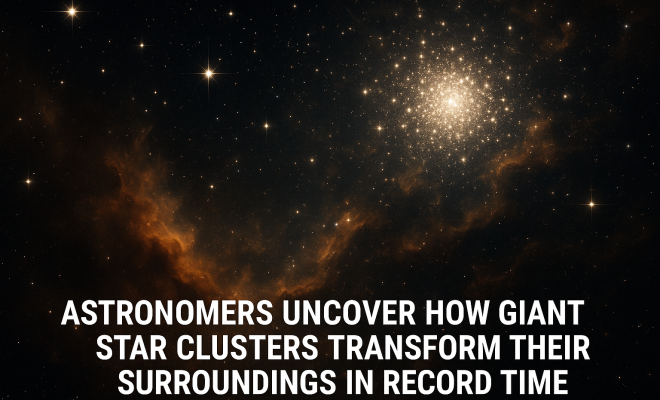
In a groundbreaking study utilizing the powerful capabilities of the James Webb Space Telescope (JWST) and the Hubble Space Telescope, astronomers have made astonishing discoveries regarding giant star clusters and their interactions with surrounding dust clouds. A survey encompassing nearly 9,000 young star clusters in four nearby galaxies has revealed that these clusters are capable of dispersing their surrounding dust clouds in as little as 5 million years. This finding is particularly significant as it alters our understanding of the timeline for how massive stars clear out the gas and dust essential for future star formation.
The Role of Giant Star Clusters in Star Formation
Star formation is a complex process that takes place in regions dense with gas and dust, often referred to as stellar nurseries. Traditionally, it was believed that these stellar nurseries remain obscured for extended periods before their celestial products become visible. However, the recent findings suggest that this process is far more rapid than previously thought.
The discovery implicates giant star clusters as vital players in shaping the environments in which stars are born. As massive stars evolve and end their life cycles, they release powerful stellar winds and radiation that can significantly impact their surroundings. The ability of these clusters to clear out surrounding dust and gas in just 5 million years pushes the boundaries of our understanding of galactic evolution.
A Closer Look at the Research Methodology
The research team conducted a comprehensive observational survey that included a substantial statistical sample, making it a robust study in the field of astrophysics. By examining nearly 9,000 young star clusters across four nearby galaxies, they were able to gather data that would be difficult to obtain through smaller-scale studies.
This extensive analysis involved detailed imaging and spectroscopy from both the JWST and Hubble, allowing researchers to measure the dispersal of dust clouds with unprecedented accuracy. The insights gained from this survey mark a significant advancement in our understanding of giant star clusters and their influence on cosmic environments.
Implications for Galactic Evolution
The implications of this research extend beyond the immediate findings. Understanding how giant star clusters interact with their environments is crucial for answering larger questions about the evolution of galaxies and the universe itself. The rapid dispersal of dust clouds sheds light on the processes that lead to star formation and the lifecycle of galaxies.
As giant star clusters clear their surrounding areas, they create new opportunities for other stars to form, thereby influencing the overall star population within a galaxy. This dynamic interplay between star clusters and their environments is essential for a holistic understanding of how galaxies evolve over time.
Challenging Existing Theories
One of the most striking aspects of this research is how it challenges existing theories about star formation. For decades, astronomers believed that stellar nurseries remained hidden for much longer periods, potentially on the order of tens of millions of years. However, the new data suggests a much faster timeline, allowing for a reevaluation of how we think about giant star clusters and their role in creating new stars.
This paradigm shift could have far-reaching consequences in our understanding of the cosmic landscape. Astronomers may need to reconsider how we classify star formation events and the lifecycle of star clusters, as well as the environments that foster them.
A Broader Appeal for Space Enthusiasts
The findings from this research resonate with a broad audience, appealing both to professional astronomers and laypeople alike. The connection to fundamental questions about star and galaxy evolution captivates space enthusiasts, sparking curiosity about the universe’s intricate mechanisms.
As astronomers continue to delve into the complexities of giant star clusters and their role in cosmic evolution, they illuminate pathways that could lead to even more striking discoveries. The use of cutting-edge technology like JWST and Hubble highlights the importance of ongoing investment in astronomical research and exploration.
Conclusion
The revelation that giant star clusters can disperse surrounding dust clouds in a record time of 5 million years is a remarkable advancement in astrophysics. This discovery not only enhances our understanding of star formation processes but also invites a reexamination of the evolutionary timelines of galaxies. As researchers continue to explore these celestial phenomena, the implications of their findings could reshape our understanding of the universe for years to come.