The Tech Edvocate

Top Menu

  • Advertisement
  • Apps
  • Home Page
  • Home Page Five (No Sidebar)
  • Home Page Four
  • Home Page Three
  • Home Page Two
  • Home Tech2
  • Icons [No Sidebar]
  • Left Sidbear Page
  • Lynch Educational Consulting
  • My Account
  • My Speaking Page
  • Newsletter Sign Up Confirmation
  • Newsletter Unsubscription
  • Our Brands
  • Page Example
  • Privacy Policy
  • Protected Content
  • Register
  • Request a Product Review
  • Shop
  • Shortcodes Examples
  • Signup
  • Start Here
    • Governance
    • Careers
    • Contact Us
  • Terms and Conditions
  • The Edvocate
  • The Tech Edvocate Product Guide
  • Topics
  • Write For Us
  • Advertise

Main Menu

  • Start Here
    • Our Brands
    • Governance
      • Lynch Educational Consulting, LLC.
      • Dr. Lynch’s Personal Website
      • Careers
    • Write For Us
    • The Tech Edvocate Product Guide
    • Contact Us
    • Books
    • Edupedia
    • Post a Job
    • The Edvocate Podcast
    • Terms and Conditions
    • Privacy Policy
  • Topics
    • Assistive Technology
    • Child Development Tech
    • Early Childhood & K-12 EdTech
    • EdTech Futures
    • EdTech News
    • EdTech Policy & Reform
    • EdTech Startups & Businesses
    • Higher Education EdTech
    • Online Learning & eLearning
    • Parent & Family Tech
    • Personalized Learning
    • Product Reviews
  • Advertise
  • Tech Edvocate Awards
  • The Edvocate
  • Pedagogue
  • School Ratings

logo

The Tech Edvocate

  • Start Here
    • Our Brands
    • Governance
      • Lynch Educational Consulting, LLC.
      • Dr. Lynch’s Personal Website
        • My Speaking Page
      • Careers
    • Write For Us
    • The Tech Edvocate Product Guide
    • Contact Us
    • Books
    • Edupedia
    • Post a Job
    • The Edvocate Podcast
    • Terms and Conditions
    • Privacy Policy
  • Topics
    • Assistive Technology
    • Child Development Tech
    • Early Childhood & K-12 EdTech
    • EdTech Futures
    • EdTech News
    • EdTech Policy & Reform
    • EdTech Startups & Businesses
    • Higher Education EdTech
    • Online Learning & eLearning
    • Parent & Family Tech
    • Personalized Learning
    • Product Reviews
  • Advertise
  • Tech Edvocate Awards
  • The Edvocate
  • Pedagogue
  • School Ratings
  • Best GetYourGuide tours in Paris

  • Does Viator offer group discounts?

  • Hotels.com vs Airbnb features

  • What is Regus Business Lounge?

  • What is Couchsurfing verification?

  • How to use Viator gift cards?

  • Klook payment methods accepted

  • Best Notion templates for teams

  • WeWork vs traditional office cost

  • Klook vs GetYourGuide vs Viator

Tech News
Home›Tech News›USC Engineers Create Heat-Resistant Memory Chip for Venus Missions

USC Engineers Create Heat-Resistant Memory Chip for Venus Missions
By Matthew Lynch
April 15, 2026
0
Spread the love

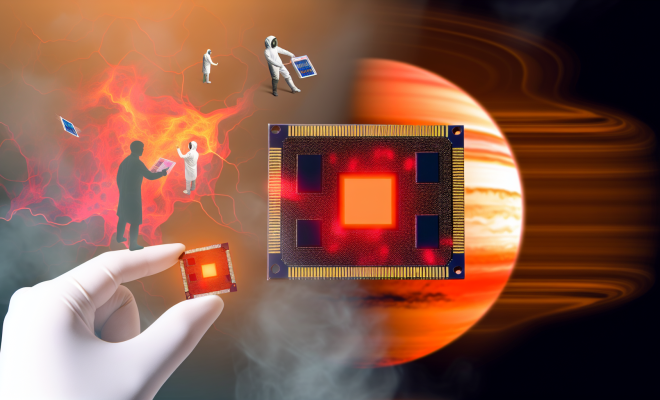
The harsh environment of Venus has long posed a significant challenge for space exploration, with its stifling surface temperatures reaching up to 900 degrees Fahrenheit (475 degrees Celsius) and atmospheric pressure over 90 times that of Earth. For decades, this hellish landscape has thwarted attempts to send electronic devices capable of surviving its extreme conditions. However, engineers at the University of Southern California (USC) have made a groundbreaking advancement in memory chip technology that could change the game for future missions to our neighboring planet.

A Revolutionary Breakthrough

The newly developed memory chip is designed to withstand temperatures that exceed even those of molten lava, making it a remarkable feat of engineering. Previous attempts to send electronic devices to Venus have ended in failure, with every device succumbing to the planet’s relentless heat and pressure. The USC engineers’ innovation signifies a leap forward in the potential for exploration of this mysterious planet.

The Accidental Discovery

Interestingly, the breakthrough began with what the engineers describe as a “happy accident.” While developing materials for a different project, they stumbled upon a combination that exhibited exceptional thermal resilience. This serendipitous finding led them to explore the potential applications of this material, ultimately paving the way for the creation of the heat-resistant memory chip.

Technical Specifications

The chip’s design incorporates advanced materials that are both durable and capable of functioning under extreme heat. Unlike traditional silicon-based chips, which would quickly fail in Venus’s environment, this new chip can maintain its integrity and functionality even in the most severe conditions. The engineers have conducted extensive testing to ensure reliability, simulating the Venusian environment in laboratory settings.

  • Temperature Resistance: The chip can endure temperatures exceeding 900°F (475°C).
  • Pressure Tolerance: It is built to withstand atmospheric pressures over 90 times that of Earth.
  • Material Composition: Utilizes a unique combination of materials that have yet to be disclosed.
  • Durability: Designed to function reliably for extended periods in extreme conditions.

Implications for Space Exploration

The successful development of this chip opens up new avenues for future missions to Venus. Scientists have long been intrigued by the planet’s potential to harbor life and its geological features, but the extreme conditions have made it virtually impossible to gather meaningful data. With this new technology, the possibility of deploying long-lasting landers or even atmospheric probes becomes feasible.

Furthermore, the engineering principles applied in the creation of this chip may have broader applications, extending beyond space exploration. Industries that face extreme environments on Earth, such as oil drilling or geothermal energy production, could benefit from similar technology.

Future Missions to Venus

The first potential mission to utilize this chip is still in the early planning stages. NASA’s upcoming VERITAS (Venus Emissivity, Radio Science, InSAR, Topography, and Spectroscopy) mission aims to map the surface of Venus and analyze its geology, which could greatly enhance our understanding of the planet’s history and composition.

Challenges Ahead

Despite this significant breakthrough, several challenges remain for future Venus missions. The extreme conditions not only threaten electronic devices but also present difficulties in heat shielding, power generation, and communications. Engineers and scientists will need to address these issues to make sustained exploration a reality.

Conclusion

The development of a memory chip that can survive the extreme conditions of Venus is a monumental step forward in our quest to explore the solar system. As researchers continue to refine this technology, we may be on the brink of uncovering the secrets of the second planet from the sun. The implications of this breakthrough extend well beyond Venus, potentially transforming how we approach other extreme environments on Earth and beyond.

In a world where technological advancements are often born from unexpected discoveries, this revolutionary chip serves as a reminder of the potential for innovation through exploration and experimentation. As we look to the stars, the possibilities for discovery continue to expand, driven by the ingenuity of scientists and engineers willing to push the boundaries of what is possible.


Previous Article

Unlocking Neutrino Mass: A Breakthrough in Particle ...

Next Article

Unlocking the Universe’s Expansion Rate: A Global ...

Matthew Lynch

Related articles More from author

  • Tech News

    How to cast to TV without Chromecast

    June 13, 2026
    By Matthew Lynch
  • Tech News

    Mastering CRM: How to Import Contacts Seamlessly

    June 20, 2026
    By Matthew Lynch
  • Tech News

    Your Ultimate Guide to 5K Training: Run Your Best Race

    July 1, 2026
    By Matthew Lynch
  • Tech News

    How to benchmark computer performance

    June 20, 2026
    By Matthew Lynch
  • Tech News

    Master 10 Effective Knee Taping Techniques for Support & Pain Relief

    July 2, 2026
    By Matthew Lynch
  • Tech News

    Harris Taunts Trump After He Backs Out of Debates

    July 27, 2024
    By Matthew Lynch

Search

Login & Registration

  • Log in
  • Entries feed
  • Comments feed
  • WordPress.org

Newsletter

Signup for The Tech Edvocate Newsletter and have the latest in EdTech news and opinion delivered to your email address!

About Us

Since technology is not going anywhere and does more good than harm, adapting is the best course of action. That is where The Tech Edvocate comes in. We plan to cover the PreK-12 and Higher Education EdTech sectors and provide our readers with the latest news and opinion on the subject. From time to time, I will invite other voices to weigh in on important issues in EdTech. We hope to provide a well-rounded, multi-faceted look at the past, present, the future of EdTech in the US and internationally.

We started this journey back in June 2016, and we plan to continue it for many more years to come. I hope that you will join us in this discussion of the past, present and future of EdTech and lend your own insight to the issues that are discussed.

Newsletter

Signup for The Tech Edvocate Newsletter and have the latest in EdTech news and opinion delivered to your email address!

Contact Us

The Tech Edvocate
910 Goddin Street
Richmond, VA 23231
(601) 630-5238
[email protected]

Copyright © 2026 Matthew Lynch. All rights reserved.