This Professor’s Alarming AI Cheating Warning Reveals a Deeper Crisis in Education
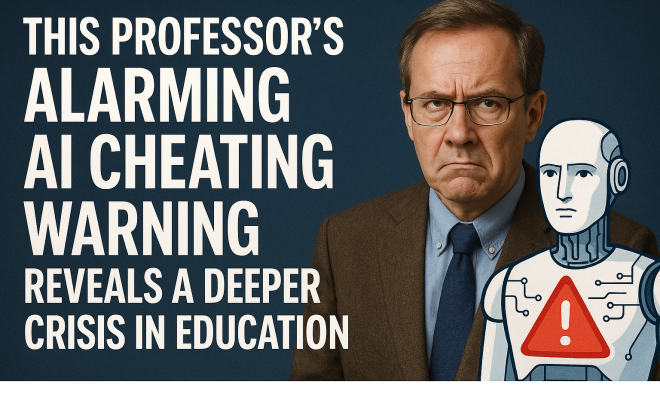
Imagine this: you’ve spent weeks, maybe months, meticulously crafting a challenging take-home exam for your university students. It’s designed to push their critical thinking, to see how they synthesize complex ideas, to truly gauge their understanding. Then, the results come in. An unprecedented number of students, far beyond historical averages, achieve near-perfect scores. You’re left with a gnawing suspicion: is this a sudden surge of genius, or something else entirely?
That’s precisely the unsettling scenario that recently unfolded at Brown University, courtesy of Professor Roberto Serrano in the economics department. The incident has not only put Serrano in a difficult spot but has also blown the lid off a simmering debate about academic integrity in the age of artificial intelligence. It’s not just about one professor or one exam; it’s a stark, urgent warning sign for the entire landscape of higher education, forcing us to confront the uncomfortable truth about AI cheating in education and what it means for the very purpose of learning.
The Brown University Quagmire: A Case Study in AI’s Impact
Professor Serrano’s experience is a vivid illustration of the ethical tightrope universities are now walking. Details are still emerging, but the core of the controversy centers on a take-home exam where students reportedly achieved astonishingly high marks. In a pre-AI world, such results might be celebrated as a triumph of teaching. Today, however, they trigger immediate alarm bells. The question isn’t whether students are smart, but whether their intelligence was augmented, perhaps even overshadowed, by generative AI tools.
What makes this particular incident so impactful is its visibility. Brown University is an Ivy League institution, a beacon of academic excellence. When questions of AI-assisted academic dishonesty surface there, it sends ripples across the entire educational ecosystem. It forces us to ask: if this can happen at Brown, what’s happening elsewhere? And more importantly, what are we going to do about it? Serrano’s predicament isn’t unique; it’s a harbinger of challenges many educators are already grappling with or will face very soon. We covered Arne Duncan's insights on accountability in more detail.
The AI Tsunami: Rapid Adoption Outpaces Guidance
The truth is, AI isn’t just knocking on the classroom door; it’s already burst through, leaving educators scrambling to adapt. Statistics reveal a staggering pace of adoption: nearly 60% of K-12 teachers are expected to use AI instructional tools in the 2024-2025 school year. That’s a massive leap in a very short time, and it highlights a critical disconnect: while teachers are embracing these tools, formal guidance and clear policy frameworks from institutions and governing bodies are lagging far behind.
This rapid, largely unregulated adoption creates a volatile environment. On one side, you have students who are digital natives, quick to experiment with new technologies, often viewing AI as just another tool for efficiency. On the other, you have teachers, many of whom are still trying to understand the capabilities and limitations of AI, let alone how to integrate it ethically into their pedagogy. This gap in understanding and policy is where the tension brews, leading to emotionally charged conflicts over acceptable usage and, inevitably, concerns about AI cheating in education.
Defining the Line: What Constitutes AI Cheating?
Here’s where things get really murky. What exactly counts as AI cheating in education? Is it using an AI to write an entire essay? What about using it to brainstorm ideas, structure an argument, or correct grammar? Is paraphrasing an AI-generated text cheating? The boundaries are incredibly fluid, making it difficult for both students and educators to navigate.
Consider the traditional definition of cheating: presenting someone else’s work as your own. Generative AI complicates this significantly. Is the AI ‘someone else’? Or is it a tool, like a calculator or a spell-checker, that simply assists in the production of work? Universities are struggling to update their academic integrity policies fast enough to keep pace with these nuances. Without clear, universally understood guidelines, students are left guessing, and educators are left playing detective, often without the right tools or training.
The Broader Policy Landscape: State-Level Responses
While universities like Brown grapple with individual incidents, state and city governments are beginning to wade into the AI policy waters, albeit cautiously and with varying approaches. We’re seeing a patchwork of responses that reflect the deep uncertainty surrounding AI’s role in education.
For instance, Florida has implemented rules allowing parents to opt out of certain AI instructional tools. This move underscores concerns about data privacy, algorithmic bias, and the potential for AI to influence learning in ways parents might not approve of. Meanwhile, New York City has taken a more restrictive stance, blocking generative AI for younger grades, likely out of a desire to protect foundational learning skills and prevent over-reliance on technology too early. These differing approaches highlight the lack of consensus and the experimental nature of current AI governance in education. These are not just technical decisions; they are deeply philosophical ones about the future of learning itself.
Beyond Detection: Rethinking Assessment in the AI Era
The immediate, almost instinctive reaction to AI cheating in education is to develop better detection tools. And yes, AI detection software is a rapidly growing segment of the EdTech market. However, relying solely on detection is a losing battle, a technological arms race where AI models will always be one step ahead. It’s like trying to patch a leaky dam with chewing gum. The real solution lies not just in identifying cheating, but in fundamentally reimagining how we assess learning. (See: AI's impact on education.)
If an AI can write a passable essay, then perhaps the essay as a primary form of assessment needs to evolve. Educators need to design assignments that AI struggles with – tasks that demand genuine critical thinking, personal reflection, real-world application, and creativity that goes beyond pattern recognition. This might mean more oral exams, project-based learning, in-class writing with human supervision, or assessments that require students to connect learning to their unique experiences or local contexts. The focus needs to shift from ‘what can you produce?’ to ‘how do you think and create?’
Empowering Educators: AI Literacy and Professional Development
The current situation places an enormous burden on teachers and professors. Many feel ill-equipped to handle the complexities of AI in their classrooms. They need more than just a directive to ‘deal with it.’ They need comprehensive professional development that goes beyond basic tool tutorials. For more context, see this elite university's AI ban.
True AI literacy for educators involves understanding how generative AI works, its capabilities and limitations, ethical considerations, and practical strategies for integrating it responsibly into their curriculum. It means learning how to design AI-resistant assignments, how to teach students to use AI as a beneficial tool rather than a crutch, and how to foster a culture of academic integrity in this new paradigm. Universities and school districts have a responsibility to invest heavily in this training, otherwise, the battle against AI cheating in education is already lost.
The Student Perspective: Navigating a Moral Maze
It’s easy to villainize students who use AI to cheat, but we also need to understand their perspective. They are growing up in a world saturated with AI, where these tools are often presented as efficiency boosters. Many genuinely don’t understand the ethical lines, or if they do, they might feel pressured to use them to keep up with peers who are. The fear of falling behind, coupled with the ease of access to powerful AI tools, creates a moral maze for students.
Universities and schools need to engage students in open, honest conversations about AI. This isn’t just about handing down rules; it’s about educating them on responsible AI use, the value of genuine learning, and the long-term implications of relying on AI to bypass the learning process. It’s about fostering a culture where academic integrity is understood not as a set of arbitrary rules, but as a foundational principle for personal and intellectual growth.
The Future of Learning: Beyond the Cheating Hysteria
While the immediate concern around AI cheating in education is valid and pressing, it’s crucial to look beyond the hysteria and consider the transformative potential of AI. If we only focus on preventing misuse, we risk missing out on the incredible opportunities AI offers to personalize learning, provide instant feedback, automate mundane tasks for educators, and make education more accessible.
The goal shouldn’t be to ban AI outright, but to integrate it thoughtfully and ethically. This means moving towards a future where AI is a collaborative partner in the learning process, not a tool for deception. It requires a significant paradigm shift, moving away from rote memorization and towards higher-order thinking skills that AI can augment but not replace. This is a chance to redefine what ‘learning’ truly means in the 21st century.
Monetizing the AI Education Conundrum
This evolving landscape, despite its challenges, also presents significant opportunities. The EdTech sector, for example, is already seeing a boom in AI detection software, tools designed to identify AI-generated text. But the market extends far beyond that. There’s a growing need for ethical AI tools that guide students in responsible AI use, or platforms that help educators design AI-resistant assessments.
Beyond software, there’s a huge demand for consulting services. Universities are desperately seeking expert guidance on developing robust AI policies, updating their academic integrity frameworks, and training their faculty. Similarly, professional development for educators on AI literacy is becoming a critical and highly sought-after service. This isn’t just about preventing cheating; it’s about preparing an entire generation of educators and students for an AI-powered future, and those who can provide clarity and solutions in this turbulent time will undoubtedly find significant opportunities.
The Psychological Impact of AI on Learning
The discussion around AI cheating in education often centers on policy and detection, but we also need to consider the deeper psychological effects on students. When AI tools become readily available, what does it do to a student’s sense of accomplishment? Does it diminish the intrinsic motivation to learn and struggle through difficult concepts? If an essay can be generated in minutes, does the student still feel the pride of intellectual effort?
There’s a real risk of cognitive erosion. Learning isn’t just about output; it’s about the process of grappling with ideas, forming connections, and developing independent thought. If AI consistently shortcuts this process, students might miss out on developing crucial problem-solving skills, resilience, and the ability to articulate complex thoughts in their own voice. This isn’t just about getting a good grade; it’s about shaping future thinkers and innovators. We need to foster environments where students value the journey of learning as much as the destination. There’s a fuller look at Is higher education worth it?.
The Equity Gap: Who Benefits (or Suffers) Most?
While AI tools are becoming more accessible, we can’t ignore the potential for an exacerbated equity gap. Students with access to premium AI subscriptions, or those in environments where AI literacy is actively taught, might gain an unfair advantage. Conversely, students from underserved communities, who might lack consistent internet access, up-to-date devices, or proper AI guidance, could fall further behind. (See: academic integrity and AI cheating.)
This isn’t just about who can afford the “best” AI. It’s also about cultural capital and prior knowledge. AI models are trained on vast datasets, often reflecting dominant cultural narratives. This can inadvertently disadvantage students whose backgrounds or learning styles don’t align with these dominant patterns. Universities and schools must actively work to ensure that AI integration is equitable, providing resources and training to all students, and being mindful of how AI might perpetuate or even worsen existing inequalities in education. The goal should be to level the playing field, not tilt it further.
Expert Perspectives: Voices from the Field
To truly grasp the complexity of AI cheating in education, it helps to hear from those on the front lines. Dr. Anya Sharma, a professor of educational technology, emphasizes the need for a balanced approach. “Banning AI outright is like trying to ban the internet,” she says. “It’s an impossible, and frankly, counterproductive goal. Our energy should be focused on teaching digital citizenship for AI, much like we teach it for social media.” For more context, see the AI bubble and economic reckoning.
Meanwhile, Dr. Ben Carter, a specialist in academic integrity, highlights the pedagogical shift required. “We’ve got to stop asking questions AI can answer easily. If your exam can be aced by ChatGPT, your exam is probably testing recall, not real understanding. We need to move towards open-ended problems, ethical dilemmas, and creative synthesis that requires human ingenuity.” He suggests that this moment is a catalyst for overdue pedagogical reform, pushing us towards more authentic assessment methods.
These perspectives underscore a critical point: this isn’t just a technological problem with a technological solution. It’s a human challenge requiring thoughtful educational, ethical, and pedagogical responses.
Case Studies in Adaptation: Success Stories and Cautionary Tales
While the Brown University incident serves as a cautionary tale, some institutions are experimenting with proactive AI integration strategies. For example, some community colleges are incorporating AI literacy modules into their core curriculum, teaching students how to use AI for research, brainstorming, and editing, but with strict guidelines on attribution and originality. They frame AI as a co-pilot, not an autopilot.
On the other hand, we’ve seen instances where institutions rushed into adopting AI detection software without clear policies, leading to false positives and undue stress for students. One university reportedly flagged a significant percentage of student essays as AI-generated, only for later review to reveal many were original work. This highlights the dangers of relying solely on technology without human oversight and clear, well-communicated guidelines.
These varied experiences demonstrate that there’s no one-size-fits-all solution. Successful integration requires a nuanced understanding of AI’s capabilities, a commitment to ongoing policy development, and continuous dialogue between faculty, students, and administrators.
The Role of Parental Engagement in the AI Era
For younger students, parental involvement plays a crucial role in shaping their understanding and use of AI tools. Just as parents guide children on internet safety or responsible social media use, they now need to engage with the concept of AI. Schools can facilitate this by hosting workshops, providing clear communication on AI policies, and offering resources for parents to discuss AI ethics at home.
Parents can help reinforce the value of original thought, the importance of academic honesty, and the long-term benefits of developing skills independently. Without this home-school partnership, the messages students receive about AI use can become muddled, potentially leading to confusion about what constitutes appropriate academic behavior.
FAQ: Navigating AI Cheating in Education
Q1: What is the most common form of AI cheating in education?
The most common form currently involves students using generative AI tools like ChatGPT to produce essays, research papers, or answers to take-home exams. This can range from generating entire assignments to using AI for significant portions of text, brainstorming, or detailed outlining without proper attribution or permission. (See: research on AI in education.)
Q2: Can AI detection software reliably catch AI-generated text?
While AI detection software is improving, it’s not 100% reliable. These tools often use algorithms to identify patterns common in AI-generated text, but they can produce false positives (flagging human-written text as AI) and false negatives (missing AI-generated text). The technology is in a constant arms race with evolving AI models, making it a challenging, often inconclusive, primary method for identifying cheating.
Q3: How are universities updating their academic integrity policies for AI?
Universities are generally taking one of three approaches: a) outright banning AI use for all assignments, b) allowing AI with strict guidelines for attribution and permissible use (e.g., for brainstorming but not writing), or c) encouraging AI use as a learning tool and adapting assessments to be “AI-resistant.” Many are still in the process of defining these policies, often involving faculty committees and student input.
Q4: What are “AI-resistant” assignments?
AI-resistant assignments are designed to minimize the ability of AI to complete them effectively. They often require personal reflection, real-world application, critical analysis of current events, data from specific local contexts, oral presentations, group projects, or in-class, supervised work. The goal is to assess higher-order thinking, creativity, and unique human insights that AI struggles to replicate.
Q5: How can educators prepare themselves for AI in the classroom?
Educators need professional development focusing on AI literacy. This includes understanding how generative AI works, its capabilities and limitations, ethical considerations, and practical strategies for integrating it responsibly into their curriculum. It also means learning to design AI-resistant assignments and fostering a culture of academic integrity around AI use.
Q6: Should students be taught how to use AI?
Many experts argue that teaching students responsible AI use is essential. Since AI tools are ubiquitous, students will encounter them regardless. Education can equip them with the critical thinking skills to evaluate AI outputs, understand biases, use AI as a productive tool, and understand the ethical implications of its use, rather than just banning it and hoping for the best.
Q7: What are the long-term implications of AI cheating for students?
Relying on AI to bypass the learning process can hinder students’ cognitive development, critical thinking skills, and ability to articulate their own ideas. It can also diminish their sense of accomplishment and undermine the value of their education. In the long run, it can lead to a lack of genuine understanding and preparedness for future academic or professional challenges. This builds on Current issues in higher education.
Q8: Is there a benefit to students using AI in their learning process?
Absolutely, when used responsibly. AI can act as a tutor, provide instant feedback, help brainstorm ideas, refine writing, summarize complex texts, and even personalize learning experiences. The key is using AI as a tool to augment learning and understanding, not to replace it.
Professor Serrano’s experience at Brown isn’t just a controversy; it’s a flashing red light. It compels us to move beyond superficial fixes and engage in a deep, systemic re-evaluation of our educational practices. The challenge of AI cheating in education isn’t going away, and simply trying to catch students will prove futile. Instead, we have a profound opportunity to redefine academic integrity, empower our educators, and ultimately, design a future where AI enhances, rather than undermines, the true spirit of learning.
Trending Now
Frequently Asked Questions
What is the AI cheating warning from Professor Serrano?
Professor Roberto Serrano from Brown University raised alarms about academic integrity after students scored unusually high on a challenging take-home exam. This incident highlights concerns over the use of generative AI tools that may enhance performance, prompting a broader discussion on the implications for education.
How is AI impacting education and academic integrity?
AI technologies are increasingly being used by students to assist in their studies, which raises significant questions about academic integrity. The situation at Brown University illustrates how AI can potentially distort assessment outcomes, making it difficult to gauge true student understanding and capabilities.
What happened at Brown University regarding AI and student performance?
At Brown University, Professor Serrano observed an unprecedented number of students achieving near-perfect scores on a take-home exam. This phenomenon has sparked discussions about the role of AI in augmenting student performance and the potential for academic dishonesty in higher education.
Why are high scores on exams raising concerns among educators?
High scores that deviate significantly from historical averages raise red flags for educators, suggesting the possibility of AI-assisted cheating. Such outcomes challenge the validity of assessments and prompt educators to rethink the effectiveness of traditional testing methods in the age of advanced technology.
What does the Brown University incident reveal about higher education?
The incident at Brown University serves as a wake-up call for higher education institutions, highlighting the urgent need to address the challenges posed by AI in academic settings. It emphasizes the necessity for universities to develop strategies to maintain academic integrity while adapting to technological advancements.
Have you experienced this yourself? We'd love to hear your story in the comments.