The Tech Edvocate

Top Menu

  • Advertisement
  • Apps
  • Home Page
  • Home Page Five (No Sidebar)
  • Home Page Four
  • Home Page Three
  • Home Page Two
  • Home Tech2
  • Icons [No Sidebar]
  • Left Sidbear Page
  • Lynch Educational Consulting
  • My Account
  • My Speaking Page
  • Newsletter Sign Up Confirmation
  • Newsletter Unsubscription
  • Our Brands
  • Page Example
  • Privacy Policy
  • Protected Content
  • Register
  • Request a Product Review
  • Shop
  • Shortcodes Examples
  • Signup
  • Start Here
    • Governance
    • Careers
    • Contact Us
  • Terms and Conditions
  • The Edvocate
  • The Tech Edvocate Product Guide
  • Topics
  • Write For Us
  • Advertise

Main Menu

  • Start Here
    • Our Brands
    • Governance
      • Lynch Educational Consulting, LLC.
      • Dr. Lynch’s Personal Website
      • Careers
    • Write For Us
    • The Tech Edvocate Product Guide
    • Contact Us
    • Books
    • Edupedia
    • Post a Job
    • The Edvocate Podcast
    • Terms and Conditions
    • Privacy Policy
  • Topics
    • Assistive Technology
    • Child Development Tech
    • Early Childhood & K-12 EdTech
    • EdTech Futures
    • EdTech News
    • EdTech Policy & Reform
    • EdTech Startups & Businesses
    • Higher Education EdTech
    • Online Learning & eLearning
    • Parent & Family Tech
    • Personalized Learning
    • Product Reviews
  • Advertise
  • Tech Edvocate Awards
  • The Edvocate
  • Pedagogue
  • School Ratings

logo

The Tech Edvocate

  • Start Here
    • Our Brands
    • Governance
      • Lynch Educational Consulting, LLC.
      • Dr. Lynch’s Personal Website
        • My Speaking Page
      • Careers
    • Write For Us
    • The Tech Edvocate Product Guide
    • Contact Us
    • Books
    • Edupedia
    • Post a Job
    • The Edvocate Podcast
    • Terms and Conditions
    • Privacy Policy
  • Topics
    • Assistive Technology
    • Child Development Tech
    • Early Childhood & K-12 EdTech
    • EdTech Futures
    • EdTech News
    • EdTech Policy & Reform
    • EdTech Startups & Businesses
    • Higher Education EdTech
    • Online Learning & eLearning
    • Parent & Family Tech
    • Personalized Learning
    • Product Reviews
  • Advertise
  • Tech Edvocate Awards
  • The Edvocate
  • Pedagogue
  • School Ratings
  • How to create estimates in Buildertrend

  • How to use Bluebeam for punch lists

  • Procore vs Viewpoint features

  • How to submit invoices in Procore

  • How to set up Monday.com for contractors

  • Can PlanGrid track punch lists

  • How to create selections in CoConstruct

  • How to markup drawings in PlanGrid

  • How to use PlanGrid for blueprints

  • How to create custom tools in Bluebeam

Tech News
Home›Tech News›X-Class Solar Flare Disrupts Radio, Raises Artemis 2 Concerns 2026

X-Class Solar Flare Disrupts Radio, Raises Artemis 2 Concerns 2026
By Matthew Lynch
March 31, 2026
0
Spread the love

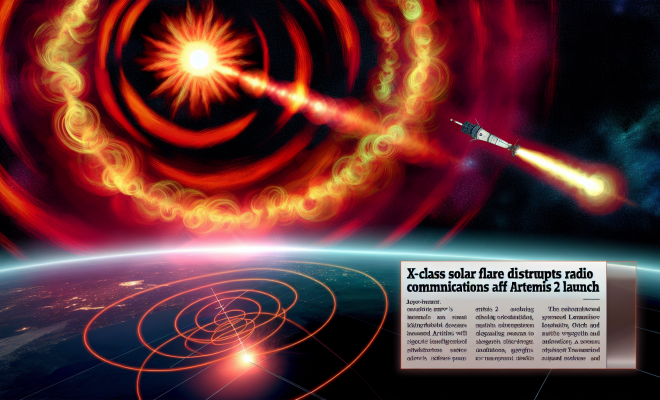
On March 30, 2026, the Sun unleashed a powerful X1.4 solar flare, creating significant disruptions in radio communications on Earth and raising concerns regarding NASA’s upcoming Artemis 2 mission, scheduled to launch on April 1. This event underscores the dynamic nature of solar activity and its potential impacts on space missions and terrestrial technology.

The Solar Flare and Its Impacts

The X1.4 solar flare, categorized as an X-class flare, is indicative of intense solar activity. Such flares are capable of producing significant amounts of radiation, which can lead to various disruptions in the Earth’s ionosphere, affecting radio signals and satellite operations. The recent flare triggered a radio blackout, particularly impacting high-frequency communications, which are critical for aviation and maritime operations.

The National Oceanic and Atmospheric Administration’s (NOAA) Space Weather Prediction Center promptly issued a moderate (G2) geomagnetic storm watch for March 31, 2026. The prediction indicated the possibility of minor (G1) storm conditions both on March 30 and April 1, creating a potentially complex environment for the Artemis 2 mission preparations.

Artemis 2 Mission Overview

The Artemis 2 mission represents a significant milestone in NASA’s ambitious program aimed at returning humans to the Moon. This mission will build upon the successes of Artemis 1, which tested the Space Launch System (SLS) and the Orion spacecraft in an uncrewed flight around the Moon. Artemis 2 aims to carry astronauts on a similar trajectory, providing vital data and experience for future lunar missions, including Artemis 3, which plans to land astronauts on the lunar surface.

The Artemis 2 crew is set to embark on a 10-day journey that will take them around the Moon and back to Earth, testing critical systems and operations with human participants aboard. However, the recent solar activity poses a unique challenge, as the electromagnetic emissions from solar flares can interfere with the spacecraft’s navigational and communication systems.

Potential Effects of Solar Activity

Solar flares are not merely a concern for spacecraft; they can also affect various systems on Earth:

  • Radio Communication: As demonstrated by the recent X-class flare, high-frequency radio communications can be disrupted, impacting everything from air traffic control to maritime navigation.
  • GPS Systems: Increased ionospheric disturbances can lead to inaccuracies in GPS signals, which may complicate navigation for both terrestrial and aerial vehicles.
  • Power Grids: Geomagnetic storms can induce currents in power lines, potentially leading to voltage irregularities and outages.
  • Auroras: On the positive side, heightened solar activity often results in increased visibility of the northern and southern lights, creating stunning natural displays in the polar regions and beyond.

Monitoring and Preparedness

In light of these phenomena, agencies like NOAA and NASA continuously monitor solar activity to provide timely warnings and forecasts. The ability to predict solar flares and geomagnetic storms is crucial for mitigating their impacts on technology and human activities.

NASA has taken steps to prepare for the effects of solar activity on missions like Artemis 2. Engineers and mission planners are well aware of the risks posed by solar flares and design spacecraft systems with redundancies and protective measures to minimize disruptions. This includes shielding sensitive electronics and utilizing robust communication systems to ensure that critical operations can continue, even in the event of solar interference.

Looking Ahead

The Artemis 2 mission is poised to be a historic step in lunar exploration, paving the way for future missions that aim to establish a sustainable human presence on the Moon. As preparations continue, the space community remains vigilant about solar activity that could affect launch conditions and mission success.

With the possibility of geomagnetic storms in the coming days, NASA and its partners will be closely monitoring the situation. The success of Artemis 2 will not only depend on the capabilities of the spacecraft and crew but also on their ability to adapt to the unpredictable nature of space weather.

Conclusion

The X1.4 solar flare serves as a reminder of the Sun’s powerful influence on our planet and the technologies we rely on daily. As humanity ventures further into space with ambitious missions like Artemis 2, understanding and preparing for solar activity will be crucial in ensuring safe and successful exploration of the cosmos.


Previous Article

NASA Confirms Triple Asteroid Flyby: A Safe ...

Next Article

NASA Gears Up for Historic Artemis II ...

Matthew Lynch

Related articles More from author

  • Tech News

    How to restart frozen smartwatch

    June 23, 2026
    By Matthew Lynch
  • Tech News

    How to remove Docker containers?

    August 15, 2026
    By Matthew Lynch
  • Tech News

    Green Rice: Unveiling Hidden “Good Fats” for Global Nutrition 2026

    April 6, 2026
    By Matthew Lynch
  • Tech News

    How to set up parental controls iPhone

    June 14, 2026
    By Matthew Lynch
  • Tech News

    Can I edit files remotely in FileZilla?

    August 17, 2026
    By Matthew Lynch
  • Tech News

    Crafting Unforgettable Wedding Vows: Your Complete Guide

    July 12, 2026
    By Matthew Lynch

Search

Login & Registration

  • Log in
  • Entries feed
  • Comments feed
  • WordPress.org

Newsletter

Signup for The Tech Edvocate Newsletter and have the latest in EdTech news and opinion delivered to your email address!

About Us

Since technology is not going anywhere and does more good than harm, adapting is the best course of action. That is where The Tech Edvocate comes in. We plan to cover the PreK-12 and Higher Education EdTech sectors and provide our readers with the latest news and opinion on the subject. From time to time, I will invite other voices to weigh in on important issues in EdTech. We hope to provide a well-rounded, multi-faceted look at the past, present, the future of EdTech in the US and internationally.

We started this journey back in June 2016, and we plan to continue it for many more years to come. I hope that you will join us in this discussion of the past, present and future of EdTech and lend your own insight to the issues that are discussed.

Newsletter

Signup for The Tech Edvocate Newsletter and have the latest in EdTech news and opinion delivered to your email address!

Contact Us

The Tech Edvocate
910 Goddin Street
Richmond, VA 23231
(601) 630-5238
[email protected]

Copyright © 2026 Matthew Lynch. All rights reserved.