The Tech Edvocate

Top Menu

  • Advertisement
  • Apps
  • Home Page
  • Home Page Five (No Sidebar)
  • Home Page Four
  • Home Page Three
  • Home Page Two
  • Home Tech2
  • Icons [No Sidebar]
  • Left Sidbear Page
  • Lynch Educational Consulting
  • My Account
  • My Speaking Page
  • Newsletter Sign Up Confirmation
  • Newsletter Unsubscription
  • Our Brands
  • Page Example
  • Privacy Policy
  • Protected Content
  • Register
  • Request a Product Review
  • Shop
  • Shortcodes Examples
  • Signup
  • Start Here
    • Governance
    • Careers
    • Contact Us
  • Terms and Conditions
  • The Edvocate
  • The Tech Edvocate Product Guide
  • Topics
  • Write For Us
  • Advertise

Main Menu

  • Start Here
    • Our Brands
    • Governance
      • Lynch Educational Consulting, LLC.
      • Dr. Lynch’s Personal Website
      • Careers
    • Write For Us
    • The Tech Edvocate Product Guide
    • Contact Us
    • Books
    • Edupedia
    • Post a Job
    • The Edvocate Podcast
    • Terms and Conditions
    • Privacy Policy
  • Topics
    • Assistive Technology
    • Child Development Tech
    • Early Childhood & K-12 EdTech
    • EdTech Futures
    • EdTech News
    • EdTech Policy & Reform
    • EdTech Startups & Businesses
    • Higher Education EdTech
    • Online Learning & eLearning
    • Parent & Family Tech
    • Personalized Learning
    • Product Reviews
  • Advertise
  • Tech Edvocate Awards
  • The Edvocate
  • Pedagogue
  • School Ratings

logo

The Tech Edvocate

  • Start Here
    • Our Brands
    • Governance
      • Lynch Educational Consulting, LLC.
      • Dr. Lynch’s Personal Website
        • My Speaking Page
      • Careers
    • Write For Us
    • The Tech Edvocate Product Guide
    • Contact Us
    • Books
    • Edupedia
    • Post a Job
    • The Edvocate Podcast
    • Terms and Conditions
    • Privacy Policy
  • Topics
    • Assistive Technology
    • Child Development Tech
    • Early Childhood & K-12 EdTech
    • EdTech Futures
    • EdTech News
    • EdTech Policy & Reform
    • EdTech Startups & Businesses
    • Higher Education EdTech
    • Online Learning & eLearning
    • Parent & Family Tech
    • Personalized Learning
    • Product Reviews
  • Advertise
  • Tech Edvocate Awards
  • The Edvocate
  • Pedagogue
  • School Ratings
  • Dramatic: AI Surveillance Giant Cuts Hundreds of Jobs Amid Privacy Backlash

  • Dramatic: Anthropic Claude AI Just Banned ‘Cruel’ Behavior — Here’s Why It Matters

  • This One Shift in Gaming VC Could Reshape the Entire Industry

  • The AI Doctor Is Coming: Is It a Miracle or a Menace?

  • Unmasking the AI Deepfake Threat: Why Corporate America’s Billions Are at Risk

  • Shocking: China’s AI Programmers Collapse — A Disturbing Glimpse Into Our Future?

  • Dramatic Spike: College Costs Projected to Soar 7.5% — Are You Ready?

  • 20 Million Records Exposed: The Reckless Truth Behind the Oracle Health Data Breach

  • The AI Cybersecurity Threat: A Dangerous New Frontier

  • Unbelievable: [Automaker Name]’s Self-Driving Cars Under Fire After Fatal Crash — Here’s What We Know

Digital & Mobile Technology
Home›Digital & Mobile Technology›What Is External SATA (eSATA)?

What Is External SATA (eSATA)?
By Matthew Lynch
June 1, 2023
0
Spread the love

External SATA, or eSATA, is a computer interface that allows users to connect external storage devices to their computers. This connection provides users with fast data transfer speed and is commonly used for backing up important data, storing large files, and for other data-intensive tasks. In this article, we will delve into what eSATA is, how it works, and its advantages and limitations.

What Is eSATA?

eSATA is an external storage interface that was introduced in 2004 by the Serial ATA International Organization (SATA-IO). The interface is an extension of the internal SATA interface used to connect storage devices such as hard drives, SSDs, optical drives, and more to a computer’s motherboard.

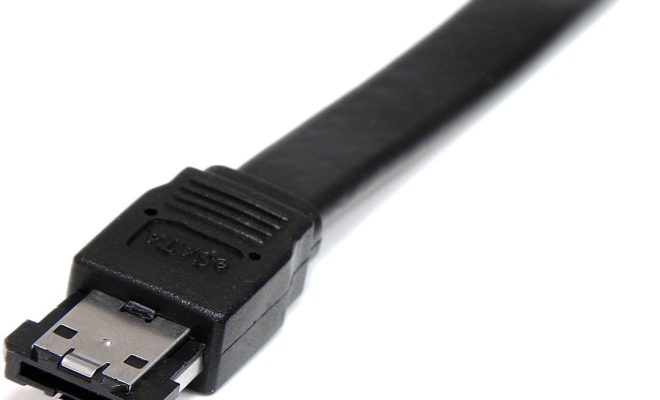
An eSATA port, also known as an external SATA, is a connector that allows users to connect external storage devices such as hard drives, RAID enclosures, and media players to a computer. This connection can be used to transfer large files from one device to another, backup files or data, or run an operating system, among other uses.

How Does eSATA Work?

eSATA operates on the same technology as the internal SATA interface used to connect storage devices inside a computer’s case. However, eSATA uses a different type of connector that is designed for external connections.

The eSATA cable has fewer wires compared to the USB or FireWire cables, which leads to better data transfer speed. The cable also has a locking mechanism that holds it securely in place, which prevents it from accidentally detaching during data transfer. eSATA supports transfer speeds of up to 6 Gbps, which is faster than USB 3.0’s maximum speed of 5 Gbps.

Advantages of eSATA

The main advantage of eSATA is its speed. Its 6 Gbps transfer speed is much faster than USB 3.0 or FireWire, making it ideal for data-intensive tasks such as transferring large files, backing up data, and running an operating system. eSATA also has a low CPU overhead, which means that it does not require much processing power to perform data transfer tasks.

Another advantage of eSATA is that it supports SATA’s advanced features such as Native Command Queuing (NCQ) and hot-swapping. NCQ is a technology that optimizes the order of read and write commands, which reduces the time taken to access data. Hot-swapping allows users to switch external storage devices without needing to restart the computer.

Limitations of eSATA

One limitation of eSATA is that it requires an external power source for some devices. Unlike USB, which provides power to some external devices, eSATA does not provide power, which means that some devices need additional power sources.

Another limitation of eSATA is its availability. Not all devices come with an eSATA port, which limits its usefulness. The popularity of USB has also meant that USB ports are more ubiquitous, which makes it easier to find a USB-enabled device than an eSATA-enabled one.

Conclusion

eSATA remains a popular option for users seeking high-speed data transfer and support for advanced SATA features. It provides an easy and secure way to connect external storage devices to a computer, and its transfer speed is faster than USB or FireWire. However, its limited availability and need for an external power source are issues to consider when deciding between different connectivity options


Previous Article

How to Fix ‘Cannot Be Opened Because ...

Next Article

How to Log Out of YouTube

Matthew Lynch

Related articles More from author

  • Digital & Mobile TechnologyOnline Learning & eLearning

    What Is a PCB and What Does the Acronym Stand For?

    August 5, 2023
    By Matthew Lynch
  • Digital & Mobile Technology

    The Official Android Versions Guide: Everything You Need to Know

    June 2, 2023
    By Matthew Lynch
  • Digital & Mobile Technology

    How to Turn Off AirPlay

    June 2, 2023
    By Matthew Lynch
  • Digital & Mobile Technology

    What is a Virtual Dedicated Server (VDS)?

    April 24, 2023
    By Matthew Lynch
  • Digital & Mobile Technology

    Learn More About Xbox Gamerscores

    June 23, 2023
    By Matthew Lynch
  • Digital & Mobile Technology

    What Is the Problem if My TV Turns Itself Off?

    May 13, 2023
    By Matthew Lynch

Search

Login & Registration

  • Log in
  • Entries feed
  • Comments feed
  • WordPress.org

Newsletter

Signup for The Tech Edvocate Newsletter and have the latest in EdTech news and opinion delivered to your email address!

About Us

Since technology is not going anywhere and does more good than harm, adapting is the best course of action. That is where The Tech Edvocate comes in. We plan to cover the PreK-12 and Higher Education EdTech sectors and provide our readers with the latest news and opinion on the subject. From time to time, I will invite other voices to weigh in on important issues in EdTech. We hope to provide a well-rounded, multi-faceted look at the past, present, the future of EdTech in the US and internationally.

We started this journey back in June 2016, and we plan to continue it for many more years to come. I hope that you will join us in this discussion of the past, present and future of EdTech and lend your own insight to the issues that are discussed.

Newsletter

Signup for The Tech Edvocate Newsletter and have the latest in EdTech news and opinion delivered to your email address!

Contact Us

The Tech Edvocate
910 Goddin Street
Richmond, VA 23231
(601) 630-5238
[email protected]

Copyright © 2026 Matthew Lynch. All rights reserved.