The Tech Edvocate

Top Menu

  • Advertisement
  • Apps
  • Home Page
  • Home Page Five (No Sidebar)
  • Home Page Four
  • Home Page Three
  • Home Page Two
  • Home Tech2
  • Icons [No Sidebar]
  • Left Sidbear Page
  • Lynch Educational Consulting
  • My Account
  • My Speaking Page
  • Newsletter Sign Up Confirmation
  • Newsletter Unsubscription
  • Our Brands
  • Page Example
  • Privacy Policy
  • Protected Content
  • Register
  • Request a Product Review
  • Shop
  • Shortcodes Examples
  • Signup
  • Start Here
    • Governance
    • Careers
    • Contact Us
  • Terms and Conditions
  • The Edvocate
  • The Tech Edvocate Product Guide
  • Topics
  • Write For Us
  • Advertise

Main Menu

  • Start Here
    • Our Brands
    • Governance
      • Lynch Educational Consulting, LLC.
      • Dr. Lynch’s Personal Website
      • Careers
    • Write For Us
    • The Tech Edvocate Product Guide
    • Contact Us
    • Books
    • Edupedia
    • Post a Job
    • The Edvocate Podcast
    • Terms and Conditions
    • Privacy Policy
  • Topics
    • Assistive Technology
    • Child Development Tech
    • Early Childhood & K-12 EdTech
    • EdTech Futures
    • EdTech News
    • EdTech Policy & Reform
    • EdTech Startups & Businesses
    • Higher Education EdTech
    • Online Learning & eLearning
    • Parent & Family Tech
    • Personalized Learning
    • Product Reviews
  • Advertise
  • Tech Edvocate Awards
  • The Edvocate
  • Pedagogue
  • School Ratings

logo

The Tech Edvocate

  • Start Here
    • Our Brands
    • Governance
      • Lynch Educational Consulting, LLC.
      • Dr. Lynch’s Personal Website
        • My Speaking Page
      • Careers
    • Write For Us
    • The Tech Edvocate Product Guide
    • Contact Us
    • Books
    • Edupedia
    • Post a Job
    • The Edvocate Podcast
    • Terms and Conditions
    • Privacy Policy
  • Topics
    • Assistive Technology
    • Child Development Tech
    • Early Childhood & K-12 EdTech
    • EdTech Futures
    • EdTech News
    • EdTech Policy & Reform
    • EdTech Startups & Businesses
    • Higher Education EdTech
    • Online Learning & eLearning
    • Parent & Family Tech
    • Personalized Learning
    • Product Reviews
  • Advertise
  • Tech Edvocate Awards
  • The Edvocate
  • Pedagogue
  • School Ratings
  • A Visitors Guide to Corpus Christi (TX), United States

  • Best GetYourGuide tours in Paris

  • Does Viator offer group discounts?

  • Hotels.com vs Airbnb features

  • What is Regus Business Lounge?

  • What is Couchsurfing verification?

  • How to use Viator gift cards?

  • Klook payment methods accepted

  • Best Notion templates for teams

  • WeWork vs traditional office cost

Digital & Mobile Technology
Home›Digital & Mobile Technology›What Is Bayesian Spam Filtering?

What Is Bayesian Spam Filtering?
By Matthew Lynch
July 24, 2023
0
Spread the love

Bayesian spam filtering is a technique used for identifying and filtering out unwanted emails, also known as spam. It is based on the principles of probability theory and uses statistical analysis to determine whether an email is likely to be spam or not.

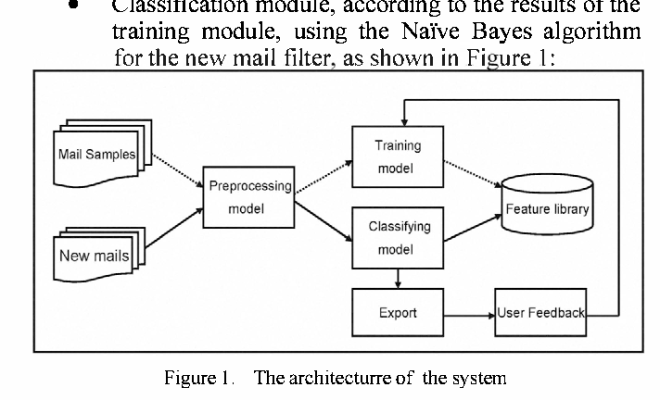
The technique is named after the Reverend Thomas Bayes, an 18th-century mathematician who developed the theory of probability. Bayesian spam filtering works by analyzing the content of an email and comparing it to a database of previously identified spam and non-spam emails. The system then calculates the probability that the email is spam based on the presence or absence of specific words and phrases, as well as other factors such as the sender’s email address and the email’s subject line.

The process of Bayesian spam filtering typically begins with a training phase, during which the system is trained to recognize spam and non-spam emails. This is done by feeding the system with a large number of sample emails and designating them as either spam or non-spam. The system then uses this data to build a database of words and phrases that are commonly found in spam emails, as well as ones that are commonly found in legitimate emails.

Once the training phase is completed, the Bayesian spam filter can then be used to analyze incoming emails and assign a probability score indicating the likelihood that the email is spam. If the score exceeds a certain threshold, the email is classified as spam and either deleted or sent to a separate folder for review.

Bayesian spam filtering is an effective technique for reducing the amount of unwanted emails that make it to a user’s inbox. It is widely used by email service providers and is also available as a feature in many email clients. However, it is not perfect and can sometimes classify legitimate emails as spam or fail to identify certain types of spam. Therefore, it is important to periodically review the spam folder to ensure that no legitimate emails have been incorrectly classified.


Previous Article

The Difference Between a Passive and Powered ...

Next Article

How to Use Chromebook Guest Mode

Matthew Lynch

Related articles More from author

  • Digital & Mobile Technology

    How to Wipe a MacBook Air

    June 4, 2023
    By Matthew Lynch
  • Digital & Mobile Technology

    Subtitles vs. Dubbing: Which Is Better When Streaming Foreign Films and Shows?

    August 5, 2023
    By Matthew Lynch
  • Digital & Mobile Technology

    Does a VPN Unlock Geo-Restricted Content on Amazon Prime Video?

    July 31, 2023
    By Matthew Lynch
  • Digital & Mobile Technology

    Is Win32:Bogent Safe? How Do I Remove It?

    July 31, 2023
    By Matthew Lynch
  • Digital & Mobile Technology

    The Best PCIe 4.0 SSDs for Gaming

    June 22, 2023
    By Matthew Lynch
  • Digital & Mobile Technology

    How to Play PC Games on Your Android Phone

    May 1, 2023
    By Matthew Lynch

Search

Login & Registration

  • Log in
  • Entries feed
  • Comments feed
  • WordPress.org

Newsletter

Signup for The Tech Edvocate Newsletter and have the latest in EdTech news and opinion delivered to your email address!

About Us

Since technology is not going anywhere and does more good than harm, adapting is the best course of action. That is where The Tech Edvocate comes in. We plan to cover the PreK-12 and Higher Education EdTech sectors and provide our readers with the latest news and opinion on the subject. From time to time, I will invite other voices to weigh in on important issues in EdTech. We hope to provide a well-rounded, multi-faceted look at the past, present, the future of EdTech in the US and internationally.

We started this journey back in June 2016, and we plan to continue it for many more years to come. I hope that you will join us in this discussion of the past, present and future of EdTech and lend your own insight to the issues that are discussed.

Newsletter

Signup for The Tech Edvocate Newsletter and have the latest in EdTech news and opinion delivered to your email address!

Contact Us

The Tech Edvocate
910 Goddin Street
Richmond, VA 23231
(601) 630-5238
[email protected]

Copyright © 2026 Matthew Lynch. All rights reserved.