The Tech Edvocate

Top Menu

  • Advertisement
  • Apps
  • Home Page
  • Home Page Five (No Sidebar)
  • Home Page Four
  • Home Page Three
  • Home Page Two
  • Home Tech2
  • Icons [No Sidebar]
  • Left Sidbear Page
  • Lynch Educational Consulting
  • My Account
  • My Speaking Page
  • Newsletter Sign Up Confirmation
  • Newsletter Unsubscription
  • Our Brands
  • Page Example
  • Privacy Policy
  • Protected Content
  • Register
  • Request a Product Review
  • Shop
  • Shortcodes Examples
  • Signup
  • Start Here
    • Governance
    • Careers
    • Contact Us
  • Terms and Conditions
  • The Edvocate
  • The Tech Edvocate Product Guide
  • Topics
  • Write For Us
  • Advertise

Main Menu

  • Start Here
    • Our Brands
    • Governance
      • Lynch Educational Consulting, LLC.
      • Dr. Lynch’s Personal Website
      • Careers
    • Write For Us
    • The Tech Edvocate Product Guide
    • Contact Us
    • Books
    • Edupedia
    • Post a Job
    • The Edvocate Podcast
    • Terms and Conditions
    • Privacy Policy
  • Topics
    • Assistive Technology
    • Child Development Tech
    • Early Childhood & K-12 EdTech
    • EdTech Futures
    • EdTech News
    • EdTech Policy & Reform
    • EdTech Startups & Businesses
    • Higher Education EdTech
    • Online Learning & eLearning
    • Parent & Family Tech
    • Personalized Learning
    • Product Reviews
  • Advertise
  • Tech Edvocate Awards
  • The Edvocate
  • Pedagogue
  • School Ratings

logo

The Tech Edvocate

  • Start Here
    • Our Brands
    • Governance
      • Lynch Educational Consulting, LLC.
      • Dr. Lynch’s Personal Website
        • My Speaking Page
      • Careers
    • Write For Us
    • The Tech Edvocate Product Guide
    • Contact Us
    • Books
    • Edupedia
    • Post a Job
    • The Edvocate Podcast
    • Terms and Conditions
    • Privacy Policy
  • Topics
    • Assistive Technology
    • Child Development Tech
    • Early Childhood & K-12 EdTech
    • EdTech Futures
    • EdTech News
    • EdTech Policy & Reform
    • EdTech Startups & Businesses
    • Higher Education EdTech
    • Online Learning & eLearning
    • Parent & Family Tech
    • Personalized Learning
    • Product Reviews
  • Advertise
  • Tech Edvocate Awards
  • The Edvocate
  • Pedagogue
  • School Ratings
  • A Visitors Guide to Long Beach (CA), United States

  • A Visitor’s Guide to Fresno (CA), United States

  • A Visitors Guide to New Orleans (LA), United States

  • A Visitors Guide to Sacramento (CA), United States

  • A Visitors Guide to Lyon, France

  • JisuLife Ultra2 Portable Fan: A Powerful Multi-Function Cooling Solution

  • A Visitors Guide to Viña del Mar, Chile

  • A Visitors Guide to Århus, Denmark

  • A Visitors Guide to Bakersfield (CA), United States

  • A Visitors Guide to Aurora (CO), United States

Digital & Mobile Technology
Home›Digital & Mobile Technology›What Is an RAF File?

What Is an RAF File?
By Matthew Lynch
June 9, 2023
0
Spread the love

Today, digital technology has revolutionized the way we store, share, and transfer information. One of the most common forms of digital data storage is the use of files. Files are types of data that are usually given a name and stored in a storage medium like a computer or external hard drive. They come in different formats and extensions depending on their type, and one of the less common but important file formats is the RAF file.

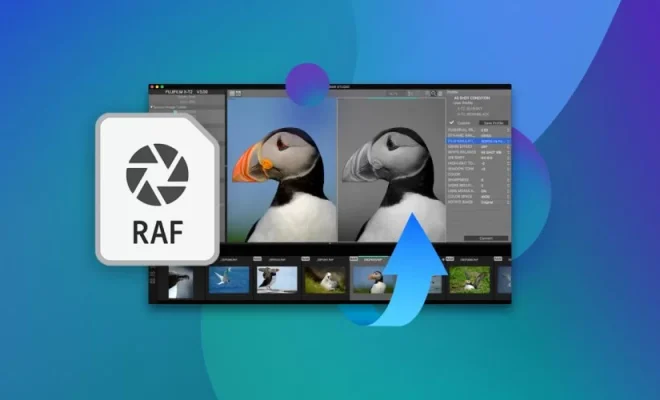
The RAF file format is an image file extension created by Fujifilm camera manufacturers. RAF stands for Fujifilm Raw Image File, and as the name suggests, it is a type of raw image format that contains minimally processed image data captured by Fujifilm digital cameras. It is similar to other raw image formats like the Canon CR2, Nikon NEF, and Sony ARW formats.

The RAF file, unlike other image file formats, contains everything the sensor captures when taking a photo without compressing the data. It provides photographers with more flexibility during post-production editing because they have greater control over the image’s processing, as they have access to all the raw data.

With RAF files, photographers can easily adjust the image’s details like brightness, contrast, and saturation, among others, and maintain image quality without worrying about data loss. By having complete control over the image’s processing, photographers can get the most out of their camera’s capabilities.

It is important to note that RAF files take up more disk space than compressed formats like the JPEG, PNG, or TIFF file formats because they contain more information. As a result, it is essential to have enough storage capacity when working with RAF files.

In summary, the RAF file format is a specific type of raw image format created by Fujifilm camera manufacturers. It provides photographers with complete control over an image’s processing, thereby allowing them to obtain the best-quality output from their camera. Although they take up more disk space than compressed file formats, photographers can benefit from using RAF files’ unmatched image quality.

In conclusion, the RAF file format is a significant invention for digital photography, allowing photographers to harness more control of their camera output. With more storage capacity and editing software to work with, Fujifilm’s RAF file format promises to provide continued flexibility for photographers across the globe.


Previous Article

10 Best Free Kindle Fire Apps

Next Article

The Most Exciting Part of the iPhone ...

Matthew Lynch

Related articles More from author

  • Digital & Mobile Technology

    CyberPowerPC GMA4000BST Review

    June 12, 2023
    By Matthew Lynch
  • Digital & Mobile Technology

    What Is Blu-ray?

    June 10, 2023
    By Matthew Lynch
  • Digital & Mobile Technology

    Ways to Fix iCloud Photos Not Syncing on Your Mac

    June 23, 2023
    By Matthew Lynch
  • Digital & Mobile Technology

    No-Hassle Ways to Connect a Microphone to Your PC

    June 5, 2023
    By Matthew Lynch
  • Digital & Mobile Technology

    Norton vs. McAfee: Which Internet Security Suite Is Better?

    June 15, 2023
    By Matthew Lynch
  • Digital & Mobile Technology

    How to Send Email From the Command Line in Windows (Without Extra Software)

    May 7, 2023
    By Matthew Lynch

Search

Login & Registration

  • Register
  • Log in
  • Entries feed
  • Comments feed
  • WordPress.org

Newsletter

Signup for The Tech Edvocate Newsletter and have the latest in EdTech news and opinion delivered to your email address!

About Us

Since technology is not going anywhere and does more good than harm, adapting is the best course of action. That is where The Tech Edvocate comes in. We plan to cover the PreK-12 and Higher Education EdTech sectors and provide our readers with the latest news and opinion on the subject. From time to time, I will invite other voices to weigh in on important issues in EdTech. We hope to provide a well-rounded, multi-faceted look at the past, present, the future of EdTech in the US and internationally.

We started this journey back in June 2016, and we plan to continue it for many more years to come. I hope that you will join us in this discussion of the past, present and future of EdTech and lend your own insight to the issues that are discussed.

Newsletter

Signup for The Tech Edvocate Newsletter and have the latest in EdTech news and opinion delivered to your email address!

Contact Us

The Tech Edvocate
910 Goddin Street
Richmond, VA 23231
(601) 630-5238
[email protected]

Copyright © 2025 Matthew Lynch. All rights reserved.