Unveiling the Past: 132-Million-Year-Old Dinosaur Tracks Discovered on South Africa’s Coast
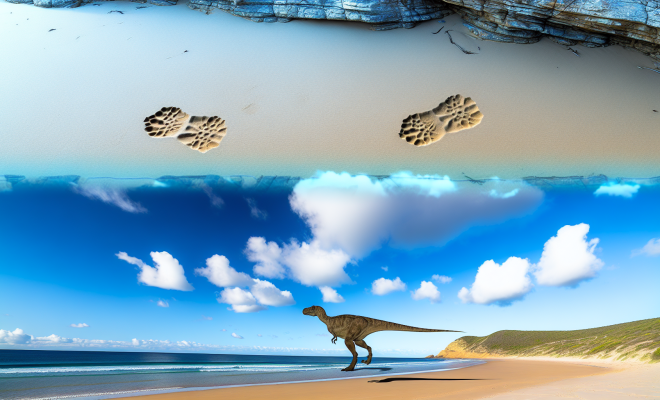
In a groundbreaking discovery, scientists have unearthed 132-million-year-old dinosaur tracks along the picturesque coast of South Africa. This remarkable find has the potential to significantly enhance our understanding of prehistoric life during the Early Cretaceous period, a time when dinosaurs roamed the Earth in abundance.
The Discovery of a Lifetime
The recent discovery highlights a rich fossil site that offers a glimpse into a prehistoric world. The dinosaur tracks were found on a stretch of coastline that has long been known for its geological significance, but this latest finding has taken paleontological research to new heights.
Importance of the Early Cretaceous Period
The Early Cretaceous period, which lasted from about 145 to 100 million years ago, was a pivotal time in the history of dinosaurs. During this era, the continents were in different positions than they are today, resulting in distinct ecosystems and climates. The tracks found in South Africa are believed to belong to theropods, a group of bipedal carnivorous dinosaurs that includes famous species such as Tyrannosaurus rex and Velociraptor.
What the Tracks Reveal
These fossilized tracks provide invaluable insights into the behavior and movement of dinosaurs during the Early Cretaceous. Scientists can analyze the size, spacing, and depth of the tracks to infer how these ancient creatures moved and interacted with their environment. For instance, the width of the tracks can indicate the size of the dinosaur, while the depth and spacing can reveal whether they were walking or running.
Geological Context and Significance
The geological context of the site is equally fascinating. The tracks are preserved in sedimentary rock, which serves as a time capsule of the Earth’s history. This particular area of South Africa has been a focal point for paleontologists due to its diverse range of fossils, including those from earlier periods. The discovery of these dinosaur tracks adds another layer to our understanding of how life evolved on our planet.
Broader Implications for Paleontology
This discovery is not just significant for South Africa; it contributes to the global narrative of dinosaur research. The tracks offer a unique opportunity for scientists to compare findings with other fossil sites around the world. Such comparisons can help paleontologists understand the environmental factors that influenced dinosaur evolution and behavior.
Future Research Directions
Following this exciting discovery, researchers are eager to explore the site further. Detailed studies will likely focus on:
- Track Analysis: Examining the characteristics of the tracks to gather more data about the species that created them.
- Environmental Reconstruction: Understanding the ecosystem in which these dinosaurs lived by analyzing surrounding sediments and fossils.
- Comparative Studies: Comparing the South African tracks with those found in other parts of the world to identify similarities and differences in dinosaur behavior.
Educational and Cultural Impact
Such discoveries not only advance scientific knowledge but also engage the public’s interest in paleontology. The excitement surrounding the tracks serves as a reminder of the rich history embedded in our planet’s geological layers. Educational institutions can use these findings to inspire future generations of scientists and foster a greater appreciation for Earth’s natural history.
Preservation of Fossil Sites
As interest in paleontological sites grows, so does the need for preservation. The delicate nature of fossil sites means they require careful management to protect them from human activities and natural erosion. Ensuring that such sites remain intact will allow for continued research and discovery in the field of paleontology.
Conclusion: A Step Back in Time
In summary, the discovery of 132-million-year-old dinosaur tracks along South Africa’s coast is a remarkable addition to our understanding of prehistoric life. This finding not only sheds light on the behavior and movement of dinosaurs but also emphasizes the importance of preserving our planet’s geological heritage. As scientists continue to study these tracks, we can expect to uncover even more secrets about our planet’s distant past.
The excitement surrounding this discovery reflects a broader trend in paleontological research, where the quest to understand the history of life on Earth is continually evolving. With each new finding, we take another step back in time, piecing together the intricate puzzle of our planet’s biological history.