Hubble & Webb Unite: Unveiling the Pinwheel Galaxy’s Secrets
Introduction
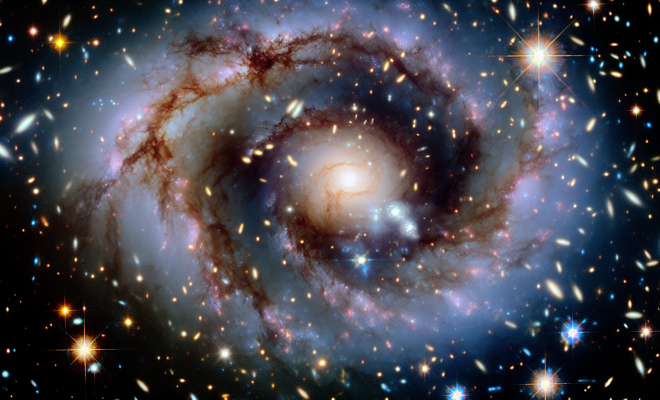
The cosmos never fails to fascinate, and NASA’s latest release of an extraordinary image of the Pinwheel Galaxy, also known as Messier 101, stands testament to that. This remarkable image is the result of a synergistic collaboration between two of the most advanced astronomical observatories to date—the Hubble Space Telescope and the James Webb Space Telescope (JWST). The combination of their unique capabilities allows us to delve deeper into the universe than ever before.
The Pinwheel Galaxy: An Overview
Messier 101, located approximately 21 million light-years away in the constellation Ursa Major, is a beautiful spiral galaxy that showcases intricate structures of star formations and dust lanes. Its distinctive pinwheel shape earned it the nickname ‘Pinwheel Galaxy’, and it has long been a subject of astronomical interest. With a diameter of about 170,000 light-years, it is larger than our Milky Way and contains billions of stars, many of which are still in the process of forming.
Historical Context
The discovery of the Pinwheel Galaxy dates back to 1781 when French astronomer Pierre Méchain first observed it. It was later cataloged by Charles Messier, who included it in his famous list of nebulae and star clusters. Since then, Messier 101 has been the focal point for numerous studies and observations, helping astronomers understand the dynamics of spiral galaxies.
Technological Advancements in Astronomy
The collaboration between the Hubble and Webb telescopes underscores the advancements in technology that have revolutionized our ability to observe the universe. Each telescope brings distinct strengths to the table, making them invaluable in the quest to understand cosmic phenomena.
The Hubble Space Telescope
Launched in 1990, the Hubble Space Telescope has provided breathtaking images of the universe, capturing visible light with an unmatched clarity. Its ability to observe celestial objects without atmospheric interference has allowed it to deliver detailed images of galaxies, nebulae, and other astronomical phenomena. Hubble’s contributions to our understanding of the universe are immeasurable, providing insights into the rate of cosmic expansion and the presence of exoplanets.
The James Webb Space Telescope
In contrast, the James Webb Space Telescope, which launched on December 25, 2021, is designed to observe the universe primarily in infrared wavelengths. This capability allows it to peer through cosmic dust and gas, revealing hidden features of celestial bodies. Webb’s advanced technology is expected to unlock mysteries about star formation, galaxy evolution, and the atmospheres of distant exoplanets.
Combining Forces: The New Image of the Pinwheel Galaxy
The recent image released by NASA combines data from both Hubble and Webb, providing an unprecedented view of Messier 101. Hubble’s observations capture the galaxy’s visible light, showcasing its beautiful spiral arms and bright star clusters. Meanwhile, Webb’s infrared data highlights the regions where new stars are forming and the intricate dust lanes that weave through the galaxy.
The Importance of Collaboration
This collaboration not only emphasizes the strengths of each telescope but also demonstrates the importance of multi-wavelength observations in astronomy. By integrating data from both Hubble and Webb, scientists can achieve a more comprehensive understanding of the structure and composition of galaxies.
Understanding Cosmic Structures
The striking image of the Pinwheel Galaxy serves as a reminder of the complexities of cosmic structures. The various colors and features visible in the image tell a story about the ongoing processes within the galaxy. The bright blue areas indicate regions of active star formation, while the reddish hues highlight the presence of dust and cooler stars.
Star Formation in the Pinwheel Galaxy
One of the most fascinating aspects of Messier 101 is its robust star-forming activity. The spiral arms of the galaxy are rich in gas and dust, providing the necessary ingredients for new stars to ignite. Webb’s infrared capabilities allow astronomers to study these regions in detail, shedding light on the conditions that lead to star formation.
The Role of Dust in Galaxies
Dust plays a crucial role in the life cycle of galaxies. While it may seem like an obstruction to observing celestial objects, dust is essential for star formation. It cools the gas and allows it to collapse under gravity, leading to the birth of new stars. The intricate dust lanes visible in the new image of the Pinwheel Galaxy highlight the dynamic interplay between dust and star formation.
Future Implications of the Hubble-Webb Collaboration
The release of this stunning image is just the beginning of what can be achieved through the collaboration between Hubble and Webb. As both telescopes continue their observations, astronomers will have access to an ever-growing wealth of data that can enhance our understanding of the universe.
Mapping Distant Galaxies
The combined data from Hubble and Webb will enable scientists to map distant galaxies with unprecedented accuracy. This is crucial for studying the evolution of galaxies over time and understanding the large-scale structure of the universe.
Advancing Our Knowledge of Exoplanets
In addition to studying galaxies, the collaboration will also facilitate research into exoplanets. Webb’s infrared capabilities will allow astronomers to analyze the atmospheres of distant exoplanets, providing insights into their composition and potential habitability.
Conclusion
The stunning image of the Pinwheel Galaxy is a testament to the power of modern astronomy and the collaborative efforts between two groundbreaking telescopes. As we continue to explore the universe, the combined capabilities of the Hubble and James Webb Space Telescopes will undoubtedly lead to new discoveries and a deeper understanding of the cosmos.
Looking Ahead
As we gaze upon the breathtaking image of Messier 101, we are reminded of the vastness of the universe and the intricate beauty of its structures. The collaboration between Hubble and Webb not only enriches our knowledge but also inspires future generations of astronomers and space enthusiasts to explore the mysteries that lie beyond our planet.