Unveiling the AI Music 2026 Reckoning: Why Everyone’s Suing Everyone
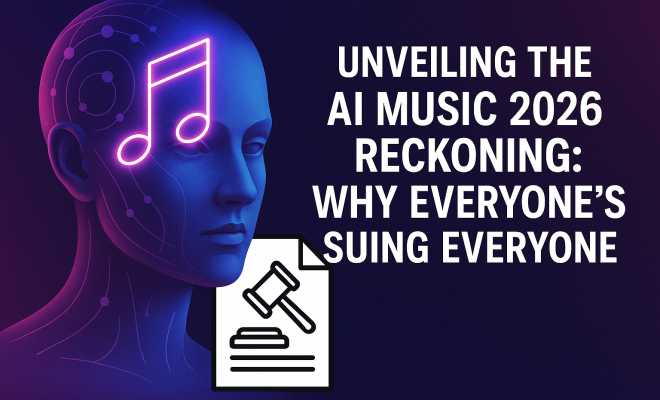
The music industry, a vibrant and often turbulent landscape, is currently experiencing a seismic shift, and it’s all thanks to the rapid, sometimes reckless, ascent of AI music generation. If you’ve been paying even a little attention, you’ll know that the conversation around AI music in 2026 isn’t just about cool new tools; it’s about a full-blown legal brawl that’s set to redefine copyright, compensation, and the very nature of artistic creation. We’re talking about a multi-front war involving some of the biggest names in entertainment, independent artists, and powerful tech companies.
It’s a classic ‘David vs. Goliath’ scenario, but with a twist: there are multiple Davids and a few very large Goliaths, all throwing legal punches. The stakes couldn’t be higher. We’re not just talking about millions of dollars; we’re talking about setting precedents that will shape the future of music and artificial intelligence for decades to come. The ethical questions alone are enough to make your head spin: Who owns a song created by an AI? What constitutes ‘fair use’ when an AI is trained on thousands of copyrighted tracks? And how do you compensate the original creators when their work becomes the building blocks for something entirely new?
1. The Sony Music vs. Udio Showdown: A Major Label’s Second Strike
When a heavyweight like Sony Music Entertainment steps into the ring, you know things are serious. And they’ve done more than just step in; they’ve launched a second, significant lawsuit against Udio, one of the prominent AI music generation platforms. This isn’t a small skirmish; it’s a direct challenge to the core business model of these AI companies, alleging that Udio has been training its AI systems on an astonishing scale using Sony’s copyrighted material without permission.
The numbers cited are eye-watering: over 30,000 specific sound recordings. Think about that for a moment. That’s not a casual sampling; that’s a massive, systematic ingestion of intellectual property. Sony’s argument is clear: Udio has benefited financially from the unauthorized use of their catalog, and they’re seeking not just damages but also a clear signal that this kind of activity won’t be tolerated. This case is pivotal because it represents a major label flexing its considerable legal muscle, and the outcome will undoubtedly send ripples throughout the entire AI music 2026 landscape.
2. Independent Artists Unite Against Suno and Udio: The Class-Action Front
It’s not just the corporate behemoths getting in on the legal action. Thousands of independent musicians, the lifeblood of the industry, have joined forces to file class-action lawsuits against both Suno and Udio. This is a powerful demonstration of collective strength, as individual artists, often lacking the resources of major labels, realize that their best chance against tech giants is to stand together.
These artists are seeking compensation for their music being used without permission to train these AI models. Imagine pouring your heart and soul into creating a piece of music, only to find out it’s been fed into an algorithm that then spits out new tracks, potentially competing with your own, without a dime of compensation or even acknowledgment. That’s the core grievance here, and it highlights the ethical dilemma at the heart of AI music in 2026. This class-action approach could set a precedent for how individual creators are protected in the age of AI, moving beyond the traditional framework of copyright that wasn’t designed for such a scenario.
3. The American Federation of Musicians vs. Universal and Warner: Union Power
Adding another layer of complexity, the American Federation of Musicians (AFM), a union representing countless professional musicians, filed an amended complaint on July 28, 2026. Their targets? None other than Universal Music Group and Warner Music Group, two of the other ‘Big Three’ record labels. The accusation is serious: breaching union contracts by licensing member recordings to AI companies without proper compensation.
This isn’t just about copyright; it’s about labor rights and existing contractual obligations. The AFM argues that these labels have a duty to their members, and that duty extends to ensuring fair compensation when their performances are used in new technological contexts. This particular lawsuit is fascinating because it tackles the issue from a union perspective, which introduces collective bargaining agreements and established artist-label relationships into the AI music 2026 debate. If the AFM prevails, it could force labels to renegotiate how they approach licensing for AI training, potentially creating a new revenue stream for musicians whose work is used in this way.
4. GEMA v. Suno: A Verdict on the Horizon: The July 31st Deadline
While all these legal battles simmer, one particular case is reaching a crucial point: GEMA v. Suno, with a verdict expected on July 31, 2026. GEMA is Germany’s performing rights organization, essentially the equivalent of ASCAP or BMI in the U.S. Their lawsuit against Suno is another critical test case, and its outcome could have significant international ramifications for AI music in 2026.
The GEMA case focuses on similar issues of unauthorized use of copyrighted material for AI training. What makes this one particularly noteworthy is the imminent verdict. A ruling in favor of GEMA would send a very strong signal across Europe and beyond, potentially emboldening other rights organizations and artists to pursue similar legal action. Conversely, a ruling against GEMA could create a chilling effect, making it harder for creators to protect their work from AI ingestion. This verdict is a flashpoint, a moment where we might get our first clear legal direction on some of these thorny issues.
5. The Viral Nature of the Controversy: Why Everyone’s Talking About AI Music 2026
This whole saga isn’t just confined to legal documents and courtrooms; it’s gone viral. Why? Because it touches on so many hot-button issues. First, there are the significant financial implications. We’re talking about billions of dollars in potential damages and future revenue streams. No one wants to be left out, or worse, left behind, as this new gold rush unfolds. (See: Artificial Intelligence and health.)
Second, and perhaps more profoundly, are the ethical questions surrounding AI and creativity. What does it mean to be a human artist when machines can generate music that sounds indistinguishable from human-made tracks? Is it truly creation if it’s derived from existing human effort without consent? These are philosophical questions that resonate deeply with artists and consumers alike, fueling passionate discussions online and off. And finally, the ‘David vs. Goliath’ narrative of individual artists and unions fighting against powerful tech giants is always compelling, drawing empathy and attention from the wider public.
6. Monetization Potential in the Legal Services Niche: A Boom for Lawyers
While artists and tech companies duke it out, there’s one sector quietly (or not so quietly) benefiting immensely: the legal services industry. This ongoing controversy creates significant monetization potential within the high-CPC (Cost Per Click) legal services niche. Think about it: every major label, every independent artist, and every AI tech company involved needs legal counsel. And those not yet involved are scrambling to understand their rights and liabilities.
This situation is a goldmine for lawyers specializing in intellectual property, copyright, and entertainment law. Commercial search intent for terms like ‘AI music copyright lawyers’ or ‘intellectual property protection for musicians’ is skyrocketing. We’re seeing a surge in demand for legal expertise, from drafting preventative measures to representing clients in complex litigation. It’s a specialized field, and the attorneys who can navigate the intricacies of both music law and emerging AI technology are incredibly valuable right now.
7. Affiliate Opportunities: Legal Tech and Copyright Protection Services
Beyond direct legal representation, the legal storm around AI music in 2026 is also ripe for affiliate opportunities related to legal tech and copyright protection services. As artists and labels become more aware of the risks and challenges posed by AI, they’re actively seeking tools and services to safeguard their work. This includes everything from advanced digital rights management (DRM) solutions to AI-powered content recognition software that can detect unauthorized use.
Imagine services that help artists register their copyrights more efficiently, or platforms that monitor the web for AI-generated music that might infringe on their original tracks. There’s a growing market for tools that provide analytics on how and where music is being consumed and potentially used by AI. For those in the affiliate marketing space, partnering with companies offering these kinds of solutions presents a timely and highly relevant opportunity to connect creators with the protection they desperately need.
8. New Tools Emerge Amidst the Chaos: The Other Side of the Coin for AI Music 2026
It’s easy to get caught up in the legal drama, but it’s crucial to remember that amidst all the lawsuits, innovation in AI music is still surging forward. While some AI companies are battling legal challenges, others are developing new tools designed to be more ethically sound, or at least, more transparent. We’re seeing the emergence of platforms that offer clearer licensing models for training data, or that provide better attribution to original artists.
Some tools are focusing on augmentation rather than outright generation, helping human artists refine their work, suggest harmonies, or even create virtual instruments. The goal for many innovators isn’t to replace human creativity but to enhance it. This duality is critical to understanding AI music in 2026: it’s not just about what’s being fought over, but also about what new possibilities are being forged, often with a greater emphasis on ethical AI development and artist collaboration.
9. The Pros Are Using It (Carefully): AI as an Assistant, Not a Replacement
So, with all this controversy, are professional musicians and producers shunning AI music tools entirely? Not at all. Many pros are embracing AI, but they’re doing so with a degree of caution and a clear understanding of its role: as an assistant, not a replacement. Think of it like this: a carpenter doesn’t stop using power tools just because a few people misuse them; they learn how to wield them effectively and safely.
For many artists and producers, AI is becoming another instrument in their toolkit. It can help with tedious tasks, generate ideas for a creative block, or even provide quick mock-ups of arrangements. A film composer might use AI to generate atmospheric background music or to quickly try out different orchestral textures. A songwriter might use it to explore new lyrical concepts or chord progressions. The key is that the human element of curation, direction, and final artistic decision-making remains paramount. The pros who are successfully navigating AI music in 2026 are those who see it as a powerful collaborator, not a substitute for their unique creative voice. The legal battles will certainly shape the boundaries, but the creative exploration continues, pushing the art form into exciting, albeit sometimes contentious, new territories.
10. The Broader Economic Impact: Beyond the Courtroom
While the legal battles grab headlines, the economic ripples of AI music in 2026 stretch far beyond just courtrooms and lawyer fees. We’re talking about a potential reshaping of revenue streams across the entire music ecosystem. Consider the impact on session musicians, for instance. If AI can generate a passable drum track or bassline in seconds, what does that mean for the human drummer or bassist who used to get paid for that work? This isn’t just about replacing, but about redefining the demand for certain skills.
On the flip side, AI could lower the barrier to entry for aspiring artists, allowing them to create professional-sounding demos without needing expensive studio time or session players. This democratization could lead to an explosion of new music, potentially saturating the market but also creating new niches and subgenres. There’s also the question of live performance. AI can’t currently replicate the raw energy and connection of a live band, which might ironically increase the value of human-centric concerts and tours. Brands looking for jingles or background music for commercials might turn to AI for cost-effective solutions, impacting the work of commercial composers. The shift isn’t just about who makes the music, but who profits from it and how value is distributed throughout the industry.
11. Expert Perspectives: Diverse Voices on AI’s Role
When you talk to people in the music industry about AI, you get a wild range of opinions, and that’s really important for understanding AI music in 2026. On one side, you have tech visionaries who see AI as an inevitable progression, a tool that will unlock unprecedented creative potential. They often argue that just like synthesizers or digital audio workstations (DAWs) changed music production, AI will simply be the next evolutionary step. They point to the efficiency gains and the ability for artists to experiment in ways never before possible. (See: AI music copyright issues.)
Then you have the purists and many established artists who express deep concern. They worry about the soul of music, the human touch, and the potential for AI to devalue artistic effort. They ask if music loses its meaning if it’s generated by an algorithm rather than born from human experience and emotion. Intellectual property lawyers and ethicists are grappling with how to adapt existing laws to this new reality, often emphasizing the need for clear consent, attribution, and fair compensation for training data. It’s a complex conversation, with each perspective highlighting a valid aspect of this transformative technology. There’s no single, universally accepted view, and this clash of ideas is what’s driving much of the debate and legal action we’re seeing.
12. International Comparisons: How Other Regions Are Responding
The legal battles we’re seeing in the US and Germany are just part of a global conversation about AI music in 2026. Different countries and regions are approaching this challenge with varying legal frameworks and cultural sensitivities. For example, some countries might have stronger artist rights laws that make it easier to pursue claims against AI companies, while others might prioritize technological innovation, creating a more permissive environment for AI development. The European Union, with its robust General Data Protection Regulation (GDPR), is already looking at AI regulation through a privacy and ethical lens, which could influence how AI models are trained on copyrighted works.
In Asia, particularly in countries like Japan and South Korea, where intellectual property is highly valued, we might see different approaches to licensing and compensation models. The key takeaway is that there won’t be a one-size-fits-all solution. International agreements and treaties will need to adapt, or we could see a fragmented legal landscape where AI music created in one country faces different legal challenges when distributed in another. This global patchwork of regulations adds another layer of complexity for tech companies and artists alike, trying to navigate these uncharted waters.
13. The Future of Fandom: Audience Reception and Engagement
Beyond the creators and the legal system, how do fans feel about AI music in 2026? This is a crucial, often overlooked, aspect. Will audiences embrace music created by AI, or will there be a backlash? Some might not care who or what created the music, as long as it sounds good and evokes emotion. Others might be deeply turned off by the idea of soulless algorithms producing art, preferring to support human artists.
There’s also the potential for novelty. AI-generated music could open up entirely new genres or experimental sounds that human artists might not have conceived. Imagine personalized soundtracks for your daily life, generated on the fly by AI to match your mood or activity. However, the connection fans feel to an artist often goes beyond just the sound; it’s about the story, the personality, the shared human experience. If AI music lacks that narrative, will it ever truly replace the deep connection fans have with their favorite human musicians? The answer probably lies in a blend, where AI serves various purposes, from background music to collaborative art, but the unique bond with human artists remains strong for many.
14. The Role of Blockchain and NFTs in AI Music Protection
As the legal disputes around AI music in 2026 continue, some innovators are looking to emerging technologies like blockchain and Non-Fungible Tokens (NFTs) as potential solutions for copyright protection and transparent compensation. Imagine a system where every piece of music is tokenized as an NFT, recording its creation, ownership, and every subsequent use on an immutable ledger. This could provide an unprecedented level of transparency for tracking when and how music is used to train AI models.
Smart contracts on the blockchain could automatically distribute royalties to original creators whenever their music is accessed or repurposed by an AI. This might offer a more efficient and equitable system than the current, often opaque, licensing mechanisms. While blockchain technology itself isn’t a silver bullet for all copyright issues, it presents a compelling vision for a future where attribution and compensation in the AI music space are far more automated and fair. It’s an area of active development, and its integration could fundamentally change how intellectual property is managed in the digital, AI-driven age.
FAQ: Navigating the World of AI Music in 2026
Q1: What exactly is AI music generation?
AI music generation involves using artificial intelligence algorithms to create original musical compositions, melodies, harmonies, rhythms, and even full instrumental or vocal tracks. These AIs are usually trained on vast datasets of existing music, learning patterns, styles, and structures, and then using that knowledge to generate new pieces.
Q2: Why are there so many lawsuits regarding AI music right now?
The surge in lawsuits stems from concerns over copyright infringement. AI models are often trained on massive amounts of copyrighted music without explicit permission or compensation to the original creators. Artists and labels argue that this unauthorized use devalues their work and constitutes a breach of intellectual property rights.
Q3: Who are the main parties involved in these legal battles?
Major record labels like Sony Music, Universal Music Group, and Warner Music Group are often plaintiffs, along with independent artists (sometimes through class-action lawsuits) and artists’ unions like the American Federation of Musicians. On the defendant side, you typically find prominent AI music generation platforms such as Udio and Suno. (See: Ethics of AI in creative industries.)
Q4: What is “fair use” in the context of AI music training?
Fair use is a legal doctrine that permits limited use of copyrighted material without acquiring permission from the rights holders. In the AI context, the argument for fair use often centers on whether training an AI model constitutes a “transformative” use or if it’s merely making unauthorized copies. Courts are currently grappling with how to apply this traditional concept to novel AI technologies, making it a highly contentious area.
Q5: Can AI music be copyrighted?
This is a complex and evolving question. Generally, in the U.S. and many other countries, copyright requires human authorship. If an AI creates music entirely on its own, without significant human creative input, it may not be eligible for copyright protection. However, if a human artist uses AI as a tool to generate elements, and then significantly curates, arranges, or modifies those elements, the resulting work might be copyrightable as a human creation with AI assistance. The legal frameworks are still catching up to this distinction.
Q6: How does AI music impact independent artists differently from major labels?
Independent artists often have fewer resources to defend their copyrights individually. Class-action lawsuits allow them to pool resources and collectively challenge AI companies. Major labels, with their vast catalogs and legal departments, can pursue individual, high-stakes lawsuits, setting broader precedents. Both groups are impacted by the potential devaluation of their work and the unauthorized use of their music for AI training.
Q7: What are the ethical concerns surrounding AI music in 2026?
Beyond copyright, ethical concerns include: the potential for AI to displace human artists, the philosophical debate about what constitutes “art” when created by machines, the lack of attribution or recognition for original artists whose work trains the AI, and the potential for AI to perpetuate biases present in its training data.
Q8: Are all AI music tools facing legal challenges?
No, not all. Many AI music tools are designed with ethical considerations in mind, focusing on augmentation rather than outright generation, or using properly licensed or public domain data for training. The lawsuits primarily target platforms that are alleged to have used copyrighted material on a massive scale without permission or compensation.
Q9: How might the GEMA v. Suno verdict on July 31, 2026, affect the industry?
The GEMA v. Suno verdict is highly anticipated because it could be one of the first major rulings specifically addressing unauthorized AI training on copyrighted music. A ruling in GEMA’s favor would likely empower other rights organizations and artists globally, setting a strong precedent for creator protection. Conversely, a ruling against GEMA could create uncertainty and make it harder for creators to protect their work.
Q10: What opportunities does AI music present for the industry?
Despite the controversies, AI music offers significant opportunities. It can democratize music creation, help artists overcome creative blocks, assist with tedious production tasks, generate unique sounds, and even create personalized music experiences for listeners. It can be a powerful tool for augmentation and collaboration when used ethically and responsibly.
Trending Now
Frequently Asked Questions
What is the AI music reckoning of 2026 about?
The AI music reckoning of 2026 involves a major legal battle in the music industry driven by the rise of AI music generation. It highlights issues of copyright, compensation, and artistic creation, with lawsuits from major labels against AI platforms challenging their business models.
Why is Sony Music suing Udio?
Sony Music is suing Udio for allegedly using over 30,000 of its copyrighted sound recordings to train its AI systems without permission. This lawsuit challenges the core business practices of AI music generation platforms.
What are the ethical questions surrounding AI music?
The ethical questions around AI music include ownership of songs created by AI, definitions of 'fair use' when AI is trained on copyrighted material, and how to fairly compensate original creators whose work contributes to AI-generated music.
How does the AI music lawsuit affect independent artists?
The AI music lawsuit impacts independent artists by setting precedents for copyright and compensation that could either protect their rights or complicate their ability to profit from their work in an AI-driven landscape.
What implications do AI music lawsuits have for the future of music?
AI music lawsuits have significant implications for the future of music, as they will shape copyright laws, establish new compensation frameworks, and redefine artistic creation in an era where AI plays a central role.
Agree or disagree? Drop a comment and tell us what you think.