Explore the Universe: Largest 3D Map of 47 Million Galaxies
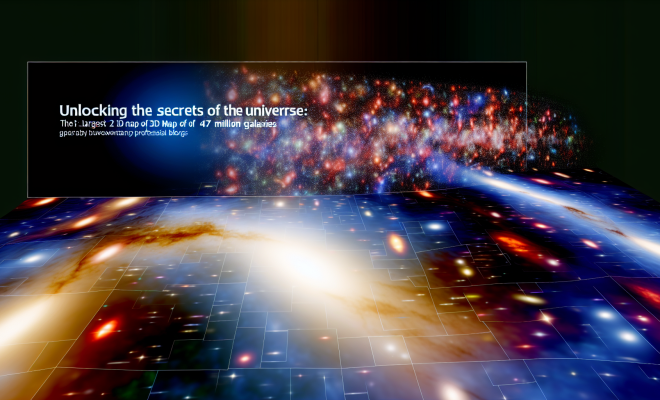
The cosmos has always fascinated humankind, and with the advent of advanced astronomical technologies, our understanding of the universe continues to expand exponentially. In an extraordinary achievement that marks a significant milestone in astrophysics, scientists have successfully created the largest high-resolution 3D map of the universe, encompassing a staggering 47 million galaxies. This monumental project promises to deepen our understanding of dark energy and the intricate structure of the universe.
The Significance of the 3D Cosmic Map
The creation of this colossal 3D map is not merely a technical triumph; it represents a profound leap in our ability to study the cosmos. By providing an unprecedented level of detail, this mapping endeavor opens new frontiers in astronomical research, particularly concerning the elusive phenomenon known as dark energy.
Dark energy, a mysterious force believed to be driving the accelerated expansion of the universe, has puzzled scientists since its discovery. Understanding its nature is one of the most significant challenges in modern cosmology. The expansive 3D map will enable researchers to analyze the distribution of galaxies with remarkable precision, potentially revealing patterns and insights that could illuminate the characteristics of dark energy.
How the Mapping Process Works
The construction of such an extensive 3D map involves sophisticated technology and collaboration among scientists from various disciplines. Using advanced telescopes and imaging techniques, astronomers collect vast amounts of data about the light emitted by galaxies across different wavelengths. This light carries information about the galaxies’ distance, composition, and movement.
The Role of Survey Telescopes
- Large Synoptic Survey Telescope (LSST): One of the key instruments in this mapping project is the LSST, which is designed to capture images of the night sky with unprecedented speed and detail.
- Hubble Space Telescope: Hubble’s capability to observe distant galaxies has been instrumental in providing high-resolution images that contribute to the 3D structure of the universe.
- Other Ground-Based Telescopes: Various ground-based observatories have also contributed by observing specific regions of the sky, collecting data crucial for constructing the map.
Once the data is gathered, astronomers employ complex algorithms and computational models to process and analyze the information. This analysis involves reconstructing the spatial relationships between galaxies, allowing researchers to visualize the universe’s structure in three dimensions.
Implications for Cosmic Understanding
The 3D map does not just serve as a visual representation of the universe; it is a powerful tool for understanding cosmic phenomena. With 47 million galaxies represented, researchers can explore various aspects of cosmic structure and evolution.
Studying Galaxy Distribution
One of the primary benefits of this extensive mapping is the ability to study galaxy distribution on a large scale. Understanding how galaxies are clustered and distributed throughout the universe can provide insights into the underlying forces at play, including gravitational interactions and the influence of dark matter.
Investigating Cosmic Expansion
The map also allows scientists to investigate the rate of cosmic expansion. By analyzing the redshift of galaxies—how their light shifts towards the red end of the spectrum due to their movement away from us—researchers can determine how quickly the universe is expanding and how this expansion has changed over time.
The Future of Cosmological Research
As scientists delve into the data provided by this monumental 3D map, numerous research opportunities will arise. The insights gained could lead to a deeper understanding of not only dark energy but also fundamental questions about the origin and fate of the universe.
Potential Discoveries
- New Galaxy Types: The extensive data set may reveal previously unknown types of galaxies, enriching our understanding of cosmic diversity.
- Insights into Dark Matter: By analyzing the gravitational effects on galaxy formation and distribution, researchers may uncover new information about dark matter, another mysterious component of the universe.
- Evolution of Galaxies: The map will facilitate studies on how galaxies evolve over billions of years, shedding light on the processes that govern their formation and development.
Collaboration and Technological Advancements
The successful completion of this 3D cosmic map is a testament to the power of collaboration among scientists worldwide. Teams of astronomers, physicists, and computer scientists have worked together to harness cutting-edge technology and algorithms, showcasing the interdisciplinary nature of modern scientific research.
Technological Innovations
Advancements in telescope technology, data processing, and machine learning have played a crucial role in the creation of the map. These innovations allow scientists to handle the enormous data sets generated by observations and to extract meaningful patterns from them.
Conclusion: A New Era in Astronomy
The creation of the largest high-resolution 3D map of the universe is not just a monumental scientific achievement; it heralds a new era in our understanding of the cosmos. As researchers continue to analyze the data, the potential to unlock the mysteries of dark energy and other fundamental cosmic phenomena awaits. With every galaxy mapped, we take another step closer to unraveling the secrets of the universe, bringing us one step nearer to understanding our place within it.
This groundbreaking work exemplifies the relentless pursuit of knowledge that defines the field of astronomy and illustrates how technological advancements can inspire new scientific discoveries. As we gaze into the depths of space, the insights gleaned from this vast cosmic map will undoubtedly shape the future of astronomical research for generations to come.