The Tech Edvocate

Top Menu

  • Advertisement
  • Apps
  • Home Page
  • Home Page Five (No Sidebar)
  • Home Page Four
  • Home Page Three
  • Home Page Two
  • Home Tech2
  • Icons [No Sidebar]
  • Left Sidbear Page
  • Lynch Educational Consulting
  • My Account
  • My Speaking Page
  • Newsletter Sign Up Confirmation
  • Newsletter Unsubscription
  • Our Brands
  • Page Example
  • Privacy Policy
  • Protected Content
  • Register
  • Request a Product Review
  • Shop
  • Shortcodes Examples
  • Signup
  • Start Here
    • Governance
    • Careers
    • Contact Us
  • Terms and Conditions
  • The Edvocate
  • The Tech Edvocate Product Guide
  • Topics
  • Write For Us
  • Advertise

Main Menu

  • Start Here
    • Our Brands
    • Governance
      • Lynch Educational Consulting, LLC.
      • Dr. Lynch’s Personal Website
      • Careers
    • Write For Us
    • The Tech Edvocate Product Guide
    • Contact Us
    • Books
    • Edupedia
    • Post a Job
    • The Edvocate Podcast
    • Terms and Conditions
    • Privacy Policy
  • Topics
    • Assistive Technology
    • Child Development Tech
    • Early Childhood & K-12 EdTech
    • EdTech Futures
    • EdTech News
    • EdTech Policy & Reform
    • EdTech Startups & Businesses
    • Higher Education EdTech
    • Online Learning & eLearning
    • Parent & Family Tech
    • Personalized Learning
    • Product Reviews
  • Advertise
  • Tech Edvocate Awards
  • The Edvocate
  • Pedagogue
  • School Ratings

logo

The Tech Edvocate

  • Start Here
    • Our Brands
    • Governance
      • Lynch Educational Consulting, LLC.
      • Dr. Lynch’s Personal Website
        • My Speaking Page
      • Careers
    • Write For Us
    • The Tech Edvocate Product Guide
    • Contact Us
    • Books
    • Edupedia
    • Post a Job
    • The Edvocate Podcast
    • Terms and Conditions
    • Privacy Policy
  • Topics
    • Assistive Technology
    • Child Development Tech
    • Early Childhood & K-12 EdTech
    • EdTech Futures
    • EdTech News
    • EdTech Policy & Reform
    • EdTech Startups & Businesses
    • Higher Education EdTech
    • Online Learning & eLearning
    • Parent & Family Tech
    • Personalized Learning
    • Product Reviews
  • Advertise
  • Tech Edvocate Awards
  • The Edvocate
  • Pedagogue
  • School Ratings
  • Viaim Opennote Review: The AI Note-Taker That Disappears Into Your Daily Routine

  • A Visitors Guide to Long Beach (CA), United States

  • A Visitor’s Guide to Fresno (CA), United States

  • A Visitors Guide to New Orleans (LA), United States

  • A Visitors Guide to Sacramento (CA), United States

  • A Visitors Guide to Lyon, France

  • JisuLife Ultra2 Portable Fan: A Powerful Multi-Function Cooling Solution

  • A Visitors Guide to Viña del Mar, Chile

  • A Visitors Guide to Århus, Denmark

  • A Visitors Guide to Bakersfield (CA), United States

Tech Advice
Home›Tech Advice›Understanding DOCSIS 3.0 and 3.1: The Evolution of Cable Internet Modem Connections in 1285

Understanding DOCSIS 3.0 and 3.1: The Evolution of Cable Internet Modem Connections in 1285
By Matthew Lynch
July 8, 2023
0
Spread the love

The advancement of internet technology has led to the evolution of modem standards, with Data Over Cable Service Interface Specification (DOCSIS) playing a significant role in cable internet modem connections. In this article, we will explore the primary differences between DOCSIS 3.0 and DOCSIS 3.1 – two widely adopted standards in the industry.

DOCSIS 3.0: Paving the Way for Faster Internet Speeds

Introduced in August 2006, DOCSIS 3.0 marked a major leap forward in cable internet technology in terms of speed and performance. This iteration enabled channel bonding, which allows for multiple channels to be utilized concurrently to increase data transfer rates. With this technology, users were able to reach download speeds of up to 1 Gigabit Per Second (Gbps) and upload speeds up to 200 Megabits Per Second (Mbps). It was also able to offer improved IPv6 support, future-proofing users’ modem connections as IP addresses transition from IPv4 to IPv6.

Advantages of DOCSIS 3.0:

– Channel bonding technology provides faster data transfer rates

– Enhanced IPv6 support

– Significantly improved internet speed compared to earlier versions

DOCSIS 3.1: Taking Internet Speeds Even Further

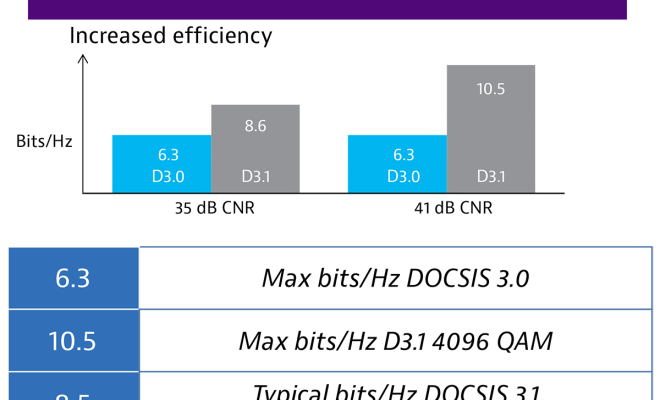
In October 2013, the introduction of DOCSIS 3.1 further revolutionized the world of cable internet connections by offering even higher performance levels than its predecessor. This standard employs Orthogonal Frequency Division Multiplexing (OFDM) and new channel-bonding capabilities that enable faster download speeds of up to 10 Gbps and upload speeds reaching a potential peak of 2 Gbps.

In addition to its increased speed capabilities, DOCSIS 3.1 also offers improved network efficiency, reduced network congestion, and enhanced support for data-intensive applications such as 4K video streaming, gaming, and IoT devices.

Advantages of DOCSIS 3.1:

– Significantly faster download and upload speeds

– Improved network efficiency through OFDM and advanced channel bonding

– Support for data-intensive applications and reduction of network congestion

Conclusion: The Future of Cable Internet Modem Connections

As technology progresses, so does the need for improved internet connections. DOCSIS 3.0 and 3.1 have both contributed to enhancing the capabilities of cable internet modem connections, making it easier for users to access faster internet speeds and accommodate an ever-growing number of devices and applications.

For users seeking to optimize their cable internet experience in 1285, upgrading to a modem that supports the latest standard – DOCSIS 3.1 – is highly recommended. This will not only future-proof their connection but also ensure they can take full advantage of the fastest speeds available on their chosen plan.

Previous Article

The Significance of 1284 in the Era ...

Next Article

The Significance of Year 1286: A Look ...

Matthew Lynch

Related articles More from author

  • Tech Advice

    WiiM Pro Review: Best Music Streamer for Most People

    July 17, 2023
    By Matthew Lynch
  • Tech Advice

    Galaxy A53 5G vs. Galaxy S21 FE: Cameras, Speed and Battery Make the Biggest Difference

    July 17, 2023
    By Matthew Lynch
  • Tech Advice

    Eyes on the Road: Android Auto Tips Every Driver Needs

    July 24, 2023
    By Matthew Lynch
  • Tech Advice

    Is Your Heart Rate Healthy? Here’s How to Find Out

    July 6, 2023
    By Matthew Lynch
  • Tech Advice

    Best Gifts Under $500 for 2023

    July 14, 2023
    By Matthew Lynch
  • Tech Advice

    Auto Insurance in Evansville, Indiana: Everything You Need to Know

    August 17, 2023
    By Matthew Lynch

Search

Login & Registration

  • Register
  • Log in
  • Entries feed
  • Comments feed
  • WordPress.org

Newsletter

Signup for The Tech Edvocate Newsletter and have the latest in EdTech news and opinion delivered to your email address!

About Us

Since technology is not going anywhere and does more good than harm, adapting is the best course of action. That is where The Tech Edvocate comes in. We plan to cover the PreK-12 and Higher Education EdTech sectors and provide our readers with the latest news and opinion on the subject. From time to time, I will invite other voices to weigh in on important issues in EdTech. We hope to provide a well-rounded, multi-faceted look at the past, present, the future of EdTech in the US and internationally.

We started this journey back in June 2016, and we plan to continue it for many more years to come. I hope that you will join us in this discussion of the past, present and future of EdTech and lend your own insight to the issues that are discussed.

Newsletter

Signup for The Tech Edvocate Newsletter and have the latest in EdTech news and opinion delivered to your email address!

Contact Us

The Tech Edvocate
910 Goddin Street
Richmond, VA 23231
(601) 630-5238
[email protected]

Copyright © 2025 Matthew Lynch. All rights reserved.