The Tech Edvocate

Top Menu

  • Advertisement
  • Apps
  • Home Page
  • Home Page Five (No Sidebar)
  • Home Page Four
  • Home Page Three
  • Home Page Two
  • Home Tech2
  • Icons [No Sidebar]
  • Left Sidbear Page
  • Lynch Educational Consulting
  • My Account
  • My Speaking Page
  • Newsletter Sign Up Confirmation
  • Newsletter Unsubscription
  • Our Brands
  • Page Example
  • Privacy Policy
  • Protected Content
  • Register
  • Request a Product Review
  • Shop
  • Shortcodes Examples
  • Signup
  • Start Here
    • Governance
    • Careers
    • Contact Us
  • Terms and Conditions
  • The Edvocate
  • The Tech Edvocate Product Guide
  • Topics
  • Write For Us
  • Advertise

Main Menu

  • Start Here
    • Our Brands
    • Governance
      • Lynch Educational Consulting, LLC.
      • Dr. Lynch’s Personal Website
      • Careers
    • Write For Us
    • The Tech Edvocate Product Guide
    • Contact Us
    • Books
    • Edupedia
    • Post a Job
    • The Edvocate Podcast
    • Terms and Conditions
    • Privacy Policy
  • Topics
    • Assistive Technology
    • Child Development Tech
    • Early Childhood & K-12 EdTech
    • EdTech Futures
    • EdTech News
    • EdTech Policy & Reform
    • EdTech Startups & Businesses
    • Higher Education EdTech
    • Online Learning & eLearning
    • Parent & Family Tech
    • Personalized Learning
    • Product Reviews
  • Advertise
  • Tech Edvocate Awards
  • The Edvocate
  • Pedagogue
  • School Ratings

logo

The Tech Edvocate

  • Start Here
    • Our Brands
    • Governance
      • Lynch Educational Consulting, LLC.
      • Dr. Lynch’s Personal Website
        • My Speaking Page
      • Careers
    • Write For Us
    • The Tech Edvocate Product Guide
    • Contact Us
    • Books
    • Edupedia
    • Post a Job
    • The Edvocate Podcast
    • Terms and Conditions
    • Privacy Policy
  • Topics
    • Assistive Technology
    • Child Development Tech
    • Early Childhood & K-12 EdTech
    • EdTech Futures
    • EdTech News
    • EdTech Policy & Reform
    • EdTech Startups & Businesses
    • Higher Education EdTech
    • Online Learning & eLearning
    • Parent & Family Tech
    • Personalized Learning
    • Product Reviews
  • Advertise
  • Tech Edvocate Awards
  • The Edvocate
  • Pedagogue
  • School Ratings
  • The Lobby Before the Lights: How Digital Casino Design Sets an Evening in Motion

  • The Lobby Before the Lights: How Small Interface Choices Shape Casino Discovery

  • The Reckless Rise of AI Finance: Why You Could Lose Everything

  • Baffling: Fintech Founder’s $6.7 Million Lie — And How to Spot the Red Flags

  • Dramatic: Teddy AI Funding Ignites Legal Tech’s $60M Consolidation Battle

  • Florida’s Gambling War: Seminole Tribe’s Bold Move Against DraftKings Could Reshape Betting Forever

  • California’s Bold AI Move: Nearly 30 New Laws Reshape Tech’s Future

  • The AI Skills Gap: Why 71% of Companies Are Dramatically Behind — And What It Means For Your Career

  • Unbelievable: AI Deepfake Phishing Attacks Just Got a Whole Lot Scarier

  • This One Reckless Data Breach Just Exposed 50 Million Bank Customers

Uncategorized
Home›Uncategorized›Optical AI Training: Revolutionizing Deep Learning & Climate Models

Optical AI Training: Revolutionizing Deep Learning & Climate Models
By Matthew Lynch
May 17, 2026
0
Spread the love

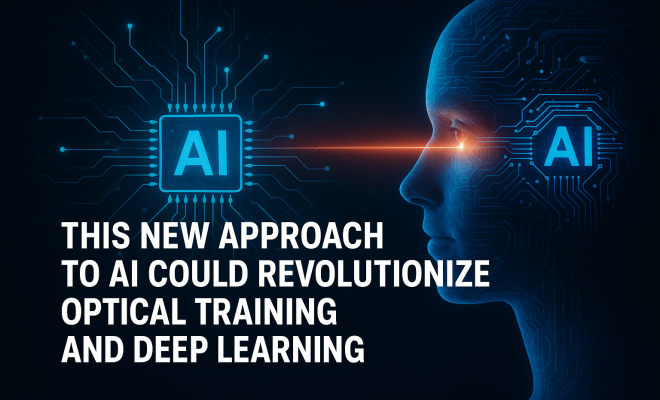
In a remarkable advancement that might reshape the future of artificial intelligence, researchers have unveiled a new optical training approach designed for large-scale deep learning architectures. This innovative method involves using optical systems to conduct training processes traditionally reliant on electronic computing. With the rise of billion-parameter models such as Transformers and Vision Transformers, particularly in climate applications, this development holds immense promise for the field of optical training deep learning.

The Futuristic Promise of Optical Computing

The core concept behind this novel technique is intriguing: by leveraging optics, there exists the potential to drastically reduce the cost and energy demands associated with AI training. Traditional deep learning models require significant computational power, often leading to high energy consumption and financial costs. The introduction of optical training could herald a new era, positioning optical computing as a serious contender for overcoming these challenges.

How Optical Training Works

The researchers’ approach focuses on integrating optical components into the training of deep learning algorithms. This method utilizes light to perform computations that would typically be executed by electronic processors. By doing so, the researchers suggest that they can achieve faster processing speeds and reduced energy consumption, thereby making the training of large AI models more efficient.

The paper highlights that this optical training framework is not merely a proof-of-concept but is designed to scale with the complexity of modern AI systems. This scalability is critical, particularly as AI applications continue to grow in size and complexity. The researchers assert that the framework can competently support large models, making it a viable option for both researchers and industry practitioners looking to optimize their deep learning processes.

A Closer Look at AI Architectures

Among the architectures targeted by these advancements are billion-parameter Transformers and Vision Transformers, which have gained traction for their performance in various applications, including climate modeling. The integration of these models into the optical training framework could lead to breakthroughs in how we understand and address climate change, as the models can process vast amounts of data more efficiently.

Furthermore, the exploration of diffusion models in this optical context adds another layer of potential. These models, which have recently emerged in the AI landscape, can generate new data points by learning from existing datasets. By employing optical training, researchers may enhance the effectiveness of these models, allowing for quicker and more energy-efficient data generation.

The Debate: Is Optical Computing the Future?

The unveiling of this optical training approach is likely to ignite discussions among tech enthusiasts and skeptics alike. Questions around the feasibility and practicality of optical computing in deep learning are at the forefront. Can this method truly deliver on its promises of reduced costs and energy efficiency, or is it yet another prototype that will fade into the background?

Critics may argue that while the theoretical benefits are substantial, actual implementation in real-world scenarios remains to be seen. There are also concerns about the transition from traditional electronic systems to optical systems, which may involve substantial changes in infrastructure and technology.

Implications for the Future of AI

If the optical training method proves successful at scale, it could significantly alter the landscape of AI development. Researchers can potentially train models that were previously deemed too expensive or energy-intensive to operate. As AI grows more integrated into critical sectors such as healthcare, transportation, and environmental science, these efficiency gains could become increasingly vital.

Moreover, the environmental implications of reducing the energy demands of AI training cannot be overstated. As society grapples with climate change and sustainability, making AI models greener through optical training could represent a crucial step in balancing technological advancement with ecological responsibility.

The Road Ahead

As we look to the future, the intersection of optics and AI training suggests that exciting developments are on the horizon. The researchers’ work not only opens the door to a more efficient way of training large models but also challenges the traditional paradigms of deep learning.

This new approach could provide a vital advantage to industries eager to leverage AI without incurring prohibitive costs or energy demands. While the field is still in its infancy, the potential applications of optical training deep learning are vast, and its success could pave the way for a transformative shift in how we engage with artificial intelligence.

In conclusion, as the landscape of AI continues to evolve, the integration of optical training methods highlights a promising path toward addressing the growing challenges of cost and sustainability. Keeping an eye on this development will be essential for anyone invested in the future of technology.


Previous Article

27 New Circumbinary Planets Discovered: TESS Reveals ...

Next Article

Himalayan Tectonics & Climate: Shaping Our Future

Matthew Lynch

Related articles More from author

  • Uncategorized

    Unmasking the Cyber Threat: Why Your Small Business Needs This Now

    September 25, 2026
    By Matthew Lynch
  • Uncategorized

    Uncovering the Chilling Truth About AI Cyberattacks vs Traditional Cyberattacks

    August 23, 2026
    By Matthew Lynch
  • Uncategorized

    Trailblazers in Edtech: Shelley Sanchez Terrell

    August 17, 2017
    By Matthew Lynch
  • How ToUncategorized

    4 Ways to Let Go of the Past

    October 16, 2023
    By Matthew Lynch
  • Uncategorized

    The FinTech Funding Boom: 7 Startups That Just Landed Huge Investments

    September 6, 2026
    By Matthew Lynch
  • Uncategorized

    Gut Health vs. Antidepressants: 2026 Breakthroughs

    July 26, 2026
    By Matthew Lynch

Search

Login & Registration

  • Log in
  • Entries feed
  • Comments feed
  • WordPress.org

Newsletter

Signup for The Tech Edvocate Newsletter and have the latest in EdTech news and opinion delivered to your email address!

About Us

Since technology is not going anywhere and does more good than harm, adapting is the best course of action. That is where The Tech Edvocate comes in. We plan to cover the PreK-12 and Higher Education EdTech sectors and provide our readers with the latest news and opinion on the subject. From time to time, I will invite other voices to weigh in on important issues in EdTech. We hope to provide a well-rounded, multi-faceted look at the past, present, the future of EdTech in the US and internationally.

We started this journey back in June 2016, and we plan to continue it for many more years to come. I hope that you will join us in this discussion of the past, present and future of EdTech and lend your own insight to the issues that are discussed.

Newsletter

Signup for The Tech Edvocate Newsletter and have the latest in EdTech news and opinion delivered to your email address!

Contact Us

The Tech Edvocate
910 Goddin Street
Richmond, VA 23231
(601) 630-5238
[email protected]

Copyright © 2026 Matthew Lynch. All rights reserved.