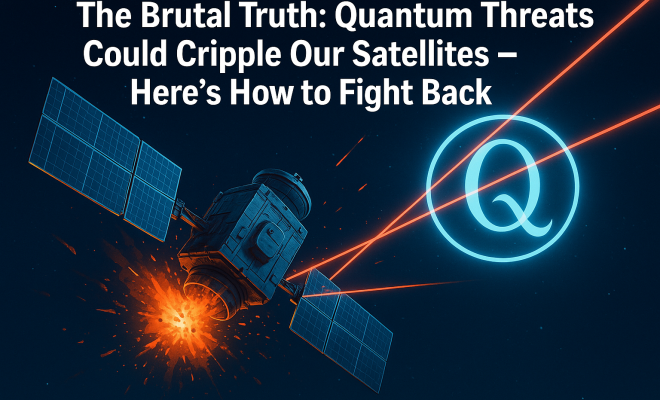
The Brutal Truth: Quantum Threats Could Cripple Our Satellites – Here’s How to Fight Back
“`html
It feels like science fiction, doesn’t it? The idea of quantum computers, capable of breaking today’s most robust encryption in mere seconds, isn’t just a distant academic curiosity anymore. It’s a looming reality, and for our increasingly vital space infrastructure, it represents an existential threat. Our satellites – the silent workhorses enabling everything from GPS navigation and global communication to weather forecasting and national security – are currently protected by cryptographic algorithms that will be rendered utterly useless by sufficiently powerful quantum machines. That’s why understanding how to implement post-quantum security in space isn’t just a good idea; it’s an urgent imperative.
The stakes couldn’t be higher. Imagine a world where adversaries could eavesdrop on secure satellite communications, disrupt navigation signals, or even take control of critical orbital assets. The economic, social, and geopolitical ramifications would be catastrophic. Companies like SEALSQ and WISeSat.Space aren’t waiting around for this future to arrive; they’re actively developing and testing hardware-based security solutions, even putting them into orbit. A recent SpaceX Falcon 9 mission, for instance, carried a satellite equipped with advanced secure-element technology, validating its performance under the harsh, unforgiving conditions of space. This isn’t just about protecting data; it’s about protecting our way of life, which has become inextricably linked to the reliable functioning of our space-based systems.
WISeQey, the parent company of WISeSat.Space, has clearly articulated its strategic vision: building secure infrastructure for what they call the ‘Intelligence Age.’ This isn’t a piecemeal approach. It involves integrating secure chips, robust digital identity solutions, and, crucially, post-quantum security across the entire ecosystem – from the satellites themselves to the ground stations that control them, and right down to the user systems that interact with them. This holistic view is exactly what’s needed to truly safeguard against quantum-era cyber threats. Let’s delve into the essential strategies and technologies required to make our space assets quantum-resistant.
1. Understanding the Quantum Threat to Space Systems: The Clock is Ticking
Before we can fortify our defenses, we need a crystal-clear understanding of what we’re up against. Quantum computers, unlike classical computers, leverage the bizarre principles of quantum mechanics – superposition and entanglement – to perform calculations that are simply impossible for even the most powerful supercomputers today. Specifically, algorithms like Shor’s algorithm threaten to break widely used public-key cryptography standards, including RSA and Elliptic Curve Cryptography (ECC), which are the bedrock of secure communications and digital signatures.
For space infrastructure, this means several critical vulnerabilities. Satellite command and control links, which rely on secure communication to transmit instructions and receive telemetry, could be compromised. Data downlinked from Earth observation satellites, scientific missions, or commercial communication satellites could be intercepted and decrypted. Even firmware updates to satellites, if not properly authenticated with quantum-resistant methods, could become vectors for malicious actors to introduce backdoors or take over systems. The long lifespan of many satellites, often extending for decades, means that systems launched today will still be operating when quantum computers capable of these attacks become prevalent. This makes proactive implementation of post-quantum security measures not just smart, but absolutely essential.
2. Adopting Post-Quantum Cryptography (PQC) Algorithms: A New Foundation
The most direct response to the quantum threat is to replace vulnerable cryptographic algorithms with new ones designed to resist quantum attacks. These are known as Post-Quantum Cryptography (PQC) algorithms. Organizations like the National Institute of Standards and Technology (NIST) have been leading a multi-year effort to standardize a suite of PQC algorithms, with several candidates now moving towards final selection. These new algorithms are typically based on different mathematical problems that are believed to be hard for both classical and quantum computers to solve.
Implementing PQC in space involves a careful transition. It’s not as simple as flipping a switch. Existing satellite hardware and software, especially those with limited processing power and memory, may struggle to run these new, often more computationally intensive algorithms. This necessitates rigorous testing and optimization. Furthermore, a phased approach is likely required, potentially starting with a ‘hybrid mode’ where both classical and PQC algorithms are used in parallel, offering a fallback in case unforeseen weaknesses are discovered in the new PQC schemes. This dual-layer approach provides an extra margin of safety during the transition period, ensuring that communications remain secure even as the new standards are fully integrated and proven.
3. Hardware-Based Security Solutions: The Orbital Shield
While software-based PQC is crucial, the unique environment of space often demands hardware-level security. This is where secure elements, like those being developed by SEALSQ and WISeSat.Space, come into play. A secure element is a tamper-resistant microcontroller that can store cryptographic keys, perform cryptographic operations, and provide a trusted execution environment, isolated from the main processing unit of a satellite. Think of it as a fortified vault within the satellite itself.
These secure elements can be designed to natively support PQC algorithms, offering a robust foundation for protecting critical functions. The fact that a recent SpaceX Falcon 9 mission successfully validated such technology in orbit is a massive step forward. It proves that these advanced security chips can withstand the radiation, extreme temperatures, and vibrations inherent to space operations. Hardware roots of trust, secure boot processes, and cryptographic key management within these secure elements are vital for ensuring that only authorized software runs on the satellite and that its identity can be securely verified, even in a post-quantum world. This approach provides a strong physical and cryptographic barrier against manipulation. (See: NIST announces post-quantum cryptography standards.)
4. Secure Key Management and Distribution: The Lifeblood of Security
Encryption is only as strong as its keys. In a post-quantum era, the secure generation, distribution, storage, and revocation of cryptographic keys become even more paramount. Traditional key exchange mechanisms, like Diffie-Hellman, are vulnerable to quantum attacks, meaning new PQC-enabled key exchange protocols are essential. Furthermore, the sheer volume of keys required for a vast constellation of satellites and their ground infrastructure demands an automated, highly resilient, and quantum-resistant key management system.
This system needs to handle the entire lifecycle of keys – from initial generation on secure hardware to secure distribution to satellites (perhaps using quantum-resistant key encapsulation mechanisms) and secure storage on board. Mechanisms for key rotation and emergency revocation are also critical, allowing for rapid response if a key is suspected of being compromised. The use of hardware security modules (HSMs) on the ground, coupled with secure elements in space, creates a robust chain of trust for managing these vital cryptographic assets. Without a strong key management strategy, even the best PQC algorithms won’t protect your data effectively. For more context, see Cybersecurity Bootcamps.
5. Supply Chain Security for Space Assets: Trusting the Unseen
It’s not enough to secure the operational phase; security must begin long before launch. The supply chain for space infrastructure is incredibly complex, involving numerous vendors for components, software, and services. Each link in this chain represents a potential vulnerability. An adversary could introduce malicious hardware or software during manufacturing, creating a ‘backdoor’ that could be exploited later, even with PQC in place. This is where a holistic approach to supply chain security, integrated with post-quantum considerations, is absolutely vital.
This means rigorous vetting of all suppliers, performing extensive integrity checks on all components, and implementing secure development lifecycles for all software. It also involves using digital signatures for all software and firmware updates, ensuring that they originate from a trusted source and haven’t been tampered with. These signatures, naturally, must be quantum-resistant. Companies like WISeQey, focusing on secure infrastructure from end-to-end, inherently understand this. They’re not just securing the final product, but aiming to secure the entire process, minimizing the risk of hidden vulnerabilities being introduced at any stage.
6. Robust Digital Identity and Authentication: Knowing Who’s Who
In the ‘Intelligence Age,’ as WISeQey calls it, strong digital identity and authentication are the gatekeepers of access. Who or what is allowed to communicate with a satellite? Who can issue commands? Who can access sensitive data? In a post-quantum world, traditional authentication methods based on vulnerable public-key cryptography will no longer suffice. We need quantum-resistant digital identities for satellites, ground stations, and human operators.
This involves using PQC-based digital certificates to establish and verify the identity of every entity in the space ecosystem. Multi-factor authentication, incorporating physical tokens or biometric data where feasible, should also be strengthened with PQC. The goal is to create a system where every communication and command is cryptographically signed and verified using algorithms that can withstand quantum attacks. This ensures that only authorized personnel and systems can interact with space assets, preventing unauthorized access and malicious control attempts. Without verifiable identities, the entire system is at risk.
7. Integrating Quantum-Resistant Capabilities Across the Ecosystem: The Holistic View
One of the most critical takeaways from companies like WISeQey is the importance of a holistic approach to security. It’s not enough to secure individual components; the entire system – from the satellite in orbit to the user’s device on Earth – must be quantum-resistant. This means integrating post-quantum security measures across all layers of the space infrastructure stack.
Consider the entire data path: data generated on the satellite, encrypted with PQC, transmitted to a ground station, decrypted and processed, then potentially re-encrypted for distribution to end-users. Every single one of these steps needs to employ quantum-resistant algorithms and secure hardware. This full-stack integration includes securing communication links (e.g., using PQC for TLS/SSL connections), encrypting data at rest on satellite storage and ground servers, and ensuring that all command and control protocols are PQC-compliant. This comprehensive strategy is complex, but it’s the only way to build truly resilient space infrastructure for the future. You can’t have a weak link in the chain.
8. Continuous Monitoring and Threat Intelligence: Staying Ahead of the Curve
Even with the most robust PQC implementations, the threat landscape is constantly evolving. Quantum computing capabilities are advancing rapidly, and new attack vectors may emerge. Therefore, continuous monitoring of space assets for anomalous behavior, coupled with active threat intelligence gathering, is absolutely essential. This proactive stance helps identify potential compromises early and allows for rapid response.
Monitoring involves tracking network traffic patterns, system logs, and cryptographic operations for any signs of tampering or attempted quantum attacks. Threat intelligence, on the other hand, involves staying abreast of the latest developments in quantum computing, cryptanalysis, and cybersecurity threats specifically targeting space systems. This includes collaborating with research institutions, government agencies, and other industry players to share information and best practices. The ability to detect an attack, understand its nature, and respond effectively will be a key differentiator in maintaining the security of space infrastructure in the quantum age. This isn’t a ‘set it and forget it’ situation; it’s an ongoing battle.
9. The Role of Quantum Key Distribution (QKD) in Space
While Post-Quantum Cryptography (PQC) focuses on mathematical algorithms resistant to quantum computers, another approach to quantum security is Quantum Key Distribution (QKD). QKD leverages the fundamental laws of quantum mechanics to establish cryptographic keys between two parties with absolute provable security. Any attempt by an eavesdropper to intercept the key immediately alters its quantum state, making the intrusion detectable. This is different from PQC, which relies on the mathematical difficulty of problems, a difficulty that could theoretically be overcome by future, more powerful quantum computers or new mathematical breakthroughs. (See: NASA satellite technology for secure communications.)
For space, QKD holds immense promise. Satellites can act as relay nodes, distributing quantum keys between distant ground stations or even directly to other satellites. Several nations and private companies are actively experimenting with satellite-based QKD. For example, China successfully launched the Micius satellite in 2016, demonstrating intercontinental QKD over thousands of kilometers. This technology could provide an ultra-secure layer for exchanging the most sensitive cryptographic keys, which are then used for traditional encryption of data. However, QKD has its own set of challenges: it requires specialized hardware, is sensitive to atmospheric interference, and has limited range without repeaters. Integrating QKD into existing satellite architectures is complex, but its potential for unconditionally secure key exchange makes it a vital area of research and development for future space security.
10. Standardizing Space-Specific PQC Profiles and Protocols
The NIST PQC standardization process is crucial, but it primarily focuses on terrestrial applications. Space systems have unique constraints: limited power, processing capabilities, memory, and resilience requirements against radiation. Not all NIST-standardized PQC algorithms will be equally suitable for deployment on a satellite. Some might be too computationally intensive, others too large in terms of key or signature size, impacting bandwidth. This means there’s a need for space-specific PQC profiles and protocols. For more context, see Cybersecurity Pros Burning Out.
Industry bodies and government agencies need to collaborate to define which PQC algorithms are best suited for different satellite applications (e.g., low-bandwidth telemetry vs. high-bandwidth data downlink). This involves benchmarking the performance of various PQC candidates under simulated space conditions, evaluating their energy consumption, and assessing their resilience to single-event upsets (SEUs) caused by cosmic radiation. Developing standardized space-PQC protocols ensures interoperability between different satellite systems and ground segments, fostering a secure ecosystem rather than a patchwork of incompatible solutions. Without such standardization, the transition to quantum-resistant space security will be fragmented and potentially less effective.
11. Training and Workforce Development: The Human Element
Implementing post-quantum security in space isn’t just a technological challenge; it’s also a human one. There’s a significant shortage of cybersecurity professionals with expertise in both quantum cryptography and space systems. Successfully transitioning to quantum-resistant space infrastructure requires a specialized workforce capable of understanding the nuances of quantum threats, designing and deploying PQC solutions, and managing complex space-based cryptographic systems.
Governments, universities, and industry need to invest heavily in training programs, academic curricula, and professional certifications focused on post-quantum space security. This includes educating engineers on the cryptographic requirements of satellite systems, training cryptographers on the unique constraints of the space environment, and developing security analysts who can monitor and respond to quantum-era threats. Without a skilled workforce, even the most advanced technologies will sit underutilized or be deployed incorrectly, leaving critical vulnerabilities. Building this talent pipeline is a long-term investment, but it’s absolutely essential for securing our orbital future.
Frequently Asked Questions About Post-Quantum Security in Space
Q1: What exactly is a “quantum threat” to satellites?
A quantum threat refers to the potential of powerful quantum computers to break the cryptographic algorithms (like RSA and ECC) that currently secure most of our digital communications, including those with satellites. If these algorithms are broken, adversaries could decrypt sensitive satellite data, jam or spoof navigation signals, or even take control of satellites.
Q2: How soon do we need to implement post-quantum security in space?
The consensus among experts is that we need to act now. While large-scale quantum computers capable of breaking current encryption aren’t widely available yet, the timeline for their development is uncertain. Crucially, satellites have very long lifespans (often 10-20 years or more). Any satellite launched today will likely still be operational when quantum computers become a threat, meaning its encryption will be vulnerable. This “harvest now, decrypt later” scenario makes immediate implementation critical.
Q3: What are Post-Quantum Cryptography (PQC) algorithms?
PQC algorithms are new cryptographic schemes designed to be resistant to attacks from both classical and quantum computers. Unlike current algorithms, which rely on mathematical problems solvable by quantum computers, PQC algorithms are based on different, harder mathematical problems. NIST (National Institute of Standards and Technology) is currently standardizing several PQC algorithms.
Q4: Why is hardware-based security so important for space assets?
Space is a harsh environment, and satellites are often remote and difficult to update. Hardware-based security solutions, such as secure elements or Hardware Security Modules (HSMs), offer a tamper-resistant environment for storing cryptographic keys and performing operations. They provide a robust root of trust, protecting against physical attacks, radiation effects, and unauthorized software modifications, which are particularly challenging to mitigate in orbit. For more context, see Crisis Killing Cybersecurity Jobs. (See: Quantum threats to satellite systems.)
Q5: Can existing satellites be upgraded with post-quantum security?
Upgrading existing satellites is a significant challenge. Many older satellites have limited processing power, memory, and no built-in mechanisms for major cryptographic overhauls. Software updates might be possible for some, but typically, a full transition to PQC will require designing and launching new satellites with quantum-resistant hardware and software built-in from the start. Hybrid approaches, where ground systems support PQC while satellites maintain existing encryption, might offer some interim protection.
Q6: What’s the difference between PQC and Quantum Key Distribution (QKD)?
PQC (Post-Quantum Cryptography) involves new mathematical algorithms that are computationally hard for quantum computers to break. QKD (Quantum Key Distribution) uses the principles of quantum mechanics to establish cryptographic keys in a way that detects any eavesdropping attempt. PQC aims to replace existing public-key algorithms, while QKD provides a method for unconditionally secure key exchange. They can be complementary, with QKD potentially securing the exchange of PQC keys.
Q7: How does supply chain security relate to post-quantum security for space?
A secure supply chain is fundamental. Even if a satellite uses the best PQC algorithms, vulnerabilities introduced during manufacturing (e.g., malicious hardware, tampered software) could compromise the entire system before it even reaches orbit. Ensuring all components and software are quantum-resistant and free from backdoors throughout the supply chain is critical to prevent pre-launch compromises.
Q8: Who is leading the effort to implement post-quantum security in space?
Governments (like the U.S. with NIST, and agencies like NASA and the Department of Defense), international space organizations, and private companies are all actively involved. Companies like SEALSQ and WISeSat.Space are developing and testing specific hardware solutions. There’s a collaborative effort across these entities to research, standardize, and deploy quantum-resistant technologies for space.
Q9: What happens if we don’t implement post-quantum security in space?
The consequences could be severe: widespread disruption of GPS and navigation systems, interception and decryption of sensitive government and commercial satellite communications, inability to securely command and control satellites, and potential takeover of critical space assets by adversaries. This could lead to massive economic losses, national security risks, and a breakdown of essential services that rely on space infrastructure.
The challenge of how to implement post-quantum security in space is immense, requiring significant investment in research, development, and infrastructure upgrades. But the alternative – leaving our vital space assets vulnerable to quantum attacks – is simply unthinkable. Companies like SEALSQ and WISeQey are showing the way forward, demonstrating that innovative, hardware-based solutions, coupled with a holistic approach to security, can protect our orbital future. The race is on, and ensuring the resilience of our space infrastructure against quantum threats is a race we absolutely must win.
“`
Trending Now
Frequently Asked Questions
What are quantum threats to satellites?
Quantum threats refer to the potential capabilities of quantum computers to break current encryption methods used to secure satellite communications. This could allow adversaries to eavesdrop, disrupt signals, or gain control over critical satellite systems, posing significant risks to national security and global infrastructure.
How can we protect satellites from quantum attacks?
Protecting satellites from quantum attacks involves implementing post-quantum security measures, such as advanced cryptographic algorithms and hardware-based security solutions. Companies like SEALSQ and WISeSat.Space are developing technologies to secure satellite communications against the vulnerabilities introduced by quantum computing.
What is post-quantum security?
Post-quantum security refers to cryptographic methods designed to be secure against the potential capabilities of quantum computers. These methods aim to protect sensitive data and communications from being compromised, ensuring the integrity and confidentiality of information transmitted through satellites and other systems.
Why are satellites vulnerable to quantum computing?
Satellites are vulnerable to quantum computing because they rely on cryptographic algorithms that could be easily broken by sufficiently powerful quantum machines. This vulnerability threatens the security of communications, navigation, and critical data, necessitating urgent advancements in satellite security technologies.
What companies are working on satellite security solutions?
Companies like SEALSQ and WISeSat.Space are at the forefront of developing satellite security solutions. They focus on integrating secure chips and post-quantum cryptography to create a robust infrastructure that can withstand threats posed by quantum computing, ensuring the reliability of satellite operations.
Agree or disagree? Drop a comment and tell us what you think.