The Birth of a Legend – StarCraft’s Development and Release
Introduction
StarCraft, a name that resonates with millions of gamers worldwide, has left an indelible mark on the real-time strategy (RTS) genre and the gaming industry as a whole. Developed by Blizzard Entertainment and released in 1998, StarCraft quickly became a phenomenon, setting new standards for RTS games and competitive gaming. This article delves into the fascinating journey of StarCraft’s development and its groundbreaking release.
The Genesis of StarCraft
The story of StarCraft begins in the mid-1990s, following the success of Blizzard’s earlier RTS title, Warcraft II: Tides of Darkness. The development team, led by Chris Metzen, James Phinney, and Bob Fitch, sought to create a new RTS experience that would push the boundaries of the genre. Initially conceived as a project codenamed “Races in Space,” the game that would become StarCraft aimed to differentiate itself from the fantasy setting of Warcraft by exploring a science fiction universe.
Overcoming Challenges
The development of StarCraft was not without its challenges. Early versions of the game were met with criticism when showcased at E3 in 1996, with many dismissing it as “Warcraft in Space.” This feedback prompted the team to overhaul the game’s visual style and gameplay mechanics, leading to the distinct look and feel that would eventually define StarCraft.
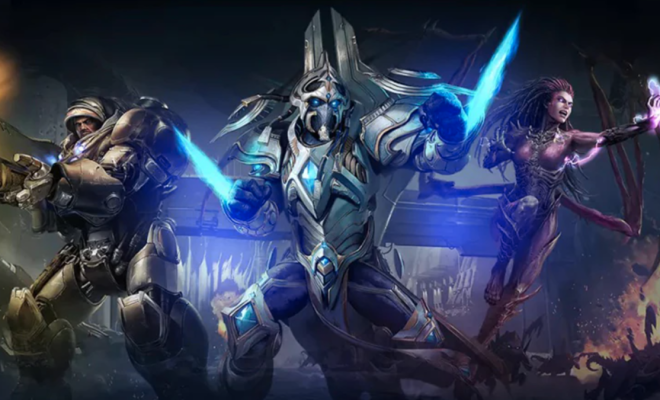
One of the most significant challenges was creating three unique playable races – the Terrans, Zerg, and Protoss – each with its own distinct playstyle, units, and strategies. This ambitious design choice set StarCraft apart from other RTS games of its time, which typically featured more symmetrical factions.
Technological Innovations
StarCraft pushed the boundaries of what was possible in RTS games at the time. The development team created a new game engine that allowed for isometric 2D graphics with a pseudo-3D effect, enhancing the visual appeal while maintaining performance on a wide range of computer systems.
The game also introduced advanced AI scripting, allowing for more complex and engaging single-player campaigns. This technology enabled the creation of memorable characters and storylines that would captivate players and lay the foundation for a rich universe.
The Launch and Immediate Impact
StarCraft was released on March 31, 1998, and it immediately took the gaming world by storm. The game’s compelling narrative, balanced gameplay, and addictive multiplayer mode through Battle.net contributed to its massive success. Within the first year, StarCraft sold over 1.5 million copies worldwide, a remarkable achievement for a PC game at the time.
The game’s impact was particularly significant in South Korea, where it became a cultural phenomenon. PC bangs (internet cafes) proliferated across the country, with many players dedicating countless hours to mastering the game. This enthusiasm laid the groundwork for what would become a professional esports scene.
Legacy and Influence
StarCraft’s influence extended far beyond its initial release. The game’s expansion, Brood War, released later in 1998, further refined the gameplay and expanded the storyline. StarCraft became a benchmark for balanced competitive play, with professional tournaments offering substantial prize pools and attracting large audiences.
The game’s success also influenced the development of future RTS titles, with many games attempting to replicate StarCraft’s formula of asymmetrical factions and intricate balance. The esports scene that grew around StarCraft paved the way for the professionalization of competitive gaming, influencing the industry’s approach to tournaments, broadcasts, and player contracts.
Conclusion
The development and release of StarCraft marked a pivotal moment in gaming history. From its humble beginnings as a concept for “Races in Space” to its status as a global phenomenon, StarCraft’s journey is a testament to the vision and dedication of its creators. The game not only set new standards for the RTS genre but also played a crucial role in the evolution of esports and competitive gaming. As we look back on the birth of this legend, it’s clear that StarCraft’s impact on the gaming industry and popular culture continues to resonate more than two decades after its release.