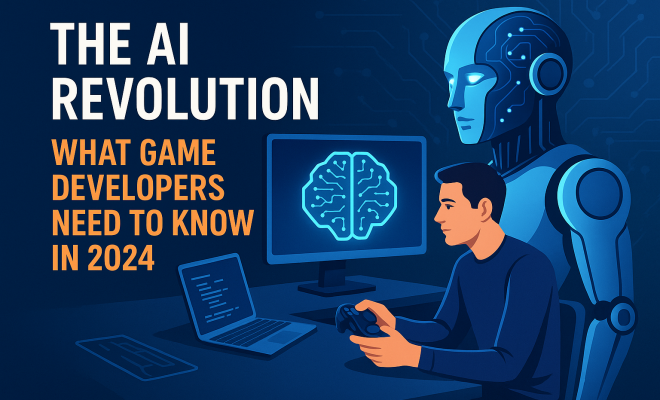
The AI Revolution: What Game Developers Need to Know in 2024
“`html
Alright, let’s talk about AI in game development, because if you’re not paying attention, you’re already falling behind. The buzz isn’t just hype anymore; it’s a fundamental shift, and frankly, it’s raising a lot of eyebrows, not just in the development trenches but in boardrooms and even legislative halls. We’re seeing a rapid integration of Artificial Intelligence across the gaming industry, and it’s sparking some pretty intense debates, especially around ethics and those often-unforeseen consequences.
Picture this: a 2026 report from KPMG and UNLV’s International Gaming Institute already highlighted the urgent need for responsible AI practices. Why? Because incidents involving AI have shot up dramatically since 2023, even including deepfakes popping up in illegal gambling schemes. And here’s the kicker: only about 70% of gaming companies even claim to have responsible AI practices in place, with a paltry less than 5% actually embedding them fully. That’s a massive gap, isn’t it? So, while we’re diving into the best AI tools for game developers in 2024, keep this ethical tightrope walk in mind. This isn’t just about efficiency; it’s about navigating a whole new landscape of creativity, intellectual property, and what it even means to make a ‘game’ anymore.
1. ChatGPT & Large Language Models (LLMs): Your Narrative Powerhouse
When we talk about the best AI tools for game developers in 2024, ChatGPT, and really, the broader category of Large Language Models (LLMs), has to be at the top of the list. Forget just writing emails; these models are becoming indispensable for narrative design, quest generation, and even dynamic dialogue systems. Imagine being able to prototype an entire game’s lore in a fraction of the time it used to take, or generating unique side quests for thousands of NPCs without manually crafting each one. That’s the power LLMs bring to the table.
Developers are leveraging ChatGPT for everything from brainstorming character backstories and world-building details to scripting complex, branching dialogue trees. It can help you inject personality into your characters, ensuring consistency in their voice, and even assist in localizing game text into multiple languages with surprising accuracy. While it’s not a magic bullet that will write your entire epic novel for you, it’s an incredible co-pilot that can accelerate the most labor-intensive parts of narrative creation, freeing up human writers to focus on the truly creative, high-level storytelling.
One common use case we’re seeing is the rapid prototyping of dialogue options. A writer can feed the AI character profiles and a scenario, then ask it to generate ten different ways a specific NPC might respond, each reflecting their personality. This isn’t about replacing the writer, but giving them a diverse pool of starting points to refine and elevate, saving hours of initial drafting. We’re also seeing LLMs being trained on specific game lore, allowing them to generate consistent in-world texts, historical accounts, or even unique item descriptions that feel authentically part of the game’s universe.
2. Midjourney & Stable Diffusion: Visual Asset Generation on Steroids
For visual artists and environment designers, generative AI tools like Midjourney and Stable Diffusion are nothing short of revolutionary. These aren’t just fancy image filters; they’re capable of generating incredibly detailed and stylistically consistent artwork from simple text prompts. Need a concept art piece for a dystopian city? Or perhaps a suite of fantasy creature designs? You can iterate through dozens of high-quality concepts in minutes, a process that used to take days or even weeks for a team of artists.
The applications extend beyond initial concepting. Developers are using these tools to generate textures, create unique UI elements, and even populate game worlds with diverse assets. While they don’t replace human artists, they augment their capabilities, allowing them to focus on refining, animating, and integrating these AI-generated elements. This significantly speeds up the asset pipeline, especially for indie studios or smaller teams with limited art resources. The key here is learning how to prompt effectively and knowing when to take the AI’s output and elevate it with human artistic finesse.
Think about a scenario where you need dozens of unique portraits for NPCs in an RPG. Instead of hiring an illustrator for each, you can use these tools to generate a base image, then have an artist touch it up to ensure stylistic consistency and add unique character. Or consider environmental details: generating variations of foliage, rock formations, or intricate architectural patterns that would be tedious to model manually. The sheer volume of unique assets these tools can produce in a short amount of time means richer, more varied game worlds without ballooning art budgets. It’s a game-changer for environmental storytelling and visual diversity.
3. Replika & AI Companions: Deepening Player Immersion
This is where things get really interesting for player engagement. AI companions, like the technology powering apps such as Replika, are pushing the boundaries of what’s possible for non-player characters (NPCs) in games. We’re talking about NPCs that don’t just follow a script but can learn, adapt, and engage in dynamic, context-aware conversations with players. Imagine a companion in an RPG who remembers your past choices, comments on your play style, and develops a unique personality based on your interactions.
Integrating such AI into games can lead to incredibly personalized and immersive experiences. These companions could offer genuine emotional support, provide unique strategic advice, or even become antagonists based on complex behavioral models. Of course, this also brings up those ethical considerations we touched on earlier – how much ‘personality’ do we want to give an AI, and what are the long-term psychological impacts on players forming deep bonds with non-human entities? Nevertheless, for developers looking to create truly memorable and interactive character relationships, these AI companion frameworks are rapidly becoming essential.
Beyond simple dialogue, advanced AI companions can dynamically react to in-game events. If a player struggles with a particular boss, the companion might offer specific tactical advice based on observed weaknesses. If a player frequently chooses morally ambiguous options, the companion’s trust level might decrease, leading to different dialogue or even betrayal. This level of dynamic interaction moves beyond scripted branching narratives into truly emergent gameplay experiences, making each player’s journey feel uniquely their own. The challenge lies in balancing this emergent behavior with narrative coherence and preventing the AI from straying too far from its intended role.
4. Ludo.ai: The Game Design Brainstormer
Ludo.ai is a fascinating entry in the best AI tools for game developers in 2024, specifically tailored for the ideation and design phase. Think of it as an AI-powered brainstorming partner that can help you flesh out game concepts, identify market trends, and even suggest mechanics. It’s designed to spark creativity by analyzing vast datasets of existing games, player preferences, and industry trends to give you data-driven insights. (See: AI's impact on the gaming industry.)
Stuck on how to make your combat system more engaging? Ludo.ai might suggest a hybrid approach based on successful elements from seemingly disparate genres. Trying to come up with a unique monetization strategy? It can analyze current market successes and failures to guide your choices. This tool isn’t about replacing the human game designer; it’s about empowering them with an unparalleled knowledge base and an engine for generating novel ideas, helping you avoid common pitfalls and discover untapped potential in your game concepts.
For example, if you’re designing a new puzzle game, Ludo.ai can analyze successful puzzle games, break down their core mechanics, and suggest variations or combinations that haven’t been fully explored. It can also identify potential player demographics for a specific genre or art style, helping developers tailor their marketing and design decisions. This data-driven approach means fewer shots in the dark and more informed decisions, especially valuable in a competitive market. It helps bridge the gap between pure creative vision and market viability. For more context, see toxic trends in gaming.
5. Nvidia Omniverse: Collaborative Virtual Development
Nvidia Omniverse isn’t strictly a generative AI tool, but its integration of AI capabilities makes it a powerful platform for game development, especially for large, collaborative teams. It’s a real-time collaboration and simulation platform that allows artists, designers, and engineers to work together on 3D assets and environments from anywhere in the world, using a variety of software. Its core strength lies in its Universal Scene Description (USD) framework, enabling seamless interoperability between different applications.
Where AI comes in is through its advanced simulation capabilities, AI-driven asset optimization, and even AI-powered animation tools. Imagine simulating realistic physics for thousands of objects in real-time, or using AI to automatically retopologize complex meshes for game engines. Omniverse aims to create a ‘metaverse’ for creators, streamlining workflows and reducing the friction often associated with large-scale 3D production. It’s about creating a more intelligent, connected, and efficient development pipeline, making it a crucial tool for studios pushing the boundaries of graphical fidelity and complex world-building.
One of the significant benefits of Omniverse’s AI integration is its ability to accelerate content creation for virtual worlds. For instance, AI can assist in the procedural generation of environments within the Omniverse, taking a few artist-created assets and intelligently populating vast landscapes with variations that maintain stylistic consistency. This is invaluable for open-world games where manual placement of every tree or rock would be impossible. Furthermore, AI-powered denoising and upscaling within the platform can dramatically improve render quality and speed, allowing for quicker iteration and higher fidelity previews for development teams.
6. TensorFlow & PyTorch: Custom AI for Game Logic and Playtesting
For developers who want to get their hands dirty with custom AI, frameworks like TensorFlow and PyTorch are invaluable. These open-source machine learning libraries allow you to build and train your own neural networks for incredibly specific game applications. This isn’t about off-the-shelf solutions; it’s about crafting AI that understands and interacts with your game’s unique mechanics and systems in bespoke ways.
Think about training an AI to playtest your game, identifying bugs and balance issues far faster than human testers ever could. Or perhaps developing adaptive difficulty systems that learn from individual player performance, offering a personalized challenge. You could even use these frameworks to create highly sophisticated enemy AI that learns player strategies in real-time and adapts its tactics accordingly, leading to incredibly dynamic and challenging encounters. While they require a deeper technical understanding of machine learning, the potential for innovation and customization is immense, making them essential for truly cutting-edge game AI.
A practical example of custom AI in action is in strategy games. Using TensorFlow or PyTorch, developers can train AI opponents not just to follow predefined tactics, but to learn from player behaviors over time. This means an AI could identify a player’s preferred opening moves, unit compositions, or defensive setups, and then devise countermeasures tailored specifically to that player. This results in AI that feels genuinely intelligent and challenging, rather than predictable, significantly enhancing replayability and player satisfaction. It’s about creating AI that truly “understands” the game at a strategic level.
7. Speech Synthesis & Voice AI (e.g., ElevenLabs, Play.ht): Dynamic Voice Acting
Voice acting is a cornerstone of immersive gaming, but it’s also incredibly expensive and time-consuming. This is where advanced speech synthesis and voice AI tools, like ElevenLabs or Play.ht, are becoming absolute game-changers. These platforms can generate incredibly natural-sounding speech in a wide range of voices, accents, and emotional tones from text. And we’re not talking about those robotic voices from a decade ago; these are nuanced, expressive, and often indistinguishable from human speech.
For game developers, this means the ability to rapidly prototype dialogue, voice thousands of NPCs without hiring a massive cast, and even create dynamic, on-the-fly voiceovers for procedurally generated content or personalized player interactions. Imagine a game where every NPC has a unique voice, or where story branches that were previously text-only can now be fully voiced. This technology drastically reduces production costs and timelines, making high-quality voice acting accessible to a much broader range of projects. Of course, the ethical debate around replacing human voice actors is a real one, but the utility for rapid iteration and expansive content is undeniable.
Beyond just static dialogue, these tools are enabling dynamic voice responses. Consider a game with a customizable protagonist. With voice AI, players could type in their own dialogue choices, and the game’s AI could generate a voiced response from the player character in real-time, matching the chosen voice actor’s style. This opens up entirely new avenues for player agency and personalization. For smaller indie teams, it means they can have fully voiced games, a luxury previously reserved for AAA studios, enhancing the overall production value and immersion without breaking the bank.
8. AI-Powered Animation Tools (e.g., DeepMotion, Plask): Streamlining Character Movement
Animation is another traditionally labor-intensive aspect of game development that AI is poised to revolutionize. Tools like DeepMotion and Plask are leveraging AI to simplify and accelerate the animation pipeline. These platforms can take simple motion capture data, even from a webcam, and automatically generate realistic character animations, or they can use AI to interpolate between keyframes, clean up raw motion data, or even generate entirely new movements based on a set of parameters.
Imagine being able to generate hundreds of unique walk cycles or combat animations for different character archetypes in a fraction of the time it would take to animate them manually. This not only speeds up production but also allows for greater variety and realism in character movement, which significantly enhances player immersion. These tools are democratizing high-quality animation, making it more accessible for smaller teams and indie developers to achieve AAA-level fidelity in their character movements, without needing a dedicated team of animators.
One powerful application is in retargeting animations. An AI can take a single motion capture sequence and automatically adapt it to multiple character rigs with different proportions, saving countless hours of manual adjustment. This is particularly useful for games with diverse character rosters or customizable player avatars. Furthermore, AI can assist in procedural animation, creating believable idle animations, environmental interactions (like characters reacting to uneven terrain), or even dynamic facial expressions based on dialogue or emotional states, adding a layer of organic realism previously difficult to achieve. (See: AI and workplace ethics.)
9. AI for Game Testing & Quality Assurance (e.g., Mabl, Test.ai): The Unseen Hero
While not as ‘sexy’ as generative art or narrative AI, AI for game testing and Quality Assurance (QA) is arguably one of the most impactful, if often unseen, applications. Tools like Mabl or Test.ai, adapted for the gaming context, can automate vast portions of the testing process. They can learn how to play your game, identify bugs, detect performance issues, and even flag potential exploits faster and more consistently than any human team.
Think about it: an AI can run through hundreds of hours of gameplay in minutes, testing every possible combination of actions, item interactions, and environmental conditions. It can pinpoint game-breaking bugs, balance anomalies, and even identify areas where the player experience might be frustrating. This doesn’t eliminate the need for human QA, who can focus on subjective elements like fun factor and narrative coherence, but it offloads the tedious, repetitive, and exhaustive task of functional testing. The result? Cleaner, more stable games launched faster, with fewer post-release patches needed. It’s an essential component of modern game development, ensuring a higher quality product for players. For more context, see AI ethics and debates.
AI testing tools can simulate thousands of concurrent players to stress-test server infrastructure for online games, identifying bottlenecks before launch. They can also perform regression testing with unparalleled speed, ensuring that new features or bug fixes don’t inadvertently break existing functionality. This meticulous, tireless approach to QA means developers can catch obscure edge-case bugs that might only appear after hundreds of hours of specific gameplay sequences, leading to a much smoother and more polished experience for the end-user.
10. Unreal Engine 5’s MetaHumans & AI Integration: Photorealistic Characters Made Easy
Unreal Engine 5 (UE5) has made waves with its MetaHuman Creator, a cloud-based application that allows for the creation of incredibly realistic, high-fidelity digital humans. While MetaHumans aren’t purely AI-generated in the same way as a Stable Diffusion image, the underlying technology heavily leverages AI and machine learning for its impressive capabilities. It uses AI to blend and sculpt photorealistic faces, apply complex skin shaders, and generate full body rigs with motion capture compatibility.
For game developers, this means the ability to create a diverse cast of realistic characters with unprecedented speed. Instead of spending weeks or months modeling, sculpting, and rigging a single character, MetaHuman Creator lets you achieve near-photorealism in minutes, with full control over facial features, hair, clothing, and body type. The AI helps ensure anatomical correctness and subtle details that make characters believable. This is a massive leap forward for narrative-driven games or those requiring a large cast of unique NPCs, bringing AAA character fidelity within reach of smaller studios.
The beauty of MetaHumans lies in their integration with UE5’s animation tools. You can easily apply motion capture data, create custom animations, or even use AI-powered facial animation tools to bring these characters to life with realistic expressions. This significantly reduces the technical barrier to entry for high-quality character pipelines, allowing developers to focus more on performance and storytelling rather than the painstaking technical details of character creation.
11. RunwayML & Video Generation AI: Rapid Cinematic Prototyping
RunwayML is a powerful platform that brings a suite of AI-powered creative tools, including impressive video generation capabilities, to developers. While not directly generating in-game assets, its ability to create short video clips, iterate on visual concepts, and even perform complex video edits with AI can be incredibly useful for game development, particularly in the pre-production and marketing phases.
Imagine being able to quickly prototype cinematic cutscenes or trailer concepts. You can generate short video sequences from text prompts or existing images, explore different visual styles for a game’s opening, or even visualize complex gameplay mechanics in motion without needing to render them in-engine. This rapid prototyping capability allows developers to test ideas, gather feedback, and iterate on visual storytelling concepts much faster than traditional methods. It’s a fantastic tool for visualizing the “feel” and atmosphere of a game before significant development resources are committed.
RunwayML also offers tools like inpainting and outpainting for video, allowing developers to seamlessly remove unwanted elements from footage or expand existing video clips. This can be useful for cleaning up motion capture data, enhancing recorded gameplay footage for trailers, or creating dynamic marketing assets with minimal effort. It empowers creators to visualize and communicate their game’s vision more effectively and efficiently.
Ethical Considerations and the Road Ahead
The rapid adoption of AI in game development isn’t without its challenges. The ethical tightrope walk mentioned earlier is becoming a central theme in industry discussions. Intellectual property rights for AI-generated content remain a murky area, with ongoing legal battles shaping future precedents. Questions arise: Who owns the copyright to an image generated by an AI trained on millions of existing artworks? What about the data used to train LLMs – is it ethically sourced?
Beyond legalities, there’s the significant concern about job displacement. As AI becomes more capable, roles traditionally held by junior artists, animators, or even writers might see shifts. The industry is grappling with how to integrate AI as a co-pilot and augment human creativity, rather than replace it entirely. This requires reskilling, adapting workflows, and fostering a collaborative environment where humans and AI work synergistically. For more context, see impact of AI in various sectors. (See: Harvard's research on AI ethics.)
Finally, the psychological impact on players cannot be ignored. The potential for ‘microfetishes’ – highly specific, niche content generated for individual players – raises questions about filter bubbles and potentially isolating experiences. The ‘holy wars’ over AI-generated content, where players passionately debate the authenticity or artistic merit of AI creations, highlight a growing tension between technological advancement and traditional notions of art and authorship. As developers, we have a responsibility not just to innovate, but to guide this technology responsibly and thoughtfully, ensuring it enriches the gaming experience without undermining its core values.
The Future of Game Development: A Human-AI Partnership
Looking ahead, the best AI tools for game developers in 2024 are just the beginning. The future isn’t about AI replacing humans, but about a more sophisticated human-AI partnership. Imagine AI systems that can dynamically adjust game difficulty not just based on player skill, but on their emotional state, detected through biometric feedback or even subtle gameplay cues. Or AI that can generate entire game levels on the fly, tailoring challenges and environments to a player’s preferred playstyle and narrative choices, ensuring every playthrough feels fresh and personal.
We’ll likely see AI becoming even more embedded in the core game engine itself, optimizing rendering in real-time, predicting player input for smoother experiences, and even dynamically composing musical scores that react to gameplay events. The goal is not just efficiency, but the creation of unprecedented levels of immersion and personalization, where games feel like living, breathing worlds that understand and react to each individual player. This evolution demands that developers remain adaptable, continuously learning, and critically engaging with the ethical implications of these powerful new capabilities.
Frequently Asked Questions About AI in Game Development
Q1: Will AI replace game developers?
A: The consensus among industry experts is that AI will augment, not replace, game developers. While AI can automate repetitive and labor-intensive tasks (like generating basic assets, testing, or drafting dialogue), it still lacks true creativity, nuanced decision-making, and the ability to understand complex human emotions and storytelling needs. Developers who learn to effectively use AI tools will likely be more efficient and valuable, focusing on high-level design, artistic direction, and innovative problem-solving.
Q2: Is it ethical to use AI-generated content in games?
A: This is a complex and highly debated topic. Ethically, concerns often revolve around intellectual property (since AI is trained on existing human-created works), potential job displacement for artists and writers, and the impact on the perceived authenticity of art. Many developers strive for transparency about AI use and ensure that AI-generated content is refined and creatively directed by human artists. The industry is still working on establishing clear guidelines and legal frameworks.
Q3: How can indie developers afford these AI tools?
A: Many of the best AI tools for game developers in 2024, especially generative AI models like Stable Diffusion, have open-source versions or affordable subscription tiers. Cloud-based services often operate on a pay-as-you-go model, making them accessible even for small budgets. The key is to strategically choose tools that offer the most impact for your specific project needs and integrate them into your workflow efficiently.
Q4: What are the biggest challenges of integrating AI into game development?
A: Beyond ethical and IP concerns, technical challenges include integrating diverse AI tools into existing pipelines, ensuring data privacy and security, and managing the computational resources required for training and running complex AI models. There’s also the challenge of maintaining creative control and ensuring the AI’s output aligns with the game’s vision and quality standards.
Q5: Can AI help with game monetization strategies?
A: Absolutely. AI can analyze player behavior, spending patterns, and engagement metrics to recommend optimal pricing strategies, personalize in-game offers, identify potential churn risks, and even predict the success of new content updates. Tools like Ludo.ai can also provide data-driven insights into market trends for monetization models during the design phase.
Q6: How does AI impact game accessibility?
A: AI has significant potential to improve game accessibility. For example, AI-powered speech synthesis can provide dynamic voiceovers for text-heavy interfaces or complex instructions, helping players with visual impairments. AI can also adapt game difficulty in real-time to assist players with motor skill challenges or cognitive differences, ensuring a more inclusive experience. Custom AI models could even personalize control schemes or UI layouts based on individual player needs.
“`
Trending Now
Frequently Asked Questions
What is the role of AI in game development?
AI is revolutionizing game development by enhancing narrative design, quest generation, and dynamic dialogue systems. Tools like ChatGPT and Large Language Models (LLMs) enable developers to create immersive game experiences more efficiently, allowing for rapid prototyping and unique content generation.
How are game developers using ChatGPT in 2024?
In 2024, game developers are utilizing ChatGPT for tasks such as narrative design, creating character backstories, and generating side quests. This allows for faster development cycles and richer storytelling, improving overall game quality and player engagement.
What ethical concerns are associated with AI in gaming?
The integration of AI in gaming raises ethical questions, particularly around responsible AI practices. Concerns include the rise of deepfakes in illegal gambling and the need for developers to consider intellectual property and creativity in their game design processes.
What percentage of gaming companies have responsible AI practices?
Approximately 70% of gaming companies claim to have responsible AI practices, but less than 5% have fully embedded these practices into their operations. This highlights a significant gap in the industry's approach to ethical AI usage.
What are the best AI tools for game developers in 2024?
The best AI tools for game developers in 2024 include ChatGPT and other Large Language Models (LLMs). These tools facilitate narrative creation, enhance gameplay experiences, and streamline the development process, making them essential for modern game design.
Have you experienced this yourself? We'd love to hear your story in the comments.