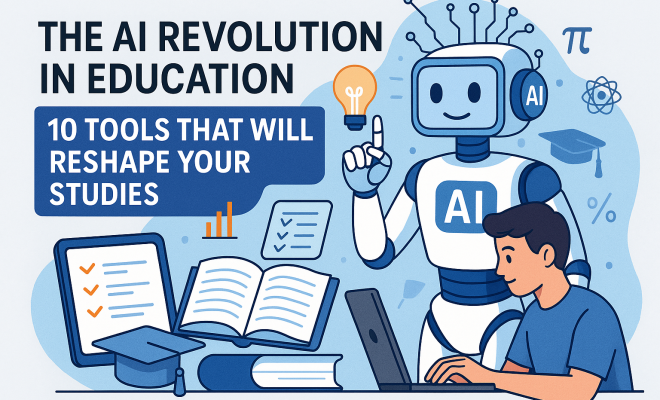
The AI Revolution in Education: 10 Tools That Will Reshape Your Studies
“`html
You’ve probably heard the buzz, seen the headlines, and perhaps even dabbled a bit yourself. Artificial intelligence isn’t just a futuristic concept anymore; it’s firmly planted in our present, especially in the world of education. Gone are the days when AI was relegated to sci-fi movies. Now, it’s a practical, everyday companion for students tackling everything from dense readings to complex research papers. In fact, a whopping 57% of U.S. college students are already using AI in their coursework weekly. That’s a significant chunk, wouldn’t you say? It shows just how quickly these tools have become indispensable.
But with so many options popping up, how do you sort through the noise? What are the actual best AI tools for students that can genuinely make a difference without compromising your academic integrity? That’s precisely what we’re here to explore. We’re going to dive deep into some of the most impactful AI tools out there, dissecting what they do, how they work, and why they might just become your next favorite study buddy. From synthesizing information to generating quizzes, these tools are changing the game. Let’s get started.
1. NotebookLM: Your Personalized AI Research Assistant
Imagine having a study partner that has read every single one of your course materials, remembers every detail, and can instantly pull up relevant information, summarize complex topics, and even brainstorm ideas with you. That’s essentially what NotebookLM offers. Developed by Google, this tool is designed to be a personal AI research assistant, moving far beyond a simple chatbot. It allows you to upload your own documents – lecture notes, textbooks, research papers, even meeting transcripts – and then interact with an AI model that understands and references *only* those sources.
The real power here lies in its ability to ground its responses in your specific content. This means you can ask it questions about a particular reading, have it summarize key arguments from a collection of articles, or even generate new ideas based on the material you’ve provided. For students grappling with extensive reading lists and trying to connect disparate pieces of information, NotebookLM is an absolute game-changer. It helps you synthesize dense readings, identify connections between concepts, and prepare for discussions or exams with a deeper understanding of your own materials.
2. Turbo AI: The Speed Demon for Summaries and Explanations
In the whirlwind of academic life, time is a precious commodity. You’re constantly bombarded with information, and sometimes, you just need to grasp the core concepts quickly without sacrificing understanding. This is where Turbo AI shines. It’s built for speed and efficiency, focusing on providing concise summaries and clear explanations of complex topics in a snap. Think of it as your express lane to understanding, especially when you’re pressed for time or trying to get a quick overview before diving into the details.
What sets Turbo AI apart is its streamlined interface and its ability to rapidly process information. Whether you’re pasting in a lengthy article, a section of a textbook, or even your own rough notes, Turbo AI can quickly distill the essential points. It’s particularly useful for reviewing material right before a class, getting a handle on a new subject, or simply refreshing your memory on topics you’ve already covered. While it might not offer the deep, personalized interaction of NotebookLM, its efficiency in delivering quick, accurate summaries makes it one of the best AI tools for students who value speed and clarity.
3. Perplexity AI: The Conversational Search Engine with Citations
Let’s be honest: traditional search engines can sometimes feel like a wild goose chase, especially when you’re trying to conduct academic research. You type in a query, get thousands of results, and then have to sift through countless links to find credible sources. Perplexity AI offers a refreshing alternative. It’s often described as a conversational search engine, but it’s much more than just a chatbot. When you ask a question, Perplexity doesn’t just give you an answer; it provides a concise summary of information pulled from various sources, and crucially, it includes live citations.
This citation feature is what makes Perplexity a standout tool for students. You can quickly see where the information came from, allowing you to verify its credibility and even click through to the original sources if you need to delve deeper. This not only saves you time but also helps you build a strong foundation for your research, ensuring you’re working with reliable data. For anyone struggling with research papers, literature reviews, or simply needing to find accurate information quickly and transparently, Perplexity AI is an invaluable asset.
4. QuillBot: Your Writing and Paraphrasing Powerhouse
Writing is an integral part of academic life, but it’s rarely easy. Crafting clear, concise, and original prose can be a challenge, especially when you’re trying to synthesize information from various sources without plagiarizing. Enter QuillBot, a versatile AI-powered writing assistant that has become a staple for many students. While it’s best known for its paraphrasing capabilities, QuillBot offers a suite of tools designed to enhance your writing, grammar, and even vocabulary.
Its paraphraser allows you to rephrase sentences and paragraphs in different styles, helping you avoid accidental plagiarism and improve the flow of your writing. Beyond that, it includes a grammar checker, a summarizer, and a citation generator, making it a comprehensive writing companion. For students who want to refine their essays, ensure grammatical accuracy, or simply find different ways to articulate their thoughts, QuillBot is an incredibly useful tool. It helps you elevate your writing while maintaining your unique voice, making it one of the best AI tools for students focused on improving their academic output. (See: U.S. Department of Education.)
5. ChatPDF: The Intelligent Reader for Your Documents
How many times have you stared at a lengthy PDF document, knowing you need to extract key information but feeling overwhelmed by the sheer volume of text? ChatPDF solves this problem by turning your PDFs into interactive conversational partners. You upload your document – whether it’s a textbook chapter, a research paper, or a lecture transcript – and then you can ask it questions directly. The AI will read the document and provide answers based solely on its content. For more context, see Why Millions Are Finally Using AI to Master High-Demand Skills.
This is incredibly useful for quickly grasping the main arguments of a paper, finding specific data points, or even preparing for discussions by asking the AI to summarize sections or explain complex concepts. Instead of scrolling endlessly or highlighting indiscriminately, you can engage with the text in a dynamic way, making your study sessions more efficient and targeted. ChatPDF transforms static documents into living resources, helping you extract maximum value from your readings with minimal effort.
6. Gamma AI: Crafting Engaging Presentations in Minutes
Presentations are a common requirement in academia, but creating visually appealing and informative slides can be a time-consuming chore. Gamma AI aims to streamline this process by leveraging artificial intelligence to generate presentations for you. Instead of spending hours fiddling with design elements and formatting, you can focus on your content, letting Gamma handle the aesthetics.
You simply input your topic, key points, or even paste in a summary of your content, and Gamma will generate a professional-looking presentation complete with layouts, visuals, and text. You can then easily customize and refine it to match your specific needs. This tool is a lifesaver for students who need to create compelling presentations under tight deadlines, allowing them to allocate more time to research and understanding their subject matter rather than design mechanics. It’s a fantastic example of how AI can boost productivity in creative tasks.
7. Consensus: Scientific Research at Your Fingertips
When you’re deep into scientific research, finding credible, peer-reviewed articles that directly answer your questions can be like searching for a needle in a haystack. Traditional academic databases require precise keywords and often return a deluge of irrelevant papers. Consensus AI aims to simplify this by acting as an AI-powered search engine specifically for scientific research.
You can ask it a natural language question – for example, “Does mindfulness reduce anxiety?” – and it will scour a vast database of scientific papers, extract relevant findings, and provide you with a synthesized answer, complete with direct links to the source studies. It even indicates the consensus among researchers on a particular topic. This makes it incredibly efficient for literature reviews, understanding the current state of research on a subject, and ensuring your arguments are backed by solid scientific evidence. For science and medical students, Consensus AI is an indispensable tool for navigating the complexities of academic literature.
8. QuestionWell: Turning Content into Quizzes Automatically
One of the most effective ways to solidify learning and prepare for exams is through self-quizzing. But creating good, relevant quiz questions from your lecture notes or readings can be a tedious process. QuestionWell automates this by generating quiz questions from any text you provide. Imagine converting an entire lecture transcript or a chapter from your textbook into a series of practice questions with just a few clicks.
This tool supports various question formats, including multiple-choice, true/false, and open-ended questions, allowing you to tailor your practice sessions. It’s particularly useful for students who want to actively test their understanding, identify knowledge gaps, and reinforce key concepts. The ability to quickly create personalized quizzes makes QuestionWell one of the best AI tools for students looking to optimize their study routine and boost their exam performance. The surge in search volume for ‘AI Quiz’ (a 164% YoY increase!) perfectly illustrates the demand for this kind of functionality.
9. Elicit: Accelerating Your Literature Review
For advanced students and researchers, the literature review process can be incredibly time-consuming. Identifying relevant papers, extracting key information, and synthesizing findings from dozens or even hundreds of studies is a monumental task. Elicit is an AI research assistant designed specifically to accelerate this process.
When you pose a research question, Elicit doesn’t just find papers; it helps you systematically analyze them. It can identify key takeaways from abstracts, extract methods, populations, and outcomes, and even summarize the main conclusions across multiple papers. This allows you to quickly get an overview of the existing literature, identify gaps in research, and build a strong foundation for your own studies. It’s a powerful tool for anyone undertaking comprehensive literature reviews, making the daunting task of academic research much more manageable and efficient. (See: AI tools in education.)
10. Genei: The AI-Powered Notetaker and Summarizer
Effective note-taking is a cornerstone of successful studying, yet it’s often done haphazardly. Genei aims to revolutionize how students interact with their study materials by offering an AI-powered platform for note-taking, summarizing, and content organization. You can upload articles, PDFs, or even paste web links, and Genei will automatically identify key themes, extract important facts, and generate summaries.
Beyond automatic summarization, Genei allows you to highlight text and have the AI generate questions or flashcards based on your highlights. It also helps you organize your notes and research into projects, making it easier to connect ideas across different sources. For students who struggle with information overload or want to streamline their research and note-taking process, Genei provides a robust solution. It helps you engage more deeply with your content, ensuring you capture and retain the most critical information efficiently. For more context, see Why These 7 AI Governance Courses Are Your Golden Ticket to a High-Paying Job.
The Broader Conversation: Academic Integrity and the Future of Learning
As you can see, these best AI tools for students offer incredible potential to transform how we learn and study. They can synthesize dense readings, convert lectures into quizzes, conduct academic research with live citations, and even craft engaging presentations. The efficiency gains are undeniable, and for many students, these tools are already becoming essential for keeping up with demanding coursework.
However, it would be disingenuous to ignore the elephant in the room: academic integrity. The rapid adoption of AI has sparked widespread debate among educators and institutions. How do we balance the benefits of efficiency with concerns about potential misuse, like submitting AI-generated content as original work? The conversation is complex, and there are no easy answers. Many universities are now developing new policies, focusing on teaching students how to use AI responsibly as a tool for learning and augmentation, rather than replacement.
The key, ultimately, lies in understanding that these are tools to assist and enhance, not to take shortcuts. They can help you grasp concepts faster, organize your thoughts, and improve your output, but they don’t replace critical thinking, genuine understanding, or the hard work of learning. As educators and students continue to navigate this evolving landscape, the focus will likely shift towards fostering AI literacy – teaching how to leverage these powerful resources ethically and effectively. The future of learning isn’t just about using AI; it’s about learning *with* AI, wisely and thoughtfully.
Beyond the Classroom: AI Skills for the Workforce
It’s worth remembering that the skills you develop using these AI tools today aren’t just for acing your next exam. They’re increasingly becoming critical for your future career. The job market is rapidly evolving, with AI integration becoming a standard across almost every industry. Learning how to effectively prompt an AI, discern credible AI-generated information, and use AI to boost productivity are no longer niche skills – they’re foundational. Think about it: whether you go into marketing, engineering, healthcare, or even creative fields, the ability to work alongside AI will give you a significant edge.
Using tools like Perplexity AI teaches you how to quickly gather and vet information, a skill invaluable in any research-heavy role. Mastering QuillBot helps you refine your communication, crucial for professional reports and emails. Even creating presentations with Gamma AI builds proficiency in visual communication, a must-have for client pitches or team updates. These aren’t just academic hacks; they’re professional development opportunities disguised as study aids. Embracing these tools responsibly now sets you up for success well beyond graduation, demonstrating adaptability and a forward-thinking approach to problem-solving.
Choosing the Right AI Tool: A Strategic Approach
With so many fantastic AI tools available, how do you decide which ones are right for you? It’s not about using every single one, but rather strategically integrating the ones that address your specific academic challenges. Start by identifying your biggest pain points. Are you struggling with:
- Information Overload? Tools like NotebookLM, Turbo AI, ChatPDF, and Genei are perfect for synthesizing large amounts of text.
- Research and Sourcing? Perplexity AI, Consensus, and Elicit will be your best friends for finding and analyzing credible sources.
- Writing and Editing? QuillBot is the clear winner for refining your prose and avoiding accidental plagiarism.
- Active Learning and Exam Prep? QuestionWell can transform your study materials into effective quizzes.
- Presentations and Visuals? Gamma AI streamlines the creation of engaging slides.
Consider your learning style, too. If you’re a visual learner, Gamma AI might be more impactful. If you learn by doing, QuestionWell’s interactive quizzes could be transformative. Don’t be afraid to try a few free versions or trials to see what resonates. The goal is to build a personalized AI toolkit that complements your strengths and shores up your weaknesses, making your academic journey smoother and more productive. (See: Impact of AI on learning.)
Expert Perspectives on AI in Education
The conversation around AI in education is incredibly dynamic, with educators, technologists, and ethicists all weighing in. Dr. Ethan Mollick, a professor at the Wharton School, has been a vocal proponent of integrating AI into teaching, emphasizing its potential to act as a “thought partner” for students. He argues that rather than banning AI, institutions should teach students how to use it effectively and ethically, viewing it as a powerful new literacy.
Similarly, many pedagogical experts suggest that AI can personalize learning experiences on a scale previously unimaginable. Imagine an AI tutor adapting to your pace and style, providing targeted feedback, or generating custom practice problems based on your individual needs. This vision isn’t far off, with tools like NotebookLM already hinting at truly personalized academic assistance. The shift isn’t just about efficiency; it’s about unlocking deeper, more individualized learning pathways. However, concerns about bias in AI models and equitable access remain important considerations that academic institutions are actively working to address.
Frequently Asked Questions About AI Tools for Students
Q1: Are these AI tools free to use?
Many of the tools mentioned offer free tiers with limited features, or free trials, which are great for testing them out. For full functionality, some require a paid subscription. Always check their pricing pages for the most up-to-date information.
Q2: Can I get caught for plagiarism if I use these tools?
This is a critical point. Tools like QuillBot are designed to help you *rephrase* content in your own words, not to generate original content for you to claim. If you use AI to generate entire essays or significant portions of your work and submit it as your own, that is plagiarism. The key is to use AI as an assistant for understanding, brainstorming, and refining, not as a shortcut to bypass learning or writing. Always cite your sources properly, whether AI-generated or human-written, and ensure the final output reflects your own critical thinking and understanding.
Q3: How do I know if the information provided by an AI tool is accurate?
Always verify information, especially when using AI tools for research. Tools like Perplexity AI and Consensus are great because they provide citations, allowing you to check the original sources. For other tools, treat AI-generated information as a starting point, then cross-reference with credible academic sources like peer-reviewed journals, reputable textbooks, and university-affiliated websites. AI can sometimes “hallucinate” or provide confidently incorrect information, so human oversight is essential.
Q4: Will using AI tools make me less capable as a student?
Not if used correctly! Think of AI tools like a calculator for math or a spell checker for writing. They automate tedious tasks, allowing you to focus your mental energy on higher-order thinking like critical analysis, synthesis, and creative problem-solving. By offloading routine tasks, you can engage more deeply with complex concepts, improve your understanding, and develop stronger academic skills. The goal is to augment your intelligence, not replace it.
Q5: Are there any ethical guidelines for using AI in academic work?
Yes, and these are still evolving! Many universities are developing specific policies. Generally, ethical use involves:
- Transparency: Disclose when and how you’ve used AI in your work if required by your instructor.
- Originality: Ensure the final work reflects your own ideas and understanding, even if AI helped in the process.
- Verification: Double-check AI-generated information for accuracy and bias.
- Fairness: Don’t use AI to gain an unfair advantage over classmates who aren’t using similar tools (unless explicitly allowed).
When in doubt, always ask your professor or academic advisor about their specific expectations regarding AI tools.
“`
Trending Now
Frequently Asked Questions
What are the best AI tools for students in 2023?
In 2023, some of the best AI tools for students include NotebookLM, which serves as a personalized research assistant, and various other tools designed to enhance learning through information synthesis, quiz generation, and more. These tools are transforming education by providing tailored support for academic tasks.
How is AI changing the education sector?
AI is revolutionizing the education sector by providing personalized learning experiences, automating administrative tasks, and enhancing research capabilities. Tools like NotebookLM help students manage their studies more efficiently by summarizing content and providing instant access to relevant information.
Can AI help with research papers?
Yes, AI can significantly assist with research papers by helping students organize their thoughts, summarize complex topics, and generate relevant questions. Tools like NotebookLM allow users to upload their course materials and interact with AI to get tailored insights and support.
What percentage of students use AI in their studies?
According to recent data, approximately 57% of U.S. college students are using AI tools in their coursework on a weekly basis. This indicates a growing reliance on AI technologies to enhance academic performance and streamline study processes.
Is using AI in education ethical?
Using AI in education can be ethical if students utilize these tools to enhance their learning rather than to bypass academic integrity. Tools like NotebookLM are designed to support research and study efforts while encouraging proper citation and original thought.
What's your take on this? Share your thoughts in the comments below — we read every one.