Tesla settles lawsuit over deadly crash involving full self-driving | The Star
“`html
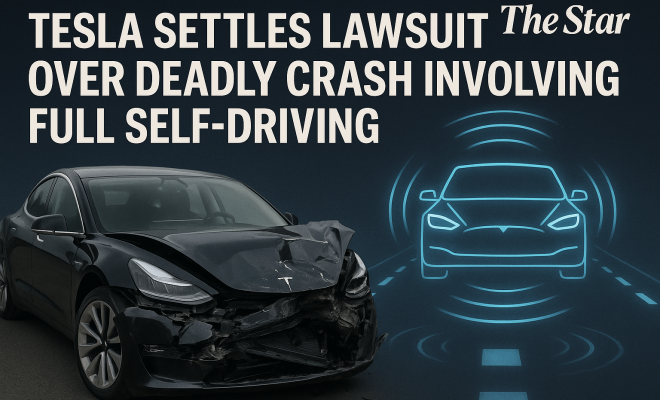
The automotive world, and indeed the broader public, recently learned that Tesla has quietly settled a lawsuit related to a fatal crash involving its ‘Full Self-Driving’ (FSD) technology. This isn’t just another legal skirmish; it’s a pivotal moment, forcing us to confront difficult questions about the safety, ethics, and future of autonomous vehicles. The incident, which occurred in 2023, saw a 71-year-old pedestrian, Johna Story, struck and killed by a Tesla Model Y operating on FSD in Arizona. This wasn’t just a tragic accident; it was, as far as we know, the first pedestrian fatality directly linked to Tesla’s FSD system. And while the settlement closes one chapter, it opens many more, particularly regarding the ongoing federal investigations and the alarming allegations from a former Tesla manager about the company’s FSD testing protocols. The implications of this Tesla full self-driving lawsuit ripple far beyond the immediate parties, touching on regulatory oversight, public trust, and the very design philosophy of autonomous systems.
The Tragic Incident and the Quiet Settlement
Let’s rewind to 2023. A Tesla Model Y, allegedly operating with its Full Self-Driving system engaged, was involved in a collision that resulted in the death of Johna Story. Details surrounding the crash itself remain somewhat opaque, largely due to the nature of a private settlement. When a company settles a lawsuit, especially one involving a fatality and cutting-edge technology, it often comes with non-disclosure agreements. This means the specific findings, expert testimonies, and internal data that might have shed light on why the FSD system failed to prevent the tragedy are unlikely to see the light of day publicly. For the family of Ms. Story, the settlement provides some form of closure and perhaps financial recompense, but for those of us trying to understand the broader safety implications of autonomous driving, it leaves a void of information.
The quiet nature of this settlement is noteworthy. Tesla, a company known for its often-public and sometimes combative stance on various issues, opted for a discreet resolution. This choice, while standard practice in many corporate legal strategies, raises eyebrows when the technology in question is still in a beta phase and being tested on public roads. It suggests a desire to mitigate further public scrutiny and potentially avoid setting legal precedents that could be leveraged in future cases. But can you really quiet a controversy when federal regulators are already knocking at your door?
NHTSA’s Escalating Investigation into Tesla FSD
The death of Johna Story didn’t just prompt a lawsuit; it also intensified a critical federal investigation by the National Highway Traffic Safety Administration (NHTSA). This isn’t NHTSA’s first rodeo with Tesla’s FSD. The agency has been looking into various incidents involving Tesla’s driver-assistance systems for a while, but this particular fatality added a serious new dimension. Initially, NHTSA launched a preliminary evaluation, a standard step when safety concerns emerge with a vehicle system. However, the scope of their inquiry quickly broadened and escalated significantly.
NHTSA’s investigation has now moved to an engineering analysis, a much more rigorous and expansive phase. This isn’t just about the single incident in Arizona; it now covers a staggering 3.2 million Tesla vehicles equipped with FSD. Why such a wide net? Because the core concern is that FSD may fail to detect or warn drivers effectively under specific, yet common, impaired visibility conditions. Think about scenarios like dusk, dawn, heavy rain, fog, or even just glare. These are everyday driving conditions where human drivers adapt instinctively, but for an AI relying on camera vision, they can pose significant challenges. The agency is looking for systemic issues, not just isolated failures, which makes this investigation a major headache for Tesla and a critical moment for the future of autonomous technology.
The ‘Highly Dangerous’ Testing Allegations
Just when you thought the waters couldn’t get murkier, a former Tesla manager has stepped forward with some truly explosive allegations. This individual is suing the company, claiming that Tesla’s FSD testing practices were not just flawed, but “highly dangerous.” What does that mean, exactly? According to the lawsuit, operators testing the FSD system were allegedly instructed to delay intervening in critical situations, allowing the software to operate closer to the edge, all in the name of gathering more data. Imagine being in the driver’s seat, seeing a potential collision unfold, and being told to hold back, to let the AI try to resolve it, even if it puts you or others at risk. That’s the chilling picture painted by these allegations.
The former manager claims he was retaliatorily terminated after he raised these significant safety concerns internally. If these claims hold water, they speak to a corporate culture that prioritized data acquisition over immediate safety, a potentially catastrophic ethical breach. Such practices, if proven, would not only undermine public trust in Tesla but could also have profound implications for how autonomous vehicle testing is regulated across the industry. This Tesla full self-driving lawsuit, if it proceeds, could expose a great deal about the internal workings and decision-making processes behind one of the most talked-about technologies in the world.
The Camera-Only Approach: A Point of Contention
At the heart of much of the debate surrounding Tesla’s FSD lies its unique, camera-only approach to autonomous driving. Unlike many competitors who employ a sensor suite that often includes lidar (light detection and ranging) and radar in addition to cameras, Tesla has famously doubled down on what it calls ‘Tesla Vision’ – a system that relies almost exclusively on cameras and neural networks. Elon Musk has often argued that human drivers navigate the world perfectly well with just two eyes, so a sophisticated camera system should be sufficient for an AI. It’s a bold stance, but it’s one that comes with significant challenges, especially under adverse conditions. whistleblower claims about FSD offers useful background here.
While cameras excel at identifying objects and reading road signs in good lighting, they can struggle dramatically in low light, heavy rain, dense fog, or when confronted with glare. These are precisely the “impaired visibility conditions” that NHTSA is reportedly concerned about. Lidar and radar, on the other hand, can ‘see’ through many of these conditions, providing redundant data streams that can compensate for camera limitations. The argument for a multi-sensor approach is that redundancy equals robustness and safety. Tesla’s purist approach, while potentially simplifying hardware and reducing costs, places an immense burden on its AI to interpret complex visual data flawlessly, every single time. This philosophical divergence isn’t just an engineering choice; it’s a fundamental bet on how autonomous vehicles should perceive and interact with the world. (See: Tesla's Full Self-Driving technology.)
Ethical Implications of Autonomous Vehicle Development
The incidents and lawsuits surrounding Tesla’s FSD force us to confront a complex web of ethical dilemmas inherent in autonomous vehicle development. Who is responsible when an AI-driven car causes an accident? Is it the car manufacturer, the software developer, the owner, or even the ‘safety driver’ who failed to intervene? The traditional legal frameworks for automotive accidents are struggling to keep pace with these technological advancements. Moreover, the alleged practice of delaying human intervention during testing, as claimed by the former Tesla manager, raises profound ethical questions about the balance between data collection for system improvement and the immediate safety of individuals.
There’s also the broader societal contract. When a company deploys technology that is still in a ‘beta’ phase on public roads, are the public unknowingly becoming unwitting participants in a vast, unregulated experiment? This isn’t to say that all technological advancement should be halted, but it does highlight the need for clear ethical guidelines, robust regulatory oversight, and transparent communication from companies about the capabilities and limitations of their systems. The development of autonomous vehicles is not merely an engineering challenge; it’s a societal one, demanding careful consideration of human values, safety, and accountability.
The Regulatory Landscape and Future of FSD
The regulatory landscape for autonomous vehicles is, to put it mildly, a patchwork. In the United States, there’s no single, overarching federal framework specifically for autonomous driving. Instead, we have a mix of federal guidelines from NHTSA, state-level regulations that vary wildly, and industry self-regulation. This fragmented approach creates challenges for both manufacturers and consumers. NHTSA’s escalated engineering analysis into Tesla’s FSD is a significant step, indicating that federal regulators are becoming increasingly proactive in scrutinizing these systems. Depending on their findings, NHTSA could demand recalls, mandate software updates, or even impose restrictions on how FSD can be used. Such actions could profoundly impact Tesla’s business model and its timeline for achieving true autonomy.
Looking ahead, it’s clear that a more cohesive and robust regulatory framework is desperately needed. This would likely involve a combination of performance standards, clear testing protocols, data reporting requirements, and perhaps even certification processes for autonomous systems before they are widely deployed. The goal isn’t to stifle innovation but to ensure that these powerful technologies are developed and deployed responsibly, with public safety as the paramount concern. The outcomes of investigations like NHTSA’s, and the various Tesla full self-driving lawsuit cases, will undoubtedly shape these future regulations.
Public Perception and Trust in Autonomous Vehicles
Incidents like the fatal Arizona crash and the subsequent lawsuit have a tangible impact on public perception and trust in autonomous vehicles. For many, the idea of a car driving itself without human intervention is still a futuristic concept, tinged with both excitement and apprehension. When news breaks of a fatality or serious safety concern linked to such technology, it reinforces those apprehensions. It chips away at the essential trust that manufacturers need to build with consumers if autonomous vehicles are ever to achieve widespread adoption.
Building and maintaining public trust requires more than just technological prowess; it demands transparency, accountability, and a demonstrated commitment to safety above all else. When settlements are quiet, and allegations of dangerous testing emerge, it erodes that trust. Consumers need to feel confident that these systems are rigorously tested, thoroughly validated, and that their limitations are clearly communicated. Without this trust, the journey towards a future dominated by self-driving cars will be significantly longer and more challenging. The narrative around every Tesla full self-driving lawsuit contributes to this evolving public sentiment.
Monetization Opportunities and the AV Ecosystem
While the safety concerns are paramount, it’s also worth acknowledging the significant economic ripple effects stemming from the evolving landscape of autonomous vehicles and the legal challenges they present. The very existence of a Tesla full self-driving lawsuit, and others like it, highlights burgeoning monetization opportunities across several sectors. Legal services, for instance, specializing in autonomous vehicle accidents, are poised for substantial growth. These are high-stakes, complex cases that require specialized expertise in product liability, software engineering, and accident reconstruction, often commanding high-value legal fees. This creates a high-CPC (cost-per-click) niche for law firms looking to attract clients affected by AV incidents.
Beyond legal services, the insurance industry is undergoing a seismic shift. Specialized auto insurance providers for autonomous vehicles are emerging, grappling with new risk models and liability frameworks. Who insures the software? Who covers the hardware? How do you assess risk when human error is theoretically removed from the equation, only to be replaced by potential software glitches or sensor failures? These are questions that traditional insurance models weren’t built to answer, creating a fertile ground for innovative insurance products and carriers. Furthermore, the increasing reliance on in-car software also means a growing demand for cybersecurity firms offering solutions for protecting these complex systems from hacking, data breaches, or malicious interference. The entire AV ecosystem, from manufacturing to post-incident services, is expanding, creating new markets and investment opportunities.
Expert Perspectives: Bridging the Gap Between Innovation and Safety
It’s helpful to consider how experts from various fields view these challenges. Automotive safety engineers often advocate for a layered approach to safety, emphasizing redundancy in sensors and software checks. They might argue that while human vision is incredibly capable, it’s also prone to fatigue, distraction, and impairment – factors an AI system should ideally overcome. Relying solely on cameras, they suggest, leaves less room for error in situations where even a split-second misinterpretation can have dire consequences. These engineers often point to statistical data from traditional vehicle accidents, highlighting common causes like poor visibility, and question whether current FSD systems adequately address these known risks. (See: Motor vehicle safety statistics.)
On the legal front, product liability attorneys are grappling with how to apply existing laws to a product that continuously updates its core functionality. Is a software update a new product? Does it reset liability? These are uncharted legal waters. Consumer advocates, meanwhile, are pushing for greater transparency. They want clear labeling about what FSD truly is (a driver-assist system, not fully autonomous) and robust complaint mechanisms. They often cite studies on consumer misunderstanding of driver-assist features, noting that marketing language can often overstate capabilities, leading to a false sense of security for drivers.
Conversely, proponents of Tesla’s approach often highlight the rapid iteration and data collection capabilities of their camera-only system. They argue that the sheer volume of real-world driving data collected from millions of Tesla vehicles provides an unparalleled feedback loop, allowing for faster improvements than systems relying on more expensive and complex sensor suites. They also point to the potential for AI to eventually surpass human driving capabilities across all conditions, given enough data and computational power. This philosophical divide among experts is a key reason why the debate around AV safety and regulation is so complex and often heated.
The Role of Data and AI in FSD Development
The development of FSD is fundamentally a data-driven process, powered by advanced artificial intelligence. Every mile driven by a Tesla with FSD engaged, whether in simulation or on public roads, generates a massive amount of data. This data is then used to train and refine the neural networks that form the brain of the FSD system. The quality and diversity of this data are crucial. If the system isn’t exposed to enough varied scenarios – different weather conditions, unique road layouts, unexpected pedestrian behaviors – it will struggle to react appropriately when those situations arise in the real world.
This is where the alleged “highly dangerous” testing practices, if true, become particularly concerning. While pushing the boundaries of the system might yield valuable data points about its limitations, it comes at a potentially unacceptable cost to safety. The challenge for AI development in critical applications like autonomous driving is to find a balance between aggressive data collection and rigorous safety protocols. Simulation plays an increasingly vital role here, allowing developers to test millions of scenarios, including rare and hazardous ones, in a virtual environment before deploying updates to physical vehicles. However, simulations can only be as good as the real-world data and models they are built upon, underscoring the continuous interplay between virtual and physical testing.
Comparison with Other Autonomous Driving Systems
It’s helpful to put Tesla’s FSD into context by comparing it to other prominent autonomous driving systems. Companies like Waymo (Google’s self-driving car project) and Cruise (GM’s autonomous vehicle subsidiary) have largely opted for a different strategy: a multi-sensor approach (lidar, radar, cameras) and a more geographically constrained rollout. These companies tend to operate fully autonomous robotaxis in specific, mapped urban areas, often with safety drivers initially, before moving to driverless operations. Their systems are typically classified as SAE Level 4, meaning they can handle all driving tasks under specific conditions without human intervention.
Tesla’s FSD, on the other hand, is considered SAE Level 2, requiring constant driver supervision and readiness to take over. Its broader aim is to work “everywhere,” meaning it’s designed for a much wider array of driving environments and conditions, but still with a human in the loop. This fundamental difference in philosophy, from sensor suites to operational design domain, directly impacts their development, testing, and deployment strategies. The trade-offs involve cost, complexity, scalability, and ultimately, the perceived and actual safety of the system. While Waymo and Cruise emphasize a more cautious, geofenced approach, Tesla aims for a mass-market, globally applicable solution that evolves rapidly through software updates.
Looking Ahead: The Road to True Autonomy
The path to true, widespread autonomous driving is clearly fraught with more complexities than many initially imagined. The recent Tesla full self-driving lawsuit settlement, the ongoing NHTSA investigation, and the serious allegations from a former manager underscore that this isn’t just a technological race; it’s a societal evolution. The promise of autonomous vehicles — enhanced safety, reduced congestion, greater accessibility — remains compelling, but realizing that promise requires a cautious, ethical, and rigorously tested approach.
Companies like Tesla, at the forefront of this revolution, bear a heavy responsibility. Their actions, their testing methodologies, and their responses to incidents will shape not only their own future but the future trajectory of the entire industry. As consumers, regulators, and the public, we must remain vigilant, asking tough questions and demanding transparency and accountability. The tragic death of Johna Story serves as a stark reminder that while the technology promises convenience, safety must always be the ultimate, non-negotiable destination. The road ahead for FSD, and autonomous driving in general, will undoubtedly be paved with more legal challenges, more regulatory hurdles, and hopefully, continuous improvements driven by an unwavering commitment to human safety. (See: National Highway Traffic Safety Administration on automated vehicles.)
Frequently Asked Questions About Tesla FSD and Lawsuits
What is Tesla Full Self-Driving (FSD)?
Tesla’s Full Self-Driving (FSD) is an advanced driver-assistance system (ADAS) that allows the vehicle to navigate on highways and city streets, make turns, and stop at traffic lights and stop signs. It’s important to understand that despite its name, FSD does not make the car fully autonomous. It’s a Level 2 system, meaning the human driver must remain attentive, keep their hands on the steering wheel, and be ready to take over at any moment. It’s a suite of features designed to assist the driver, not replace them entirely.
Why are there lawsuits related to Tesla FSD?
Lawsuits related to Tesla FSD typically arise from incidents where the system is alleged to have contributed to accidents, injuries, or fatalities. These cases often involve questions of liability: who is at fault when a vehicle operating with FSD is involved in a collision? Is it the driver who failed to intervene, or is it Tesla for issues with the FSD software or its marketing? The complexity of these systems and the relative novelty of the technology mean that legal precedents are still being established, leading to numerous challenges and settlements.
What is the role of NHTSA in regulating FSD?
The National Highway Traffic Safety Administration (NHTSA) is the primary federal agency responsible for vehicle safety in the United States. NHTSA investigates safety defects, issues recalls, and sets safety standards for vehicles. In the context of FSD, NHTSA has launched several investigations into Tesla’s driver-assistance systems, including an engineering analysis covering millions of vehicles. Their role is to determine if FSD poses an unreasonable risk to safety and, if so, to mandate appropriate remedies, such as recalls or software updates, to protect the public.
What are the ‘highly dangerous’ testing allegations about?
These allegations come from a former Tesla manager who is suing the company. He claims that during FSD testing, operators were instructed to delay intervening in critical situations, allowing the software to operate closer to its limits. The purpose, according to the lawsuit, was to gather more data on the system’s performance in challenging scenarios. If true, these claims suggest a testing culture that potentially prioritized data collection over immediate safety, raising significant ethical and safety concerns.
Is Tesla’s camera-only approach safe compared to other systems?
Tesla’s camera-only approach, known as ‘Tesla Vision,’ relies solely on cameras and neural networks to perceive the environment, unlike many competitors who also use lidar and radar. Tesla argues that this mirrors how human drivers perceive the world. Critics, however, contend that cameras can struggle in adverse conditions like heavy rain, fog, or low light, where lidar and radar provide crucial redundancy and can ‘see’ through such impairments. The safety of this approach is a central point of debate and investigation, particularly by NHTSA, which is looking into FSD’s performance in impaired visibility conditions.
How does a private settlement affect public understanding of FSD incidents?
When a lawsuit is settled privately, it often involves non-disclosure agreements (NDAs). This means that details about the incident, such as expert testimonies, internal company data, or specific findings about why the FSD system may have failed, are typically kept confidential. While settlements provide closure for the parties involved, they can limit public access to critical information that could help the broader community, regulators, and other manufacturers understand and prevent similar incidents in the future. This lack of transparency can hinder public trust and the development of informed safety standards.
“`
Trending Now
Frequently Asked Questions
What was the Tesla lawsuit settlement about?
Tesla recently settled a lawsuit related to a fatal crash involving its Full Self-Driving (FSD) technology. The incident, which occurred in 2023, involved a pedestrian, Johna Story, who was struck and killed by a Tesla Model Y operating on FSD in Arizona, marking a significant moment in discussions about the safety of autonomous vehicles.
Who was involved in the Tesla crash incident?
The crash involved a 71-year-old pedestrian named Johna Story, who was tragically killed by a Tesla Model Y that was allegedly operating with the Full Self-Driving (FSD) system engaged. This incident is noted as the first pedestrian fatality directly linked to Tesla's FSD technology.
What are the implications of the Tesla settlement?
The settlement closes one chapter but raises many questions regarding safety, ethics, and regulatory oversight of autonomous vehicles. It also highlights concerns raised by a former Tesla manager about the company's FSD testing protocols, affecting public trust in self-driving technology.
Why is the Tesla FSD lawsuit significant?
The Tesla FSD lawsuit is significant as it sheds light on the potential dangers of autonomous driving technology. It marks a pivotal moment in understanding the responsibilities of manufacturers in ensuring the safety of their systems, especially after a fatal incident involving a pedestrian.
What happens next after the Tesla settlement?
Following the Tesla settlement, federal investigations into the incident may continue, and discussions about the safety and regulatory framework surrounding autonomous vehicles are likely to intensify. The settlement may also lead to increased scrutiny of FSD testing protocols and public trust in such technologies.
Have you experienced this yourself? We'd love to hear your story in the comments.